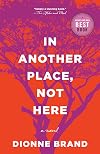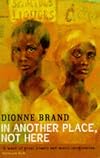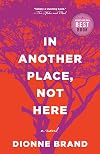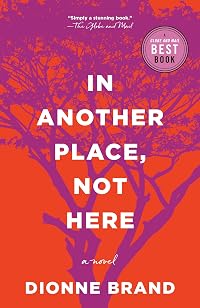
In Another Place, Not Here
by Dionne Brand
On This Page
Description
Acclaimed by Adrienne Rich as "fierce, sensuous . . . a work of great beauty and moral imagination," In Another Place, Not Here tells of two contemporary Caribbean women who find brief refuge in each other on an island in the midst of political uprising. Elizete, dreaming of running to another place to escape the harshness of her daily life on the island, meets Verlia, an urban woman in constant flight who has returned to her island birthplace with hopes of revolution. Their tumultuous story show more moves between city and island, past and future, fantasy and reality. show lessTags
Recommendations
















Member Reviews
there are some really, really lovely parts of this - parts that make it obvious that she's a poet - but most of this was just too hard for me. i'm glad i read it for those bits, but overall this was very difficult and i know i missed some of it.
the book opens in dialect, and it's tough to understand. i read probably about 60 pages, not entirely sure what i'd read, and then started over. it made a lot more sense on the second reading, and i found that i probably read most of this book in short parts, back and forth, 2-4 times, trying to understand what i was reading. i know i didn't get it all.
i really had a hard time with elizete's sections, while verlia's were far easier for me. (since they weren't in dialect.) it's been a while since show more i had to work this hard with a book and maybe i was just underprepared for this one, but it was a bit too much for me, unfortunately.
still, the story of wanting to bring on the revolution, the near slavery, the description of being an immigrant, the surprise at finding love - these were beautiful. i don't think i've ever read so clearly what it's like to be in a new place where nothing is familiar, what it must be like to have just come to a new country. incredible. some of this was amazing, i just wish i'd been able to stay in it the whole time, to really get it and appreciate it all.
i think if i'd read it over again, from the beginning, after finishing, that i might have appreciated it more. there's a lot here, and i'm sure it's much better than i'm giving it credit for.
"...because nothing ever happen to me until Verl come along and when Verl come along I see my chance out of what ordinary, out of the plenty day when all it have for a woman to do is lie down and let a man beat against she body, and work cane and chop up she foot and make children and choke on the dryness in she chest and have only one road in and the same road out and know that she tied to the ground and can never lift up."
"A woman can be a bridge..."
"They had not come here willingly looking for food or water or liking the way the place set off against the sky or even for hunger. They had not come because the hunting was good or the ground moist for planting. They had not come moving into the forest just after the rainy season. They had not come because they saw great cities foreshadowed in the horizon or rum shops sprawling with their dancing and laughter. Not because a shape overtook them in geometry or because after observing speeding clouds they coveted a new landfall. They had been taken. Plain. Hard. Rough. Swept up from thinking of the corn to be shucked, the rains coming or no rain coming at all for the season, that patch of high grass to clear. The mist gathering at their feet. The steam of baking. Poised over a well, the bag lowered, they had been plucked, or, caught in the misfortune of a wedding or a war, sold."
"She could not get her mind to recognize this place. ...If she could just recognize something it would be all right. ...She saw light always bright turned on in the daytime, all day long as if the sky was not enough... After months she still saw no birds to speak of or the same birds, no river to speak of, no mountains to speak of, no grass to speak of, no moon to speak of. Especially no moon. And no ocean or sea. No sound that was the usual sound, no chorus of beetles, crickets, frogs beginning with night, ending with morning. And since this was how she knew the signs of things, she was lost. ...The noise, the everlasting noise came from nothing she could recognize, no particular machine, just the noise of machinery; but machinery past the individualism of a machine, machines lost from identity. The mouth of them wide open in a yawn. She didn't sleep because of the everlasting noise. She couldn't get used to it. Couldn't sleep for thinking what noise it was, wanting to distinguish it, this is the noise of this, this is the noise of that. Icebox and wire and light-brighter-than-the-moon noise, pitch, crack and the iron haw six o'clock noise of the garbage truck, and the noise nobody makes but the radiator, sighing and knocking in its metal slip. ...This is how she would come to know a place but somehow this place resisted knowing. When she tried calling it something, the words would not come. Not easy, not easy at all. Cling to me vine, dust trace walk, water behind me, water in front me bush, take in front track, blind face man, drop me down here fruit. She would not come to know this place no matter how much she walked it, no matter if she set herself to knowing, she could not size it up. It resisted knowing, the words would not come. ...This city was imaginary that's all. That's all."
"I wouldn't call nothing that we do love because love too simple. All the soft-legged oil, all the nakedness brushing, all the sup of neck and arms and breasts. All that touching. Nothing simple about it. All that opening like breaking bones." show less
the book opens in dialect, and it's tough to understand. i read probably about 60 pages, not entirely sure what i'd read, and then started over. it made a lot more sense on the second reading, and i found that i probably read most of this book in short parts, back and forth, 2-4 times, trying to understand what i was reading. i know i didn't get it all.
i really had a hard time with elizete's sections, while verlia's were far easier for me. (since they weren't in dialect.) it's been a while since show more i had to work this hard with a book and maybe i was just underprepared for this one, but it was a bit too much for me, unfortunately.
still, the story of wanting to bring on the revolution, the near slavery, the description of being an immigrant, the surprise at finding love - these were beautiful. i don't think i've ever read so clearly what it's like to be in a new place where nothing is familiar, what it must be like to have just come to a new country. incredible. some of this was amazing, i just wish i'd been able to stay in it the whole time, to really get it and appreciate it all.
i think if i'd read it over again, from the beginning, after finishing, that i might have appreciated it more. there's a lot here, and i'm sure it's much better than i'm giving it credit for.
"...because nothing ever happen to me until Verl come along and when Verl come along I see my chance out of what ordinary, out of the plenty day when all it have for a woman to do is lie down and let a man beat against she body, and work cane and chop up she foot and make children and choke on the dryness in she chest and have only one road in and the same road out and know that she tied to the ground and can never lift up."
"A woman can be a bridge..."
"They had not come here willingly looking for food or water or liking the way the place set off against the sky or even for hunger. They had not come because the hunting was good or the ground moist for planting. They had not come moving into the forest just after the rainy season. They had not come because they saw great cities foreshadowed in the horizon or rum shops sprawling with their dancing and laughter. Not because a shape overtook them in geometry or because after observing speeding clouds they coveted a new landfall. They had been taken. Plain. Hard. Rough. Swept up from thinking of the corn to be shucked, the rains coming or no rain coming at all for the season, that patch of high grass to clear. The mist gathering at their feet. The steam of baking. Poised over a well, the bag lowered, they had been plucked, or, caught in the misfortune of a wedding or a war, sold."
"She could not get her mind to recognize this place. ...If she could just recognize something it would be all right. ...She saw light always bright turned on in the daytime, all day long as if the sky was not enough... After months she still saw no birds to speak of or the same birds, no river to speak of, no mountains to speak of, no grass to speak of, no moon to speak of. Especially no moon. And no ocean or sea. No sound that was the usual sound, no chorus of beetles, crickets, frogs beginning with night, ending with morning. And since this was how she knew the signs of things, she was lost. ...The noise, the everlasting noise came from nothing she could recognize, no particular machine, just the noise of machinery; but machinery past the individualism of a machine, machines lost from identity. The mouth of them wide open in a yawn. She didn't sleep because of the everlasting noise. She couldn't get used to it. Couldn't sleep for thinking what noise it was, wanting to distinguish it, this is the noise of this, this is the noise of that. Icebox and wire and light-brighter-than-the-moon noise, pitch, crack and the iron haw six o'clock noise of the garbage truck, and the noise nobody makes but the radiator, sighing and knocking in its metal slip. ...This is how she would come to know a place but somehow this place resisted knowing. When she tried calling it something, the words would not come. Not easy, not easy at all. Cling to me vine, dust trace walk, water behind me, water in front me bush, take in front track, blind face man, drop me down here fruit. She would not come to know this place no matter how much she walked it, no matter if she set herself to knowing, she could not size it up. It resisted knowing, the words would not come. ...This city was imaginary that's all. That's all."
"I wouldn't call nothing that we do love because love too simple. All the soft-legged oil, all the nakedness brushing, all the sup of neck and arms and breasts. All that touching. Nothing simple about it. All that opening like breaking bones." show less
It's a beautiful and rewarding book. See my review here:
http://caseythecanadianlesbrarian.wordpress.com/2012/06/20/dionne-brands-in-anot...
http://caseythecanadianlesbrarian.wordpress.com/2012/06/20/dionne-brands-in-anot...
Ratings
Members
- Recently Added By
Author Information

35+ Works 1,605 Members
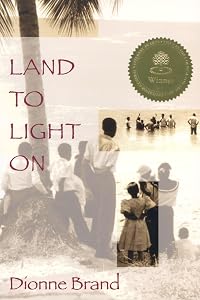
Dionne Brand was born in 1953 in Guayguayare, Trinidad and was educated at the University of Toronto and the Ontario Institute for Studies in Education. Brand was the founder and editor of Our Lives, Canada's first newspaper for black women. She has also worked on Fuse Magazine, The Harriet Tubman Review, Canadian Women Studies, and Research for show more Feminist Research. She also belongs to several community organizations including the Immigrant Women's Center and the Caribbean Peoples' Development Agency. Brand's involvement in politics is prevalent in her books, Chronicles of the Hostile Sun, Rivers Have Sources, Trees Have Roots: Speaking of Racism and Primitive Offensive, and Land to Light On, for which she received a Governor General's Award. Brand has also directed Sister's in Struggle, Long Time Comin' and Older, Stronger, Wiser for the National Film Board of Canada. (Bowker Author Biography) show less
Common Knowledge
- Original publication date
- 1996
Classifications
Statistics
- Members
- 193
- Popularity
- 170,339
- Reviews
- 2
- Rating
- (3.79)
- Languages
- English
- Media
- Paper, Ebook
- ISBNs
- 7
- ASINs
- 2