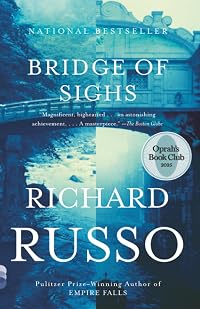
Bridge of Sighs
by Richard Russo
On This Page
Description
Six years after the bestselling, Pulitzer Prize-winning Empire Falls, Richard Russo returns with a novel that expands even further his widely heralded achievement. Louis Charles ("Lucy") Lynch has spent all his sixty years in upstate Thomaston, New York, married to the same woman, Sarah, for forty of them, their son now a grown man. Like his late, beloved father, Lucy is an optimist, though he's had plenty of reasons not to be -- chief among them his mother, still indomitably alive. Yet it show more was her shrewdness, combined with that Lynch optimism, that had propelled them years ago to the right side of the tracks and created an "empire" of convenience stores about to be passed on to the next generation. Lucy and Sarah are also preparing for a once-in-a-lifetime trip to Italy, where his oldest friend, a renowned painter, has exiled himself far from anything they'd known in childhood. In fact, the exact nature of their friendship is one of the many mysteries Lucy hopes to untangle in the "history" he's writing of his hometown and family. And with his story interspersed with that of Noonan, the native son who'd fled so long ago, the destinies building up around both of them (and Sarah, too) are relentless, constantly surprising, and utterly revealing. BRIDGE OF SIGHS is classic Russo, coursing with small-town rhythms and the claims of family, yet it is brilliantly enlarged by an expatriate whose motivations and experiences -- often contrary, sometimes not -- prove every bit as mesmerizing as they resonate through these richly different lives. Here is a town, as well as a world, defined by magnificent and nearly devastating contradictions. show lessTags
Recommendations

Member Reviews
First, an admission. This reviewer is partial to Richard Russo’s work. Therefore, discovering this 2007 work which followed immediately on the heels of his magnificent ‘Empire Falls’ was a great thrill.
For about the first hundred pages.
Then the glacial pace and huge scope of this coming-of-age tale mingled with an unraveling of what constitutes “truth, the whole truth, and nothing but the truth, so help me God”, overlaid with the stories of several marriages and parent-child relationships and the ugly class differences lurking in a blue-collar town… Well, it was just too much.
But when one of your favorite authors is presenting a story, one tends to hang on. And hang on. And hang on, far past the point where common sense says show more “this isn’t going to get any better and you might as well cut your losses”.
Sometimes we need to listen to that voice.
By the time the reader gets to the sixth decade of Lou Lynch’s life and the 500th page of this tome, one is thoroughly tired of his ambivalence, of his unwillingness to let go of childhood friendships which may have disguised any number of betrayals, of his wife whose burning artistic talent just sort of dribbles off into the corner until the final chapter, and even of the new adventure on which he and his wife seem to be embarking.
It’s too much. Just too much. Too many words. Too many characters. Too many simmering conflicts. Too much to ask of any reader, even one whose admiration for the author gets crushed to jelly under the weight of this interminable tale. show less
For about the first hundred pages.
Then the glacial pace and huge scope of this coming-of-age tale mingled with an unraveling of what constitutes “truth, the whole truth, and nothing but the truth, so help me God”, overlaid with the stories of several marriages and parent-child relationships and the ugly class differences lurking in a blue-collar town… Well, it was just too much.
But when one of your favorite authors is presenting a story, one tends to hang on. And hang on. And hang on, far past the point where common sense says show more “this isn’t going to get any better and you might as well cut your losses”.
Sometimes we need to listen to that voice.
By the time the reader gets to the sixth decade of Lou Lynch’s life and the 500th page of this tome, one is thoroughly tired of his ambivalence, of his unwillingness to let go of childhood friendships which may have disguised any number of betrayals, of his wife whose burning artistic talent just sort of dribbles off into the corner until the final chapter, and even of the new adventure on which he and his wife seem to be embarking.
It’s too much. Just too much. Too many words. Too many characters. Too many simmering conflicts. Too much to ask of any reader, even one whose admiration for the author gets crushed to jelly under the weight of this interminable tale. show less
Maybe I'm too much like Lucy's mother, but I believe some of these people just need to get on with life. There was way too much introspection and self analysis on the part of everyone. So many questions: "...who hasn't...been victimized and found himself imprisoned in this life?" "In what reality was his father a decent guy?" "Had she known in that instant of brutal loss whose comforting embrace and genuine kindness she wanted and needed?" Especially toward the end of the novel--long paragraphs filled with self-examining questions that almost seem like voice overs in a soap opera.
That said, I did enjoy most of the book especially the first half. For a while it seemed like I was reading some sort of weird version of "Happy Days" with the show more Fonz (Bobby) and Richie (Lucy). I believe there is some food for thought here: Why do some stay where they are and be happily content while others can leave and never look back. However, I think this could have been told in about half the words and half of what I call "overdramatization" of some events. I loved "Empire Falls"; this just doesn't quite make it. show less
That said, I did enjoy most of the book especially the first half. For a while it seemed like I was reading some sort of weird version of "Happy Days" with the show more Fonz (Bobby) and Richie (Lucy). I believe there is some food for thought here: Why do some stay where they are and be happily content while others can leave and never look back. However, I think this could have been told in about half the words and half of what I call "overdramatization" of some events. I loved "Empire Falls"; this just doesn't quite make it. show less
I've read nice reviews of this book,but alas, I do not share these positive feelings. The dullness of the main character permeates everything, to the point that I started thinking: I could not care less what happens next. The characters stay rather one-dimensional, too, which is unusual for Russo, who is one of my favourite authors.
But I finally gave up on this book after more than 300 pages (I tried hard!): it is well-written, but writing an interesting novel about "the dullest person on earth" in a dull little town has proved too much even for someone of Russo's calibre.”
But I finally gave up on this book after more than 300 pages (I tried hard!): it is well-written, but writing an interesting novel about "the dullest person on earth" in a dull little town has proved too much even for someone of Russo's calibre.”
For those of you who don't read the end of the book first, as I do, you might want to know that I'm going to talk about the end of the book in this review. In other words, spoilers abound.
Lou Lynch (nicknamed Lucy from a role-calling mistake) starts writing a memoir about growing up in a tannery town, the son of the friendly milk-delivery guy, and his family's purchase of a local store. It turns into a sort of catalog of the horrors of small-town life: industrial collapse, racial, class and sexual intolerance, alcoholism, and environmental degradation.
The best part of a Richard Russo book is the ending. You can say that about so few novelists — most want someone to get their just deserts, or leave off at an appropriately postmodern show more point so that nothing gets tied up. Bridge of Sighs has some deserts, but it's not a tragedy, in the Greek sense of being led to catharsis through pity and fear, or in the sense of a character being doomed by his own flaws. The book ends with a death, not because that's the culmination of the dramatic tension, but because that's the end of everything there is to tell. It's a beautiful thing when you end a book imagining that you've been visiting with old friends: not with people you wish you'd never met, and not with people who end the conversation rather rudely right in the middle.
Russo has a very interesting way with medical conditions: he hands them out statistically, with men on the other side of middle age rather more likely to have high blood pressure, women rather more likely to have breast cancer. I like how sometimes things (like Lucy's seizures) just turn out to be random medical mysteries, and not some deep inner conflict. I was worried with all of Tessa's warnings for Lucy to see things as they really are that he was suppressing something horrible. And I think I was worried because Lucy himself was worried, as you get when you have some random medical mystery that can't be explained. But sometimes a seizure is just a seizure. I love that about Russo's characters: they worry and overthink and act strangely, and *know* they're acting strangely, and still can't stop, and gradually move on to something else to worry about. They're deliciously alive.
In the end, I prefer the short comedies (Straight Man, That Old Cape Magic). Russo's not gentle with the academic in this book, nor does he downplay the many deaths waiting for the downtrodden: alcohol-related crashes, war, poisoning, suicide, etc. But it's a great book. show less
Lou Lynch (nicknamed Lucy from a role-calling mistake) starts writing a memoir about growing up in a tannery town, the son of the friendly milk-delivery guy, and his family's purchase of a local store. It turns into a sort of catalog of the horrors of small-town life: industrial collapse, racial, class and sexual intolerance, alcoholism, and environmental degradation.
The best part of a Richard Russo book is the ending. You can say that about so few novelists — most want someone to get their just deserts, or leave off at an appropriately postmodern show more point so that nothing gets tied up. Bridge of Sighs has some deserts, but it's not a tragedy, in the Greek sense of being led to catharsis through pity and fear, or in the sense of a character being doomed by his own flaws. The book ends with a death, not because that's the culmination of the dramatic tension, but because that's the end of everything there is to tell. It's a beautiful thing when you end a book imagining that you've been visiting with old friends: not with people you wish you'd never met, and not with people who end the conversation rather rudely right in the middle.
Russo has a very interesting way with medical conditions: he hands them out statistically, with men on the other side of middle age rather more likely to have high blood pressure, women rather more likely to have breast cancer. I like how sometimes things (like Lucy's seizures) just turn out to be random medical mysteries, and not some deep inner conflict. I was worried with all of Tessa's warnings for Lucy to see things as they really are that he was suppressing something horrible. And I think I was worried because Lucy himself was worried, as you get when you have some random medical mystery that can't be explained. But sometimes a seizure is just a seizure. I love that about Russo's characters: they worry and overthink and act strangely, and *know* they're acting strangely, and still can't stop, and gradually move on to something else to worry about. They're deliciously alive.
In the end, I prefer the short comedies (Straight Man, That Old Cape Magic). Russo's not gentle with the academic in this book, nor does he downplay the many deaths waiting for the downtrodden: alcohol-related crashes, war, poisoning, suicide, etc. But it's a great book. show less
I feel like I just sat down to the table, hungry, and in front of me is placed fried chicken and mashed potatoes. It tastes wonderful and fills me up. The characters that Russo creates in Bridge of Sighs and all of the other novels of his that I have read are comfortable and familiar. I have never been to upstate New York. I grew up in a city, not a small town. But somehow I can relate the places that Russo creates as if they were my own. Lucy and Sarah, Lou Lou and Tessa, and Bobby: Russo makes them real because they are not perfect. Neither are they unique, but that is okay too. I fall into the world he creates and reside there for the duration. Their imperfections make my imperfections acceptable and more understandable. But just show more like a meal of fried chicken and mashed potatoes is not memorable, Bridge of Sighs is not completely satisfying. Comfort food, at least for me, never will be. show less
It's hard to deny that the scope of this novel, with its several points of view, depiction of a whole town, and portrait of three families living there, is impressive. And it all hangs together, which over the course of 528 densely-packed pages is no small feat. But I just didn't enjoy the novel much at all. I got more engaged in the last quarter or so, but it took some doing to get to that point, let me tell you. If this hadn't been a book club book I was determined to finish, I almost certainly would have quit *well* before I got to the stuff I kind of sort of enjoyed.
Much of the narrative, especially in the first half of the book, takes the form of Lou Charles "Lucy" Lynch recalling his childhood, and while there are some deft show more portrayals of characters and of what it was like to live in a small town in the 50s, not much of it is super compelling. Or at least it wasn't to me. Lucy is not a particularly interesting character, and Russo just failed to make me care about him (or most anyone else in the story, although some of them come much more to life in that aforementioned last quarter of the book). I felt throughout the book that Russo had made very strange choices about what to put on the page, especially when it's revealed that Lucy is an unreliable narrator to the point he has left out *the* most important, compelling, and telling piece of information about his childhood.
I was also sometimes impatient with Russo's use of symbolic actions on the part of his characters. For a book that spends so much time and effort trying to portray something real, it sure uses a lot of over-the-top and heavy-handed imagery to make sure we get something that was perfectly apparent from his storytelling.
On the whole, the portrait of the town and families and how class divisions work there and how they affect everyone's lives was well done, but other than that I was just exhausted by the book. If it had been two hundred pages shorter and Russo had focused his attention slightly differently on his characters, I might have enjoyed it quite a bit. show less
Much of the narrative, especially in the first half of the book, takes the form of Lou Charles "Lucy" Lynch recalling his childhood, and while there are some deft show more portrayals of characters and of what it was like to live in a small town in the 50s, not much of it is super compelling. Or at least it wasn't to me. Lucy is not a particularly interesting character, and Russo just failed to make me care about him (or most anyone else in the story, although some of them come much more to life in that aforementioned last quarter of the book). I felt throughout the book that Russo had made very strange choices about what to put on the page, especially when it's revealed that Lucy is an unreliable narrator to the point he has left out *the* most important, compelling, and telling piece of information about his childhood.
I was also sometimes impatient with Russo's use of symbolic actions on the part of his characters. For a book that spends so much time and effort trying to portray something real, it sure uses a lot of over-the-top and heavy-handed imagery to make sure we get something that was perfectly apparent from his storytelling.
On the whole, the portrait of the town and families and how class divisions work there and how they affect everyone's lives was well done, but other than that I was just exhausted by the book. If it had been two hundred pages shorter and Russo had focused his attention slightly differently on his characters, I might have enjoyed it quite a bit. show less
"There are two kinds of people in this world....." So begins an oft used phrase that over simplifies our understanding of people into simple dichotomies. It also seems to be the view of the world that Richard Russo leads us into at the beginning of this novel.
Lou Lynch, an eternal optimist who views everyone he encounters in the best possible light is paired with his wife, Tessa, who views the actions of people for their ulterior motives. Their young son, Lou C. Lynch whose trusting temperment matches his father is paired with young Bobbie Marconi who trusts no one, especially not his father.
The story quickly progresses to a more realistic exploration and development of characters with all the complexities that motive, desire, class, show more and race bring to the spectrum of human behavior.
The setting is a small, dying, one business industrial town in upstate New York in the post-war era. Familiar territory shared with Russo's previous book, Empire Falls. The town tannery is polluting the ground water with industrial chemicals while failing to keep pace with changes in the industry. Thus the town is dying both economically and physically.
The story is told in retrospect from the vantage point of Lucy (Lou C.), Bobby Marconi (Noonan), and Sarah Berg Lynch as they turn 60. Much of the narrative is by Lucy as he copes with his wife Sarah's treatment for breast cancer. He tries to write down the past as a way to make it tangible. Bobby (Noonan) and Sarah's voices tend to be third person narrative.
Russo's writing is strong, engaging and he is compassionate with even his most despicable characters. These characters are well developed and there are several key incidents in the story that are told from the perspectives of different characters, and sometimes the same character at different times in their life.
I thoroughly enjoyed reading this novel. but felt that the last 100 pages could have been significantly reduced. It made no sense to me that a new, strong character (Kayla) is introduced in the last 50 pages of the book. If she is the the redeemer who pulls Sarah and Lucy back from the Bridge of Sighs, then this aspect seems to be bit contrived in relation to the rest of the story. Hence the last half-star instead of a full 4 stars. show less
Lou Lynch, an eternal optimist who views everyone he encounters in the best possible light is paired with his wife, Tessa, who views the actions of people for their ulterior motives. Their young son, Lou C. Lynch whose trusting temperment matches his father is paired with young Bobbie Marconi who trusts no one, especially not his father.
The story quickly progresses to a more realistic exploration and development of characters with all the complexities that motive, desire, class, show more and race bring to the spectrum of human behavior.
The setting is a small, dying, one business industrial town in upstate New York in the post-war era. Familiar territory shared with Russo's previous book, Empire Falls. The town tannery is polluting the ground water with industrial chemicals while failing to keep pace with changes in the industry. Thus the town is dying both economically and physically.
The story is told in retrospect from the vantage point of Lucy (Lou C.), Bobby Marconi (Noonan), and Sarah Berg Lynch as they turn 60. Much of the narrative is by Lucy as he copes with his wife Sarah's treatment for breast cancer. He tries to write down the past as a way to make it tangible. Bobby (Noonan) and Sarah's voices tend to be third person narrative.
Russo's writing is strong, engaging and he is compassionate with even his most despicable characters. These characters are well developed and there are several key incidents in the story that are told from the perspectives of different characters, and sometimes the same character at different times in their life.
I thoroughly enjoyed reading this novel. but felt that the last 100 pages could have been significantly reduced. It made no sense to me that a new, strong character (Kayla) is introduced in the last 50 pages of the book. If she is the the redeemer who pulls Sarah and Lucy back from the Bridge of Sighs, then this aspect seems to be bit contrived in relation to the rest of the story. Hence the last half-star instead of a full 4 stars. show less
Members
- Recently Added By
Published Reviews
ThingScore 63
Russo schrijft bij vlagen virtuoos, over de veranderingen in het stadje vooral wanneer de belangrijkste industrie, een vervuilende looierij, failliet is en de werkloosheid toeslaat. Over de raciale verhoudingen binnen het stadje. Over de dreiging die binnen en buiten het gezin Marconi van de vader uitgaat, met wie zoon Bobby een essentieel conflict uitvecht. Het leest prettig, maar beklijft te show more weinig om een hoogtepunt te worden in Russo’s oeuvre. show less
added by sneuper
As a study of small-town life and the endless chain of relationships that lies at its core, this is beautifully done. (...) As a novel of late-20th-century America it achieves its effects through a deliberate obliquity. This is particularly evident in its treatment of race. (...) Not everything in the novel wholly convinces. The Venetian scenes, taking in modern-era Bobby's erratic love-life show more and his relationship with art-dealing Hugh, are too sporadic to engage, to the point where the reader wonders whether Russo has begun to lose interest in him.
Bridge of Sighs is full of these moments of half-occluded revelation, understanding that is compromised by lack of information, nervy compromises between the lives its characters want and the things they finally obtain. If modern American life and the fiction that rises from it are really only a series of balancing acts, then Richard Russo is one of the most accomplished tightrope-walkers on the block. show less
Bridge of Sighs is full of these moments of half-occluded revelation, understanding that is compromised by lack of information, nervy compromises between the lives its characters want and the things they finally obtain. If modern American life and the fiction that rises from it are really only a series of balancing acts, then Richard Russo is one of the most accomplished tightrope-walkers on the block. show less
added by sneuper
Lists

Best 21st Century Books (So Far)
670 works; 86 members

Books Read in 2022
5,166 works; 114 members

Books Read in 2016
4,666 works; 199 members

Books to Reread Someday
53 works; 7 members

Italian adventures
21 works; 1 member
Author Information

37+ Works 29,086 Members
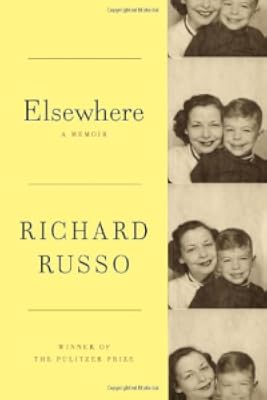
Richard Russo was born in Johnstown, New York on July 15, 1949. He received a Bachelor's degree, a Master of Fine Arts degree, and a Doctor of Philosophy degree from the University of Arizona. He taught at numerous colleges including Southern Illinois University Carbondale and Colby College. He has written numerous books including Mokawk, The Risk show more Pool, Straight Man, Bridge of Sighs, and That Old Cape Magic, as well as a short story collection, The Whore's Child. His novel Empire Falls won the 2002 Pulitzer Prize for Fiction and Nobody's Fool was made into a movie starring Paul Newman, Bruce Willis and Melanie Griffith. His memoir was entitled Elsewhere. He also co-wrote the 1998 film Twilight with director Robert Benton and the teleplay for the HBO adaptation of Empire Falls. (Bowker Author Biography) Richard Russo lives in coastal Maine with his wife & two daughters. (Publisher Fact Sheets) show less
Awards and Honors
Awards
Distinctions
Work Relationships
Is contained in
Common Knowledge
- Canonical title*
- Puente de los suspiros
- Original publication date
- 2007
- People/Characters
- Lou "Lucy" Lynch; Bobby Noonan; Sara Berg
- Important places
- Europe; Italy; USA; Long Island, New York, USA; New York, USA; New York, New York, USA (show all 9); Thomaston, New York, USA; Veneto, Italy; Venice, Veneto, Italy
- Dedication
- For Gary Fisketjon
- First words
- First, the facts.
- Last words
- (Click to show. Warning: May contain spoilers.)We will go.
- Publisher's editor
- Fisketjon, Gary
*Some information comes from Common Knowledge in other languages. Click "Edit" for more information.
Classifications
Statistics
- Members
- 3,369
- Popularity
- 4,990
- Reviews
- 114
- Rating
- (3.79)
- Languages
- 5 — Dutch, English, French, Italian, Spanish
- Media
- Paper, Audiobook, Ebook
- ISBNs
- 22
- ASINs
- 9