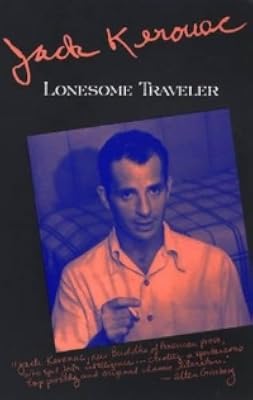
Lonesome Traveler
by Jack Kerouac 
On This Page
Description
In his first frankly autobiographical work, Jack Kerouac tells the exhilarating story of the years when he was writing the books that captivated and infuriated the public, restless years of wandering during which he worked as a railway brakeman in California, a steward on a tramp steamer, and a fire lookout on the crest of Desolation Peak in the Cascade Mountains.Tags
Recommendations































Member Reviews
This was another solid Kerouac book. The beginning was a little slow to get into, but once the ball began rolling it was a great ride that I enjoyed thoroughly. The autobiographical snippets that Kerouac weaves into his fiction truly illuminates him as a character and, foremost, as a grand player in the Beat Generation and what they stood for. The values and themes associated with his work all abound here. There is so much to like here and I especially cared for the Kerouac and his love of life, of experience and all that surrounds him. He speaks of the plight of the hobo and the wanderer in life- as expressed through his actions. Kerouac did things and then wrote about them- this much is plainly evident here.
4.25 stars- great read!
4.25 stars- great read!
I appreciate how atmospheric this was. The anti-narrative helped to just experience the setting, but the long blocks of text made it not as easily enjoyable as I would have liked.
Re-read of my 2nd favorite Jack, after Dharma Bums. First read under the Pacific on Hawkbill and will forever remember coming across this line -
But oh so typical of seaman, that they never do anything - just go ashore with money in their pockets and amble around dully and even with a kind of uninterested sorrow, visitors from another world, a floating prison, in civilian clothes most uninteresting looking anyway.
But oh so typical of seaman, that they never do anything - just go ashore with money in their pockets and amble around dully and even with a kind of uninterested sorrow, visitors from another world, a floating prison, in civilian clothes most uninteresting looking anyway.
In his first frankly autobiographical work, Jack Kerouac tells the exhilarating story of the years when he was writing the books that captivated and infuriated the public, restless years wandering during which he worked as a railway brakeman in California, a steward on a tramp steamer, and a fire lookout on the crest of Desolation Peak in the Cascade Mountains. Resembling his novels in its exuberant style and "jazzy impressionistic prose" (The New Yorker), Lonesome Traveler gives us "Kerouac's nerve ends vs. the universe, with flashes of poetry, truth, and daffiness' (The New York Times Book Review).
Patchy, as with all Kerouac, but the good bits are so beautifully written they leave me breathless.
Short stories about Kerouac’s life. Life on the railway. Life on a steamer. Mexico, California, and New York. And Desolation Peak, again. As he writes in the Author’s Introduction, “… pieces connected together because they have a common theme: Traveling.”
Lots of observational writing, very little happening in these stories. Sometimes it read like a travel guide, like Jack's things to see and do in the various cities. He even included prices of meals, beverages, and lodging! Interesting-ish, but not terribly entertaining.
Good last line though: “The woods are full of wardens.”
Lots of observational writing, very little happening in these stories. Sometimes it read like a travel guide, like Jack's things to see and do in the various cities. He even included prices of meals, beverages, and lodging! Interesting-ish, but not terribly entertaining.
Good last line though: “The woods are full of wardens.”
The early and later prose styles of Jack Kerouac are very different. Kerouac's earliest prose was written during the 1930s and 1940s. These early prose works are written in a fairly conventional prose style, although themes such as the search for freedom and detachment from convention can be found, besides the beginnings of an interest in experimentation with drugs.
In his later prose style, Kerouac's search for freedom and detachment from convention is pushed into his use of language. His late prose, written in a type of stream of consciousness is a wildly extatic outpour of verbiage, poetic at times, and often incoherent. Some of these prose texts were likely written while drunk or under the influence of drugs. They are not really show more enjoyable to read.
Lonesome traveler brings together various texts of Kerouac's travel writing, or short stories based on his travels. The first story, ""Piers of the Homeless Night" is stylistically the least accessible. It is a pain to read. There are better, more lyrical examples of Kerouac's stream of conscious style in some of the other stories.
Various members of the Beat Generation loved travelling to Mexico, as it is the nearest foreign country, which is very different from the American way of life. Besides, in Mexico they access to a native culture of using drugs, and were free to experiment. "Mexico Fellaheen" and "Railroad Earth" describe such journeys to Mexico, where Kerouac did not only find drugs, but also a much freer, more relaxed lifestyle, and he feels tempted to look at the suave, slender bodies of Mexican men. These two stories have strong elements of Kerouac's later prose style. "New York Scenes" is a lovely portrait of New York City.
While Kerouac found freedom on the road by hitch-hiking, for longer voyages he mustered on board ships. "Slobs of the Kitchen Sea" presents a story describing such a sea adventure.
"On a Mountain Top" describes Kerouac's longing for solitude, to work and to meditate. In describes his awakening interest into Buddhism. The story describes an experience of living in nature on Desolation Peak, close to Thoreau's Walden experience. (O lonesome traveler!)
"Big Trip to Europe" is a hilarious story, in which Kerouac describes his trip to Tangier, Marseille, Paris, and the most funny part of it, his attempt to convince British customs that he is not just a penniless bummer, but a renowned American author.
The last story, "The Vanishing American Hobo" is an endearing tribute, evoking the spirit of Benjamin Franklin and Walt Whitman as they traveled the open road. It describes how people's attitudes towards wanderers have changed, from sympathy to disgust, and how "hobos" are now seen as a nuisance and a danger.
Lonesome traveler is another form of writing about Kerouac's experience "on the road", and his quest to seek freedom in far off places. show less
In his later prose style, Kerouac's search for freedom and detachment from convention is pushed into his use of language. His late prose, written in a type of stream of consciousness is a wildly extatic outpour of verbiage, poetic at times, and often incoherent. Some of these prose texts were likely written while drunk or under the influence of drugs. They are not really show more enjoyable to read.
Lonesome traveler brings together various texts of Kerouac's travel writing, or short stories based on his travels. The first story, ""Piers of the Homeless Night" is stylistically the least accessible. It is a pain to read. There are better, more lyrical examples of Kerouac's stream of conscious style in some of the other stories.
Various members of the Beat Generation loved travelling to Mexico, as it is the nearest foreign country, which is very different from the American way of life. Besides, in Mexico they access to a native culture of using drugs, and were free to experiment. "Mexico Fellaheen" and "Railroad Earth" describe such journeys to Mexico, where Kerouac did not only find drugs, but also a much freer, more relaxed lifestyle, and he feels tempted to look at the suave, slender bodies of Mexican men. These two stories have strong elements of Kerouac's later prose style. "New York Scenes" is a lovely portrait of New York City.
While Kerouac found freedom on the road by hitch-hiking, for longer voyages he mustered on board ships. "Slobs of the Kitchen Sea" presents a story describing such a sea adventure.
"On a Mountain Top" describes Kerouac's longing for solitude, to work and to meditate. In describes his awakening interest into Buddhism. The story describes an experience of living in nature on Desolation Peak, close to Thoreau's Walden experience. (O lonesome traveler!)
"Big Trip to Europe" is a hilarious story, in which Kerouac describes his trip to Tangier, Marseille, Paris, and the most funny part of it, his attempt to convince British customs that he is not just a penniless bummer, but a renowned American author.
The last story, "The Vanishing American Hobo" is an endearing tribute, evoking the spirit of Benjamin Franklin and Walt Whitman as they traveled the open road. It describes how people's attitudes towards wanderers have changed, from sympathy to disgust, and how "hobos" are now seen as a nuisance and a danger.
Lonesome traveler is another form of writing about Kerouac's experience "on the road", and his quest to seek freedom in far off places. show less
Members
- Recently Added By
Lists


Author Information

217+ Works 68,507 Members
Jack Kerouac was born in Lowell, Massachusetts, in 1922. His first novel, The Town and the City, was published in 1950. He considered all of his "true story novels," including On the Road, to be chapters of "one vast book," his autobiographical Legend of Duluoz. He died in St. Petersburg, Florida, in 1969 at the age of forty-seven. (Publisher show more Provided) show less
Jack Kerouac has a Legacy Library. Legacy libraries are the personal libraries of famous readers, entered by LibraryThing members from the Legacy Libraries group.
Some Editions
Awards and Honors
Work Relationships
Is contained in
Common Knowledge
- Canonical title*
- Lonesome Traveler
- Original title
- Lonesome traveler
- Original publication date
- 1960
- Important places
- USA
*Some information comes from Common Knowledge in other languages. Click "Edit" for more information.
Classifications
Statistics
- Members
- 1,346
- Popularity
- 17,874
- Reviews
- 9
- Rating
- (3.60)
- Languages
- 10 — Czech, English, Finnish, French, German, Hungarian, Italian, Portuguese, Swedish, Turkish
- Media
- Paper, Ebook
- ISBNs
- 37
- ASINs
- 23