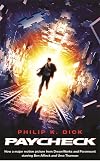
Paycheck
by Philip K. Dick
On This Page
Description
Electronic mechanic Jennings wakes up with no memory of the past two years of his life- except that he had agreed to work for Retherick Construction. Payment for his services, now completed, is a bag of seemingly worthless objects: a code key, a ticket stub, a receipt, a length of wire, half a poker chip, a piece of green cloth and a bus token. But when he is confronted by the Special Police, who seem to be investigating Retherick for their own reasons, Jennings finds himself running for his show more life, realizing that the "worthless" objects are the key to unlocking his recent past, and ensuring that he has a future. Viewed by many as the greatest science fiction writer on any planet, Philip K. Dick has written some of the most intriguing, original and thought-provoking fiction of our time. He has been described by The Wall Street Journal as the man who, "More than anyone else ... really puts you inside people's minds.". show lessTags
Recommendations











Member Reviews
When “Paycheck” appeared in 1953, Philip K. Dick was in his mid-20s and had been publishing for two years. The Golden Age of science fiction was in full swing in a year that gave us still-popular works by Poul Anderson, Arthur C. Clarke, Brian W. Aldiss, Ray Bradbury, Hal Clement, Theodore Sturgeon, Clifford D. Simak, Frederick Pohl, Robert Heinlein, and Isaac Asimov. Somehow, though, I never think of PKD as a contemporary of most of these writers. He seems younger to me.
The movies have something to do with that impression. His work has always inspired glossy, updated treatments by Hollywood. “Paycheck,” for example, got a second life in 2003 when it was adapted into a movie by John Woo with Ben Affleck and Uma Thurman. The show more action of the film is as quick as a Marvel superhero epic. The script and special effects provide an appropriately futuristic, if unergonomic, look and feel to the technology.
All this glitz conceals the story’s Cold War roots. Jennings, PKD’s protagonist, is not a programmer, a hacker, or engineer. He is a “mechanic” hired to work on computer programs as if they were Model-Ts. He is not, like Affleck’s character, a high-priced, valued professional. He considers himself a working stiff who wants his life to follow the pattern of a Horatio Alger story, where the hero starts poor and, through luck and pluck, gets rich and marries the boss’s daughter. Uma Thurman’s Rachel is a stronger character than PKD’s Kelley, especially in the action scenes.
In its own time, the story was forward-looking. It explores some ideas we would hear more about later in the decade. Jennings sees himself caught between the corporations and the government, between what C. Wright Mills would call elements of “the power elite.” Like Thorby in Heinlein’s 1957 Citizen of the Galaxy, he wants to use corporate power to start a revolution to overthrow the police state. His life, he says, “depends on the Company,” and he wants “to get inside before it’s too late.” None of these political ideas appear in the movie. Affleck and Thurman’s characters take the money and are content to tend their greenhouse. show less
The movies have something to do with that impression. His work has always inspired glossy, updated treatments by Hollywood. “Paycheck,” for example, got a second life in 2003 when it was adapted into a movie by John Woo with Ben Affleck and Uma Thurman. The show more action of the film is as quick as a Marvel superhero epic. The script and special effects provide an appropriately futuristic, if unergonomic, look and feel to the technology.
All this glitz conceals the story’s Cold War roots. Jennings, PKD’s protagonist, is not a programmer, a hacker, or engineer. He is a “mechanic” hired to work on computer programs as if they were Model-Ts. He is not, like Affleck’s character, a high-priced, valued professional. He considers himself a working stiff who wants his life to follow the pattern of a Horatio Alger story, where the hero starts poor and, through luck and pluck, gets rich and marries the boss’s daughter. Uma Thurman’s Rachel is a stronger character than PKD’s Kelley, especially in the action scenes.
In its own time, the story was forward-looking. It explores some ideas we would hear more about later in the decade. Jennings sees himself caught between the corporations and the government, between what C. Wright Mills would call elements of “the power elite.” Like Thorby in Heinlein’s 1957 Citizen of the Galaxy, he wants to use corporate power to start a revolution to overthrow the police state. His life, he says, “depends on the Company,” and he wants “to get inside before it’s too late.” None of these political ideas appear in the movie. Affleck and Thurman’s characters take the money and are content to tend their greenhouse. show less
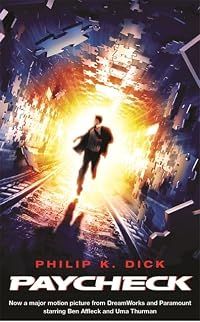
Hoo-hoo, people must have been pissed when they bought this one, thinking they were getting some novelization of a movie they once half-watched on a plane. Instead they find they've bought (quelle horror!) a collection of twelve kind of/sorta related short stories, drawn from throughout Philip Dick's career. There are some good tales included but this was a pretty clever (i.e. dishonest) marketing gimmick by somebody, old stories packaged with a flashy new cover. P.T. Barnum would've approved...
When mechanic Jennings completes his contract with Rethrick Construction, he learns he turned down a fortunate for a number of trinkets. Since his memory of the two years he served with Rethrick has been erased, he has no idea why he gave up his paycheck. When the secret police come for him, they do not believe he has "forgotten" two years of his life and everything he knew about Rethrick. As Jennings realizes the trinkets are helping him escape from complex situations, he realizes the only way to be safe is to blackmail Rethrick into protecting him from the government. With the way the trinkets are always the perfect object at the perfect time, Jennings also realizes he was working on a machine that allowed one to view the future. He show more created a plan to ensure his success and survival.
SPOILERS:
The trinkets that Jennings received as payment are as follows:
-- A length of fine wire (to short out and open a police car door)
-- A bus token (to speed escape from the police)
-- A ticket stub (to locate the hidden Rethrick's building)
-- A green strip of cloth (as a worker's armband it enables him to sneak into Rethrick's building)
-- A code key (to open an exit from the Rethrick's building)
-- Half a broken poker chip (to gain entry into a gambling establishment where he hides from multiple factions)
-- A parcel receipt (to access the material he stored to blackmail Rethrick) show less
SPOILERS:
The trinkets that Jennings received as payment are as follows:
-- A length of fine wire (to short out and open a police car door)
-- A bus token (to speed escape from the police)
-- A ticket stub (to locate the hidden Rethrick's building)
-- A green strip of cloth (as a worker's armband it enables him to sneak into Rethrick's building)
-- A code key (to open an exit from the Rethrick's building)
-- Half a broken poker chip (to gain entry into a gambling establishment where he hides from multiple factions)
-- A parcel receipt (to access the material he stored to blackmail Rethrick) show less
This collection holds 12 of PKD's 121 short stories.
To be honest, these are mostly in the "just OK" and "hadn't aged that well" area, and far from his best.
Or his second best.
Or even his third best...
To be honest, these are mostly in the "just OK" and "hadn't aged that well" area, and far from his best.
Or his second best.
Or even his third best...
The idea behind the story is pretty good, especially considering it came from, what, the 1940s? (And I guessed it was an older one as soon as I saw "rockets" mentioned.) But I didn't really get into it. At least "Paycheck" was a quick read and a bit interesting in parts. I have the feeling, though, that this might be one of those rare cases where the movie is better than the story/book behind it... of course, I've yet to watch the movie...
Ratings
Members
- Recently Added By
Lists

My TBR
371 works; 3 members
Author Information

667+ Works 146,384 Members
Phillip Kindred Dick was an American science fiction writer best known for his psychological portrayals of characters trapped in illusory environments. Born in Chicago, Illinois, on December 16, 1928, Dick worked in radio and studied briefly at the University of California at Berkeley before embarking on his writing career. His first novel, Solar show more Lottery, was published in 1955. In 1963, Dick won the Hugo Award for his novel, The Man in the High Castle. He also wrote a series of futuristic tales about artificial creatures on the loose; notable of these was Do Androids Dream of Electric Sheep?, which was later adapted into film as Blade Runner. Dick also published several collections of short stories. He died of a stroke in Santa Ana, California, in 1982. (Bowker Author Biography) show less
Series
Belongs to Publisher Series
Work Relationships
Is contained in
Common Knowledge
- Canonical title
- Paycheck
- Original title
- Paycheck
- Original publication date
- 2004-02 (Collection) (Collection); 1953; 1953 Novelette (Paycheck) (Paycheck); 1955 Short Story (Nanny) (Nanny); 1954 Novelette (Jon's World) (Jon's World); 1954 Short Story (Breakfast at Twilight) (Breakfast at Twilight) (show all 14); 1954 Short Story (Small Town) (Small Town); 1954 Short Story (The Father-Thing) (The Father-Thing); 1955 Short Story (The Chromium Fence) (The Chromium Fence); 1955 Novelette (Autofac) (Autofac); 1963 Novelette (The Days of Perky Pat) (The Days of Perky Pat); 1963 Short Story (Stand-By) (Stand-By); 1974 Novelette (A Little Something For Us Temponauts) (A Little Something For Us Temponauts); 1974 Novelette (The Pre-Persons) (The Pre-Persons)
- Original language
- English
- Disambiguation notice
- This is a Gollancz UK selection of 12 stories. Contents: Paycheck, Nanny, Jon's World, Breakfast at Twilight, Small Town, The Father-Thing, The Chromium Fence, Autofac, The Days of Perky Pat, Stand-By, A Little Some... (show all)thing For Us Temponauts, The Pre-Persons. It should not be combined with Paycheck and Other Classic Stories, which is an alternative title for Volume 1 of the Collected Stories (containing 25 stories, and also known as The Short Happy Life of the Brown Oxford and Beyond Lies the Wub).
Correct ISBNs for this work include:
0575075856, 057507583X, 0575070013
There are a number of non-English language editions here that have not been checked: if you are aware of any of these that are not the listed collection of 12 stories, please contact the combiners group.
Classifications
Statistics
- Members
- 312
- Popularity
- 101,996
- Reviews
- 5
- Rating
- (3.44)
- Languages
- 7 — Czech, English, French, German, Polish, Portuguese, Turkish
- Media
- Paper, Audiobook, Ebook
- ISBNs
- 14
- ASINs
- 6