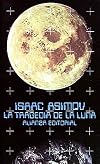
The Tragedy of the Moon
by Isaac Asimov
Science essays for The Magazine of Fantasy and Science Fiction (11), Essay Collections
On This Page
Description
A collection of eighteen science essays which range from Asimov's recommendation for changing our calendar to his answer to the question of whether cassettes will replace books.Tags
Recommendations

















Member Reviews
Asimov's popular science writing is pure joy. His auctorial voice is one of utter charm. And he usually makes sense.
These essays are as fine as any of them. And his proposal for a World Season Calendar, contained in the essay "The Week Excuse," is my kind of nutballery: entirely rational but without one chance in a million of having practical effect. (Yes, I've been thinking, recently, about the idiotic juxaposition of solar and lunar reckonings in our calendar, and have thought it best to get rid of the lunacy of the months, just as Asimov proposes.)
Asimov was always clear. He enjoyed knowledge, and communicated his enthusiasm well. I've long suspected that the best way to teach science in, say, junior high, would be to have one period show more every day to the reading and discussion of Isaac Asimov essays. That would be the Education for Exposure science class, to be followed in subsequent years by Education to Mastery science classes . . . you know, physics, chemistry, biology, per usual.
I would have enjoyed it, that's for sure! show less
These essays are as fine as any of them. And his proposal for a World Season Calendar, contained in the essay "The Week Excuse," is my kind of nutballery: entirely rational but without one chance in a million of having practical effect. (Yes, I've been thinking, recently, about the idiotic juxaposition of solar and lunar reckonings in our calendar, and have thought it best to get rid of the lunacy of the months, just as Asimov proposes.)
Asimov was always clear. He enjoyed knowledge, and communicated his enthusiasm well. I've long suspected that the best way to teach science in, say, junior high, would be to have one period show more every day to the reading and discussion of Isaac Asimov essays. That would be the Education for Exposure science class, to be followed in subsequent years by Education to Mastery science classes . . . you know, physics, chemistry, biology, per usual.
I would have enjoyed it, that's for sure! show less
Very entertaining collection on a great variety of subjects. Viruses and the discovery of DNA, Biblical exegesis, how the week came to be, etc etc. What I remembered from when I last read it were the first two essays. In the first he argues that if our moon orbited Venus we’d be more advanced technologically. In the second he argues that if our moon orbited Venus land life would never have developed.
It’s been a long time since I’ve read any of Asimov’s non-fiction. I’d forgotten how charming he could be when he writes in his writer-persona. Though the way he recounts his interactions with women… I’d taken them as jokes when I read this in the 90s. Unfortunately the internet has now been created and I can’t read them show more without having the ‘sexual harassment’ section of his Wikipedia article at the front of my mind. show less
It’s been a long time since I’ve read any of Asimov’s non-fiction. I’d forgotten how charming he could be when he writes in his writer-persona. Though the way he recounts his interactions with women… I’d taken them as jokes when I read this in the 90s. Unfortunately the internet has now been created and I can’t read them show more without having the ‘sexual harassment’ section of his Wikipedia article at the front of my mind. show less
This collection of articles starts off on a terrific high and goes downhill at a constant rate until its finale. The eponymous starter, The Tragedy of the Moon, is worth the price of entry alone. The succeeding The Triumph of the Moon is a worthy adjunct and counterpoint. Things get religious for a chapter, then The Week Excuse provides interesting food for thought. The rest (thirteen more articles/chapters) have odd nuggets of interest, but are weak by comparison. By the Numbers, late on, is an interesting take on the ubiquitous presence of computers written well before it became a reality.
Asimov elides personal anecdotes here and there – especially at the start of chapters – which I presume he thought were quirky and humorous, but show more instead come across as conceit. He enjoys name-dropping and preening to an irritating degree. This was written in a different age, so perhaps circumstances dictated this. show less
Asimov elides personal anecdotes here and there – especially at the start of chapters – which I presume he thought were quirky and humorous, but show more instead come across as conceit. He enjoys name-dropping and preening to an irritating degree. This was written in a different age, so perhaps circumstances dictated this. show less
A collection of Asimov's essays on science, ranging from astronomy (the moon and the solar system) to biology (his own area) to sociology, with a bit of autobiography thrown in. Told with his usual wit and verve. The science and social science is a bit dated, but still fun to read.
It isn't that I don't like this book, its just that the only time I find to read is usually very late at night, and this book requires an alert reader! I shall return to it someday.
FOR REFERENCE:
Contents:
Introduction
A — About the Moon
• 1. The Tragedy of the Moon
• 2. The Triumph of the Moon
• 3. Moon Over Babylon
• 4. The Week Excuse
B — About Other Small Worlds
• 5. The World Ceres
• 6. The Clock in the Sky
C — About Carbon
• 7. The One and Only
• 8. The Unlikely Twins
D — About Micro-organisms
• 9. Through The Microglass
• 10. Down From The Amoeba
• 11. The Cinderella Compound
E — About the Thyroid Gland
• 12. Doctor, Doctor, Cut My Throat
F — About Society
• 13. Lost in Non-Translation
• 14. The Ancient and the Ultimate
• 15. By The Numbers
G — And (You Guessed It!) About Me
• 16. The Cruise And I (July 1973)
• 17. Academe And I
Contents:
Introduction
A — About the Moon
• 1. The Tragedy of the Moon
• 2. The Triumph of the Moon
• 3. Moon Over Babylon
• 4. The Week Excuse
B — About Other Small Worlds
• 5. The World Ceres
• 6. The Clock in the Sky
C — About Carbon
• 7. The One and Only
• 8. The Unlikely Twins
D — About Micro-organisms
• 9. Through The Microglass
• 10. Down From The Amoeba
• 11. The Cinderella Compound
E — About the Thyroid Gland
• 12. Doctor, Doctor, Cut My Throat
F — About Society
• 13. Lost in Non-Translation
• 14. The Ancient and the Ultimate
• 15. By The Numbers
G — And (You Guessed It!) About Me
• 16. The Cruise And I (July 1973)
• 17. Academe And I
Ratings
Members
- Recently Added By
Author Information

2,440+ Works 294,604 Members
Isaac Asimov was born in Petrovichi, Russia, on January 2, 1920. His family emigrated to the United States in 1923 and settled in Brooklyn, New York, where they owned and operated a candy store. Asimov became a naturalized U.S. citizen at the age of eight. As a youngster he discovered his talent for writing, producing his first original fiction at show more the age of eleven. He went on to become one of the world's most prolific writers, publishing nearly 500 books in his lifetime. Asimov was not only a writer; he also was a biochemist and an educator. He studied chemistry at Columbia University, earning a B.S., M.A. and Ph.D. In 1951, Asimov accepted a position as an instructor of biochemistry at Boston University's School of Medicine even though he had no practical experience in the field. His exceptional intelligence enabled him to master new systems rapidly, and he soon became a successful and distinguished professor at Columbia and even co-authored a biochemistry textbook within a few years. Asimov won numerous awards and honors for his books and stories, and he is considered to be a leading writer of the Golden Age of science fiction. While he did not invent science fiction, he helped to legitimize it by adding the narrative structure that had been missing from the traditional science fiction books of the period. He also introduced several innovative concepts, including the thematic concern for technological progress and its impact on humanity. Asimov is probably best known for his Foundation series, which includes Foundation, Foundation and Empire, and Second Foundation. In 1966, this trilogy won the Hugo award for best all-time science fiction series. In 1983, Asimov wrote an additional Foundation novel, Foundation's Edge, which won the Hugo for best novel of that year. Asimov also wrote a series of robot books that included I, Robot, and eventually he tied the two series together. He won three additional Hugos, including one awarded posthumously for the best non-fiction book of 1995, I. Asimov. "Nightfall" was chosen the best science fiction story of all time by the Science Fiction Writers of America. In 1979, Asimov wrote his autobiography, In Memory Yet Green. He continued writing until just a few years before his death from heart and kidney failure on April 6, 1992. (Bowker Author Biography) show less
Series

Science essays for The Magazine of Fantasy and Science Fiction
27 works (11)

Essay Collections
43 works
Belongs to Publisher Series
Common Knowledge
- Canonical title
- The Tragedy of the Moon
- Original publication date
- 1973
- First words
- Douglas W. Jerrold, a nineteenth-century English author, was once told that he was going to have a book dedicated to him by a friend of his who was, alas, a pronouncedly mediocre writer. [Introduction]
- Last words
- (Click to show. Warning: May contain spoilers.)So there you are . . .
I'm a science-fiction writer. - Original language
- English
- Disambiguation notice
- Collects essays from The Magazine of Fantasy and Science Fiction, March 1972-July 1973.
Contents:
Introduction
A — About the Moon
• 1. The Tragedy of the Moon
• 2. The Triumph of the M... (show all)oon
• 3. Moon Over Babylon
• 4. The Week Excuse
B — About Other Small Worlds
• 5. The World Ceres
• 6. The Clock in the Sky
C — About Carbon
• 7. The One and Only
• 8. The Unlikely Twins
D — About Micro-organisms
• 9. Through The Microglass
• 10. Down From The Amoeba
• 11. The Cinderella Compound
E — About the Thyroid Gland
• 12. Doctor, Doctor, Cut My Throat
F — About Society
• 13. Lost in Non-Translation
• 14. The Ancient and the Ultimate
• 15. By The Numbers
G — And (You Guessed It!) About Me
• 16. The Cruise And I
• 17. Academe And I
Classifications
Statistics
- Members
- 342
- Popularity
- 92,982
- Reviews
- 6
- Rating
- (3.88)
- Languages
- English, Hungarian, Spanish
- Media
- Paper, Ebook
- ISBNs
- 8
- ASINs
- 9