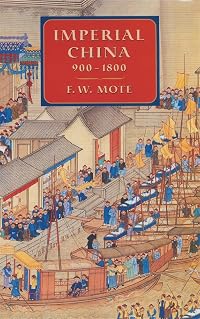
Imperial China 900-1800
by F. W. Mote
On This Page
Description
"This history of China for the 900-year time span of the late imperial period, by a senior scholar of the epoch, highlights the personal characteristics of the rulers and dynasties and probes the cultural theme of Chinese adaptations to recurrent alien rule. No other work provides a similar synthesis: generational events, personalities, and the spirit of the age combine to yield a comprehensive history of the civilization, not isolated but shaped by its relation to outsiders."--Jacket.Tags
Recommendations






Member Recommendations
Member Reviews
Only got up to Chapter 27, on the Ming Dynasty, but what I managed to read before my loan ended was enough to convince me to track down a more permanent copy. Very good overview that, while you do sometimes get the sense some important things are left out, seems to hit on most of the immediate questions. Mote does a good job moving up and down in scale, giving just enough biographical information to personalize the periods he's talking about (and, significantly, to make clear how different life was at various points), while never losing sight of the big picture. I especially appreciated the digressions on China's nomadic neighbors, which despite being even more abbreviated than the main body of the text were detailed and consistently show more engrossing in their own right. show less
This is an excellent book dealing with the struggles between the sedentary population of China and the nomad tribes on their northern and western boundaries. In The Rise of the West by William McNeil deals with this theme on a worldwide scale. Frederick Mote has focused on China between the years 900-1800.
Between 9000 and 1800 different tribes of nomads ruled the whole of China for 450 years and northern China for another 200 years. The history of China is the history of the constant struggle between the nomads and the sedentary population. This produced a country that turned inward and built the Great Wall. The Southern Song dynasty resolved the problem by payment to the nomads and felt the money was better spent than on an army. The show more sedentary population produced the wealth and the nomad population produced the warriors. The warriors sought the wealth and thus the continual struggle.
Another theme of the book is the saying, " China can be conquered on horseback but it cannot be ruled on horseback." In order to extract the wealth from the sedentary population the nomads had to adapt to the Imperial system. The Manchus were most effective in this adaption and ruled China from 1644 to 1911. Each official position would have a Chinese and a Manchu working together. I think any history of modern China should emphasize that the "Chinese" encountered by the West in late 1700's until 1911 were not Chinese, they were foreign rulers.
The volume covers in detail the relations with the western nomads. The peoples in Tibet and what is now Xinjiang province. They had a more symbiotic relationship with the Chinese and were on occasion conquered by them. One factoid that has stuck in my mind is that the Dalai Lama was given his title by the chief of a Mongol tribe who supported the yellow hat lamas in their struggle with the red hat lamas in Tibet.
The author set out in great detail how the Imperial system worked. Their was always a struggle over the exercise of power between the Emperor and the officials and for intermittent time periods the eunuchs. Yong le, an Emperor in the Ming dynasty dynasty established a communication system with the provinces that was kept secret from the officials because part of their power was the memorial system. Officials from the provinces would write memorials and the officials would log them in and read them and write to the Emperor what was said. Then the officials would write a memorial to the provinces in reply. This limited the real power of the Emperor.
China during this period provided the highest standard of living in the world for the most people. The government system was very efficient and used the least amount of the surplus produced by the population than most any other country. This only applied to the periods when China was stable and intact. Another factor in the encounter between the modern contacts between China and the West was that the Manchu dynasty was past it's prime when the Westerner's and then the Japanese defeated it.
I felt that reading this book added great depth to my understanding of China. The author provides an analysis of Imperial China at an anthropological level. This explains some of the trends in Chinese history. show less
Between 9000 and 1800 different tribes of nomads ruled the whole of China for 450 years and northern China for another 200 years. The history of China is the history of the constant struggle between the nomads and the sedentary population. This produced a country that turned inward and built the Great Wall. The Southern Song dynasty resolved the problem by payment to the nomads and felt the money was better spent than on an army. The show more sedentary population produced the wealth and the nomad population produced the warriors. The warriors sought the wealth and thus the continual struggle.
Another theme of the book is the saying, " China can be conquered on horseback but it cannot be ruled on horseback." In order to extract the wealth from the sedentary population the nomads had to adapt to the Imperial system. The Manchus were most effective in this adaption and ruled China from 1644 to 1911. Each official position would have a Chinese and a Manchu working together. I think any history of modern China should emphasize that the "Chinese" encountered by the West in late 1700's until 1911 were not Chinese, they were foreign rulers.
The volume covers in detail the relations with the western nomads. The peoples in Tibet and what is now Xinjiang province. They had a more symbiotic relationship with the Chinese and were on occasion conquered by them. One factoid that has stuck in my mind is that the Dalai Lama was given his title by the chief of a Mongol tribe who supported the yellow hat lamas in their struggle with the red hat lamas in Tibet.
The author set out in great detail how the Imperial system worked. Their was always a struggle over the exercise of power between the Emperor and the officials and for intermittent time periods the eunuchs. Yong le, an Emperor in the Ming dynasty dynasty established a communication system with the provinces that was kept secret from the officials because part of their power was the memorial system. Officials from the provinces would write memorials and the officials would log them in and read them and write to the Emperor what was said. Then the officials would write a memorial to the provinces in reply. This limited the real power of the Emperor.
China during this period provided the highest standard of living in the world for the most people. The government system was very efficient and used the least amount of the surplus produced by the population than most any other country. This only applied to the periods when China was stable and intact. Another factor in the encounter between the modern contacts between China and the West was that the Manchu dynasty was past it's prime when the Westerner's and then the Japanese defeated it.
I felt that reading this book added great depth to my understanding of China. The author provides an analysis of Imperial China at an anthropological level. This explains some of the trends in Chinese history. show less
Frederick W. Mote was an eminent American sinologist and in this opus, Imperial China one sees the dedication and love towards the history of China that this man had.
Covering nearly a millennium, from the fall of the Tang and the Five Dynasties, the Liao Dynasty, the Song Dynasty, the Xi Xia state, the Jin Dynasty, the Yuan Dynasty, the Ming Dynasty to the first century and a half of the Qing Dynasty, this book is a major contribution to scholarship.
Readable and accessible to layperson and scholar alike, Mote intimately brings alive 900 years of history and in spite of its length, is able to maintain the reader's attention throughout. As scholarly material, this book is well-researched with an excellent bibliography.
This is an show more excellent addition to any sinologist's library or to an interested layperson. show less
Covering nearly a millennium, from the fall of the Tang and the Five Dynasties, the Liao Dynasty, the Song Dynasty, the Xi Xia state, the Jin Dynasty, the Yuan Dynasty, the Ming Dynasty to the first century and a half of the Qing Dynasty, this book is a major contribution to scholarship.
Readable and accessible to layperson and scholar alike, Mote intimately brings alive 900 years of history and in spite of its length, is able to maintain the reader's attention throughout. As scholarly material, this book is well-researched with an excellent bibliography.
This is an show more excellent addition to any sinologist's library or to an interested layperson. show less
De meeste gedetailleerde overzichtsgeschiedenis voor de behandelde periode, met name voor de geschiedenis van de randstaten rond "China Proper", zoals de Liao, Jin, Xixia en Yuan. Hoewel voltooid in 1999, is zeker niet alle recente vakliteratuur verwerkt.
Ratings
Members
- Recently Added By
Lists

r/History Recommended Reading List
603 works; 12 members

r/AskHistorians' Recommended Books
1,068 works; 19 members

The China Project Book List
100 works; 2 members

In Our Time books
4,934 works; 2 members
Author Information

8+ Works 420 Members
Awards and Honors
Notable Lists
Common Knowledge
- Important places
- China
- Important events
- Five Dynasties and Ten Kingdoms (907 | 960); Song Dynasty (960 | 1279); Yuan Dynasty (1271 | 1368); Ming Dynasty (1368 | 1644); Qing Dynasty (1644 | 1911)
Classifications
Statistics
- Members
- 214
- Popularity
- 152,996
- Reviews
- 4
- Rating
- (4.56)
- Languages
- English
- Media
- Paper, Ebook
- ISBNs
- 3