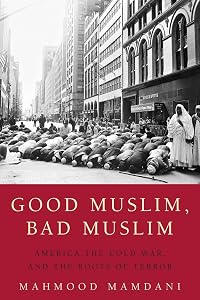
Good Muslim, Bad Muslim: America, the Cold War, and the Roots of Terror
by Mahmood Mamdani
On This Page
Description
"Dispels the idea of 'good' (secular, westernized) and 'bad' (premodern, fanatical) Muslims, pointing out that these judgments refer to political rather than cultural or religious identities ... Argues that political Islam emerged as the result of a modern encounter with Western power, and that the terrorist movement at the center of Islamist politics is an even more recent phenomenon, one that followed America's embrace of proxy war after its defeat in Vietnam"--jacket.Tags
Recommendations
















Member Reviews
The author traces the rise of Islamic terrorism from American training of the mujahadeen in Afghanistan to fighting the Soviets. There, the CIA found it could recruit anti-Soviets by using Muslim religious language to accomplish American political goals.
The CIA's actions were part of a more general trend to conduct the cold war through surrogates after the failure of Viet Nam. Presidents Carter and Reagan attempted to combat various left wing national governments through undermining them indirectly rather than through direct confrontation. Nicaragua is a classic example.
Because the president was unable to obtain funding for such subversive activities, the CIA turned to the drug trade to fund its activities in Nicaragua and show more Afganistan.
The author is perplexed by America's uncritical support of Israel. He refers to the strong Jewish lobby that acts more as a fund raiser than a get-out-the-vote organization. But he still wonders why American news media is willing to criticize any country, including the USA, but not Israel. He sees the phenomenon as a product of the perception (held by both Israelis and Americans) that Israelis are not colonizers or settlers, but people returning to their country after two millenia. That perception is quite rare anywhere else in the world.
The author asserts (not very convincingly) that the Nicaragua-Contra affair could have been as destructive of Reagan's presidency as Watergate was to Nixon's, except that Israeli involvement gave the activities a kind of immunity.
The use of surrogate warriors motivated by religion to accomplish political goals is a common denominator for both CIA subversion and Muslim terrorism. Bin Ladin is a politician, not a theologian.
I think Mamdani, who is Muslim, ignores elements of Islam that make it so easy to recruit Muslims to fight such battles. He seeks to put the blame for the start of terrorism on the CIA, which deserves some blame, but hardly all of it. Nonetheless, the book is often a thought provoking counter to Huntington's "clash of civilizations" thesis. (JAB) show less
The CIA's actions were part of a more general trend to conduct the cold war through surrogates after the failure of Viet Nam. Presidents Carter and Reagan attempted to combat various left wing national governments through undermining them indirectly rather than through direct confrontation. Nicaragua is a classic example.
Because the president was unable to obtain funding for such subversive activities, the CIA turned to the drug trade to fund its activities in Nicaragua and show more Afganistan.
The author is perplexed by America's uncritical support of Israel. He refers to the strong Jewish lobby that acts more as a fund raiser than a get-out-the-vote organization. But he still wonders why American news media is willing to criticize any country, including the USA, but not Israel. He sees the phenomenon as a product of the perception (held by both Israelis and Americans) that Israelis are not colonizers or settlers, but people returning to their country after two millenia. That perception is quite rare anywhere else in the world.
The author asserts (not very convincingly) that the Nicaragua-Contra affair could have been as destructive of Reagan's presidency as Watergate was to Nixon's, except that Israeli involvement gave the activities a kind of immunity.
The use of surrogate warriors motivated by religion to accomplish political goals is a common denominator for both CIA subversion and Muslim terrorism. Bin Ladin is a politician, not a theologian.
I think Mamdani, who is Muslim, ignores elements of Islam that make it so easy to recruit Muslims to fight such battles. He seeks to put the blame for the start of terrorism on the CIA, which deserves some blame, but hardly all of it. Nonetheless, the book is often a thought provoking counter to Huntington's "clash of civilizations" thesis. (JAB) show less
I'd like to read again, or parts of it again, now that I am out of an academic setting, to see how it applies to the practicalities of most work.
Ratings
Members
- Recently Added By
Author Information

19 Works 1,352 Members
Mahmood Mamdani is the Herbert Lehman Professor of Government at Columbia University and executive director of the Makerere Institute of Social Research. His many books include Citizen and Subject (Princeton) and Saviors and Survivors (Crown).
Common Knowledge
- Canonical title
- Good Muslim, Bad Muslim: America, the Cold War, and the Roots of Terror
- Original publication date
- 2004
- Important events
- Cold War ; Afghan Wars (2001- )
Classifications
- Genres
- Nonfiction, Religion & Spirituality, History, General Nonfiction, Politics and Government
- DDC/MDS
- 320.557 — Society, government, & culture Political science Types of Government Political ideologies Religiously oriented ideologies Islamic ideologies
- LCC
- E840 .M346 — History of the United States United States Later twentieth century, 1961-2000 Biography (General)
- BISAC
Statistics
- Members
- 456
- Popularity
- 67,145
- Reviews
- 2
- Rating
- (3.83)
- Languages
- 6 — English, Finnish, French, German, Hindi, Italian
- Media
- Paper, Ebook
- ISBNs
- 13
- UPCs
- 1
- ASINs
- 2