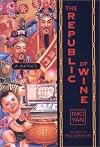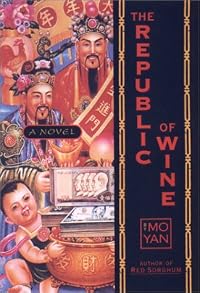
The Republic of Wine
by Mo Yan
On This Page
Description
In this hypnotic epic novel, Mo Yan, the most critically acclaimed Chinese writer of this generation, takes us on a journey to a conjured province of contemporary China known as the Republic of Wine—a corrupt and hallucinatory world filled with superstitions, gargantuan appetites, and surrealistic events. When rumors reach the authorities that strange and excessive gourmandise is being practiced in the city of Liquorland (so named for the staggering amount of alcohol produced and consumed show more there), veteran special investigator Ding Gou'er is dispatched from the capital to discover the truth. His mission begins at the Mount Lou Coal Mine, where he encounters the prime suspect—Deputy Head Diamond Jin, legendary for his capacity to hold his liquor. During the ensuing drinking duel at a banquet served in Ding's honor, the investigator loses all sense of reality, and can no longer tell whether the roast suckling served is of the animal or human variety. When he finally wakes up from his stupor, he has still found no answers to his rapidly mounting questions. Worse yet, he soon finds that his trusty gun is missing.Interspersed throughout the narrative—and Ding's faltering investigation—are letters sent to Mo Yan by one Li Yidou, a doctoral candidate in Liquor Studies and an aspiring writer. Each letter contains a story that Li would like the renowned author's help in getting published. However, Li's tales, each more fantastic and malevolent than the last, soon begin alarmingly to resemble the story of Ding's continuing travails in Liquorland. Peopled by extraordinary characters—a dwarf, a scaly demon, a troupe of plump, delectable boys raised in captivity, a cookery teacher who primes her students with monstrous recipes—Mo Yan's revolutionary tour de force reaffirms his reputation as a writer of world standing. Wild, bawdy, politically explosive, and subversive, The Republic of Wine is both mesmerizing and exhilarating, proving that no repressive regime can stifle true creative imagination.
. show less
Tags
Recommendations





Member Reviews
I hear the piteous wails of little boys in the steamers. I hear them wailing in crackling woks, on chopping blocks, in oil, salt, soy sauce, vinegar, sugar, anise powder, peppercorns, cinnamon, ginger and cooking liquor. They are wailing in your intestines, in the toilets and in the sewers. They are wailing in the rivers and in the septic tanks. They are wailing in the bellies of fish and in the soil of farmlands. In the bellies of whales, sharks, eels, and hairtail fish. In tassels of wheat, in kernels of corn, in tender peapods, in the vines of sweet potatoes, in the stalks of sorghum, and in the pollens of millet. Why are they wailing? They cry and they cry, they howl, breaking the heart of anyone who hears the sound emerging from show more apples, from pears, from grapes, from peaches and apricots, and from walnuts. Fruit stalls carry the sound of children crying. Vegetable stalls carry the sound of children crying. Slaughterhouses carry the sound of children crying. From the banquet tables of Liquorland come the chilling, skin-crawling wails of one murdered little boy after another.
A magical realist satire on regional government, literary censorship and the Chinese obesession with food and drink - I just hope that there isn't really a donkey meat dish called Dragon and Phoenix Lucky Together.
There are rumours of cannibalism emanating from the Liquorland region of China, so Special Investigator Ding Gou'er is sent to find out the truth of the matter, and starts his investigations at the Mount Luo coal mine. He seems quite unstable at the best of times, lusting after women when he should be concentrating on the case and firing his gun accidentally more than once in the opening chapters, so the fact that the inhabitants of Liquorland have a prodigious appetite for alcohol and seem to be trying to keep him constantly drunk, doesn't help him to distinguish between fact and fancy.
The main story is interspersed with the correspondence between Mo Yan and a young writer who sends him stories, asking for his help in getting them published. Li Yidou is a PhD student at the Liquorland Brewing College and his stories are like fantastic offshoots of the main story, concerning drink, demons, donkeys, as well as small boys who are bred for the pot by their parents and sold to the Special Purchasing Section of Liquorland's Culinary Academy.
Overall I'd say that this book was weirdly compelling, if not enjoyable. I bought it for 30p at the library book sale and it doesn't look as if it had been borrowed much. show less
A magical realist satire on regional government, literary censorship and the Chinese obesession with food and drink - I just hope that there isn't really a donkey meat dish called Dragon and Phoenix Lucky Together.
There are rumours of cannibalism emanating from the Liquorland region of China, so Special Investigator Ding Gou'er is sent to find out the truth of the matter, and starts his investigations at the Mount Luo coal mine. He seems quite unstable at the best of times, lusting after women when he should be concentrating on the case and firing his gun accidentally more than once in the opening chapters, so the fact that the inhabitants of Liquorland have a prodigious appetite for alcohol and seem to be trying to keep him constantly drunk, doesn't help him to distinguish between fact and fancy.
The main story is interspersed with the correspondence between Mo Yan and a young writer who sends him stories, asking for his help in getting them published. Li Yidou is a PhD student at the Liquorland Brewing College and his stories are like fantastic offshoots of the main story, concerning drink, demons, donkeys, as well as small boys who are bred for the pot by their parents and sold to the Special Purchasing Section of Liquorland's Culinary Academy.
Overall I'd say that this book was weirdly compelling, if not enjoyable. I bought it for 30p at the library book sale and it doesn't look as if it had been borrowed much. show less
Truly bizarre from beginning to end, it is easy to see why some readers might be put off. The author weaves at least three threads here - the story of an investigator sent to Liquorland to investigate reports of babies being eaten, an exchange of letters between the author (Mo Yan himself) and a Doctor of Liquor Studies in Liquorland who is also an amateur writer, and the stories the amateur writer sends to Mo Yan. All of these threads eventually weave together into a hallucinatory ending that leaves pretty much everything unresolved. I think the author (Mo Yan, that is) is trying to say something here, but I'm not quite sure what. Nor am I sure that I need to know. The pleasures of this book, and there are many, come from the absurd show more scenes, whether it is the investigator trying to make love to a lady truck driver, or apes making wine, there are laughs, horrors, and grotesqueries one after the other. I think it helps to have lived some time in China, which I have, and to have made some attempt to study and understand Chinese culture to appreciate the role that food and drink play in people's lives. So no matter how extreme or ridiculous parts of the book feel, there is just an edge of reality to them that keeps you enthralled. As usual, the translation by Howard Goldblatt is superb. If you are new to the author, definitely turn to Red Sorghum, his masterpiece, first. But if you are anxious to understand a little more about his range as an author, definitely check this out. It's an immersive experience different from any you've had before. show less
A dark comedy, a detective novel, and an existential look at the transformation of China over the past thirty years. Mo Yan is a master storyteller, and this is a beautiful example. It is a book that is almost too disturbing to continue reading, and yet too compelling to let go.
Mo Yan creates the world of Liquorland, a province of reckless abundance, of gluttony to the highest degree (eating children, of course) and of extreme alcoholism. In it, he throws a misfit crew that are Frankenstein's monsters of literary characters and caricatures. The story itself becomes more and more inebriated as it progresses toward its bizarre and bitter conclusion.
Mo Yan creates the world of Liquorland, a province of reckless abundance, of gluttony to the highest degree (eating children, of course) and of extreme alcoholism. In it, he throws a misfit crew that are Frankenstein's monsters of literary characters and caricatures. The story itself becomes more and more inebriated as it progresses toward its bizarre and bitter conclusion.
Now, having finished The Republic of Wine, having stuck with it even as it got more and more experimental and largely remained boring throughout (though boring in a variety of ways), I'm left with absolutely no idea of what Mo Yan wanted the sum of this book to be. The framework of a detective story is quickly discarded, the short stories of Li Yidou that interconnect with the main story never lead to a payoff and aren't very interesting in their own right, and the second beginning of the same story starring the character Mo Yan is too short and too devoid of new ideas to pull the book together.
Obviously Mo Yan wasn't trying to tell a detective story with The Republic of Wine, or give us a mediocre short story collection, but I'm at a show more loss as to what he was trying to do. Is this a Chinese version of the Inferno, where Ding Gou'er (and later Mo Yan) walks through a land of gluttony and lust, where the sex, eating, and drinking gets more and more disgusting, with supposedly beautiful women having mouths that smell perpetually of barbecue and delicacies are fished out of the runoff in ditches? If so, it fails in comparison, as Dante gave a vision of virtue as well as vice- The Republic of Wine merely wallows in the revulsion of its sin. It's a satire of Chinese culture, at least in part, but, unlike the quick punchiness of A Modest Proposal, this book drags on far too long, and goes to such extremes, that I can't imagine it would be a piercing enough satire to wound.
It becomes experimental at the cost of coherency, and the experimental nature doesn't add anything- even if the final pages were meant to mimic the experience of being drunk, this book falls far short of Under the Volcano. Scenes that should be creepy, like a scaly imp-child sitting atop the chest of the main character and playing with a loaded gun, while that main character is passed out from having drunk far too much, are instead completely devoid of tension. Some of the book is boring because of its inability to create any excitement or to inspire any emotion besides disgust, other parts are boring because of the structure, having the reader go through numerous letters concerning submitting subpar stories for publication. Disgust, for the record, isn't an impressive emotion to inspire- thus why good horror films inspire terror, while the bad rely on gore and revulsion for easy scares. At every point in this book I was having to push myself onward, not because of any distaste for the subject matter, but just because I didn't care.
This review is a mess, I admit, but that's at least in part due to this book being a mess. Now, perhaps it was intentionally a mess, or maybe even a mess with a purpose, but even if that's the case it doesn't change the fact that I didn't find this book enjoyable or rewarding. It wasn't terrible, I suppose, but what really drops this book down to two stars is that it's such a slog. While it's only slightly over 350 pages, it felt like a book twice as long, with every page requiring effort to get through- and not in a way where that effort is rewarded. What am I left with after finishing this book that I didn't have before having read it? An aversion to trying bird's nest soup and a reluctance to read any more Mo Yan. show less
Obviously Mo Yan wasn't trying to tell a detective story with The Republic of Wine, or give us a mediocre short story collection, but I'm at a show more loss as to what he was trying to do. Is this a Chinese version of the Inferno, where Ding Gou'er (and later Mo Yan) walks through a land of gluttony and lust, where the sex, eating, and drinking gets more and more disgusting, with supposedly beautiful women having mouths that smell perpetually of barbecue and delicacies are fished out of the runoff in ditches? If so, it fails in comparison, as Dante gave a vision of virtue as well as vice- The Republic of Wine merely wallows in the revulsion of its sin. It's a satire of Chinese culture, at least in part, but, unlike the quick punchiness of A Modest Proposal, this book drags on far too long, and goes to such extremes, that I can't imagine it would be a piercing enough satire to wound.
It becomes experimental at the cost of coherency, and the experimental nature doesn't add anything- even if the final pages were meant to mimic the experience of being drunk, this book falls far short of Under the Volcano. Scenes that should be creepy, like a scaly imp-child sitting atop the chest of the main character and playing with a loaded gun, while that main character is passed out from having drunk far too much, are instead completely devoid of tension. Some of the book is boring because of its inability to create any excitement or to inspire any emotion besides disgust, other parts are boring because of the structure, having the reader go through numerous letters concerning submitting subpar stories for publication. Disgust, for the record, isn't an impressive emotion to inspire- thus why good horror films inspire terror, while the bad rely on gore and revulsion for easy scares. At every point in this book I was having to push myself onward, not because of any distaste for the subject matter, but just because I didn't care.
This review is a mess, I admit, but that's at least in part due to this book being a mess. Now, perhaps it was intentionally a mess, or maybe even a mess with a purpose, but even if that's the case it doesn't change the fact that I didn't find this book enjoyable or rewarding. It wasn't terrible, I suppose, but what really drops this book down to two stars is that it's such a slog. While it's only slightly over 350 pages, it felt like a book twice as long, with every page requiring effort to get through- and not in a way where that effort is rewarded. What am I left with after finishing this book that I didn't have before having read it? An aversion to trying bird's nest soup and a reluctance to read any more Mo Yan. show less
Republic of Wine is a wild cocktail (to stick to the alcoholic idiom that perfuses the book) of humor, disgust, satire, horror, and just general orneriness. As beleaguered translator Howard Goldblatt notes in his introduction, Chinese authorities suppressed it until it was printed in Taiwan. I’m sure they felt there was something very subversive about it, even if they couldn’t quite figure out what it was. Goldblatt also admits that he had to leave a lot of wordplay behind. You can tell there are verbal fireworks going on, but for the English reader, it’s like watching them on a black and white television. Nevertheless, a lot gets through, and Mo Yan does the best drunken interior monologues since Malcolm Lowry. The final chapter, show more in all-out stream-of-stupor, explicitly toasts models Faulkner and Joyce.
Mo Yan’s writing is vivid and intense. Some scenes are hilarious, some affectionate, some very disturbing. I recommend small doses at a time, to avoid hangover. show less
Mo Yan’s writing is vivid and intense. Some scenes are hilarious, some affectionate, some very disturbing. I recommend small doses at a time, to avoid hangover. show less
Let them understand that food and drink play an important role not only in the physiological process, but in the processes of spiritual molding and aesthetic appreciation.
My wife and I were about to watch a film the other night when I spoke loudly during the previews, it is becoming increasingly difficult to appreciate film when the screen is constantly being obscured by references: I'm getting too old. My appreciation for Republic of Wine thus pivoted on these gross, overbearing metaphors: A town built on alcohol and the practice of eating of children. Where does one even begin? The literal and symbolic asides to the Cultural revolution alone boggle the modern reader. Consider me boggled and then sickened. Well, almost anyway. There show more was reading as gagging sublimation underway. I pushed through it, though without relief.
Mo Yan's novel reminded me of Kafka's Castle, replete with sticky tavern floors and loose women. Each chapter is punctuated by an epistolary exchanges between "Mo Yan" and a resident of Liquorville, a doctoral candidate in distilling, as well as an aspiring author. A story from the aspiring author then follows before the chief thread of the novel is resumed. I appreciated the asides and stories more than blind drunk narrative arc. This isn't for the squeamish. show less
My wife and I were about to watch a film the other night when I spoke loudly during the previews, it is becoming increasingly difficult to appreciate film when the screen is constantly being obscured by references: I'm getting too old. My appreciation for Republic of Wine thus pivoted on these gross, overbearing metaphors: A town built on alcohol and the practice of eating of children. Where does one even begin? The literal and symbolic asides to the Cultural revolution alone boggle the modern reader. Consider me boggled and then sickened. Well, almost anyway. There show more was reading as gagging sublimation underway. I pushed through it, though without relief.
Mo Yan's novel reminded me of Kafka's Castle, replete with sticky tavern floors and loose women. Each chapter is punctuated by an epistolary exchanges between "Mo Yan" and a resident of Liquorville, a doctoral candidate in distilling, as well as an aspiring author. A story from the aspiring author then follows before the chief thread of the novel is resumed. I appreciated the asides and stories more than blind drunk narrative arc. This isn't for the squeamish. show less
The unusual narrative structure fails to achieve the heights Mo Yan reached in Red Sorghum. But it still works to an extent. This book is famous for a reason.
It's funny in parts, though I presume a lot is lost in translation, and there are certainly some fascinating episodes. But that’s just it - this is a book of parts and episodes, and as a whole it doesn’t really hold. The plot-cement between the big scenes is often dull. It's more like a book of short stories rather than a novel.
Its themes are pretty complex, using food/drink/consumables as an analogy for the sublime in art and literature. It’s like a quotidian variant of Eliot’s catalytic conception of literary inspiration. This is a novel obsessed with how fiction show more contains external reality by engaging its readership, anticipating censorship, wrestling with its muses, etc. There’s also the carnivalesque anti-corruption stuff I didn’t really care for, though it’s probably more significant, at least in terms of the amount of words devoted to describing it. I found that side of the story a little too flat, though Mo Yan brilliantly subverts it at the end, so at least there’s that.
There’s a lot here - a lot to think about - and the book would probably benefit from a reread. Though I doubt many people would want to read this book twice. At least not in translation. show less
It's funny in parts, though I presume a lot is lost in translation, and there are certainly some fascinating episodes. But that’s just it - this is a book of parts and episodes, and as a whole it doesn’t really hold. The plot-cement between the big scenes is often dull. It's more like a book of short stories rather than a novel.
Its themes are pretty complex, using food/drink/consumables as an analogy for the sublime in art and literature. It’s like a quotidian variant of Eliot’s catalytic conception of literary inspiration. This is a novel obsessed with how fiction show more contains external reality by engaging its readership, anticipating censorship, wrestling with its muses, etc. There’s also the carnivalesque anti-corruption stuff I didn’t really care for, though it’s probably more significant, at least in terms of the amount of words devoted to describing it. I found that side of the story a little too flat, though Mo Yan brilliantly subverts it at the end, so at least there’s that.
There’s a lot here - a lot to think about - and the book would probably benefit from a reread. Though I doubt many people would want to read this book twice. At least not in translation. show less
Members
- Recently Added By
Talk Discussions
Past Discussions
The Republic of Wine - discussion in Read Mo Yan (November 2012)
Author Information

115+ Works 4,875 Members
Mo Yan is the pseudonym of Guan Moye, who was born in Gaomi, Shandong Province, China on March 5, 1955. He became a teenager during the Cultural Revolution, leaving school to work first on a farm and then in a cottonseed oil factory. He started writing while he was serving in the People's Liberation Army. His first short story was published in show more 1981. His works include Life and Death Are Wearing Me Out, Red Sorghum, The Garlic Ballads, Big Breasts and Wide Hips, The Republic of Wine, and Sandalwood Death. He received the 2012 Nobel Prize in Literature. (Bowker Author Biography) show less
Some Editions
Awards and Honors
Awards
Distinctions
Notable Lists
Series
Belongs to Publisher Series
Otavan kirjasto (251)
Common Knowledge
- Canonical title*
- Страна вина
- Original title
- 酒国
- Original publication date
- 1992 (Chinese original) (Chinese original); 2013 (Hungarian edition) (Hungarian edition)
- First words
- Special Investigator Ding Gou'er of the Higher Protectorate climbed aboard a Liberation truck and set out for the Mount Luo coal mine to undertake a special investigation.
- Last words
- (Click to show. Warning: May contain spoilers.)We both feel our hearts pierced with unbearable pain we jump up like carp on dry land with all hope gone it seems our flesh was shot but what springs up from the ground is our shadows then we fall down face to face smiling like true brothers reunited after a long separation . . .
*Some information comes from Common Knowledge in other languages. Click "Edit" for more information.
Classifications
- Genres
- General Fiction, Fiction and Literature
- DDC/MDS
- 895.1352 — Literature & rhetoric Literatures of other languages Literatures of East and Southeast Asia Chinese Chinese fiction Modern period 1912–2010 1949–2010
- LCC
- PL2886 .J5813 — Language and Literature Languages and literatures of Eastern Asia, Africa, Oceania Languages of Eastern Asia, Africa, Oceania Chinese language and literature Chinese literature Individual authors and works
- BISAC
Statistics
- Members
- 376
- Popularity
- 82,331
- Reviews
- 11
- Rating
- (3.35)
- Languages
- 13 — Chinese, Dutch, English, Finnish, French, German, Hungarian, Italian, Multiple languages, Polish, Romanian, Russian, Spanish
- Media
- Paper, Ebook
- ISBNs
- 35
- ASINs
- 6