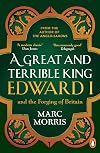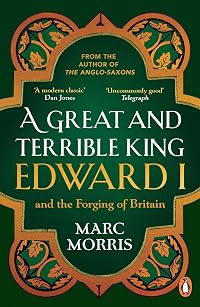
A Great and Terrible King: Edward I and the Forging of Britain
by Marc Morris
On This Page
Description
Edward I is familiar to millions as "Longshanks," conqueror of Scotland and nemesis of Sir William Wallace (in "Braveheart"). Yet that story forms only the final chapter of the king's action-packed life. Earlier, Edward had defeated and killed Simon de Montfort in battle; traveled to the Holy Land; conquered Wales, extinguishing its native rulers and constructing a magnificent chain of castles. He raised the greatest armies of the Middle Ages and summoned the largest parliaments; show more notoriously, he expelled all the Jews from his kingdom. The longest-lived of England's medieval kings, Edward fathered fifteen children with his first wife, Eleanor of Castile and, after her death, erected the Eleanor Crosses-the grandest funeral monuments ever fashioned for an English monarch. In this book, Marc Morris examines afresh the forces that drove Edward throughout his relentless career: his character, his Christian faith, and his sense of England's destiny-a sense shaped largely by the tales of the legendary King Arthur. Morris also explores the competing reasons that led Edward's opponents (including Robert Bruce) to resist him. The result is a sweeping story, immaculately researched yet compellingly told, and a vivid picture of medieval Britain at the moment when its future was decided. show lessTags
Recommendations








Member Reviews
I came close to setting this book aside at the start, as the opening tone was so jocular that it seemed inappropriate to the subject at hand. However, Morris firms up quickly, and launches on a step-by-step journey through Edward's life, as one follows the path to the man's great mistake; the attempt to impose a strong over-lordship on Scotland, in the wake of that nation's experience of dynastic collapse.
Early on though, through conflicts with his parents, the fight with the party of Simon de Montfort, the wars with the Welsh, and the conflicts Edward had with his own nominal overlord, the King of France, Morris is essentially tracing two key characteristics of Edward's personality. One, a strong sense of having to fight for his show more entitlements as King of England; particularly when it came to control of land and wealth. Two, Edward's feeling that there were "final solutions" available to his problems; though the latter tendency seems to have moderated for a bit in the man's prime, Edwards displaying a knack for diplomacy when it mattered.
Still, though Morris has to conclude that Edward was a man of his age, and that most of his acts likely would have been committed by any English king, particularly in regards to the expulsion and expropriation of the Jews, the grand play for Scotland was the start of nothing but trouble which led to Edward's long-term legacy of violence for the British Isles.
As for my other main thought having finished this biography, I particularly like the way Morris uses fiscal matters as a backbone for his narrative. Let's just say that Edward would have agreed with the modern quip that the answer to all your questions is money. show less
Early on though, through conflicts with his parents, the fight with the party of Simon de Montfort, the wars with the Welsh, and the conflicts Edward had with his own nominal overlord, the King of France, Morris is essentially tracing two key characteristics of Edward's personality. One, a strong sense of having to fight for his show more entitlements as King of England; particularly when it came to control of land and wealth. Two, Edward's feeling that there were "final solutions" available to his problems; though the latter tendency seems to have moderated for a bit in the man's prime, Edwards displaying a knack for diplomacy when it mattered.
Still, though Morris has to conclude that Edward was a man of his age, and that most of his acts likely would have been committed by any English king, particularly in regards to the expulsion and expropriation of the Jews, the grand play for Scotland was the start of nothing but trouble which led to Edward's long-term legacy of violence for the British Isles.
As for my other main thought having finished this biography, I particularly like the way Morris uses fiscal matters as a backbone for his narrative. Let's just say that Edward would have agreed with the modern quip that the answer to all your questions is money. show less
This is biography of Edward I of England is written by an academic but aimed at a general audience. There are no really new insights here—Morris is working from secondary sources, not from primary ones—but it's very readable and I think is quite accessible. Morris has a good eye for an engaging anecdote. That said, I don't think that Morris's mostly laudatory conclusion on Edward quite bears up in the light of the evidence presented in previous chapters. There are also places where I thought Morris' phrasing was not quite felicitous—there's a difference between saying that the medieval English thought their neighbours in Ireland and Wales were uncivilised, and saying that the medieval Irish and Welsh were uncivilised. I would show more accept the former but absolutely dispute the latter—difference is not the same as inferiority! show less
Being a biography of England's Edward I, yclept Longshanks. An effective king bracketed by two duds, Edward is one of the most important monarchs in English history. This is an interesting book, a model of how to write a medieval narrative history; the author is painstaking and his account may fairly be called definitive. He assumes very little prior knowledge, explains the background of the events thoroughly and he isn't afraid to deploy a touch of wit to leaven his account. That said, this is an extremely long book, as befits a life of a major monarch, and few will be sorry to reach the end.
Marc Morris’ work was been advertised as the first biography of Edward I in years, and in many ways it may have been a necessary one.
Edward I ‘Longshanks’ stands today as arguably one of the most notorious and despised Kings of Medieval England (perhaps in part with good reason), many people may know him only as the baddie in Braveheart. Some (as a result of the said movie) have seem even to regard him as a ‘pagan’ King.
Morris explores Edward’s life in its entirely to present a more well-rounded view of Edward the man, far removed from the diabolical movie baddie.
From his birth and early childhood, to his turbulent teenage years in which the England was in the grip of political upheaval, to his ascension and reign show more spanning thirty years, revealing Edward’s varying roles as warrior, crusader, ruler, lawmaker, friend, adversary, and faithful husband.
Perhaps most significantly, the author generally tries to avoid the pitfalls of judging the King by modern standards, though I did not feel that this prevented him from being critical upon occasion.
One reviewer said that this biography ‘bordered on hagiography’. I disagree, not everything Morris says about Edward was positive as far as I could see, and sometimes a rather unflattering picture of the King or Prince emerges.
This said, the author does shed light on some of the perhaps more controversial and unpalatable actions of Edward by the standards of the time, by which they might not have been considered so heinous.
For instance, the infamous massacre at Berwick upon Tweed, as terrible as it was, was consistent with the medieval laws of war regarding sieges. Also England’s relationship with Scotland, before Edward’s fateful decision in the 1290s is also examined, and perhaps surprisingly is revealed to have been positive.
Other aspects of the social background of the political and military events of Edward’s reign are also shed light upon, such as the common attitude towards the Welsh, or the challenges posed by the last King of Wales in ruling his own Kingdom, as well as Edward’s turbulent relationship with his nobles. Also there are other interesting details, such as the assassination attempt on Edward by none other than Sultan Baybars himself.
On a personal level, I found the chronological examination supported a belief I have long held- that Edward’s wife died, and he faced rebellion and war not long after expelling all the Jews from England, and so his ‘ill-fortune’ was a direct consequence of such. In the Jewish and Christian scriptures it says of the Jews that God would ‘bless those who bless you and curse those who curse you’ and it seems what happened to Edward was the latter.
Though towards the end I found the book became a little slower, bogged down perhaps with relating the King’s extortions of money from his nobles to fund his wars, and it may sometimes be a little too detailed, I believe it is still a fascinating and valuable work on the King.
I also wasn’t sure if I agreed with all the author’s conclusions made in the final chapter, especially regarding the King’s temper, but his overall summary of the characters and reign of Edward may be hard to undermine.
Hate him or view him more sympathetically, Edward was indeed A Great and Terrible King, admired by many of his contemporaries, missed when he died, and shaped by his times. show less
Edward I ‘Longshanks’ stands today as arguably one of the most notorious and despised Kings of Medieval England (perhaps in part with good reason), many people may know him only as the baddie in Braveheart. Some (as a result of the said movie) have seem even to regard him as a ‘pagan’ King.
Morris explores Edward’s life in its entirely to present a more well-rounded view of Edward the man, far removed from the diabolical movie baddie.
From his birth and early childhood, to his turbulent teenage years in which the England was in the grip of political upheaval, to his ascension and reign show more spanning thirty years, revealing Edward’s varying roles as warrior, crusader, ruler, lawmaker, friend, adversary, and faithful husband.
Perhaps most significantly, the author generally tries to avoid the pitfalls of judging the King by modern standards, though I did not feel that this prevented him from being critical upon occasion.
One reviewer said that this biography ‘bordered on hagiography’. I disagree, not everything Morris says about Edward was positive as far as I could see, and sometimes a rather unflattering picture of the King or Prince emerges.
This said, the author does shed light on some of the perhaps more controversial and unpalatable actions of Edward by the standards of the time, by which they might not have been considered so heinous.
For instance, the infamous massacre at Berwick upon Tweed, as terrible as it was, was consistent with the medieval laws of war regarding sieges. Also England’s relationship with Scotland, before Edward’s fateful decision in the 1290s is also examined, and perhaps surprisingly is revealed to have been positive.
Other aspects of the social background of the political and military events of Edward’s reign are also shed light upon, such as the common attitude towards the Welsh, or the challenges posed by the last King of Wales in ruling his own Kingdom, as well as Edward’s turbulent relationship with his nobles. Also there are other interesting details, such as the assassination attempt on Edward by none other than Sultan Baybars himself.
On a personal level, I found the chronological examination supported a belief I have long held- that Edward’s wife died, and he faced rebellion and war not long after expelling all the Jews from England, and so his ‘ill-fortune’ was a direct consequence of such. In the Jewish and Christian scriptures it says of the Jews that God would ‘bless those who bless you and curse those who curse you’ and it seems what happened to Edward was the latter.
Though towards the end I found the book became a little slower, bogged down perhaps with relating the King’s extortions of money from his nobles to fund his wars, and it may sometimes be a little too detailed, I believe it is still a fascinating and valuable work on the King.
I also wasn’t sure if I agreed with all the author’s conclusions made in the final chapter, especially regarding the King’s temper, but his overall summary of the characters and reign of Edward may be hard to undermine.
Hate him or view him more sympathetically, Edward was indeed A Great and Terrible King, admired by many of his contemporaries, missed when he died, and shaped by his times. show less
So this was a very intense book: marriages, deaths, wars, crusades, etc.
I personally really enjoyed it, but afterward, my brain was a little dead.
I actually hadn’t watched the movie “Braveheart” before reading this book, but when I did watch it afterward, I couldn’t bring myself to hate Edward I since this book really humanized him for me.
I personally really enjoyed it, but afterward, my brain was a little dead.
I actually hadn’t watched the movie “Braveheart” before reading this book, but when I did watch it afterward, I couldn’t bring myself to hate Edward I since this book really humanized him for me.
I read a lot of biographies, my theory being that history is best studied by looking at the people who make it. In this case, the subject is Edward I of England, nicknamed “Longshanks”.
I would venture to say that most people best know Edward I through his portrayal in the movie “Braveheart”. As the movie is told through the eyes of the Scottish freedom fighters, Edward is not treated charitably, though by earning the nickname, “Hammer of the Scots”, it is likely he would likely not have been terribly unhappy with his portrayal.
Edward I is a subject deserving of study, as his reign was long and eventful. Unfortunately, I found this treatment to be extremely dry and uninteresting. While it lays out the important facts and show more events, the narrative does not flow well and fails to engage the reader. I would think that a better biography of Edward would be available. show less
I would venture to say that most people best know Edward I through his portrayal in the movie “Braveheart”. As the movie is told through the eyes of the Scottish freedom fighters, Edward is not treated charitably, though by earning the nickname, “Hammer of the Scots”, it is likely he would likely not have been terribly unhappy with his portrayal.
Edward I is a subject deserving of study, as his reign was long and eventful. Unfortunately, I found this treatment to be extremely dry and uninteresting. While it lays out the important facts and show more events, the narrative does not flow well and fails to engage the reader. I would think that a better biography of Edward would be available. show less
A very readable, well researched and balanced account of this most significant of kingly lives and reigns. This took me longer to read than expected and I slowed down a bit during the interminable Welsh uprisings of the 1270s and early 80s. The author rightly does not judge Edward by modern standards, though some of his actions still shock, such as the execution of half the adult male Jewish population of England in 1279 for alleged counterfeiting.
Members
- Recently Added By
Published Reviews
ThingScore 75
Morris tells Edward's story fluently and conveys a compelling sense of the reality, and the contingency, of personal rule; but we rarely see the king in intimate close-up.
added by oszymandias
Lists

al.vick-wishlist-history
70 works; 2 members

historical biographies : great lives, well told
64 works; 4 members

Books Read in 2023
5,547 works; 145 members

Kindle Non-Fiction
221 works; 1 member

In Our Time books
4,934 works; 2 members
Author Information

9+ Works 3,089 Members
Marc Morris is a historian specializing in the Middle Ages. He is also the author of A Great and Terrible King, King John, and the Wall Street Journal and USA Today bestselling The Norman Conquest. Marc lives in England.
Awards and Honors
Notable Lists
Common Knowledge
- Original publication date
- 2008
- People/Characters
- Edward I, King of England; Henry III, King of England; Eleanor of Castile, Queen Consort of England; Alexander III, King of Scots; John Balliol, King of Scots; Roger Bigod, 2nd Earl of Norfolk (show all 27); Humphrey de Bohun, Earl of Hereford; Robert Bruce, King of Scots; Robert Burnell, Bishop of Bath & Wells; Gilbert de Clare, Earl of Gloucester; Dafydd ap Gruffudd; Edmund Crouchback, Earl of Lancaster; Edward the Confessor; Edward II, King of England; Eleanor of Provence (Queen Consort of Henry III of England); Otto de Grandson; Walter of Guisborough; Henry de Lacy, Earl of Lincoln; Llewelyn ap Gruffud; Louis IX, King of France; Simon de Montfort; Philip IV, King of France; Richard, Earl of Cornwall; William de Valence, Earl of Pembroke; William Wallace; John de Warenne, Earl of Surrey; Robert Winchelsey, Archbishop of Canterbury
- Important places
- Bordeaux, France; Carlisle, Cumbria, England, UK; Dover, Kent, England, UK; Jerusalem; Stirling, Scotland, UK; Westminster, London, England, UK (show all 7); Winchester, Hampshire, England, UK
- Important events
- Reign of Henry III, King of England (1216-10-19 | 1272-11-16); Second Barons' War (1264 | 1267); Reign of Edward I, King of England (1272-11-16 | 1307-07-07); Battle of Evesham; Battle of Lewes; Edward I's Crusade (show all 9); First Scottish War of Independence; Gascon War; Edict of Expulsion
- Epigraph
- Counties are not laid on in heaven, they are shaped and reshaped here on earth by the by the stratagems of men and the victories of the fortuitous.
R. R. Davies, The First English Empire (2000)
Like Alexander, he would speedily subdue the whole world, if Fortune's moving wheel would stand still forever.
The Song of Lewes, on Edward I (1264) - Dedication
- In memory of Rees Davies
- First words
- Preface
On learning that I was writing a book about Edward I, my non-historian friends and neighbours have asked me, almost invariably, the same two questions.
Classifications
- Genres
- History, Nonfiction, General Nonfiction, Biography & Memoir
- DDC/MDS
- 942.035092 — History & geography History of Europe England and Wales England Plantagenet 1154-1399 Edward I 1272-1307
- LCC
- DA229 .M67 — History of Europe, Asia, Africa and Oceania Great Britain History of Great Britain England History By period Early and medieval to 1485 1154-1485. Angevins. Plantagenets.
- BISAC
Statistics
- Members
- 849
- Popularity
- 32,256
- Reviews
- 12
- Rating
- (4.05)
- Languages
- English
- Media
- Paper, Audiobook, Ebook
- ISBNs
- 10
- ASINs
- 8