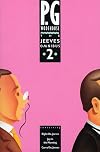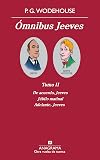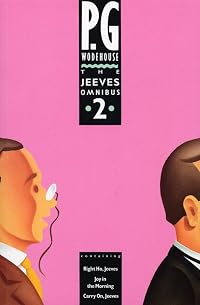
The Jeeves Omnibus: No. 2 (Carry On, Jeeves; Right Ho, Jeeves!; Jeeves in the Morning)
by P. G. Wodehouse
Jeeves (Collections and Selections — Omnibus 2, 5, 7)
On This Page
Description
Jeeves may not always see eye to eye with Bertie on ties and fancy waistcoats, but he can always be relied on to whisk his young master spotlessly out of the soup (even if, for tactical reasons, he did drop him in it in the first place). The paragon of Gentlemen's Personal Gentlemen shimmers through these fat pages in much the same way as he did through the first Jeeves Omnibus. This volume contains- Right Ho, Jeeves, Joy in the Morningand Carry On, Jeeves.Tags
Recommendations






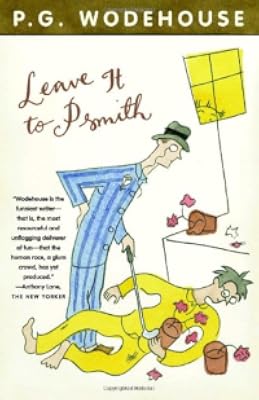










Member Reviews
Right Ho, Jeeves:
These are a lot of fun, but my reading of them has been, and will forever be, coloured by the 1980s TV series starring Stephen Fry as Jeeves and Hugh Laurie as Bertie Wooster. To Brits, it was perfect casting (Americans, knowing Laurie from House, may feel differently).
As I was reading Right Ho, Jeeves, I was sure I’d read it before, even though some of the details were new to me. It’s probably because it’s a plot Wodehouse used several times – I came across it first, I think, in The Code of the Woosters, which is actually a later novel. Friends of Wooster are engaged but then the engagement is broken for the slightest of reasons, and Wooster decides to intervene and reunite the two broken hearts. Chiefly show more because he might be forced to marry the girl. But often because the break-up might impact Wooster’s enjoyment of the meals prepared by Anatole, Aunt Dahlia’s much-feted cook. I mean, certainly Aunt Dahlia appears in The Code of the Woosters (which may be the third Jeeves & Wooster novel but appears in the first Jeeves Collection omnibus, for reasons best known to Penguin), and I definitely remember reading a Wooster novel in which he attempts to repair relationships between one or more couples…
None of which really matters, because these are comic novels and funny ones at that. Even if they’re set among the same people both Nancy Mitford and Evelyn Waugh satirised in their novels – she because she was part of that world, and he because he wanted to be part of that world. (Waugh was good, but Mitford was just as good and much less racist.)
Gussie Fink-Nottle is in love with Madeline Bassett but does not have the courage to tell her. He asks Jeeves for help, But Bertie steps in, offended that his butler’s advice would be preferred over his own. Bertie invites Gussie to Brinkley Court, to stay with his Aunt Dahlia, where Madeline is also a house-guest. He also volunteers Gussie to give the prizes at the local school, a task Aunt Dahlia had originally blackmailed Bertie into undertaking.
There are further problems. Aunt Dahlia spent all her money at the casinos in Cannes, and needs more cash to keep her ladies magazine afloat – but is afraid to ask her husband. Also, Aunt Dahlia’s daughter, Angela, is at Brinkley Court, with her betrothed, Tuppy. And then they decide to break their engagement.
When Bertie arrives at Brinkley Court, he has to: persuade Gussie to declare his undying love to Madeline, fix Angela and Tuppy’s relationship, figure out a way for Aunt Dahlia to get cash out of her husband, and prevent all the upsets from prompting chef Anatole from resigning, which he does several times. Of course, everything Bertie does only makes the situation worse… but Jeeves is there to subtly direct things to the proper conclusions.
I think the reason these books work is because even though Bertie is a dimwit, and Jeeves is supercilious, Wodehouse treats them both with the same level of affection. If anything, their personalities are treated as scaffolding for the story, much as the settings and situations are. It’s a form of humour that can easily turn cruel, but in Wodehouse’s hands it never does.
There are five Jeeves omnibuses. All five were on offer for 99p on Kindle during 2025, so I have them. I’m looking forward to reading them.
Joy in the Morning
Wodehouse’s first novel was published in 1902, and I had always thought his Jeeves and Wooster stories and novels were published in the decade in which they were set, the 1920s. In fact, he continued writing Jeeves and Wooster novels right up until his death in 1975, although all were set during Edwardian times. As Wodehouse himself explains, Edwardian England was one of the few periods when a character like Bertie Wooster could exist, or indeed an entire community or subculture like him, second sons living on the largesse of their families. In later decades, they would have been forced to find work to fund their lifestyles, but in the 1920s their families were still unencumbered enough to fund them.
Joy in the Morning was written in 1946, two decades later, just after the Second World War, while Wodehouse was in Germany after being released from internment by the Nazis. He then moved to the US and never returned to the UK. Its story, however, follows pretty much the same plot as other Jeeves and Wooster novels. Jeeves, or occasionally Wooster, is asked to help a friend in a matter, romantic or business, and somewhere involved in this is either one or two romantic couples. Who promptly split up. And Wooster ends up, against his wishes, affianced to one of the women involved.
In Joy in the Morning, Wooster is asked to help his uncle arrange a secret meeting with an American shipping magnate called J Chichester Clam (the names in these books are excellent). Meanwhile, Wooster also has to help his friend Boko Fittleworth persuade the same uncle he is a fit husband, despite being a successful writer, for Nobby Hopwood, the ward of the uncle, and against whom the uncle is set after several botched meetings. Wooster further manages to break up the engagement of Florence Craye, the uncle’s daughter, and Stilton Cheeseworth, an old schoolfriend of Wooster’s, who is both large and somewhat dim, and has chosen to join the police rather than become a MP (although, to be fair, both qualities are useful in either career). Florence, who was once affianced to Wooster, promptly re-institutes their old engagement.
The usual hijinks ensue. There’s also a young boy, the uncle’s son, whose efforts to perform good deeds generally result in hurt and chaos – such as accidentally burning down the cottage where Wooster was intending to stay.
Given Wodehouse had by this point been writing these stories and novels for three decades, it comes as no surprise the plot ticks along like well-engineered clockwork, every remark and incident falling inexorably into place to keep plot momentum at a steady pace. Unlike other Jeeves and Wooster novels I’ve read, it’s the two of them who resolve the various situations, rather than Wooster worsening matters and Jeeves resolving it all. In fact, at several points Jeeves declares himself unable to think of a solution (although on one occasion this is a deliberate ploy). Good stuff.
Carry On, Jeeves
This collection is the third book in the second volume of the Jeeves Omnibuses, and contains stories published between 1916 and 1925. Some of the plots were later used in novels. I say “plots”, but there’s pretty much just the one Wodehouse uses.
Interestingly, the opening story, ‘Jeeves Takes Charge’, describes Bertie hiring Jeeves. Around half of the stories take place in New York. They all follow the usual pattern: a friend approaches Bertie, or sometimes Jeeves directly, for help with a small problem, usually involving a fiancée or a relative, it all goes horribly wrong, but Jeeves has not only foreseen this, he has carefully engineered events to produce the desired ending. It’s all very clever, but it does wear a bit thin over the course of ten stories. There are some characters familiar from other stories, or novels, some here introduced for the first time.
The stories were mostly originally published in Strand in the UK and the Saturday Evening Post in the US. Some of the contents are rewritten versions of stories that appeared in an earlier collection, My Man Jeeves, from 1919. So it’s not just plots Wodehouse re-uses, sometimes it’s the stories themselves. Still, they are amusing, and Wodehouse can throw a neat turn of phrase, even if it gets a little formulaic in places. The names here are not as absurd as in later stories, although I expect they would still seem absurd to any reader who is not, well, English. I should probably rephrase that: it’s not that the names do not seem absurd to English readers, they do; it’s just that they also seem entirely plausible for the upper classes.
Wodehouse’s depiction of the upper classes endures for the English. He’s not the only chronicler of the aristocracy’s inbred idiosyncrasies and depredations, and his stories only really hold true for a relatively short period in recent UK history; but then all the stories written about the English aristocracy only really hold true for the time during which the stories take place. In the twenty-first century, they’re an anachronism. Like, well, royalty. show less
These are a lot of fun, but my reading of them has been, and will forever be, coloured by the 1980s TV series starring Stephen Fry as Jeeves and Hugh Laurie as Bertie Wooster. To Brits, it was perfect casting (Americans, knowing Laurie from House, may feel differently).
As I was reading Right Ho, Jeeves, I was sure I’d read it before, even though some of the details were new to me. It’s probably because it’s a plot Wodehouse used several times – I came across it first, I think, in The Code of the Woosters, which is actually a later novel. Friends of Wooster are engaged but then the engagement is broken for the slightest of reasons, and Wooster decides to intervene and reunite the two broken hearts. Chiefly show more because he might be forced to marry the girl. But often because the break-up might impact Wooster’s enjoyment of the meals prepared by Anatole, Aunt Dahlia’s much-feted cook. I mean, certainly Aunt Dahlia appears in The Code of the Woosters (which may be the third Jeeves & Wooster novel but appears in the first Jeeves Collection omnibus, for reasons best known to Penguin), and I definitely remember reading a Wooster novel in which he attempts to repair relationships between one or more couples…
None of which really matters, because these are comic novels and funny ones at that. Even if they’re set among the same people both Nancy Mitford and Evelyn Waugh satirised in their novels – she because she was part of that world, and he because he wanted to be part of that world. (Waugh was good, but Mitford was just as good and much less racist.)
Gussie Fink-Nottle is in love with Madeline Bassett but does not have the courage to tell her. He asks Jeeves for help, But Bertie steps in, offended that his butler’s advice would be preferred over his own. Bertie invites Gussie to Brinkley Court, to stay with his Aunt Dahlia, where Madeline is also a house-guest. He also volunteers Gussie to give the prizes at the local school, a task Aunt Dahlia had originally blackmailed Bertie into undertaking.
There are further problems. Aunt Dahlia spent all her money at the casinos in Cannes, and needs more cash to keep her ladies magazine afloat – but is afraid to ask her husband. Also, Aunt Dahlia’s daughter, Angela, is at Brinkley Court, with her betrothed, Tuppy. And then they decide to break their engagement.
When Bertie arrives at Brinkley Court, he has to: persuade Gussie to declare his undying love to Madeline, fix Angela and Tuppy’s relationship, figure out a way for Aunt Dahlia to get cash out of her husband, and prevent all the upsets from prompting chef Anatole from resigning, which he does several times. Of course, everything Bertie does only makes the situation worse… but Jeeves is there to subtly direct things to the proper conclusions.
I think the reason these books work is because even though Bertie is a dimwit, and Jeeves is supercilious, Wodehouse treats them both with the same level of affection. If anything, their personalities are treated as scaffolding for the story, much as the settings and situations are. It’s a form of humour that can easily turn cruel, but in Wodehouse’s hands it never does.
There are five Jeeves omnibuses. All five were on offer for 99p on Kindle during 2025, so I have them. I’m looking forward to reading them.
Joy in the Morning
Wodehouse’s first novel was published in 1902, and I had always thought his Jeeves and Wooster stories and novels were published in the decade in which they were set, the 1920s. In fact, he continued writing Jeeves and Wooster novels right up until his death in 1975, although all were set during Edwardian times. As Wodehouse himself explains, Edwardian England was one of the few periods when a character like Bertie Wooster could exist, or indeed an entire community or subculture like him, second sons living on the largesse of their families. In later decades, they would have been forced to find work to fund their lifestyles, but in the 1920s their families were still unencumbered enough to fund them.
Joy in the Morning was written in 1946, two decades later, just after the Second World War, while Wodehouse was in Germany after being released from internment by the Nazis. He then moved to the US and never returned to the UK. Its story, however, follows pretty much the same plot as other Jeeves and Wooster novels. Jeeves, or occasionally Wooster, is asked to help a friend in a matter, romantic or business, and somewhere involved in this is either one or two romantic couples. Who promptly split up. And Wooster ends up, against his wishes, affianced to one of the women involved.
In Joy in the Morning, Wooster is asked to help his uncle arrange a secret meeting with an American shipping magnate called J Chichester Clam (the names in these books are excellent). Meanwhile, Wooster also has to help his friend Boko Fittleworth persuade the same uncle he is a fit husband, despite being a successful writer, for Nobby Hopwood, the ward of the uncle, and against whom the uncle is set after several botched meetings. Wooster further manages to break up the engagement of Florence Craye, the uncle’s daughter, and Stilton Cheeseworth, an old schoolfriend of Wooster’s, who is both large and somewhat dim, and has chosen to join the police rather than become a MP (although, to be fair, both qualities are useful in either career). Florence, who was once affianced to Wooster, promptly re-institutes their old engagement.
The usual hijinks ensue. There’s also a young boy, the uncle’s son, whose efforts to perform good deeds generally result in hurt and chaos – such as accidentally burning down the cottage where Wooster was intending to stay.
Given Wodehouse had by this point been writing these stories and novels for three decades, it comes as no surprise the plot ticks along like well-engineered clockwork, every remark and incident falling inexorably into place to keep plot momentum at a steady pace. Unlike other Jeeves and Wooster novels I’ve read, it’s the two of them who resolve the various situations, rather than Wooster worsening matters and Jeeves resolving it all. In fact, at several points Jeeves declares himself unable to think of a solution (although on one occasion this is a deliberate ploy). Good stuff.
Carry On, Jeeves
This collection is the third book in the second volume of the Jeeves Omnibuses, and contains stories published between 1916 and 1925. Some of the plots were later used in novels. I say “plots”, but there’s pretty much just the one Wodehouse uses.
Interestingly, the opening story, ‘Jeeves Takes Charge’, describes Bertie hiring Jeeves. Around half of the stories take place in New York. They all follow the usual pattern: a friend approaches Bertie, or sometimes Jeeves directly, for help with a small problem, usually involving a fiancée or a relative, it all goes horribly wrong, but Jeeves has not only foreseen this, he has carefully engineered events to produce the desired ending. It’s all very clever, but it does wear a bit thin over the course of ten stories. There are some characters familiar from other stories, or novels, some here introduced for the first time.
The stories were mostly originally published in Strand in the UK and the Saturday Evening Post in the US. Some of the contents are rewritten versions of stories that appeared in an earlier collection, My Man Jeeves, from 1919. So it’s not just plots Wodehouse re-uses, sometimes it’s the stories themselves. Still, they are amusing, and Wodehouse can throw a neat turn of phrase, even if it gets a little formulaic in places. The names here are not as absurd as in later stories, although I expect they would still seem absurd to any reader who is not, well, English. I should probably rephrase that: it’s not that the names do not seem absurd to English readers, they do; it’s just that they also seem entirely plausible for the upper classes.
Wodehouse’s depiction of the upper classes endures for the English. He’s not the only chronicler of the aristocracy’s inbred idiosyncrasies and depredations, and his stories only really hold true for a relatively short period in recent UK history; but then all the stories written about the English aristocracy only really hold true for the time during which the stories take place. In the twenty-first century, they’re an anachronism. Like, well, royalty. show less
The three books in this omnibus are: ‘Right Ho, Jeeves’, ‘Joy in the Morning’, and ‘Carry On, Jeeves’.
The first of these takes place at Bertie Wooster’s Aunt Dahlia’s country home. As ever there are complex relationships and quite a few people. Bertie determines to sort out his friends and their romantic entanglements, only to make things worse before his valet Jeeves, as ever, solves the problems.
‘Joy in the Morning’ mostly takes place in Steeple Bumpleigh, where Bertie’s least favourite aunt Agatha lives. This daunting lady doesn’t come into the story, but her second husband Percy does, as does his ward, whose nickname is Nobby. To add a bit of variety, Bertie is also plagued by the young teenager Edwin, who show more is in the Boy Scouts and determined to do ‘acts of kindness’ every day, whether or not the recipient wants him to…
All familiar stuff to those brought up on these stories, though perhaps bewildering to anyone unfamiliar with them. The humour is dry; I love it, but it won't appeal to everyone.
The final book of the three, ‘Carry On, Jeeves’, is a collection of short stories. Many describe incidents which were referred to in passing in one of the others. We discover, for instance, how Bertie was persuaded to give a speech (of sorts) at a girls’ school, how his Aunt Dahlia acquired the gifted cook Anatole, and how Bertie came to write an article for his aunt’s magazine.
I wondered if I would get a bit tired of the Wodehouse style reading three books in a row, but it didn’t happen at all. They make excellent bedtime reading, taking me back to a society that no longer exists. The plots are clever, if tending towards the ridiculous, and the dialogue between Jeeves and Wooster very enjoyable.
Highly recommended to anyone who likes this kind of satire. show less
The first of these takes place at Bertie Wooster’s Aunt Dahlia’s country home. As ever there are complex relationships and quite a few people. Bertie determines to sort out his friends and their romantic entanglements, only to make things worse before his valet Jeeves, as ever, solves the problems.
‘Joy in the Morning’ mostly takes place in Steeple Bumpleigh, where Bertie’s least favourite aunt Agatha lives. This daunting lady doesn’t come into the story, but her second husband Percy does, as does his ward, whose nickname is Nobby. To add a bit of variety, Bertie is also plagued by the young teenager Edwin, who show more is in the Boy Scouts and determined to do ‘acts of kindness’ every day, whether or not the recipient wants him to…
All familiar stuff to those brought up on these stories, though perhaps bewildering to anyone unfamiliar with them. The humour is dry; I love it, but it won't appeal to everyone.
The final book of the three, ‘Carry On, Jeeves’, is a collection of short stories. Many describe incidents which were referred to in passing in one of the others. We discover, for instance, how Bertie was persuaded to give a speech (of sorts) at a girls’ school, how his Aunt Dahlia acquired the gifted cook Anatole, and how Bertie came to write an article for his aunt’s magazine.
I wondered if I would get a bit tired of the Wodehouse style reading three books in a row, but it didn’t happen at all. They make excellent bedtime reading, taking me back to a society that no longer exists. The plots are clever, if tending towards the ridiculous, and the dialogue between Jeeves and Wooster very enjoyable.
Highly recommended to anyone who likes this kind of satire. show less
The Jeeves "Omnibus" editions are unusual in that the publishers chose not to include the books in the 'right' order. It's not essential, but certainly adds to the humour to read them consecutively!
Nevertheless, this is a bumper collection with two of the most satisfying novels - Right Ho, Jeeves and Joy in the Morning - along with the amusing-enough short story collection Carry On, Jeeves.
Nevertheless, this is a bumper collection with two of the most satisfying novels - Right Ho, Jeeves and Joy in the Morning - along with the amusing-enough short story collection Carry On, Jeeves.
Ratings
Members
- Recently Added By
Author Information

656+ Works 110,558 Members
P. G. Wodehouse was born in Guildford, United Kingdom on October 15, 1881. After completing school, he spent two years as a banker at the Hong Kong and Shanghai Bank in London and then took a job as a sports reporter and columnist for the Globe newspaper. His first novel, The Pothunters, was published in 1902. He wrote over 100 novels and short show more story collections during his lifetime including A Perfect Uncle, Love Among the Chickens, The Swoop, P. Smith in the City, Meet Mr. Milliner, Doctor Sally, Quick Service, The Old Reliable, Uneasy Money, A Damsel in Distress, Jill the Reckless, The Adventures of Sally, A Pelican at Blandings, The Girl in Blue, and Aunts Aren't Gentlemen. His most famous characters, Bertie Wooster and his manservant, Jeeves, appeared in books such as Much Obliged, Jeeves. He also wrote lyrics for musical comedies and worked as screenwriter in Hollywood in the 1930s. In 1939, he bought a villa in Le Touquet on the coast of France. He remained there when World War II started in 1939. The following year, the Germans appropriated the villa, confiscated property, and arrested him. He was detained in various German camps for almost one year before being released in 1941. He went to Berlin and spoke of his experience in five radio talks to be broadcast to America and England. The talks themselves were completely innocuous, but he was charged with treason in England. He was cleared, but settled permanently in the United States. He became a citizen in 1955. He was made a Knight Commander of the Order of the British Empire in 1975. He died from a heart attack after a long illness on February 14, 1975 at the age of 93. (Bowker Author Biography) show less
Series

Work Relationships
Common Knowledge
- Canonical title
- The Jeeves Omnibus: No. 2 (Carry On, Jeeves; Right Ho, Jeeves!; Jeeves in the Morning) (Carry On, Jeeves | Right Ho, Jeeves! | Jeeves in the Morning)
- Original title
- The Jeeves Omnibus: No. 2: Carry On, Jeeves; Right Ho, Jeeves!; Jeeves in the Morning
Classifications
Statistics
- Members
- 312
- Popularity
- 102,084
- Reviews
- 3
- Rating
- (4.35)
- Languages
- English, Spanish
- Media
- Paper, Ebook
- ISBNs
- 4
- ASINs
- 3