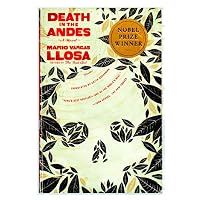
Death in the Andes
by Mario Vargas Llosa
On This Page
Description
Plunge into the heart of the remote Peruvian Andes in Mario Vargas Llosa's stunning novel, Death in the Andes. This narrative weaves an intricate tapestry of stark political realities, age-old Andean mysticism, and a chilling mystery that leaves no stone unturned. The book promises a riveting blend of genres, serving as both a political allegory and a gripping detective novel. It shimmers with an undercurrent of magical realism, embroiling readers in the nooks and corners of an isolated show more community caught in the web of violent guerrilla warfare. Immerse yourself in the ancient Dionysian rituals of Greece mirrored in unsettling, cannibalistic sacrifices, unveiling profound connections to Peru's Indian heritage and pre-Hispanic mysticism. The narrative's panoramic view of Peruvian society illuminates its violent present, deeply entrenched in its rich yet haunting past. A breathtaking exploration of South American literature from Nobel Prize-winning author Vargas Llosa, Death in the Andes is a resounding tribute to Latin American literature and an unforgettable journey into the pulsating heart of Peru. show lessTags
Recommendations



























Member Reviews
High up in the Andes, in and around the little village of Naccos, traditional life has been disrupted in many ways. Workers from outside the region are building a highway. A strange bartender and his mysterious wife ply the workers with drink. The Shining Path revolutionaries are running rampant, killing and inducing others to kill. The government, when it can find them, is responding in kind. Many villagers in the region have simply slipped away. Into this mix come Lituma, a corporal of the Civil Guard (a lowly rank in a lowly force), and his deputy, Carreno, who is pining away for the love a of a beautiful prostitute whom he "rescued" from a drug lord.
Moving back and forth in time and from character to character, in typical Vargas show more Llosa style, as Lituma becomes obsessed with the disappearance of three men, the novel essentially investigates the clash of civilizations: between people from the coast, like Lituma, and the serrenos from the mountains; between people with some "education," again like Lituma, and those who believe in the spirits of the mountains; between the Shining Path and ordinary people; between the innocence and naivete of Carreno and the worldliness of Lituma; and, above all, between those spirits of the mountains, some of them quite terrifying (for example, the pishtacos, who drain people of their fat), and the people who disrupt them.
This is not my favorite of Vargas Llosa's work, but it is still haunting me now that I've finished it. show less
Moving back and forth in time and from character to character, in typical Vargas show more Llosa style, as Lituma becomes obsessed with the disappearance of three men, the novel essentially investigates the clash of civilizations: between people from the coast, like Lituma, and the serrenos from the mountains; between people with some "education," again like Lituma, and those who believe in the spirits of the mountains; between the Shining Path and ordinary people; between the innocence and naivete of Carreno and the worldliness of Lituma; and, above all, between those spirits of the mountains, some of them quite terrifying (for example, the pishtacos, who drain people of their fat), and the people who disrupt them.
This is not my favorite of Vargas Llosa's work, but it is still haunting me now that I've finished it. show less
The old mingles with the new in Garcia Llorca’s Peru. Human sacrifices and spirits of the mountains, road building, terrucos – uncompromising, ruthless and cruel freedom fighters coming out of nowhere and conducting their cruel people trials, and superstitious mountain people (serruchos) are the backdrop for the plot and its main characters. Captain Lituma and his adjutant Tomasito, people from the new, more modern world, are posted in a remote mountain village to guard the road building against the terrucos. The terrucos don’t attack them, yet three people go missing without a trace. Captain Lituma is obsessively trying to piece what happened to them. At the same time his adjutant, Tomasito, can’t stop thinking about Mercedes, show more a prostitute he has fallen in love with and for whom he is longing. Tradition and superstition, death, love and obsession interweave and drive the plot in this tale.
It was very well written, and I loved the style and the sinister charm of this strange world. show less
It was very well written, and I loved the style and the sinister charm of this strange world. show less
An interesting novel; Heart of Darkness without the boat trip, and even the illuminations of hope are thin. Corporal Lituma and Private Carreno of the Peruvian Civil Guard (a thoroughly disliked and discredited body) are stationed, and basically forgotten, in the very small highway-construction village of Naccos, high in the mountains. Both men are obsessed: Lituma with the unexplained disappearance of three men from the village when he is convinced that people know what happened to them; Carreno by his uncritical love of a prostitute he befriended (by killing a drug lord who he thought was abusing her), but who ditched him once the situation was sorted-out. The men spend many nights in their grubby, tiny police station reliving in some show more detail Carreno’s time with Mercedes, Lituma wanting all the salacious details because this as close to sex as he is going to get in Naccos. The mountains, and the mountain society and attitudes form the context of the novel, and it is unremittingly dark. The mountains are teeming with spirits, most of whom seem to be evil: apus, which are the mountain spirits; pishtacos, which suck the fat out of living people until they shrivel up and die; and mukis, which do I’m not sure what. Add to this the terrucos, terrorists, guerillas who live in the mountains, strike at small villages and travelers, kill (by stoning) without compassion or remorse or any human empathy those, however innocent, they consider representatives of the “bourgeois, capitalist, imperialist” world (so much pain, so much human degradation and waste of life wrapped up in those three hollow mantras mouthed by people, as one protagonist puts it, “from another planet”). The mountains are beautiful, but even there, death and destruction is ever present in the form of huayco, landslides that wipe out villages and valleys; one destroys all the road work and seals the fate of Naccos.
Lituma, trying to figure out what happened to the three men who disappeared, mistakes the veneer of civilization for the real thing: “How was it possible that the laborers, many of whom had adopted modern ways and at least completed primary school, who had seen the cities, listened to the radio, went to the movies, dressed like civilized men----how could they behave like naked, savage cannibals? You could understand if they were Indians from the barrens who had never set foot in a school and still lived like their great-great-grandfathers, but with guys like these who played cards, who had been baptized: how could it be?” For Llosa, that veneer of civilization is thin, rootless, whether exemplified by the superstitious, xenophobic, murderous laborers, or the equally blind and stupid guerrillas with their own devils, their own superstitions dressed up political theory, their own xenophobia and destruction.
Lituma is a ray of hope because he is, completely against type, an honest policeman trying to do his job in a forgotten hole of the world, but it is a faint ray against crime, corruption, drug lords in the “real” world, never mind the world of Naccos and the Andes. Carreno is an innocent, an innocence founded on unquestioning, uncritical, uncomplaining love, found in the most unlikely of circumstances, and which sustains, and ultimately rewards him. But this is a personal triumph that will have to struggle against the reality of society. Maybe that’s what Llosa is saying: nourish integrity and love at the personal level while the rest of the world goes crazy. show less
Lituma, trying to figure out what happened to the three men who disappeared, mistakes the veneer of civilization for the real thing: “How was it possible that the laborers, many of whom had adopted modern ways and at least completed primary school, who had seen the cities, listened to the radio, went to the movies, dressed like civilized men----how could they behave like naked, savage cannibals? You could understand if they were Indians from the barrens who had never set foot in a school and still lived like their great-great-grandfathers, but with guys like these who played cards, who had been baptized: how could it be?” For Llosa, that veneer of civilization is thin, rootless, whether exemplified by the superstitious, xenophobic, murderous laborers, or the equally blind and stupid guerrillas with their own devils, their own superstitions dressed up political theory, their own xenophobia and destruction.
Lituma is a ray of hope because he is, completely against type, an honest policeman trying to do his job in a forgotten hole of the world, but it is a faint ray against crime, corruption, drug lords in the “real” world, never mind the world of Naccos and the Andes. Carreno is an innocent, an innocence founded on unquestioning, uncritical, uncomplaining love, found in the most unlikely of circumstances, and which sustains, and ultimately rewards him. But this is a personal triumph that will have to struggle against the reality of society. Maybe that’s what Llosa is saying: nourish integrity and love at the personal level while the rest of the world goes crazy. show less
“as everybody in the Andes knows, when the devil comes to work his evil on earth he sometimes takes the shape of a limping gringo stranger."
This is my first experience of the author and even on completion I am somewhat non-nonplussed by his methodology.The book is split into two distinct parts with an epilogue and as the title suggests is set in the mountains of Peru. However, the main protagonist of this novel is an outsider, a man from the coast, Corporal Lituma. Lituma is a police officer who along with his adjutant Carreno has been sent to offer token protection from guerilla attacks at a road construction camp in the remote mountain village of Naccos.
Three men mysteriously vanish from the camp and whilst Lituma becomes obsessed show more by the disappearances this is much more than a murder mystery tale. Intertwined throughout is Carreno's reminiscences of the murder that he had committed whilst supposedly acting as a bodyguard and the subsequent naive love affair he had with a prostitute alongside tales of the guerillas (Senderistas) and their victims. The Senderistas are portrayed as being both brutal and dogmatic but the author deliberately avoids giving them little more than a peripheral role in both this novel and perhaps in Peru in general, in contrast their victims are given greater prominance. However, their inclusion alongside Correno's ill fated love affair seems aimed purely at distracting both Lituma's and the reader's attention from the on-going case. This idea is further enforced when despite it transpiring that all three missing men had previous encounters with the guerrillas, not to mention Lituma's and Correno's own precarious situation, they virtually disappear from the second half of the novel. Instead this half centres on yet another sub-plot, one that is equally dark and violent but one far more far more difficult to fathom.
Lituma suspects that Dionisio and his wife Dona Adriana, the keepers of the local cantina, have some involvement with the disappearances. Both are degenerates. Dionisio encourages the workers to drink and dance with himself and one another when drunk whereas Adriana reads fortunes and is viewed as a witch. They are knowledgeable of local folk lore which includes pishtacos, vampires who leach the fat from their victims' bodies, and apus, ancient spirits of the mountains, who were placated by Indian women with human sacrifices before undertaking any new project, eg a road. Lituma finally discovers that the three missing men were not victims of the guerillas but rather of a sadistic ritual.
The author intimates that human blood was as important as mortar as a building material back within mountain communities. A Scandinavian anthropologist informs Lituma how ''Aztec priests stood at the top of the pyramids and tore out the hearts of the victims'' and suggests that the serruchos, local villagers' Christianity, with its very own human sacrifice, is secretly enmeshed with the cults of their ancestors. Equally the Senderista purges are necessary tools as they attempt to build a new society of their own design. Llosa seems to intimate this as an unholy trinity and that many Andean communities haven't really advanced that much at all.
There are some beautifully written vignettes but they are often difficult to mesh together and the murder mystery element ultimately seems strangely peripheral to the novel. Instead it can be viewed as a vehicle to remind Lituma and educate the reader on Peru's bloody past. Personally I feel that the author would have been better advised to concentrate on one of these mountain myths rather than trying to incorporate so many. I generally enjoyed the author's writing style but sadly felt that the plot was often muddled. This has rather intrigued rather than deterred me from reading some of the author's other works but overall OK rather than great. show less
This is my first experience of the author and even on completion I am somewhat non-nonplussed by his methodology.The book is split into two distinct parts with an epilogue and as the title suggests is set in the mountains of Peru. However, the main protagonist of this novel is an outsider, a man from the coast, Corporal Lituma. Lituma is a police officer who along with his adjutant Carreno has been sent to offer token protection from guerilla attacks at a road construction camp in the remote mountain village of Naccos.
Three men mysteriously vanish from the camp and whilst Lituma becomes obsessed show more by the disappearances this is much more than a murder mystery tale. Intertwined throughout is Carreno's reminiscences of the murder that he had committed whilst supposedly acting as a bodyguard and the subsequent naive love affair he had with a prostitute alongside tales of the guerillas (Senderistas) and their victims. The Senderistas are portrayed as being both brutal and dogmatic but the author deliberately avoids giving them little more than a peripheral role in both this novel and perhaps in Peru in general, in contrast their victims are given greater prominance. However, their inclusion alongside Correno's ill fated love affair seems aimed purely at distracting both Lituma's and the reader's attention from the on-going case. This idea is further enforced when despite it transpiring that all three missing men had previous encounters with the guerrillas, not to mention Lituma's and Correno's own precarious situation, they virtually disappear from the second half of the novel. Instead this half centres on yet another sub-plot, one that is equally dark and violent but one far more far more difficult to fathom.
Lituma suspects that Dionisio and his wife Dona Adriana, the keepers of the local cantina, have some involvement with the disappearances. Both are degenerates. Dionisio encourages the workers to drink and dance with himself and one another when drunk whereas Adriana reads fortunes and is viewed as a witch. They are knowledgeable of local folk lore which includes pishtacos, vampires who leach the fat from their victims' bodies, and apus, ancient spirits of the mountains, who were placated by Indian women with human sacrifices before undertaking any new project, eg a road. Lituma finally discovers that the three missing men were not victims of the guerillas but rather of a sadistic ritual.
The author intimates that human blood was as important as mortar as a building material back within mountain communities. A Scandinavian anthropologist informs Lituma how ''Aztec priests stood at the top of the pyramids and tore out the hearts of the victims'' and suggests that the serruchos, local villagers' Christianity, with its very own human sacrifice, is secretly enmeshed with the cults of their ancestors. Equally the Senderista purges are necessary tools as they attempt to build a new society of their own design. Llosa seems to intimate this as an unholy trinity and that many Andean communities haven't really advanced that much at all.
There are some beautifully written vignettes but they are often difficult to mesh together and the murder mystery element ultimately seems strangely peripheral to the novel. Instead it can be viewed as a vehicle to remind Lituma and educate the reader on Peru's bloody past. Personally I feel that the author would have been better advised to concentrate on one of these mountain myths rather than trying to incorporate so many. I generally enjoyed the author's writing style but sadly felt that the plot was often muddled. This has rather intrigued rather than deterred me from reading some of the author's other works but overall OK rather than great. show less
Corporal Lituma and Guard Tomás Carreño have been stuck in a post high in the Andes in the village of Naccos, where a road is being built. Three men from the camp has disappeared, including a mute Tomás brought with him when he reported to the post. At first Lituma fears the terruchos, a terrorist guerrillas of the Sendero Luminosa (Shining Path), a Marxist style rebel group that has been operating in the area, brutally killing “enemies of the people”. But no one in the camp wants to talk about what happened. There are two ambiguous camp members, Dionisio, a cantinero (cantina owner) and his wife, Doña Adriana--and that should be a tipoff as to what direction a good part of the story will take.
But there are several stories woven show more into one. Tomás, at night, tells the story of his love for Mercedes, a prostitute he “saved” from a drug lord. The narrative is so interwoven, past with present, that the reader is right there with Lituma’s and Carreño’s present comments while the story is told in flashback style. This device works brilliantly, not only for the love story but later on, as the main story--what really did happen to the three men--takes an ominous turn, and the story of Doña Adriana and Dionisio unfolds.
Over all this hovers the ancient spirits of the Peruvian Andes, the apus in Qechuan, who are not terribly pleasant deities, and only gradually do we learn to understand their role in life. Pishtacos--a sort of Peruvian vampire somewhat akin to Tony Hellerman’s Navajo ghost walkers--appear. Lituma oscillates wildly between modern cynicism and complete belief in these ancient Andean beliefs.
Based on real events--the years of the Sendero Luminosa rebellion--this beautifully written story relates a clash between indigenous folk culture and attempts to modernize an area that has resisted outsiders for a thousand years. It is a disturbing tale.
Highly recommended. show less
But there are several stories woven show more into one. Tomás, at night, tells the story of his love for Mercedes, a prostitute he “saved” from a drug lord. The narrative is so interwoven, past with present, that the reader is right there with Lituma’s and Carreño’s present comments while the story is told in flashback style. This device works brilliantly, not only for the love story but later on, as the main story--what really did happen to the three men--takes an ominous turn, and the story of Doña Adriana and Dionisio unfolds.
Over all this hovers the ancient spirits of the Peruvian Andes, the apus in Qechuan, who are not terribly pleasant deities, and only gradually do we learn to understand their role in life. Pishtacos--a sort of Peruvian vampire somewhat akin to Tony Hellerman’s Navajo ghost walkers--appear. Lituma oscillates wildly between modern cynicism and complete belief in these ancient Andean beliefs.
Based on real events--the years of the Sendero Luminosa rebellion--this beautifully written story relates a clash between indigenous folk culture and attempts to modernize an area that has resisted outsiders for a thousand years. It is a disturbing tale.
Highly recommended. show less
Naccos is a remote Andean town within the Ayacucho Region of Peru, which is populated by miners and construction workers from other regions along with serruchos, local Indians who maintain ancient tribal customs and beliefs. Life there is hard and often brutal, due to the lack of female companionship for the mostly single men, the difficult working conditions, the climate that fluctuates rapidly between bitter cold and intolerable heat, and the fear of huaycos, landslides from the surrounding mountains that threaten to bury houses and disrupt the road project.
The towns in the region are also menaced by Maoist guerrillas of the Shining Path movement, who live in the mountains and strike without warning, ambushing vehicles on the roads show more and marching into villages, as they isolate those whom they oppose and dispense justice in a most brutal fashion.
Corporal Lituma from the Peruvian Army, assigned to the region to protect the workers during the construction project, is informed of the murder of three villagers. His is accompanied by and lives with Tomás Carreño, a local young man who escaped from the Civil Guard after committing a crime of passion, who keeps Lituma entertained and on edge by telling him the story of this crime and the woman who inspired him.
As Lituma investigates the disappearances, we learn more about the missing men, the clash of cultures between the workers, serruchos, and Lituma, who comes from a modern coastal city, and the violent beauty of the region. Tensions build as Lituma and Carreño suspect that the guerrillas killed the men and will make them their next victims.
Death in the Andes is a solid work of fiction, filled with passion, intrigue and humor. The story focuses mainly on Lituma and Carreño, and the reader doesn't learn much about the Shining Path guerrillas, who are portrayed as merciless and wanton killers, or the serruchos, which would have made this a more complete and fulfilling novel for me. It is a well written, captivating and worthwhile read; I wouldn't recommend it as the first book to read by MVL, but I think that his fans will likely enjoy it. show less
The towns in the region are also menaced by Maoist guerrillas of the Shining Path movement, who live in the mountains and strike without warning, ambushing vehicles on the roads show more and marching into villages, as they isolate those whom they oppose and dispense justice in a most brutal fashion.
Corporal Lituma from the Peruvian Army, assigned to the region to protect the workers during the construction project, is informed of the murder of three villagers. His is accompanied by and lives with Tomás Carreño, a local young man who escaped from the Civil Guard after committing a crime of passion, who keeps Lituma entertained and on edge by telling him the story of this crime and the woman who inspired him.
As Lituma investigates the disappearances, we learn more about the missing men, the clash of cultures between the workers, serruchos, and Lituma, who comes from a modern coastal city, and the violent beauty of the region. Tensions build as Lituma and Carreño suspect that the guerrillas killed the men and will make them their next victims.
Death in the Andes is a solid work of fiction, filled with passion, intrigue and humor. The story focuses mainly on Lituma and Carreño, and the reader doesn't learn much about the Shining Path guerrillas, who are portrayed as merciless and wanton killers, or the serruchos, which would have made this a more complete and fulfilling novel for me. It is a well written, captivating and worthwhile read; I wouldn't recommend it as the first book to read by MVL, but I think that his fans will likely enjoy it. show less
Hhmm.. I hate it when a search for the ISBN number yields a result clearly not the same as the bk I'm reading. My copy of the bk has 247pp & the one listed here has 322. That's a pretty significant difference. I'm not surprised that the cover's different or that the publication date's different but 75 extra pages?! Maybe the edition listed is larger print or whatever. Or it cd be a mistake - after all, it's listed by Amazon & I frequently find mistakes in their postings. Whatever. I won't change it.
ANYWAY, this took me a little over a day to read. It seems like it's been a long time since I whipped thru a novel that fast. I hesitated to read this, even though I consider Vargas-Llosa one of my favorite novelists. Why? I'm not even sure show more I 'know'. Maybe it's b/c there's almost always torture & murder involved - w/ this bk being no exception. I've read almost everything by him - including a Granta edition of interviews & the like from around the time when he was running for president of Peru. What?! Me liking a writer who was a somewhat serious presidential candidate?! Remember, this is Peru I'm talking about.. not the US. STILL, me liking the writing of a presidential candidate?!
Vargas-Llosa came to lecture or read or some-such at CMU sometime since I've lived in Pittsburgh. I didn't attend. I was told that a woman political activist harangued him. I reckon he's considered to have 'conservative' politics.. His political opinions, as expressed in the aforementioned Granta interviews, struck me as more cautious & bland than anything else - extremely naive, perhaps. &, yet, his bks are far from naive. I wonder if I wd've found the harangueing political activist an example of what I've come to think of as the "new Christinanity" - ie: the political activism that thrives on its own high-&-mighty holier-than-thou oversimplifications. Vargas-Llosa is far from oversimplifying. That's one of the main reasons why I love his work.
"Death in the Andes" is a novel about disappearances in a highly troubled area of Peru. The main investigator of these disappearances is "Corporal Lituma", a character that's appeared in at least one other Vargas-Llosa novel. The Corporal suspects the "Sendero" (Sendero Luminosa - the "Shining Path" Maoists of Peru) who're referred to as "terrucos" ('terrorists') & who're active in the area. This immediately both peaks my interest & complicates matters for me. Any group referred to as "terrorists" may very well be so by my standards but I always have to wonder whether whoever's calling them that may not represent something even worse. In other words, the state obviously relies on terrorism to maintain its power & relies on calling its enemies "terrorists" in order to defame them.
My impression, though, perhaps based on too little info, is that the Sendero were/are dogmatic militants w/ a hard party line. This impression is supported by "Death in the Andes" so it rings true for me. Here's a sample of the interaction between a Sendero & an ecological activist that they're about to execute:
"'Are you going to kill me?' she asked, hearing her voice break for the first time.
The one in the leather jacket looked into her eyes without blinking.
'This is war, and you are a lackey of our class enemy,' he explained, staring at her with blank eyes, delivering his monologue in an expressionless voice. 'You don't even realize that you are a tool of imperialism and the bourgeois state. Even worse, you permit yourself the luxury of a clear conscience, seeing yourself as Peru's Good Samaritan. Your case is typical.'
'Can you explain that to me?' she said. 'In all sincerity, I don't understand. What am I a typical case of?'
'The intellectual who betrays the people,' he said with the same serene, icy confidence. 'The intellectual who serves bourgeois power and the ruling class. What you do here has nothing to do with the environment. It has to do with your class and with power. You come here with bureaucrats, the newspapers provide publicity, and the government wins a battle. Who said that this was liberated territory? That a part of the New Democracy has been established in this zone? A lie. There's the proof. Look at the photographs. A bourgeois peace reigns in the Andes. You don't know this either, but a new nation is being born here. With a good deal of blood and suffering. We can show no mercy to such powerful enemies.'"
While Vargas-Llosa clearly considers the Sendero to be terrorists & while this writing can easily be classified as propaganda against them, just how unfair is it? I don't live in Peru, it's a hard call for me. The intellectual points presented above seem like a very clear analysis - nonetheless, it's being used to justify executions & any ideology used for that is repulsive to me. I'm not personally in any hurry to kill anyone. According to WikiPedia (another source of info that I usually respect but, nonetheless, see as having an unacknowledged suspect class agenda subtext), the Sendero have denounced "Human Rights" as it's usually understood by 'Western' 'liberal' culture in the following statement:
"We start by not ascribing to either Universal Declaration of Human Rights or the Costa Rica [Convention on Human Rights:], but we have used their legal devices to unmask and denounce the old Peruvian state. . . . For us, human rights are contradictory to the rights of the people, because we base rights in man as a social product, not man as an abstract with innate rights. "Human rights" do not exist except for the bourgeois man, a position that was at the forefront of feudalism, like liberty, equality, and fraternity were advanced for the bourgeoisie of the past. But today, since the appearance of the proletariat as an organized class in the Communist Party, with the experience of triumphant revolutions, with the construction of socialism, new democracy and the dictatorship of the proletariat, it has been proven that human rights serve the oppressor class and the exploiters who run the imperialist and landowner-bureaucratic states. Bourgeois states in general. . . . Our position is very clear. We reject and condemn human rights because they are bourgeois, reactionary, counterrevolutionary rights, and are today a weapon of revisionists and imperialists, principally Yankee imperialists.
– Communist Party of Peru, Sobre las Dos Colinas[31:]"
ANYWAY, I thought this was a great bk. Clashing cultures are presented in what seems to me to be a reasonably honest manner. The Civil Guard that the central character represents are hardly presented as the 'good guys' - most of them are shown as torturers, thugs, & thieves. But then what do I 'know'? I live in relative luxury in the primo Imperialist country of the world - surrounded by bks & videos & whatnot. I've got it good - even though I'm scum in this society. If I were a peasant in Peru I might hate Vargas-Llosa's guts - if I cd even have access to his bks & if I'd be able to read them - wch might be highly improbable. show less
ANYWAY, this took me a little over a day to read. It seems like it's been a long time since I whipped thru a novel that fast. I hesitated to read this, even though I consider Vargas-Llosa one of my favorite novelists. Why? I'm not even sure show more I 'know'. Maybe it's b/c there's almost always torture & murder involved - w/ this bk being no exception. I've read almost everything by him - including a Granta edition of interviews & the like from around the time when he was running for president of Peru. What?! Me liking a writer who was a somewhat serious presidential candidate?! Remember, this is Peru I'm talking about.. not the US. STILL, me liking the writing of a presidential candidate?!
Vargas-Llosa came to lecture or read or some-such at CMU sometime since I've lived in Pittsburgh. I didn't attend. I was told that a woman political activist harangued him. I reckon he's considered to have 'conservative' politics.. His political opinions, as expressed in the aforementioned Granta interviews, struck me as more cautious & bland than anything else - extremely naive, perhaps. &, yet, his bks are far from naive. I wonder if I wd've found the harangueing political activist an example of what I've come to think of as the "new Christinanity" - ie: the political activism that thrives on its own high-&-mighty holier-than-thou oversimplifications. Vargas-Llosa is far from oversimplifying. That's one of the main reasons why I love his work.
"Death in the Andes" is a novel about disappearances in a highly troubled area of Peru. The main investigator of these disappearances is "Corporal Lituma", a character that's appeared in at least one other Vargas-Llosa novel. The Corporal suspects the "Sendero" (Sendero Luminosa - the "Shining Path" Maoists of Peru) who're referred to as "terrucos" ('terrorists') & who're active in the area. This immediately both peaks my interest & complicates matters for me. Any group referred to as "terrorists" may very well be so by my standards but I always have to wonder whether whoever's calling them that may not represent something even worse. In other words, the state obviously relies on terrorism to maintain its power & relies on calling its enemies "terrorists" in order to defame them.
My impression, though, perhaps based on too little info, is that the Sendero were/are dogmatic militants w/ a hard party line. This impression is supported by "Death in the Andes" so it rings true for me. Here's a sample of the interaction between a Sendero & an ecological activist that they're about to execute:
"'Are you going to kill me?' she asked, hearing her voice break for the first time.
The one in the leather jacket looked into her eyes without blinking.
'This is war, and you are a lackey of our class enemy,' he explained, staring at her with blank eyes, delivering his monologue in an expressionless voice. 'You don't even realize that you are a tool of imperialism and the bourgeois state. Even worse, you permit yourself the luxury of a clear conscience, seeing yourself as Peru's Good Samaritan. Your case is typical.'
'Can you explain that to me?' she said. 'In all sincerity, I don't understand. What am I a typical case of?'
'The intellectual who betrays the people,' he said with the same serene, icy confidence. 'The intellectual who serves bourgeois power and the ruling class. What you do here has nothing to do with the environment. It has to do with your class and with power. You come here with bureaucrats, the newspapers provide publicity, and the government wins a battle. Who said that this was liberated territory? That a part of the New Democracy has been established in this zone? A lie. There's the proof. Look at the photographs. A bourgeois peace reigns in the Andes. You don't know this either, but a new nation is being born here. With a good deal of blood and suffering. We can show no mercy to such powerful enemies.'"
While Vargas-Llosa clearly considers the Sendero to be terrorists & while this writing can easily be classified as propaganda against them, just how unfair is it? I don't live in Peru, it's a hard call for me. The intellectual points presented above seem like a very clear analysis - nonetheless, it's being used to justify executions & any ideology used for that is repulsive to me. I'm not personally in any hurry to kill anyone. According to WikiPedia (another source of info that I usually respect but, nonetheless, see as having an unacknowledged suspect class agenda subtext), the Sendero have denounced "Human Rights" as it's usually understood by 'Western' 'liberal' culture in the following statement:
"We start by not ascribing to either Universal Declaration of Human Rights or the Costa Rica [Convention on Human Rights:], but we have used their legal devices to unmask and denounce the old Peruvian state. . . . For us, human rights are contradictory to the rights of the people, because we base rights in man as a social product, not man as an abstract with innate rights. "Human rights" do not exist except for the bourgeois man, a position that was at the forefront of feudalism, like liberty, equality, and fraternity were advanced for the bourgeoisie of the past. But today, since the appearance of the proletariat as an organized class in the Communist Party, with the experience of triumphant revolutions, with the construction of socialism, new democracy and the dictatorship of the proletariat, it has been proven that human rights serve the oppressor class and the exploiters who run the imperialist and landowner-bureaucratic states. Bourgeois states in general. . . . Our position is very clear. We reject and condemn human rights because they are bourgeois, reactionary, counterrevolutionary rights, and are today a weapon of revisionists and imperialists, principally Yankee imperialists.
– Communist Party of Peru, Sobre las Dos Colinas[31:]"
ANYWAY, I thought this was a great bk. Clashing cultures are presented in what seems to me to be a reasonably honest manner. The Civil Guard that the central character represents are hardly presented as the 'good guys' - most of them are shown as torturers, thugs, & thieves. But then what do I 'know'? I live in relative luxury in the primo Imperialist country of the world - surrounded by bks & videos & whatnot. I've got it good - even though I'm scum in this society. If I were a peasant in Peru I might hate Vargas-Llosa's guts - if I cd even have access to his bks & if I'd be able to read them - wch might be highly improbable. show less
Members
- Recently Added By
Lists

Authors from Peru
1 work; 1 member

Las 100 Mejores Novelas en Castellano del Siglo XX
105 works; 13 members
Author Information

396+ Works 34,678 Members
Mario Vargas Llosa was born in Arequipa, Peru on March 28, 1936. He studied literature and law at the National University of San Marcos and received a Ph.D from the University of Madrid in 1959. He is a writer, politician, and journalist. His works vary in genre from literary criticism and journalism to comedies, murder mysteries, historical show more novels, and political thrillers. His books include The Time of the Hero, The Green House, Conversation in the Cathedral, Aunt Julia and the Scriptwriter, The Feast of the Goat, and The War of the End of the World. He has received numerous awards including the Rómulo Gallegos International Novel Prize, the Premio Leopoldo Alas in 1959, the Premio Biblioteca Breve in 1962, the Premio Planeta in 1993, the Miguel de Cervantes Prize in 1994, the Jerusalem Prize in 1995, and the Nobel Prize in Literature in 2010. (Bowker Author Biography) show less
Some Editions
Awards and Honors
Series
Belongs to Publisher Series
Work Relationships
Common Knowledge
- Canonical title
- Death in the Andes
- Original title
- Lituma en los Andes
- Alternate titles
- In the Andes
- Original publication date
- 1993
- People/Characters
- Lituma; Timoteo Fajardo; Tomasito; Mercedes; Iscariote
- Important places
- Peru; Andes Mountains
- Epigraph
- Cain's City built with Human Blood,
not Blood of Bulls and Goats.
William Blake, 'The Ghost of Abel' - Dedication*
- Für Beatriz de Moura, die hochgeschätzte Freundin und vorbildliche Verlegerin
- First words
- Cuando vió aparecer a la india en la puerta de la choza.
- Quotations*
- Cain's City built with Human Blood, not Blood of Bulls and Goats.
William Blake, The Ghost of Abel - Last words
- (Click to show. Warning: May contain spoilers.)...y las estrellas iluminaban siempre con nitidez, desde un cielo sin nubes, las astilladas cumbres de los Andes.
- Original language*
- Spanisch
*Some information comes from Common Knowledge in other languages. Click "Edit" for more information.
Classifications
Statistics
- Members
- 1,609
- Popularity
- 14,149
- Reviews
- 42
- Rating
- (3.67)
- Languages
- 25 — Arabic, Bulgarian, Czech, Dutch, English, Estonian, Finnish, French, German, Greek, Hebrew, Hungarian, Indonesian, Italian, Norwegian (Bokmål), Norwegian, Farsi/Persian, Polish, Romanian, Russian, Spanish, Swedish, Turkish, Portuguese (Portugal), Portuguese (Brazil)
- Media
- Paper, Ebook
- ISBNs
- 72
- ASINs
- 20