Phillis's Big Test
by Catherine Clinton
On This Page
Description
Story of Phyllis Wheatley of Boston, Mass., a slave, who published a book of poetry in 1773.Tags
Recommendations
Member Reviews
When Phillis Wheatley, an enslaved house servant in Boston, learned to read and write and wrote numerous fantastic poems, the most powerful white men in Boston did not believe she had written her own work. They tested Phillis on her literacy in court. Phillis’s strong will and identity as both a reader and a writer helps her persist through this tedious, sexist, and racist trial.
The writing as well as the illustrations of this book seem to walk hand in hand. Gentle and also fierce, imbuing Phillis’s humanity and her intersectional identities as a young, Black, enslaved woman. Well-researches blend of facts and story.
The writing as well as the illustrations of this book seem to walk hand in hand. Gentle and also fierce, imbuing Phillis’s humanity and her intersectional identities as a young, Black, enslaved woman. Well-researches blend of facts and story.
Audience- 3-5th grade
Phillis's Big Test is a wonderful book about the first African American poet who was a slave and then freed. It is about the doubts that she and others had if her poems were good enough to be published and how she overcame these fears. I will read this to older students while talking about the contributions of African Americans to society and slavery.
Phillis's Big Test is a wonderful book about the first African American poet who was a slave and then freed. It is about the doubts that she and others had if her poems were good enough to be published and how she overcame these fears. I will read this to older students while talking about the contributions of African Americans to society and slavery.
Phillis Wheatley was born in 1754 in Africa, and arrived in Boston in 1761 aboard the slave ship “Phillis.” Barely eight years old, she was placed with other slaves on the auction block, and purchased by John and Susanna Wheatley, who named her after the ship. Her masters were more kind than many, however. Although Phillis served as a housemaid, the family’s daughter Mary befriended her and began to tutor her. Phillis did so well she soon learned not only English but Latin, religion, and literature. When she was just fourteen, she published her first poem, going on to publish a total of forty-six in her short lifetime. (She died at age 31.)
The appearance of Phillis’s first collection of poems met with so much skepticism that show more she consented to be cross-examined by a panel of Boston intellectuals (including the Governor and Lieutenant Governor of Massachusetts, as well as John Hancock, then one of the wealthiest men in the Thirteen Colonies) on October 8, 1772. She was eighteen.
What the panel asked Phillis has not been recorded, but the signed conclusion of the panel has survived:
(Nevertheless, even after this validation, no American would publish her work, so Susanna Wheatley asked British friends for help. Unfortunately, the overseas benefactors of Phillis cut her off after the American Revolution from Britain, especially because Phillis wrote poems in favor of independence.)
For a while however, Phillis achieved great success and was even invited to meet General George Washington after he received a letter and poem from her.
This book gives a brief introduction to who Phillis was, and then focuses entirely on the cross-examination she endured to prove that she, an African-born slave, actually was intelligent enough to write her own poems. The story is told as if from Phillis’s perspective, showing her bravery and determination.
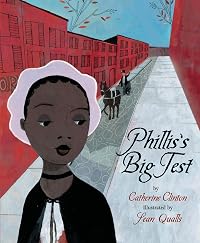
The illustrations by Sean Qualls, using a creative combination of acrylic and collage, are lovely.
No poems are included in the text, which is not surprising if you read them! They are not very kid-friendly (although Phillis herself was a child when she wrote many of them), nor very compatible with current thinking. Take, for example, this poem, written when Phillis was around fourteen:
On Being Brought From Africa To America
"Twas mercy brought me from my Pagan land,
Taught my benighted soul to understand
That there's a God, that there's a Saviour too:
Once I redemption neither sought nor knew.
Some view our sable race with scornful eye,
"Their colour is a diabolic die,"
Remember, Christians, Negros, black as Cain,
May be refin'd, and join th' angelic train."
(Harvard literary historian Henry Louis Gates, Jr., who has written his own book on Phillis, observed: “This, it can be safely said, has been the most reviled poem in African American literature.” He further laments that “Too black to be taken seriously by white critics in the eighteenth century, Wheatley [is] now considered too white to interest black critics in the twentieth.”)
None of this controversy is recounted in this book, however. Rather, it is a celebration of one girl’s pluck in the face of a particular trial in which there were enormous odds against her.
Evaluation: While this book doesn’t tell much of Phillis’s story, it should create enough interest in the subject to inspire young readers to find out more about this remarkable girl from the early years of the American nation. show less
The appearance of Phillis’s first collection of poems met with so much skepticism that show more she consented to be cross-examined by a panel of Boston intellectuals (including the Governor and Lieutenant Governor of Massachusetts, as well as John Hancock, then one of the wealthiest men in the Thirteen Colonies) on October 8, 1772. She was eighteen.
What the panel asked Phillis has not been recorded, but the signed conclusion of the panel has survived:
We whose Names are under-written, do assure the World, that the Poems specified in the following Page, were (as we verily believe) written by Phillis, a young Negro Girl, who was but a few Years since, brought an uncultivated Barbarian from Africa, and has ever since been, and now is, under the Disadvantage of serving as a Slave in a Family in this Town. She has been examined by some of the best judges, and is thought qualified to write them."
(Nevertheless, even after this validation, no American would publish her work, so Susanna Wheatley asked British friends for help. Unfortunately, the overseas benefactors of Phillis cut her off after the American Revolution from Britain, especially because Phillis wrote poems in favor of independence.)
For a while however, Phillis achieved great success and was even invited to meet General George Washington after he received a letter and poem from her.
This book gives a brief introduction to who Phillis was, and then focuses entirely on the cross-examination she endured to prove that she, an African-born slave, actually was intelligent enough to write her own poems. The story is told as if from Phillis’s perspective, showing her bravery and determination.
The illustrations by Sean Qualls, using a creative combination of acrylic and collage, are lovely.
No poems are included in the text, which is not surprising if you read them! They are not very kid-friendly (although Phillis herself was a child when she wrote many of them), nor very compatible with current thinking. Take, for example, this poem, written when Phillis was around fourteen:
On Being Brought From Africa To America
"Twas mercy brought me from my Pagan land,
Taught my benighted soul to understand
That there's a God, that there's a Saviour too:
Once I redemption neither sought nor knew.
Some view our sable race with scornful eye,
"Their colour is a diabolic die,"
Remember, Christians, Negros, black as Cain,
May be refin'd, and join th' angelic train."
(Harvard literary historian Henry Louis Gates, Jr., who has written his own book on Phillis, observed: “This, it can be safely said, has been the most reviled poem in African American literature.” He further laments that “Too black to be taken seriously by white critics in the eighteenth century, Wheatley [is] now considered too white to interest black critics in the twentieth.”)
None of this controversy is recounted in this book, however. Rather, it is a celebration of one girl’s pluck in the face of a particular trial in which there were enormous odds against her.
Evaluation: While this book doesn’t tell much of Phillis’s story, it should create enough interest in the subject to inspire young readers to find out more about this remarkable girl from the early years of the American nation. show less
I really enjoyed this book because it kept me interested in what was going to happen to Phillis's poetry. I would hate to live in a time period where it was only acceptable for men to write amazing works of art. I loved that Phillis was able to prove that she was the writer of all of her poems. My favorite part of the book was how it did not tell you the results of Phillis's test. I think it was very different for the end results to be separate, in the epilogue, then for it to give away the ending at the end of the story. I would definitely read this book to my students.
Phillis's Big Test is an interesting book about Phillis Wheatley and her determination to prove herself as a poet in a male dominant literary world. Wheatley was an African American slave brought from Africa to serve the Wheatley's at their residence. The Wheatley's children taught Phillis how to read, striking her interest to write. Eventually, Phillis published a poetry book that she was unable to publish due to her ethnicity. In order to prove that she wrote the poems and to get her book published, she had to answer a series of questions from a group of men. This book does well to emphasize the struggles of both the African American and women community based on their unjust treatment, especially in the literary world during that time.
I liked reading this book. The writing was organized and I like how the author pushes the reader to think about past real life issues. The way the author wrote the story was organized and incorporated a lot of detail to explain how Phillis became interest in poetry. The beginning of the book starts off with the conflict, that people don't believe an African-born enslaved girl wrote such wonderful verses all by herself. From there the author does a good job informing the reader how Phillis gained this love of poetry and a passion for writing it. The family she served, "taught her love of English and she began to read poetry and sonnets which inspired her to try her own handwriting". This book pushes readers to think about what it would show more be like to be in Phillis's situation. Nobody believes a young slave girl could create such beautiful poetry because slaves usually did not have any type of educational background. So the author does a good job of pushing the reader to think of different questions such as: what if you created something that no one believed you made because your skin was a different color, what if your family lived somewhere far away and you were forced to live and work for a family you don't know, etc. The main message of the story is to believe in yourself. Phillis believed in the power of her words and her writing to prove her talent. show less
I thought this book was pretty good. I like that the author included a quote from Susanna Wheatley, Phillis's master. "Your talent will speak for itself." It showed the close knit bond that Phillis had with her master and his family. Secondly, I like that the author ended the book on a cliff hanger. "She moved into the hall as all eyes turned toward to her: 'Good day, gentlemen. I am the poet Phillis Wheatley'". The author makes you read on to the epilogue to see if Phillis is accepted as an author or not. This story tells of the determination of one female African American slave to have her poems published.
Members
- Recently Added By
Author Information

33+ Works 3,042 Members
Catherine Clinton is the author of Harriet Tubman: The Road to Freedom and Fanny Kemble's Civil Wars. Educated at Harvard, Sussex, and Princeton, She is a member of the advisory committee to the Abraham Lincoln Bicentennial Commission, and holds a chair in U.S. history at Queen's University Belfast.
Awards and Honors
Awards
Common Knowledge
- Original publication date
- 2008
- People/Characters
- Phillis Wheatley
- Important places
- Boston, Massachusetts, USA
- Important events
- American Revolution (1775 | 1783)
- Dedication
- For Pat Bradford, whose talent speaks for itself.
-- C.C.
For my grandmother, Blache E. Smith and Willie D. Qualls. I miss you.
-- S.Q. - First words
- In 1773, Phillis Wheatley became the first African American to publish a book of poetry.
One crisp early-autumn morning, Phillis Wheatley was crossing the Boston cobblestones with a sheaf of papers held tightly under her arm. - Last words
- (Click to show. Warning: May contain spoilers.)She moved into the hall as all eyes turned toward her:
"Good day, gentlemen. I am the poet Phillis Wheatley."
Classifications
Statistics
- Members
- 87
- Popularity
- 369,027
- Reviews
- 19
- Rating
- (3.96)
- Languages
- English
- Media
- Paper, Ebook
- ISBNs
- 2
- UPCs
- 1
- ASINs
- 3