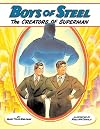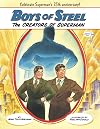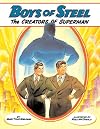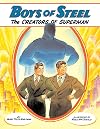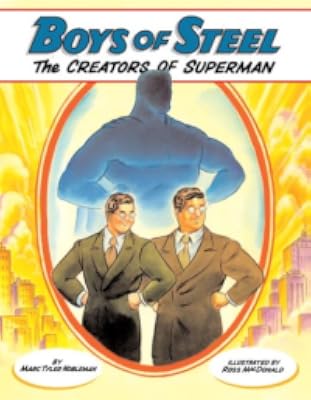
Boys of Steel: The Creators of Superman
by Marc Tyler Nobleman
On This Page
Description
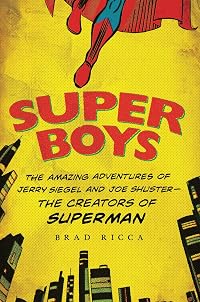
Jerry Siegel & Joe Shuster, two misfit teens in Cleveland, were more like Clark Kent than Superman. Both boys escaped into the worlds of science fiction and pulp magazine tales. In 1934, they created the superhero, but it was four years before they convinced a publisher to take a chance on their Man of Steel in a new format--the comic book.Tags
Recommendations

Member Reviews
JERRY SIEGEL AND Joe Shuster, two misfit teens in Depression-era Cleveland, were more like Clark Kent—meek, mild, and myopic—than his secret identity, Superman. Both boys escaped into the worlds of science fiction and pulp magazine adventure tales. Jerry wrote stories, and Joe illustrated them. In 1934, they created a superhero who was everything they were not. It was four more years before they convinced a publisher to take a chance on their Man of Steel in a new format—the comic book. The author includes a provocative afterword about Jerry and Joe’s long struggle with DC Comics when they realized they had made a mistake in selling all rights to Superman for a mere $130!
Marc Tyler Nobleman’s text captures the excitement of show more Jerry and Joe’s triumph, and the energetic illustrations by Ross MacDonald, the author-artist of Another Perfect Day, are a perfect complement to the time, the place, and the two young visionaries. show less
Marc Tyler Nobleman’s text captures the excitement of show more Jerry and Joe’s triumph, and the energetic illustrations by Ross MacDonald, the author-artist of Another Perfect Day, are a perfect complement to the time, the place, and the two young visionaries. show less
Nobleman, M. (2008). Boys of Steel: The creators of Superman. New York: Alfred A. Knopf.
9780375838026
Appetizer: This picturebook explores the biographies of Superman creators Jerry Siegel and Joe Shuster. The story begins while Siegel was still in high school, so he'll be a relatable child-like character (although a bit older than the intended readers). The book shares about their friendship and later partnership as they came up with the idea for Superman, illustrated it and sought out a publisher.
As an adult, I couldn't stop thinking of Michael Chabon's The Amazing Adventures of Kavalier and Clay, which took me an entire semester to finish reading while I was in undergrad. A teacher could take advantage of this by having students show more consider the number of different ways Superman has been re-imagined (from Smallville, Lois and Clark, Superman Returns, to the speech Bill gives about Superman toward the end of Kill Bill Vol. 2).
Another way to focus on this story is as the artist's journey, showing the inspirations and work it takes to develop an idea.
I liked that the illustrations were done in a classic style with broad shouldered characters that one would expect to see in old comic books (or even in some Dick and Jane series).
This is one of those historical biographies where you know many readers aren't going to engage with the person being described very well. But then, there are those few awkward turtles, who like Jerry, don't have many friends, don't like to participate in sports, are too afraid to even talk to members of the opposite sex.... Okay, so there are a lot of awkward turtles out there who can relate to Jerry. But chances are good they are a few years older than the intended audience. Despite the fact that this book is at a third or fourth grade reading level, it's probably sixth, seventh or eighth graders that will relate to the character the most. At that age, it can be difficult to get a tween or teen to pick up a picturebook. Chances are good graphic novel and comics fans will be willing to take a chance on it, but it'll probably be up to the teacher to put the book in their hands.
Dinner Conversation:
"Most days, Jerry Siegel slipped into the halls of his high school staring at the floor. He always wished he was going in the other direction--back home. That's where he could be with his friends. They were an extraordinary bunch."
"Jerry read amazing stories every evening, every weekend, every chance he got. If he wasn't reading, he was watching--the cinemas had no shortage of rousing motion pictures about daredevils who laughed at danger."
"Jerry also wrote his own adventure and science fiction stories. He'd pound away at his typewriter by the front window in his attic."
"While Jerry was typing in his attic, Joe was drawing in his kitchen, using a breadboard as a surface."
"In life, people got pushed around. Children lost parents. Criminals got away. In stories, heroes could prevent all of that."
To Go with the Meal:
A teacher could help adding meaning to this picturebook by exploring the context of the time period and its culture. While doing lectures on the Great Depression, a teacher could also bring in some classic comics of Tarzan or Flash Gordon.
Since Jerry had lost his father in a bank robbery, a teacher could focus on his grief and how he used that energy to help him create his art.
With middle grade students in particular, a teacher could discuss how some people feel excluded or included depending on their interests. Going off of this, a teacher could also encourage students to use books and art as a way to escape their problems.
Students could also research Jerry and Joe in more depth, learning more about their childhood and Jewish background and influences (on a side note, I was a little disappointed that aspect of their biographies was excluded. Sure, there is a brief mention that Samson was one of the inspirations for Superman, but I could have heard more).
Tasty Rating: !!! show less
9780375838026
Appetizer: This picturebook explores the biographies of Superman creators Jerry Siegel and Joe Shuster. The story begins while Siegel was still in high school, so he'll be a relatable child-like character (although a bit older than the intended readers). The book shares about their friendship and later partnership as they came up with the idea for Superman, illustrated it and sought out a publisher.
As an adult, I couldn't stop thinking of Michael Chabon's The Amazing Adventures of Kavalier and Clay, which took me an entire semester to finish reading while I was in undergrad. A teacher could take advantage of this by having students show more consider the number of different ways Superman has been re-imagined (from Smallville, Lois and Clark, Superman Returns, to the speech Bill gives about Superman toward the end of Kill Bill Vol. 2).
Another way to focus on this story is as the artist's journey, showing the inspirations and work it takes to develop an idea.
I liked that the illustrations were done in a classic style with broad shouldered characters that one would expect to see in old comic books (or even in some Dick and Jane series).
This is one of those historical biographies where you know many readers aren't going to engage with the person being described very well. But then, there are those few awkward turtles, who like Jerry, don't have many friends, don't like to participate in sports, are too afraid to even talk to members of the opposite sex.... Okay, so there are a lot of awkward turtles out there who can relate to Jerry. But chances are good they are a few years older than the intended audience. Despite the fact that this book is at a third or fourth grade reading level, it's probably sixth, seventh or eighth graders that will relate to the character the most. At that age, it can be difficult to get a tween or teen to pick up a picturebook. Chances are good graphic novel and comics fans will be willing to take a chance on it, but it'll probably be up to the teacher to put the book in their hands.
Dinner Conversation:
"Most days, Jerry Siegel slipped into the halls of his high school staring at the floor. He always wished he was going in the other direction--back home. That's where he could be with his friends. They were an extraordinary bunch."
"Jerry read amazing stories every evening, every weekend, every chance he got. If he wasn't reading, he was watching--the cinemas had no shortage of rousing motion pictures about daredevils who laughed at danger."
"Jerry also wrote his own adventure and science fiction stories. He'd pound away at his typewriter by the front window in his attic."
"While Jerry was typing in his attic, Joe was drawing in his kitchen, using a breadboard as a surface."
"In life, people got pushed around. Children lost parents. Criminals got away. In stories, heroes could prevent all of that."
To Go with the Meal:
A teacher could help adding meaning to this picturebook by exploring the context of the time period and its culture. While doing lectures on the Great Depression, a teacher could also bring in some classic comics of Tarzan or Flash Gordon.
Since Jerry had lost his father in a bank robbery, a teacher could focus on his grief and how he used that energy to help him create his art.
With middle grade students in particular, a teacher could discuss how some people feel excluded or included depending on their interests. Going off of this, a teacher could also encourage students to use books and art as a way to escape their problems.
Students could also research Jerry and Joe in more depth, learning more about their childhood and Jewish background and influences (on a side note, I was a little disappointed that aspect of their biographies was excluded. Sure, there is a brief mention that Samson was one of the inspirations for Superman, but I could have heard more).
Tasty Rating: !!! show less
In the 1930s, Jerry Siegel and Joe Shuster lived on a fare of pulp magazines, comic strips, and action movies. While they dreamed of being heroic like the characters that populated the media, the two teenaged boys also worked on their own creative outputs. Jerry wrote science fiction works his teachers considered trashy, while Joe work on illustrations in his spare time. Eventually the duo thought of combining their respective talents and creating their own comic strip to sell to newspaper syndicates. But finding a unique hero was proving to be a problem. That is, until Jerry had a light bulb idea one night and dreamed up a hero who was an alien who came to earth to protect humans … “The real Earth, the Great Depression Earth. That show more was something different. The other heroes Jerry and Joe about were regular humans in strange places. This hero would be a stranger in a regular place.” And so Superman – and his alter ego Clark Kent – was born and that mythos has since become an ingrained part of our culture.
Nobleman tells the story of Siegel and Shuster’s famous creation against the backdrop of the Great Depression so readers will glean clues about the scarcity faced by many during that time period. For instance, the reader learns that when his family had no money to spare for art paper, Joe would resort to drawing on the back of butcher’s paper wrapping the family’s dinner or any other scraps of paper he could find. Other economic concepts are highlighted briefly in the duo’s search for an editor and the Superman character becoming a franchise. An author’s note at the end provides more details, particularly expounding on issues of copyright and payments to the Superman creators after their character took flight.
I reviewed this book for EconKids. show less
Nobleman tells the story of Siegel and Shuster’s famous creation against the backdrop of the Great Depression so readers will glean clues about the scarcity faced by many during that time period. For instance, the reader learns that when his family had no money to spare for art paper, Joe would resort to drawing on the back of butcher’s paper wrapping the family’s dinner or any other scraps of paper he could find. Other economic concepts are highlighted briefly in the duo’s search for an editor and the Superman character becoming a franchise. An author’s note at the end provides more details, particularly expounding on issues of copyright and payments to the Superman creators after their character took flight.
I reviewed this book for EconKids. show less
I love anything Superman-related, so I was predisposed to like this, I admit. But it really is a well-written biography of Siegel and Schuster, the creators of Superman, and the illustrations look just like they came out of an original Superman comic book! Very cool. (and again, the Cleveland connection is fun)
Summary: Jerry and Joe, the creators of Superman, were living in the depression era as teenagers. They dreamed up this character that they really wished they could be and with Jerry's vivid writing and Joe's amazing detail in his drawings, they made Superman. One day, they convinced someone to publish is and then sold the rights for only $130 which was a huge mistake. This book tells the story of two men with a vision of hope in an era of Depression.
Genre: Picture Book
Review: I didn't realize that this book was so long because it was so interesting. I didn't know about anything involving the creation of Superman, so I enjoyed reading about these men and their journey. I liked how the author mentioned the era they wrote about it in and show more how because they were in the Depression, they wanted to dream up somebody who spoke against that. It would be a great project for children to read this and then create their own superhero. show less
Genre: Picture Book
Review: I didn't realize that this book was so long because it was so interesting. I didn't know about anything involving the creation of Superman, so I enjoyed reading about these men and their journey. I liked how the author mentioned the era they wrote about it in and show more how because they were in the Depression, they wanted to dream up somebody who spoke against that. It would be a great project for children to read this and then create their own superhero. show less
In the 1930s, Jerry Siegel and Joe Shuster lived on a fare of pulp magazines, comic strips, and action movies. While they dreamed of being heroic like the characters that populated the media, the two teenaged boys also worked on their own creative outputs. Jerry wrote science fiction works his teachers considered trashy, while Joe work on illustrations in his spare time. Eventually the duo thought of combining their respective talents and creating their own comic strip to sell to newspaper syndicates. But finding a unique hero was proving to be a problem. That is, until Jerry had a light bulb idea one night and dreamed up a hero who was an alien who came to earth to protect humans … “The real Earth, the Great Depression Earth. That show more was something different. The other heroes Jerry and Joe about were regular humans in strange places. This hero would be a stranger in a regular place.” And so Superman – and his alter ego Clark Kent – was born and that mythos has since become an ingrained part of our culture.
Nobleman tells the story of Siegel and Shuster’s famous creation against the backdrop of the Great Depression so readers will glean clues about the scarcity faced by many during that time period. For instance, the reader learns that when his family had no money to spare for art paper, Joe would resort to drawing on the back of butcher’s paper wrapping the family’s dinner or any other scraps of paper he could find. Other economic concepts are highlighted briefly in the duo’s search for an editor and the Superman character becoming a franchise. An author’s note at the end provides more details, particularly expounding on issues of copyright and payments to the Superman creators after their character took flight.
http://econkids.rutgers.edu/new-picture-books-in-2008-first-word-a-i/2197-boys-o... show less
Nobleman tells the story of Siegel and Shuster’s famous creation against the backdrop of the Great Depression so readers will glean clues about the scarcity faced by many during that time period. For instance, the reader learns that when his family had no money to spare for art paper, Joe would resort to drawing on the back of butcher’s paper wrapping the family’s dinner or any other scraps of paper he could find. Other economic concepts are highlighted briefly in the duo’s search for an editor and the Superman character becoming a franchise. An author’s note at the end provides more details, particularly expounding on issues of copyright and payments to the Superman creators after their character took flight.
http://econkids.rutgers.edu/new-picture-books-in-2008-first-word-a-i/2197-boys-o... show less
This is the story of Jerry Siegel and Joe Shuster, who created Superman. They met while they were in high school during the Great Depression in the 1930’s. They were very similar in looks as well as in personality. Jerry and Joe would read books and comics and watch movies about superheroes. Jerry would write about them, and Joe would draw them. In winter, Joe’s house didn’t have heat, and he would draw in layers of clothing, including a coat and gloves. Jerry decided that he and Joe needed to come up with a new character and write a comic strip about him. Then they could sell it to the newspapers. This story goes on to tell about how they sold the strip and what happened afterward. It is a very interesting story with a few show more twists, and wonderful pictures. show less
Members
- Recently Added By
Author Information

80+ Works 2,319 Members
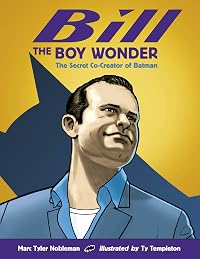
Marc Tyler Nobleman is the author of "Bill the Boy Wonder: The Secret Co-Creator of Batman" (which changed history, inspiring both the Hulu documentary "Batman & Bill" and a TED talk), "Boys of Steel: The Creators of Superman" (which made the front page of "USA Today"), "Brave Like My Brother," and "The Chupacabra Ate the Candelabra"; upcoming show more titles include "Fairy Spell" and "Thirty Minutes Over Oregon." Marc has been invited to speak at schools, conferences, companies, and other venues from Thailand to Tanzania. He blogs about adventures in publishing at Noblemania. (Bowker Author Biography) show less
Awards and Honors
Awards
Distinctions
Classifications
Statistics
- Members
- 303
- Popularity
- 106,264
- Reviews
- 18
- Rating
- (4.11)
- Languages
- English
- Media
- Paper, Ebook
- ISBNs
- 6
- ASINs
- 2