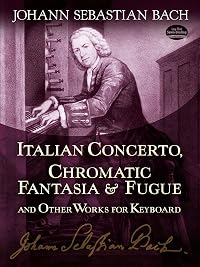
Italian Concerto, Chromatic Fantasia and Fugue and Other Works for Keyboard
by Johann Sebastian Bach
On This Page
Description
This superb selection of 16 of Bach's best-known, most-performed and most recorded works for the keyboard, reproduced from the authoritative Bach Gesellschaft edition, offers an exhilarating introduction to the great composer's keyboard virtuosity and his genius for melodic invention. The works included are Italian Concerto (BWV 971); Overture in the French Style [Partita] in B Minor (BWV 903); Chromatic Fantasia and Fugue in D Minor (BWV 903); Fantasia and Fugue in A Minor (BWV 904); show more Fantasia and Fugue in C Minor (BWV 906); Fantasia in G Minor (BWV 917); Fantasia on a Rondo in C Minor (BWV 918); Fantasia in C Minor (BWV 919); Prelude [Fantasia] in A Minor (BWV 922); Prelude and Fugue in A Minor (BWV 894); Prelude and Fughetta in F Major (BWV 901); Prelude and Fughetta in G Major (BWV 902); Fugue in C Major (BWV 946); Fugue in A Minor (BWV 947); Fugue in D Minor (BWV 948); Fugue in A Major on a Theme of Albinoni (BWV 950). Sturdy, yet inexpensive, this Dover edition is designed for a lifetime of use. It brings to amateur and professional musicians, to students, and to Bach connoisseurs the composer's choicest keyboard works in a format ideal for study and practice, with large noteheads, wide margins, and clear, bold reproduction. show lessTags
Recommendations










Members
- Recently Added By
Author Information

8,429+ Works 20,347 Members
Composer, organist, and the most famous of an illustrious family of German musicians, Johann Sebastian Bach was born in 1685. He was a master of polyphonic baroque music-a musical form characterized by the use of multiple parts in harmony and by an ornate, exuberant style. Bach's father, Johann Ambrosius, taught his son to play the violin at a show more very early age. At age 10, after both of his parents died, Bach lived with his brother Johann Christoph, an organist, who taught him to play keyboard instruments. Bach's musical genius, however, soon surpassed his brother's skill. During his lifetime, Bach was known more for his skill as an organist than as a composer. His fame as a composer did not come until years after his death, when his works were discovered by the composers Felix Mendelssohn and Robert Schumann and published in the 1800s. Between 1703 and 1717, Bach served as an organist in the German cities of Arnstadt, Muhlhausen, and Weimar. During that time, he wrote chorales, cantatas, concertos, preludes, and fugues, primarily for the organ. These works fused Italian, French, and German characteristics with a profound mastery of the contrapuntal technique. While serving as music director at the court of a German prince from 1717 to 1723, Bach wrote many compositions for the clavier and instrumental ensembles. These included preludes, fantasies, toccatas, and dance suites that served as both music instruction and entertainment. Of these works, the best known is the Well-Tempered Clavier, a series of preludes and fugues composed in 1722 and Bach's last position as cantor and music director of St. Thomas's Church in Leipzig (1724--50), exerted considerable influence on Lutheran church music. During this period, he composed as many as 300 cantatas, 200 of which have been preserved. After his death at the age of 65, Bach became revered as one of the world's greatest composers, and his compositions are regarded by many as the most sublime music ever composed. (Bowker Author Biography) show less
Series
Belongs to Publisher Series
Classifications
Statistics
- Members
- 24
- Popularity
- 1,112,514
- Languages
- No linguistic content
- ISBNs
- 1
- UPCs
- 1