Silent Music: A Story of Bagdad
by James Rumford
On This Page
Description
As bombs and missiles fall on Baghdad in 2003, a young boy uses the art of calligraphy to distance himself from the horror of war.Tags
Recommendations

Member Reviews
A young boy named Ali, living in Bagdad, loves to play soccer and to listen to loud music in this thoughtful and emotionally resonant picture book from author/illustrator James Rumford, but most of all, he loves classical Arabic calligraphy. The beauty of the shapes, the flow of his pen—there is a magic to the "silent music" of this art form, and Ali's mother compares him to Yakut, the famous calligrapher of eight hundred years before, whose work is still known and admired. When war comes to Bagdad, Ali has need of his calligraphy, and of the peace it brings, retreating into it, just as Yakut was said to do, in another war many years ago...
Silent Music: A Story of Bagdad is the ninth picture book I have read from Rumford, and like so show more many of the others, I found it outstanding. I love the simple, almost quiet narrative, exploring a young boy's daily life, his activities and his passion, and the way that life was impacted by the terrible events around him. I loved some of the language and ideas the author used, from the notion of calligraphy as silent music, to the description of the way the word for war was so easy to write, while the one for peace required so much practice. The accompanying artwork was also excellent—striking, with use of bold colors and shapes, and structured in such a way as to center and celebrate the calligraphic elements. All in all, a wonderful book, one I would recommend to picture book readers looking for stories about calligraphy, but also about war, and about the way the things we love can be a retreat in dark times. show less
Silent Music: A Story of Bagdad is the ninth picture book I have read from Rumford, and like so show more many of the others, I found it outstanding. I love the simple, almost quiet narrative, exploring a young boy's daily life, his activities and his passion, and the way that life was impacted by the terrible events around him. I loved some of the language and ideas the author used, from the notion of calligraphy as silent music, to the description of the way the word for war was so easy to write, while the one for peace required so much practice. The accompanying artwork was also excellent—striking, with use of bold colors and shapes, and structured in such a way as to center and celebrate the calligraphic elements. All in all, a wonderful book, one I would recommend to picture book readers looking for stories about calligraphy, but also about war, and about the way the things we love can be a retreat in dark times. show less
This story is about a young boy, Ali, who seems like most other young boys. He enjoys soccer, and loud music, but he also enjoys the art form of calligraphy. The second thing that makes him different to the reader is that he lives in war-torn Baghdad. The author allows the reader to see Ali’s love for calligraphy, his hours of practice and his determination to form hard-to-make letters and words. At the same time, Rumford draws parallels between the experiences of Ali in present-day Baghdad to the life of Yakut, a master calligrapher who lived in Baghdad over 800 years ago. Both used the art of calligraphy to sooth the fear and pain of war and bring beauty to a world of suffering and ugliness. The most profound statement of this book show more occurs when Ali observes that the calligraphy sign for war flows so easily on to the paper, while the letters for peace stubbornly resist the tip of his pen. This book tells the story of a boy to young children, but gives profound insight into war and peace to the adult reader.
Library Implications: The story of Ali lends itself to many learning scenarios. The librarian could partner with the art department in a school or community center to let children experiment with pen and ink calligraphy lettering; students could also make up their own lettering system. This experience with pen and ink is becoming a lost art that not many students have the opportunity to explore. The story of Yakut could also be explored, focusing on various artists from the region who made this art form popular. Older students could focus Baghdad and its tumultuous history of unrest. show less
Library Implications: The story of Ali lends itself to many learning scenarios. The librarian could partner with the art department in a school or community center to let children experiment with pen and ink calligraphy lettering; students could also make up their own lettering system. This experience with pen and ink is becoming a lost art that not many students have the opportunity to explore. The story of Yakut could also be explored, focusing on various artists from the region who made this art form popular. Older students could focus Baghdad and its tumultuous history of unrest. show less
On the surface this appears to be a story about a boy’s passion about a hobby, but beneath that is a lesson about the impact of war on children. Ali, a boy who lives in Baghdad, loves soccer and calligraphy. He takes the reader through reasons why he loves writing and tells the story of his hero, Yakut, a famous calligrapher (which is expanded upon in an Author’s Note). But he moves on to tell about how writing calligraphy became his safe place during the Baghdad bombings in 2003. The story goes even further, using writing as a metaphor for the struggles of war. The book is beautifully written, the language flowing on the page like the very ink Ali is describing. The illustrations are a gorgeous use of mixed media, with calligraphy show more and Arabic art patterns inlaid into all of the backgrounds and some foreground objects providing a very rich texture to the pages. Any calligraphy referenced in the text is written in large stark black with notes breaking down the word into letters. With such an accessible character and moving message this is the perfect book to tactfully introduce the subject of war or even just hobbies to a child age 5-8 of any background. show less
This book is about finding peace in unpeaceful times. It tells the story of how a young boy, Ali, practices the ancient art of calligraphy to feel peace during times of war in Baghdad. I liked this book for several reasons. First, I liked how it told about the history of calligraphy and how it Ali relates to it in many ways. For example, the book tells of a master calligrapher, Yakut, and how he made the beautiful art of calligraphy eight hundred years before during a similar time of war in Baghdad and used it to escape the devastation just as Ali is doing. It also explains how this writing is an important part of Islamic culture. Another reason I liked this book is because of the beautiful illustrations. For example, each page shows a show more collage of modern pictures, cultural patterns and beautiful calligraphy writing in the background. As you read the book, you must stop on each page to study all of the different images before going on to the next page. Finally, I liked how the book not only told of the cultural art of calligraphy, but it gave the reader an opportunity for a connection to Ali, even though he is from Baghdad and not America. For example, Ali described himself as loving to play soccer, listening to loud music and dancing. You do not usually think of a child from Baghdad in time of war to have similar interests as a child from America. show less
Silent Music was written and illustrated by James Rumford in mixed media, using pencil and charcoal drawings enchanced on the computer, and much of the author’s own calligraphy. This book was an ALA Notable Children’s Book for 2009 and a 2009 Charlotte Zolotow honor book. It’s a simple story of how young Ali uses calligraphy to distract himself from the bombing of Baghdad in 2003, with a little information on famous calligrapher Yaqut al-Musta'simi who did the same during the Mongol invasion in 1258.
There’s also a message, as Ali says, “It’s funny how easily my pen glides down the long, sweeping hooks of the word HARB—war...how stubbornly it resists me when I make the difficult waves and slanted staff of show more SALAM—peace...” This is combined with an Escher-like tessellation where birds break out of the interlocking geometric pattern and fly away.
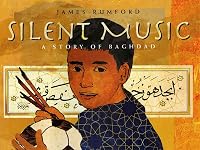
I LOVED the illustrations in this book! From the copyright page, they are “inspired by the many photos posted on the Web by photographers and American service personnel in Iraq.” They are collages of jewel-tone floral and geometric designs that echo Moorish tile designs, as well as the inclusion of silhouettes and Iraqi stamps, money and postcards, set on desert-colored backgrounds. Calligraphy Arabic words, translated in places (and not in others), are sometimes part of the background or clothing. Ali and his family are portrayed lovingly (I loved the picture of Ali’s father shaving). This is a gorgeous book – too bad it was not recognized by the Caldecott committee. show less
There’s also a message, as Ali says, “It’s funny how easily my pen glides down the long, sweeping hooks of the word HARB—war...how stubbornly it resists me when I make the difficult waves and slanted staff of show more SALAM—peace...” This is combined with an Escher-like tessellation where birds break out of the interlocking geometric pattern and fly away.
I LOVED the illustrations in this book! From the copyright page, they are “inspired by the many photos posted on the Web by photographers and American service personnel in Iraq.” They are collages of jewel-tone floral and geometric designs that echo Moorish tile designs, as well as the inclusion of silhouettes and Iraqi stamps, money and postcards, set on desert-colored backgrounds. Calligraphy Arabic words, translated in places (and not in others), are sometimes part of the background or clothing. Ali and his family are portrayed lovingly (I loved the picture of Ali’s father shaving). This is a gorgeous book – too bad it was not recognized by the Caldecott committee. show less
This book is a moving cry for peace in Iraq. We see a personal perspective of what effect the war there has on a little boy, Ali, and how he copes with the chaos that surrounds him. We learn that Ali is just a normal boy; he likes dancing, listening to music, and playing soccer with his friends. His passion, though, is calligraphy, something in which he loses himself when he is frightened by the terror and bombing. The most powerful part of the book are the last two pages, in which Ali practices writing 'SALAM' (peace), but says 'how much I have to practice until this word flows freely from my pen.' Wow! What a way to help children understand controversial world events around them and what they might do to encourage peace.
I thoroughly enjoyed this book. It allowed me to see arabic calligraphy in a brand new way. I had never thought of writing from an aesthetic perspective. It is also information on beauty and escape in a part of the world that is not often portrayed as being a part of, unfortunately. It was sad to think of a boy living through the bombings in Baghdad but with this piece of historical content, it allowed me to connect with the character.
Members
- Recently Added By
Lists

A Child's Book Tour of the Arabian Peninsula
43 works; 1 member

Precious People
119 works; 1 member
Author Information

22 Works 3,330 Members
Awards and Honors
Awards
Distinctions
Common Knowledge
- Canonical title
- Silent Music: A Story of Bagdad
- Original publication date
- 2008
- People/Characters
- Ali
- Important places
- Baghdad, Iraq; Iraq
- Dedication
- For Dodie Warren and Tuesday's Class
and for all those who love the art
of making beautiful letters. - First words
- My name is Ali.
I live in Baghdad. - Last words
- (Click to show. Warning: May contain spoilers.)It's funny how easily my pen glides down the long, sweeping hooks of the word HARB---war ...
how stubbornly it resists me when I make the
difficult waves and slanted staff of SALAM---peace ...
how much I have to practice until
this word flows freely from my pen.
Classifications
Statistics
- Members
- 474
- Popularity
- 64,225
- Reviews
- 72
- Rating
- (4.28)
- Languages
- English, French
- Media
- Paper
- ISBNs
- 3
- ASINs
- 2