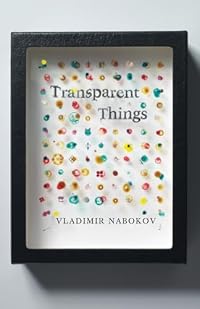
Transparent Things
by Vladimir Nabokov
On This Page
Description
"Transparent Things revolves around the four visits of the hero--sullen, gawky Hugh Person--to Switzerland . . . As a young [American] publisher, Hugh is sent to interview R. [an eccentric author], falls in love with Armande on the way, wrests her, after multiple humiliations, from a grinning Scandinavian and returns to NY with his bride. . . . Eight years later--following a murder, a period of madness and a brief imprisonment--Hugh makes a lone sentimental journey to wheedle out his past. . show more . . The several strands of dream, memory, and time [are] set off against the literary theorizing of R. and, more centrally, against the world of observable objects." --Martin Amis. show lessTags
Recommendations















Member Reviews
I’m not saying that Nabokov got the idea from me, but I once had a dream (vision? hallucination?) that I was writing a book in which I would veer off along some tangent every few pages or so and relate, say, an interesting episode in the life of a man who had chopped down the tree from which came the material for a bundle of paper tucked away in a drawer of a desk in the study of a man who was an incidental character in the main narrative of the story. Imagine the dark velvety déjà vu as I read a short chapter in Transparent Things on the manufacture of a pencil that had fallen from a drawer in the bureau of a shabby hotel room into which the protagonist had just settled his bags before recalling a previous trip to the same hotel show more with his father, during which trip the father dies while trying on a pair of trousers. Nabokov does it again a few pages later as the old man fiddles with an umbrella—I mean makes you see, how the swoop and glide of his prose can convey very nearly as much as your mind can conceive in that moment of perceiving the words on the page. show less
The extremely simple story of Hugh Person and his lover Armande is told with this wonderful, delicious examination of little snippets of life. From the 'ask me what I can do' ambitions of a humdrum life to the description of Swiss hot chocolate to its description of second-rate Swiss hotels- there is a savoring in the ordinary that shines through these pages. I read chapter-1 multiple times to make peace with 'transparent things', but it will still need more re-reads.
After note: some of Nabokov's descriptions of human digestion are the most 'beautiful' yet biologically accurate I've read in literature.
After note: some of Nabokov's descriptions of human digestion are the most 'beautiful' yet biologically accurate I've read in literature.
The dull rainbow of a fog-dogged moon
..."he grunted and sighed in his sleep, dreaming of large unwieldy blocks of blackness"...
I suppose it goes without saying that Nabokov's prose is brilliantly inventive, full of vivid turns of phrase and dark humour, but how does the book stack up as a whole? Well, Transparent Things is a novella about the life and memories of a seemingly average man. Hugh Person is his name, and this is the snapshot story of his stand-out moments which (as the short chapters reveal) are both strange and familiar, humdrum and disastrous.
Transparent Things is a subtle book: the way Nabokov shows Hugh Person is surreal and sublime, yet also mundane and melancholic. All in all Transparent Things is an elegant work - a show more masterclass in the art of long short-story writing: understated, wistful, perceptive, deft, elusive and engaging -: definitely worth reading for the imaginative writing. show less
..."he grunted and sighed in his sleep, dreaming of large unwieldy blocks of blackness"...
I suppose it goes without saying that Nabokov's prose is brilliantly inventive, full of vivid turns of phrase and dark humour, but how does the book stack up as a whole? Well, Transparent Things is a novella about the life and memories of a seemingly average man. Hugh Person is his name, and this is the snapshot story of his stand-out moments which (as the short chapters reveal) are both strange and familiar, humdrum and disastrous.
Transparent Things is a subtle book: the way Nabokov shows Hugh Person is surreal and sublime, yet also mundane and melancholic. All in all Transparent Things is an elegant work - a show more masterclass in the art of long short-story writing: understated, wistful, perceptive, deft, elusive and engaging -: definitely worth reading for the imaginative writing. show less
61. Transparent Things by Vladimir Nabokov
published: 1972
format: 104-page paperback
acquired: September
read: Dec 7-11
time reading: 4:56, 2.8 mpp
rating: 4
locations: a small villa in Switzerland and somewhere in US (which either isn’t specified or I missed it. Presumably eastern us)
about the author: 1899 – 1977. Russia born, educated at Trinity College in Cambridge, 1922. Lived in Berlin (1922-1937), Paris, the US (1941-1961) and Montreux, Switzerland (1961-1977).
This was actually a little anticlimactic after Vera, which left quite an impact. But this is a good novella, a writer's novel that still manages to reach the reader and left me with a lot to think about.
We're in Switzerland and reading about clueless Americans in Switzerland. show more And maybe this is about clueless readers in general. VN tells us on page one: “Novices must learn to skim over matter if they want matter to stay at the exact level of the moment.” So, feeling all novice-like and insulted I stumbled through another 25 pages having no idea what was going on. And every couple of pages a new chapter starts and new mindset. (I had put the book down twice in those first 25 pages, and both times could not recall anything I had read and had to go back and read it again.) But there Hugh Person‘s story, his love of the unlovable Armande, begins to come out clearly. Nabokov create's an alter-ego of himself, an old cranky American author identified as Mr. R, who lives in Switzerland. Person, who works for a publisher, travels meet him a couple times. Actually the book is four trips Person takes to Switzerland, and most of the actual moment of the text happen in Switzerland.
Nabokov was a very serious writer who was never really serious, and this aspect comes out here. It's sad, tragically sad, and yet playful, and also uncomfortably thought-provoking. Not sure who I would recommend this to (although those curious about Switzerland come to mind), but I think if you get through those first 25 pages, it rewards.
2021
https://www.librarything.com/topic/333774#7678428 show less
published: 1972
format: 104-page paperback
acquired: September
read: Dec 7-11
time reading: 4:56, 2.8 mpp
rating: 4
locations: a small villa in Switzerland and somewhere in US (which either isn’t specified or I missed it. Presumably eastern us)
about the author: 1899 – 1977. Russia born, educated at Trinity College in Cambridge, 1922. Lived in Berlin (1922-1937), Paris, the US (1941-1961) and Montreux, Switzerland (1961-1977).
This was actually a little anticlimactic after Vera, which left quite an impact. But this is a good novella, a writer's novel that still manages to reach the reader and left me with a lot to think about.
We're in Switzerland and reading about clueless Americans in Switzerland. show more And maybe this is about clueless readers in general. VN tells us on page one: “Novices must learn to skim over matter if they want matter to stay at the exact level of the moment.” So, feeling all novice-like and insulted I stumbled through another 25 pages having no idea what was going on. And every couple of pages a new chapter starts and new mindset. (I had put the book down twice in those first 25 pages, and both times could not recall anything I had read and had to go back and read it again.) But there Hugh Person‘s story, his love of the unlovable Armande, begins to come out clearly. Nabokov create's an alter-ego of himself, an old cranky American author identified as Mr. R, who lives in Switzerland. Person, who works for a publisher, travels meet him a couple times. Actually the book is four trips Person takes to Switzerland, and most of the actual moment of the text happen in Switzerland.
Nabokov was a very serious writer who was never really serious, and this aspect comes out here. It's sad, tragically sad, and yet playful, and also uncomfortably thought-provoking. Not sure who I would recommend this to (although those curious about Switzerland come to mind), but I think if you get through those first 25 pages, it rewards.
2021
https://www.librarything.com/topic/333774#7678428 show less
The only post-Pale Fire Nabokov I have read. Unmistakable signs of creative decline. All the Nabokovean tics are on parade: the misogynistic and egomaniacal protagonist, the disdain for Freud and the far left, the translated Russian and untranslated French, the implausible sexual episodes, the heavily foreshadowed murder, etc. But the novel has an air of zestless inconsequence, like the work of a trivial imitator such as Banville. Even the wordplay is mediocre: e.g. Hugh Person/You Person, and as far as "sly scrambles" go, Adam von Libnikov is a big step down from Vivian Darkbloom.
In a move that will no doubt come as a shock to Nabokov fans, the title of this book is about as far from accurate in light of the whole story.
What is wonderful about this book is that it is so simple: a man, whose most important moments take place around the same region of Switzerland, finds himself drawn there at four very different moments in his life. What happens plotwise could be summed up, rather transparently, in a sentence or two, but that's not what really matters.
Nabokov employs an astounding economy of language to show the depth of Person's psychosis, an illness that appears to be no more than boredom but ultimately evolves into something far more dangerous. His fixation on simple objects and the intense physical show more descriptions of those objects is in stark contrast to unreliability with which we see Hugh's real world -- a fact that becomes astonishingly clear in the eerie final scene.
It may be worth reading twice (and at a brief 104 pages, it's not an excessive investment) to catch the moments of wordplay and narrative misdirection that make this such an interesting read the first time around. show less
What is wonderful about this book is that it is so simple: a man, whose most important moments take place around the same region of Switzerland, finds himself drawn there at four very different moments in his life. What happens plotwise could be summed up, rather transparently, in a sentence or two, but that's not what really matters.
Nabokov employs an astounding economy of language to show the depth of Person's psychosis, an illness that appears to be no more than boredom but ultimately evolves into something far more dangerous. His fixation on simple objects and the intense physical show more descriptions of those objects is in stark contrast to unreliability with which we see Hugh's real world -- a fact that becomes astonishingly clear in the eerie final scene.
It may be worth reading twice (and at a brief 104 pages, it's not an excessive investment) to catch the moments of wordplay and narrative misdirection that make this such an interesting read the first time around. show less
Almost done with my long march through Nabokov: 17 novels down, 1 to go. This one is Nabokov in miniature, and a bit diminished. It’s got all the perhaps too well-worn by this point Nabokov markers: anti-Freudianism, play with concepts of time and death, a discomfiting obsession with “nymphettes”. If you guess butterflies make an appearance, of course they do. All done in about 100 pages of solidly enough constructed story. Not bad but probably mostly for Nabokov completists. Of which I can just about count myself.
Members
- Recently Added By
Published Reviews
A work may be modern and realistic and have the qualities that make it a perfectly crafted object. Nabokov never wrote a sentence that wasn't polished and gleaming, but his short Transparent Things qualifies for my imaginary collection of Faberge eggs. It is about transparency and the glitter of things -- pencils, windows -- transfigured in its own glassy medium.
added by KayCliff
Lists

2015 Reading challenge
18 works; 1 member

National Book Award Finalists - Fiction
377 works; 11 members
Author Information

459+ Works 95,794 Members
Vladimir Vladimirovich Nobokov was born April 22, 1899 in St. Petersburg, Russia to a wealthy family. He attended Trinity College, Cambridge. When he left Russia, he moved to Paris and eventually to the United States in 1940. He taught at Wellesley College and Cornell University. Nobokov is revered as one of the great American novelists of the show more 20th Century. Before he moved to the United States, he wrote under the pseudonym Vladimir Serin. Among those titles, were Mashenka, his first novel and Invitation to a Beheading. The first book he wrote in English was The Real Life of Sebastian Knight. He is best know for his work Lolita which was made into a movie in 1962. In addition to novels, he also wrote poetry and short stories. He was a finalist for the National Book Award for Fiction seven times, but never won it. Nabokov died July 2, 1977. show less
Awards and Honors
Awards
Series
Belongs to Publisher Series
Work Relationships
Common Knowledge
- Canonical title*
- Cose trasparenti
- Original publication date
- 1972
- People/Characters
- Hugh Person; Armande; Mr. R
- Important places
- Chur, Graubünden, Switzerland; New York, New York, USA; Stresa, Piedmont, Italy
- Dedication
- To Véra
- First words
- Here's the person I want. Hullo, person! Doesn't hear me.
- Quotations
- Perhaps if the future existed, concretely and individually, as something that could be discerned by a better brain, the past would not be so seductive: its demands would be balanced by those of the future. Persons might then ... (show all)straddle the middle section of the see-saw when considering this or that object. It might be fun.
As impossible to describe as a smile is to somebody who has never seen smiling eyes.
During the ten years that were to elapse between Hugh Person's first and second visits to Switzerland, he earned his living in the various dull ways that fall to the lot of brilliant young people who lack any special gift or ... (show all)ambition and get accustomed to applying only a small part of their wits to humdrum or charlatan tasks.
The commonplaces he and she had exchanged blazed with authenticity when placed for display against the forced guffaws in the bogus bar.
Time, however, sets to work on these ephemeral affairs, and a new flavor is added to the recollection.
'You look like the first girl on the moon', he said, indicating her boots, and if they had not been especially close fitting, she would have wiggled her toes inside as a woman does when her footwear happens to be discussed in... (show all) flattering terms (smiling toes taking over the making of mouths).
She liked to give carefully planned parties, and no matter how long ago this or that gracious gathering had taken place (ten months, fifteen months or even earlier before her marriage, at her mother's house in Brussels or Wit... (show all)t) every party and topic remained for ever preserved in the humming frost of her tidy mind. She visualized these parties in retrospect as stars on the veil of the undulating past, and saw her guests as the extremities of her own personality: vulnerable points that had to be treated thenceforth with nostalgic respect.
I thought that dying persons saw the vanity of things, the futility of fame, passion, art and so forth. I believed that treasured memories in a dying man's mind dwindled to rainbow wisps; but now i feel just the contrary: my ... (show all)most trivial sentiments and those of all men have acquired gigantic proportions.
Typically, in the case of a second rate hotel, its best view of the mountains was from the corridor window at its north end
This is, I believe, it: not the crude anguish of physical death but the incomparable pangs of the mysterious mental maneuver needed to pass from one state of being to another. - Last words
- (Click to show. Warning: May contain spoilers.)Easy, you know,does it, son.
- Blurbers
- Amis, Martin
*Some information comes from Common Knowledge in other languages. Click "Edit" for more information.
Classifications
Statistics
- Members
- 1,091
- Popularity
- 23,236
- Reviews
- 20
- Rating
- (3.68)
- Languages
- 15 — Dutch, English, Finnish, French, German, Greek, Hungarian, Italian, Japanese, Polish, Portuguese, Romanian, Spanish, Swedish, Turkish
- Media
- Paper, Audiobook, Ebook
- ISBNs
- 43
- ASINs
- 14