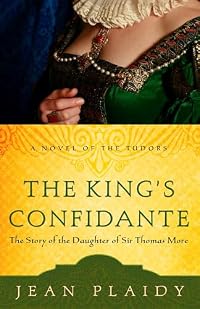
The King's Confidante: The Story of the Daughter of Sir Thomas More (A Novel of the Tudors)
by Jean Plaidy
Tudor Saga (6)
On This Page
Description
HTML:An English lawyer and statesman, Sir Thomas More was a kind father who put as much emphasis on educating his daughters as on his son, declaring that women were just as intelligent as men. His favorite daughter, Meg, is the heroine of this novel in which we witness the everyday lives of people in Tudor England. Plaidy takes readers into a world far removed from the grandeur of the courts, into the home of a simple family and a caring father who only wants to do what is morally best–not show more just for his family, but for England.As secretary and personal adviser to King Henry VIII, More becomes increasingly influential in the government, welcoming foreign diplomats, drafting official documents, and serving as a liaison between the king and the Archbishop of York. His own household stands in startling contrast to the licentious Tudor court, but as lord chancellor he gains recognition and becomes indispensable to the king. More’s love of faith surpasses his duty to the... Historical Fiction. Literature. Fiction. show less
Tags
Recommendations








Member Reviews
"St. Thomas's Eve" has some engaging scenes, along with a lot of bland scenes that should’ve been dramatized. Like with all Plaidy novels, this features a lot of repeated info and dry facts.
The main reason why her works are so dry is because there’s far too much *telling*, as opposed to *showing*. The reader is often told what happened in a few sentences, when the author could’ve dramatized scenes to show what happened.
An example of telling: >Margaret was his own child and he could never love any as he loved
her.tears began to flow silently down her cheeks.
The main reason why her works are so dry is because there’s far too much *telling*, as opposed to *showing*. The reader is often told what happened in a few sentences, when the author could’ve dramatized scenes to show what happened.
An example of telling: >Margaret was his own child and he could never love any as he loved
her.tears began to flow silently down her cheeks.
I enjoyed the book but not one of my favorites. The book described itself as the story of Thomas More and his family - primarily his relationship with his favorite daughter Meg. I did enjoy "learning" about the members of his family and his extended family and I have always admired Thomas More for he was one of the very few who stood firm against King Henry VIII in what he believed in which ultimately cost him his life but it just lacked something for me which is why I didn't give it 5 stars which I usually do with a Jean Plaidy book.
I was very excited for this book, since I love everything Tudor-related. However, I felt Plaidy undertook too much in this book, and as a result, we are left with a very superficial take on Thomas More's life.
Part of the problem stemmed from Plaidy's attempt to delve into the psyches of too many characters--Katherine, Thomas More, Queen Katherine, Jane, Alice, King Henry VIII, to name some. Such treatment leaves little room for character development, and I was never left with the impression of a fully developed character.
At times, the narrative seemed awkward. The style vacillated between very proper, "thou" and "thees" to more relaxed, improper style; there seemed to be no rhyme or reason between the vacillations.
Overall, I did not show more feel this book presented other viewpoints from the Tudor era. There are better written, more developed books over the Tudors out there. The idea of such a book from More's viewpoint is intruiging--but alas, we weren't given that with [The King's Confidante]. show less
Part of the problem stemmed from Plaidy's attempt to delve into the psyches of too many characters--Katherine, Thomas More, Queen Katherine, Jane, Alice, King Henry VIII, to name some. Such treatment leaves little room for character development, and I was never left with the impression of a fully developed character.
At times, the narrative seemed awkward. The style vacillated between very proper, "thou" and "thees" to more relaxed, improper style; there seemed to be no rhyme or reason between the vacillations.
Overall, I did not show more feel this book presented other viewpoints from the Tudor era. There are better written, more developed books over the Tudors out there. The idea of such a book from More's viewpoint is intruiging--but alas, we weren't given that with [The King's Confidante]. show less
The story begins with Thomas More’s decision to abandon his hopes of living the monastic life to opt for marriage and family life. He marries the very shy and less learned, Jane Colt. Together they have 4 children - the first-born, a daughter named Margaret (Meg), then Bessy, Cecily and finally, a son named Jack. They also adopt Mercy, who is Meg’s age.
More’s view on education was quite avant-garde for the times. More’s home is open, but not limited to, intellectuals who love to spend time at his place for conversation and discourse. An extremely rare notion back then, More believed that girls should be taught literature and be able to enjoy the same scholarly opportunities as men. He particularly loved the fact that Meg was so show more much like him- intelligent and compassionate. The two had a wonderful father –daughter relationship which clearly is noted throughout the novel. More, however, never lets on to show any preference for Meg since he always treated all of his children with special love and devotion.
When More’s first wife passes away, he shortly thereafter remarries a woman named Alice Middleton, who actually helped care for his dying wife. With the addition of Alice’s daughter, theirs becomes a full house of merriment, learning, studying and literature. Although More was a lawyer by profession, much of his interests and studies were focused on the Catholic faith and its teachings.
More lived an exemplary life according to the scriptures and the reasoning of the Church. He was much loved by all who knew him. His openness to understanding based upon ‘the teachings’ and his broad knowledge of the Law lead him to high places in the court of Henry VIII (then a staunch Catholic).
Along the years, all of his children married wonderful and respectable people. Alice enjoyed being the proud wife of Thomas More, Lord Chancellor. He was a favourite of the King. Known for his indisputably intact reputation, More’s opinions were respected and chided by all. So long as the King was in accordance with these opinions, More and his family lived a very fine life. Trouble began when the King’s views on a certain matrimonial matter did not match those of Thomas More.
From then on, the story of Thomas More and of his unfaltering and adamant stance for ‘doing what is morally right’ becomes a nightmare for him and his family. This much loved man was reduced to living in the lowest of conditions until he met his tragic fate.
I really enjoyed reading about such a fine man. Thomas More represents all that is wonderful and heroic in the fatherly sense. His morals and obligations towards a higher cause and the elevation of man through his spirituality and love of others are seen throughout the novel. I enjoyed everything about this novel and especially the More family life. How incredibly fortunate was this family to live in such unity and with so much love and kindness. Thomas More was a real life hero and role-model of the times.
This is the first Plaidy novel I read that has more to do with moral integrity rather than intrigue and royal complexities. A very different and reflective read- Loved it! show less
More’s view on education was quite avant-garde for the times. More’s home is open, but not limited to, intellectuals who love to spend time at his place for conversation and discourse. An extremely rare notion back then, More believed that girls should be taught literature and be able to enjoy the same scholarly opportunities as men. He particularly loved the fact that Meg was so show more much like him- intelligent and compassionate. The two had a wonderful father –daughter relationship which clearly is noted throughout the novel. More, however, never lets on to show any preference for Meg since he always treated all of his children with special love and devotion.
When More’s first wife passes away, he shortly thereafter remarries a woman named Alice Middleton, who actually helped care for his dying wife. With the addition of Alice’s daughter, theirs becomes a full house of merriment, learning, studying and literature. Although More was a lawyer by profession, much of his interests and studies were focused on the Catholic faith and its teachings.
More lived an exemplary life according to the scriptures and the reasoning of the Church. He was much loved by all who knew him. His openness to understanding based upon ‘the teachings’ and his broad knowledge of the Law lead him to high places in the court of Henry VIII (then a staunch Catholic).
Along the years, all of his children married wonderful and respectable people. Alice enjoyed being the proud wife of Thomas More, Lord Chancellor. He was a favourite of the King. Known for his indisputably intact reputation, More’s opinions were respected and chided by all. So long as the King was in accordance with these opinions, More and his family lived a very fine life. Trouble began when the King’s views on a certain matrimonial matter did not match those of Thomas More.
From then on, the story of Thomas More and of his unfaltering and adamant stance for ‘doing what is morally right’ becomes a nightmare for him and his family. This much loved man was reduced to living in the lowest of conditions until he met his tragic fate.
I really enjoyed reading about such a fine man. Thomas More represents all that is wonderful and heroic in the fatherly sense. His morals and obligations towards a higher cause and the elevation of man through his spirituality and love of others are seen throughout the novel. I enjoyed everything about this novel and especially the More family life. How incredibly fortunate was this family to live in such unity and with so much love and kindness. Thomas More was a real life hero and role-model of the times.
This is the first Plaidy novel I read that has more to do with moral integrity rather than intrigue and royal complexities. A very different and reflective read- Loved it! show less
Any of the Plaidy books having to do with the British Royalty is very highly recommended! She brings the characters to life and puts you right into the middle of all the action. You will cry, laugh, gasp and go through a whole range of emotions during her page-turners. Hey, just do it. You won't be sorry and you will be all the wiser in the end.
Even before I developed my obsession with Tudor England, I had a keen interest in Sir Thomas More. He’s always been a historical figure that stood out to me – someone that dared to openly defy King Henry VIII, fully knowing the consequences of doing so? That’s an admirable and curious man in my book. So when I realized that Plaidy, one of my favorite historical authors, wrote a book focusing on More’s life, I had to read it.
To read the rest of my review, please visit:
http://www.dorolerium.com/?p=1164
To read the rest of my review, please visit:
http://www.dorolerium.com/?p=1164
Members
- Recently Added By
Author Information

Jean Plaidy was a British writer who wrote under various pen names. Her real name is Eleanor Alice Burford Hibbert. She was born in London on September 1, 1906. Most of the books written as Jean Plaidy are historical romances based on English history featuring historical figures. The first, Beyond the Blue Mountains, was published in 1947. Hibbert show more also wrote five nonfiction histories and two children's books. Besides Jean Plaidy, Hibbert wrote under Victoria Holt, Phillipa Carr, Elbur Ford, Kathleen Kellow, Ellalice Tate, and her maiden name, Eleanor Burford. Hibbert died on January 18, 1993. (Bowker Author Biography) show less
Some Editions
Series

Work Relationships
Common Knowledge
- Original title
- St. Thomas' Eve
- Alternate titles
- The King's Confidante
- Original publication date
- 1954
- People/Characters
- Henry VIII, King of England; Margaret Roper; Thomas More; Margaret More; Mercy Gigs; Thomas Wolsey (Archbishop of York, 1471-1530) (show all 11); Cecily More; Elisabeth More; Jack More; Alice Middleton; Ailie Middleton
- Important places
- London, England, UK; Chelsea, London, England, UK
- Dedication
- With love to Enid and John Leigh-Hunt
- First words
- "And who is this man who dares oppose us?" demanded the King.
"And who is this man who dares oppose us?," demanded the King. - Quotations
- T'was a brave act I'll grant you; but there is a point in human nature where bravery may be called folly and folly, bravery.
- Last words
- (Click to show. Warning: May contain spoilers.)London Bridge was behind them, and they went swiftly up the river to Chelsea.
- Disambiguation notice
- Originally published as St. Thomas' Eve (1954); republished as The King's Confidante (2009).
Classifications
Statistics
- Members
- 319
- Popularity
- 99,546
- Reviews
- 7
- Rating
- (3.91)
- Languages
- Czech, English, Spanish
- Media
- Paper, Audiobook, Ebook
- ISBNs
- 16
- ASINs
- 14