On This Page
Description
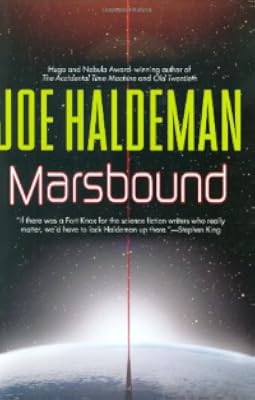
Young Carmen Dula and her family are about to embark on the adventure of a lifetime--they're going to Mars. Once on the Red Planet, however, Carmen realizes things are not so different from Earth. There are chores to do, lessons to learn, and oppressive authority figures to rebel against. And when she ventures out into the bleak Mars landscape alone one night, a simple accident leads her to the edge of death until she is saved by an angel--an angel with too many arms and legs, a head that show more looks like a potato gone bad, and a message for the newly arrived human inhabitants of Mars: We were here first.--From publisher description. show lessTags
Recommendations
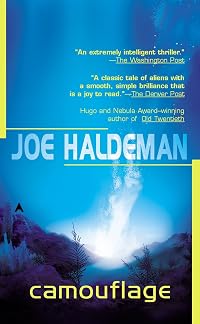













Member Recommendations

Member Reviews
Reviewing the full trilogy, (here be spoilers)...
#1 - Marsbound
Quite a good book and a very good opener to the trilogy. One of the more interesting aspects was the way Haldeman subtly managed to change the voice of the protagonist as she grew up from a teenage girl into a young woman. At the beginning of the story, Carmen Dula is leaving her Florida home to go live on Mars for a few years with her family. By the end of the book, she is a 'Martian', quarantined away from her home planet, and now facing a mission to another star system to try and deal with a vastly superior alien threat.
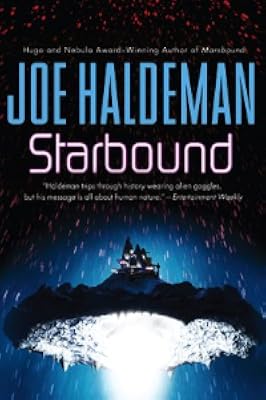
#2 - Starbound
A solid middle volume. The pace slackens a bit from the first novel but, considering it's mostly about a team of human emissaries traveling show more to another star system, it cruises along pretty well. There is some weird pseudo-science stuff that is essentially explained away using Clarke's Axiom; "Any sufficiently advanced science is indistinguishable from magic". Apart from that, the rest of the science in the book seems pretty solid while not getting in the way of keeping things moving forward, (note: I am not a rocket scientist so please don't lambaste me if the science is actually completely wonky).
Overall, this is a good book that carries the reader nicely from the end of Marsbound into the beginning of Earthbound.
#3 - Earthbound
The third book in the trilogy is a solid closing volume. The team has now returned from their trip to meet with The Others to find that the Earthly quarantine has been lifted. In this book therefore, most of the action takes place back on Terra. And there is a good amount of action. Haldeman paints a brutal and, to my mind, realistic picture of how things might progress should a scenario like this ever come to pass. Despite the grim narrative, the novel does end on a hopeful note.
The Trilogy (spoiler warning!)
A word about the entire trilogy: Haldeman takes the first-contact trope and stands it a bit on its' ear; Instead of humanity being initially out-classed by a vastly superior race and then somehow figuring a way to triumph through, y'know, "good old-fashioned human ingenuity & stuff", Haldeman imagines a scenario where humanity is not up to the task of overcoming the stacked odds. I've read many negative reviews of this series and, frankly, I don't get it. Does everyone want a happy ending all the time? The writing is smart, the characters are fairly well-developed - especially the protagonist, and the plot moves well throughout all three books. The situation is, quite honestly, about the most likely thing that we would face if another species happened to be keeping an eye on us. Think about it; A race of beings that have the ability to travel through interstellar space would realistically be so technologically advanced compared to us that, if they wanted to wipe us out, and we tried to fight back, it would be like a pack of squirrels trying to stop a bulldozer.
I give books #1 and #3 four solid stars each. Book #2 gets 3.25 stars and I average the trilogy at 3.75 overall. show less
#1 - Marsbound
Quite a good book and a very good opener to the trilogy. One of the more interesting aspects was the way Haldeman subtly managed to change the voice of the protagonist as she grew up from a teenage girl into a young woman. At the beginning of the story, Carmen Dula is leaving her Florida home to go live on Mars for a few years with her family. By the end of the book, she is a 'Martian', quarantined away from her home planet, and now facing a mission to another star system to try and deal with a vastly superior alien threat.
#2 - Starbound
A solid middle volume. The pace slackens a bit from the first novel but, considering it's mostly about a team of human emissaries traveling show more to another star system, it cruises along pretty well. There is some weird pseudo-science stuff that is essentially explained away using Clarke's Axiom; "Any sufficiently advanced science is indistinguishable from magic". Apart from that, the rest of the science in the book seems pretty solid while not getting in the way of keeping things moving forward, (note: I am not a rocket scientist so please don't lambaste me if the science is actually completely wonky).
Overall, this is a good book that carries the reader nicely from the end of Marsbound into the beginning of Earthbound.
#3 - Earthbound
The third book in the trilogy is a solid closing volume. The team has now returned from their trip to meet with The Others to find that the Earthly quarantine has been lifted. In this book therefore, most of the action takes place back on Terra. And there is a good amount of action. Haldeman paints a brutal and, to my mind, realistic picture of how things might progress should a scenario like this ever come to pass. Despite the grim narrative, the novel does end on a hopeful note.
The Trilogy (spoiler warning!)
A word about the entire trilogy: Haldeman takes the first-contact trope and stands it a bit on its' ear; Instead of humanity being initially out-classed by a vastly superior race and then somehow figuring a way to triumph through, y'know, "good old-fashioned human ingenuity & stuff", Haldeman imagines a scenario where humanity is not up to the task of overcoming the stacked odds. I've read many negative reviews of this series and, frankly, I don't get it. Does everyone want a happy ending all the time? The writing is smart, the characters are fairly well-developed - especially the protagonist, and the plot moves well throughout all three books. The situation is, quite honestly, about the most likely thing that we would face if another species happened to be keeping an eye on us. Think about it; A race of beings that have the ability to travel through interstellar space would realistically be so technologically advanced compared to us that, if they wanted to wipe us out, and we tried to fight back, it would be like a pack of squirrels trying to stop a bulldozer.
I give books #1 and #3 four solid stars each. Book #2 gets 3.25 stars and I average the trilogy at 3.75 overall. show less
I picked this one at random from a pile of samples and was totally sucked in. It’s a first person narrative of an eighteen year old girl who emigrates to Mars with her family in one of the first waves of colonists/explorers and then actually finds martians… sort of.
The science is pretty good, even for the martians (hence the “sort of”), and it was a lot of that minutiae that drew me in. No, it’s not page after page of technical exposition. Rather, it shows a lot of the “boring” day to day business of riding a space elevator up to an interplanetary ship, making the trip across the void, landing, and living in the harsh conditions of another planet. I suppose I liked it for many of the same reasons I enjoyed the daily show more details of Nathan Lowell’s Solar Clipper series, i.e. it made the fantastic life of space travel feel real without making it mundane. By the time we got to the “martians”, I was completely drawn into her personal world.
This book also comes close to one of my favorite kinds of conflict, where the bad guy isn’t really a bad guy, just that he is making decisions from his own values, and those decisions and actions end up conflicting with our hero’s goals. There are two bad guys in this. The first is a local administrator who is doing her best to protect the Mars outpost and humanity at large and who makes some bad calls in the process. The second is a distant group that is acting to protect itself at any cost with no apologies to those who get in the way.
In the end, heroes are heroic, bad guys are thwarted, and sacrifices are noble. It finishes with a semi-open happy ending, and I believe there are at least two sequels, so I may be looking at those soon. show less
The science is pretty good, even for the martians (hence the “sort of”), and it was a lot of that minutiae that drew me in. No, it’s not page after page of technical exposition. Rather, it shows a lot of the “boring” day to day business of riding a space elevator up to an interplanetary ship, making the trip across the void, landing, and living in the harsh conditions of another planet. I suppose I liked it for many of the same reasons I enjoyed the daily show more details of Nathan Lowell’s Solar Clipper series, i.e. it made the fantastic life of space travel feel real without making it mundane. By the time we got to the “martians”, I was completely drawn into her personal world.
This book also comes close to one of my favorite kinds of conflict, where the bad guy isn’t really a bad guy, just that he is making decisions from his own values, and those decisions and actions end up conflicting with our hero’s goals. There are two bad guys in this. The first is a local administrator who is doing her best to protect the Mars outpost and humanity at large and who makes some bad calls in the process. The second is a distant group that is acting to protect itself at any cost with no apologies to those who get in the way.
In the end, heroes are heroic, bad guys are thwarted, and sacrifices are noble. It finishes with a semi-open happy ending, and I believe there are at least two sequels, so I may be looking at those soon. show less
A Winston juvenile with sex. The opening brief chapters are told by a young girl being dragged off to Mars with her parents and younger brother. Eventually we learn she's 19 though the tone is slants much younger, in part because of a surprising lack of detail about the family, why they're going, what Earth society is like, why this is a thing etc. etc. It also reads young in that one of the tropes is the mean teacher -- I mean administrator -- who has it in for our heroine. The time spent in transit to the space elevator, then to orbit, then to Mars led to me think that the next volume would be life on Mars, but then events start to pile up and we meet aliens. This section also felt very much like a Winston juvenile. The aliens speak show more English and can pull a rabbit out of their hats when necessary.
All this apparent aiming for the juvenile market makes the sex part surprising. While not pornographic, there's direct discussion of erections and sexual positions, and it's a bit skeevy with her lover being 29 to her 19. The result is a book that seems too lacking in detail and depth for an adult reader, but equally too simplistic about human relationships for young adults.
While readable and fast-paced, I don't know who to recommend this to. show less
All this apparent aiming for the juvenile market makes the sex part surprising. While not pornographic, there's direct discussion of erections and sexual positions, and it's a bit skeevy with her lover being 29 to her 19. The result is a book that seems too lacking in detail and depth for an adult reader, but equally too simplistic about human relationships for young adults.
While readable and fast-paced, I don't know who to recommend this to. show less
I really liked this book! A great first-contact SF story, with a good female narrator.
18-year-old Carmen and her family have been selected to participate in the Mars Project - living on the planet's outpost for 5 years. When they arrive, Carmen attracts the ire of one of the post's administrators and spends a lot of time doing menial work. One day she rebels and takes an unauthorized walk on the planet's surface, alone. She is nearly mortally injured but saved by...an angel with a potato head and 4 limbs? Actually an alien. And that's where the fun begins!
18-year-old Carmen and her family have been selected to participate in the Mars Project - living on the planet's outpost for 5 years. When they arrive, Carmen attracts the ire of one of the post's administrators and spends a lot of time doing menial work. One day she rebels and takes an unauthorized walk on the planet's surface, alone. She is nearly mortally injured but saved by...an angel with a potato head and 4 limbs? Actually an alien. And that's where the fun begins!
“People who don’t know us might wonder why a kid with jet-black hair would be named Red.” – Carmen Dula, “Marsbound”
Unfortunately, this horrible instance of parental naming abuse continues as Carmen and her husband further add to Red’s future teenage angst by giving him the middle name “Mayfly”. In a way, “Marsbound” by Joe Haldeman is the story behind this unique naming. (And with a name like Red Mayfly, only a very good story would justify it.) Luckily, “Marsbound” is a very good story. It’s a simple, unpretentious first-contact styled sci-fi yarn that features an interesting take on Martian evolution. Not overly scientific, “Marsbound” is quite accessible to the casual science fiction reader providing show more a beautiful flowing narrative and minimal amounts of infodumps or exposition.
Written in the first person perspective of eighteen-year-old Carmen Dula, “Marsbound” starts with Carmen’s departure from Earth. Carmen and her family, which includes her parents who are both scientists and her younger brother Card, have been selected to journey to Mars and live there for at least five years. Like a lot of teenagers, Carmen is not particularly happy about leaving her life on Earth for the uncertainty and danger of living on Mars. (What do you mean there is no Internet? And where is the nearest Sephora?) On the eve of her departure, Carmen meets Paul Collins, the pilot of the John Carter of Mars which will transport her and her family to their eventual destination. Paul and Carmen hit it off and it isn’t too long in the journey before a romantic relationship ensues between them.
Finally arriving on Mars, Carmen receives a chilly reception from the antagonistic general administrator of the colony, Dargo Solingen. Dargo does not approve of the relationship between Paul and Carmen, and sets about keeping a strict eye on Carmen. Carmen chafes at this unwanted scrutiny, and one night she decides to get away from it all, exiting the colony so she can roam around the Martian landscape. Without any warning, an accident befalls Carmen and she finds herself stuck in a cave, unable to move, and slowly running out of oxygen. Miraculously, she is saved by an alien who heals her before returning her to the colony.
On her return, Carmen’s story about Martians is met with anticipated skepticism, particularly by Dargo. However little does she know, Carmen has brought back an infection which endangers the health of the community. The only hope eventually will be the Martians that Carmen claims live underground. But will she be able to convince them to help her and the others? And if she can secure their help, what other surprises do the Martians have in store for the colonists of Mars?
Easily the most impressive aspect of “Marsbound” is Haldeman’s expressive and smooth writing style. Simple in nature, the story flows easily and naturally, and the first-person characterization of the eighteen-year-old Carmen is dead-on. This is Carmen’s story, and that is clear throughout. The other characterizations are not nearly as well-defined. Interestingly, not much insight is given into the characters of her parents or her younger brother Card. Card, in particular, could have used a more expanded treatment in the novel, if only, to balance the presentation given by his sister’s narration. It might have proven intriguing to see the story from another viewpoint, and Haldeman has the characters to do this. However that would be an addition, and doesn’t detract from the story that is already here.
I don’t want to give too much away about some of the evolutionary aspects of the Martians since these are integral to the plot, but Haldeman does probably the most interesting speculative work in this area. Haldeman’s biological speculations are what raise “Marsbound” above an average first-contact type story, and completely justify the book as being a worthwhile read. That said, there is nothing particularly mind-blowing or awe-inspiring about “Marsbound” either. Ultimately, it’s a really solid novel (which is the very least you would expect from Joe Haldeman), and if some of the adult content (mostly sexual) had been removed, “Marsbound” would have made an impressive young adult book.
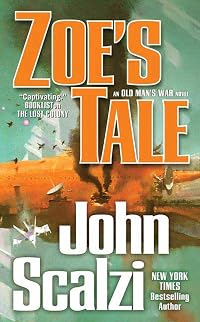
The stylistic simplicity of “Marsbound” reminds me of John Scalzi’s work, particularly his latest novel “Zoe’s Tale”. Both are easily accessible to mainstream audiences, have entertaining young female protagonists who embark on exciting adventures, and really have a beautiful flow to the narratives. There is more science in “Marsbound” than in Scalzi’s novel, but I can imagine Haldeman’s novel would appeal to fans of “Zoe’s Tale”. Both are fun, fast-paced, well-written and will keep you entertained.
Last Word:
“Marsbound” is a fine example of that science fiction staple, the first-contact-with-Martians story. Well executed and smoothly composed, the novel is an entertainment powerhouse, featuring a slick first-person characterization and cool biology. Solid in every aspect, Haldeman creates a story that never suffers a misstep or makes a wrong choice, and is really accessible to a broad audience. Haldeman scores once again, “Marsbound” is a clear winner. show less
Unfortunately, this horrible instance of parental naming abuse continues as Carmen and her husband further add to Red’s future teenage angst by giving him the middle name “Mayfly”. In a way, “Marsbound” by Joe Haldeman is the story behind this unique naming. (And with a name like Red Mayfly, only a very good story would justify it.) Luckily, “Marsbound” is a very good story. It’s a simple, unpretentious first-contact styled sci-fi yarn that features an interesting take on Martian evolution. Not overly scientific, “Marsbound” is quite accessible to the casual science fiction reader providing show more a beautiful flowing narrative and minimal amounts of infodumps or exposition.
Written in the first person perspective of eighteen-year-old Carmen Dula, “Marsbound” starts with Carmen’s departure from Earth. Carmen and her family, which includes her parents who are both scientists and her younger brother Card, have been selected to journey to Mars and live there for at least five years. Like a lot of teenagers, Carmen is not particularly happy about leaving her life on Earth for the uncertainty and danger of living on Mars. (What do you mean there is no Internet? And where is the nearest Sephora?) On the eve of her departure, Carmen meets Paul Collins, the pilot of the John Carter of Mars which will transport her and her family to their eventual destination. Paul and Carmen hit it off and it isn’t too long in the journey before a romantic relationship ensues between them.
Finally arriving on Mars, Carmen receives a chilly reception from the antagonistic general administrator of the colony, Dargo Solingen. Dargo does not approve of the relationship between Paul and Carmen, and sets about keeping a strict eye on Carmen. Carmen chafes at this unwanted scrutiny, and one night she decides to get away from it all, exiting the colony so she can roam around the Martian landscape. Without any warning, an accident befalls Carmen and she finds herself stuck in a cave, unable to move, and slowly running out of oxygen. Miraculously, she is saved by an alien who heals her before returning her to the colony.
On her return, Carmen’s story about Martians is met with anticipated skepticism, particularly by Dargo. However little does she know, Carmen has brought back an infection which endangers the health of the community. The only hope eventually will be the Martians that Carmen claims live underground. But will she be able to convince them to help her and the others? And if she can secure their help, what other surprises do the Martians have in store for the colonists of Mars?
Easily the most impressive aspect of “Marsbound” is Haldeman’s expressive and smooth writing style. Simple in nature, the story flows easily and naturally, and the first-person characterization of the eighteen-year-old Carmen is dead-on. This is Carmen’s story, and that is clear throughout. The other characterizations are not nearly as well-defined. Interestingly, not much insight is given into the characters of her parents or her younger brother Card. Card, in particular, could have used a more expanded treatment in the novel, if only, to balance the presentation given by his sister’s narration. It might have proven intriguing to see the story from another viewpoint, and Haldeman has the characters to do this. However that would be an addition, and doesn’t detract from the story that is already here.
I don’t want to give too much away about some of the evolutionary aspects of the Martians since these are integral to the plot, but Haldeman does probably the most interesting speculative work in this area. Haldeman’s biological speculations are what raise “Marsbound” above an average first-contact type story, and completely justify the book as being a worthwhile read. That said, there is nothing particularly mind-blowing or awe-inspiring about “Marsbound” either. Ultimately, it’s a really solid novel (which is the very least you would expect from Joe Haldeman), and if some of the adult content (mostly sexual) had been removed, “Marsbound” would have made an impressive young adult book.
The stylistic simplicity of “Marsbound” reminds me of John Scalzi’s work, particularly his latest novel “Zoe’s Tale”. Both are easily accessible to mainstream audiences, have entertaining young female protagonists who embark on exciting adventures, and really have a beautiful flow to the narratives. There is more science in “Marsbound” than in Scalzi’s novel, but I can imagine Haldeman’s novel would appeal to fans of “Zoe’s Tale”. Both are fun, fast-paced, well-written and will keep you entertained.
Last Word:
“Marsbound” is a fine example of that science fiction staple, the first-contact-with-Martians story. Well executed and smoothly composed, the novel is an entertainment powerhouse, featuring a slick first-person characterization and cool biology. Solid in every aspect, Haldeman creates a story that never suffers a misstep or makes a wrong choice, and is really accessible to a broad audience. Haldeman scores once again, “Marsbound” is a clear winner. show less
An old-fashioned science-fiction adventure, but no less enjoyable for its somewhat retro nature. For some reason I thought this was YA--I wouldn't call it that.
I was disappointed by Marsbound. It had a reasonably intriguing ending, but otherwise was pretty pedestrian. I found the science of the space elevator and the Mars journey and the Mars colony to be somewhat interesting, but both the protagonist, Carmen, and her adventures felt superficial and far from compelling. Perhaps I am not the intended audience for this book? It's not explicitly YA, and indeed the sex is more explicit than you would expect for YA, but the characterization and storytelling were definitely on the simple side.
Members
- Recently Added By
Author Information

191+ Works 30,867 Members
Joe Haldeman has uniquely blended a strong interest in astronomy and with his love for writing to publish numerous novels, anthologies and short stories over three decades. He holds a B.S. in astronomy from the University of Maryland (1967), and an M.F.A. in English from the Iowa Writers Workshop (1975). An adjunct professor at Massachusetts show more Institute of Technology, Haldeman has also taught at Michigan State, Larion West Seattle, SUNY Buffalo, Princeton, University of North Dakota, Kent State and the University of North Florida Haldeman's works include War Year (1972), The Forever War (1975), Worlds (1981), Worlds Apart (1983), Tools of the Trade (1987), and The Hemingway Hoax (1990). He has also co-authored and edited numerous works of science fiction. Born in Oklahoma on June 9, 1943, Haldeman grew up in Puerto Rico, New Orleans, Washington D.C., and Alaska. He was drafted into the military in 1967, fighting in the Central Highlands of Vietnam as a combat engineer with the 4th Division (1/22nd Airmobile Battalion), for which he received the Purple Heart, among other medals. (Bowker Author Biography) show less
Some Editions
Awards and Honors
Awards
Distinctions
Series

Work Relationships
Common Knowledge
- Original publication date
- 2008-08
- People/Characters
- Carmen Dula; Card Dula; Paul Collins; Red (alien); Green (alien)
- Important places
- Mars; Earth
- Epigraph
- The butterfly counts not months but moments,
and has time enough.
--- Rabindranath Tagore - Dedication
- For Carmen and Catalin,
our alien invaders. - First words
- It wasn't a lot of luggage for six years; for the longest journey anyone had ever taken.
- Last words
- (Click to show. Warning: May contain spoilers.)People who don’t know us might wonder why a kid with jet-black hair would be named Red.
- Blurbers
- King, Stephen; Straub, Peter
- Original language
- English
Classifications
Statistics
- Members
- 643
- Popularity
- 45,226
- Reviews
- 21
- Rating
- (3.44)
- Languages
- English, German, Spanish
- Media
- Paper, Audiobook, Ebook
- ISBNs
- 9
- ASINs
- 6