On This Page
Description
Trapped in rural Steeple Bumpleigh, a man less stalwart than Bertie Wooster would probably give way at the knees, for among those present were Florence Craye, to whom Bertie had once been engaged; her new fiancé "Stilton" Cheesewright, who sees Bertie as a snake in the grass; and that biggest blot on the landscape, Edwin the Boy Scout, who is busy doing acts of kindness out of sheer malevolence. All of Bertie's forebodings are fully justified, for in his efforts to oil the wheels of show more commerce, promote the course of true love, and avoid the consequences of a vendetta, he becomes the prey of all and sundry. In fact, only Jeeves can save him. show lessTags
Recommendations

















Member Reviews
I love listening to the audio editions of Wodehouse's Jeeves and Wooster series. Jonathan Cecil is my favorite narrator of these books. He manages to capture the bumbling confidence of Bertie Wooster and the confident competence of his valet Jeeves so perfectly.
As often happens in these books, Bertie is trying to ensure that a romance goes well for one of his friends while trying to avoid romantic entanglements himself. Of course it all goes spectacularly wrong and Jeeves is there to save the day.
The names in Wodehouse's books are always hilarious but this time around he outdid himself. Bertie and Jeeves travel to the village of Steeple Bumpleigh and the friend in need is D'Arcy "Stilton" Cheesewright. Both names just made me giggle show more every time they were mentioned.
I've now got The Hubster listening to this series. I'm looking forward to when he gets to this one. show less
As often happens in these books, Bertie is trying to ensure that a romance goes well for one of his friends while trying to avoid romantic entanglements himself. Of course it all goes spectacularly wrong and Jeeves is there to save the day.
The names in Wodehouse's books are always hilarious but this time around he outdid himself. Bertie and Jeeves travel to the village of Steeple Bumpleigh and the friend in need is D'Arcy "Stilton" Cheesewright. Both names just made me giggle show more every time they were mentioned.
I've now got The Hubster listening to this series. I'm looking forward to when he gets to this one. show less
This is another delightful instalment from the chronicles of Bertie Wooster and Jeeves.
I won't even attempt to summarise the plot. For one thing, it is, as always with P. G. Wodehouse's stories, incredibly complicated (although he always manages to resolve all the various threads), but also because when deconstructed it would simply sound very silly. Of course, it IS all extremely silly, but Wodehouse binds it all together in the most enchanting and beguiling way. His use of language, liberally sprinkled with Jeeves's quotations from the classics, and his endearing and enduring characters make the suspension of disbelief very simple.
I think that this particular book is one of the best in the Bertie Wooster and Jeeves series, and show more features a lot of the leading characters from the oeuvre: D'Arcy 'Stilton' Cheesewright, Lady Florence Cray, Edmund (the lethal boy scout) and Boko Fittleworth, while Bertie's fearsome Aunt Agatha (who is believed to wear barbed wire close to the skin) is hovering in the shadows. show less
I won't even attempt to summarise the plot. For one thing, it is, as always with P. G. Wodehouse's stories, incredibly complicated (although he always manages to resolve all the various threads), but also because when deconstructed it would simply sound very silly. Of course, it IS all extremely silly, but Wodehouse binds it all together in the most enchanting and beguiling way. His use of language, liberally sprinkled with Jeeves's quotations from the classics, and his endearing and enduring characters make the suspension of disbelief very simple.
I think that this particular book is one of the best in the Bertie Wooster and Jeeves series, and show more features a lot of the leading characters from the oeuvre: D'Arcy 'Stilton' Cheesewright, Lady Florence Cray, Edmund (the lethal boy scout) and Boko Fittleworth, while Bertie's fearsome Aunt Agatha (who is believed to wear barbed wire close to the skin) is hovering in the shadows. show less
This was one of the books Wodehouse wrote during the war, "about two-thirds" of it at Le Touquet in May and June 1940 whilst waiting for the Germans to decide what they were going to do with the British civilians, the rest of it in Germany after his release from internment. It was published in August 1946 in the US, June 1947 in Britain. Wodehouse and his publishers were nervous about the reception it would get after the accusations of collaboration brought against him during the war, especially in Britain, but reaction seems to have been largely positive on both sides of the Atlantic.
Despite — or perhaps because of — the troubled times it was written in, it's one of the warmest and sunniest of the Jeeves novels. For complicated show more reasons, Bertie has to visit Steeple Bumpleigh, not only the lair of his most fearsome aunt, Agatha, but also infested by Florence Craye, one of his deadliest ex-fiancées (she's the one who tried to get him to read Types of ethical theory), by her little brother Edwin the Boy Scout, and by the pumpkin-headed D'Arcy "Stilton" Cheesewright. To make matters worse, it appears that Stilton, wishing to assert his independence and earn a living by honest toil, has joined the Hampshire Constabulary and is now the village bobby.
There's a superbly complicated night-time garden scene that takes up the entire centre section of the book, making the last act of The Marriage of Figaro look trivially simple by comparison; there's a lot of business with costumes for a fancy dress ball, with some diamond bracelets, a porpentine, and a couple of incriminating letters; Bertie comes within a whisker of marriage and/or imprisonment, and of course joy cometh in the morning.
Maybe Bertie isn't on absolutely top form linguistically here, but there's still lots of his unique way of thinking about words and what they mean, and much of it is extremely funny.
When a girl uses six derogatory adjectives in her attempt to paint the portrait of the loved one, it means something. One may indicate a merely temporary tiff. Six is big stuff.
My copy is the 1946 Doubleday edition, with illustrations by Paul Galdone: it's fairly obvious that Wodehouse, still being stuck in Paris, wasn't given the chance to check the pictures. Bertie is made to look disturbingly like the Duke of Windsor, whilst Jeeves is given a striped waistcoat as though he were a footman. And they are both far too old, not that we ever really know what age Bertie is meant to be. show less
Despite — or perhaps because of — the troubled times it was written in, it's one of the warmest and sunniest of the Jeeves novels. For complicated show more reasons, Bertie has to visit Steeple Bumpleigh, not only the lair of his most fearsome aunt, Agatha, but also infested by Florence Craye, one of his deadliest ex-fiancées (she's the one who tried to get him to read Types of ethical theory), by her little brother Edwin the Boy Scout, and by the pumpkin-headed D'Arcy "Stilton" Cheesewright. To make matters worse, it appears that Stilton, wishing to assert his independence and earn a living by honest toil, has joined the Hampshire Constabulary and is now the village bobby.
There's a superbly complicated night-time garden scene that takes up the entire centre section of the book, making the last act of The Marriage of Figaro look trivially simple by comparison; there's a lot of business with costumes for a fancy dress ball, with some diamond bracelets, a porpentine, and a couple of incriminating letters; Bertie comes within a whisker of marriage and/or imprisonment, and of course joy cometh in the morning.
Maybe Bertie isn't on absolutely top form linguistically here, but there's still lots of his unique way of thinking about words and what they mean, and much of it is extremely funny.
When a girl uses six derogatory adjectives in her attempt to paint the portrait of the loved one, it means something. One may indicate a merely temporary tiff. Six is big stuff.
My copy is the 1946 Doubleday edition, with illustrations by Paul Galdone: it's fairly obvious that Wodehouse, still being stuck in Paris, wasn't given the chance to check the pictures. Bertie is made to look disturbingly like the Duke of Windsor, whilst Jeeves is given a striped waistcoat as though he were a footman. And they are both far too old, not that we ever really know what age Bertie is meant to be. show less
This review is written with a GPL 4.0 license and the rights contained therein shall supersede all TOS by any and all websites in regards to copying and sharing without proper authorization and permissions. Crossposted at WordPress, Blogspot & Librarything by Bookstooge’s Exalted Permission
Title: Joy in the Morning
Series: The Jeeves Omnibus #2.2
Author: P.G. Wodehouse
Rating: 3.5 of 5 Stars
Genre: Humor
Pages: 272
Format: Digital Edition
Synopsis:
Bertie gets roped into going to Bumpleigh in the Country to help his Uncle by marriage close a business deal with an American Magnate. At the same time Bertie is supposed to help his cousin get said Uncle's blessing to marry a rich novelist who the Uncle dislikes immensely (for good reason). Then show more Bertie gets engaged to a woman who he was engaged to a year or two ago and who broke off her engagement to a policeman who was one of Bertie's old classmates. Said Classmate is a sack of man-meat and looking for any excuse to jail Birtie.
Throw in a nephew whose every act of kindness turns into some kind of disaster, a country ball where Bertie wears a stolen police uniform and midnight escapades and you have this novel in a pinch.
My Thoughts:
More of the same, more of the same.
At this point, if you've made it this far you know you're going to keep on going with the series. If this wasn't for you (Yes, I'm looking at you, Miiiiiiister Newton!), you'd have given up sometime during the first omnibus.
Spineless Bertie can't act like a man for 2 seconds. Which leads to humorous situations that only Jeeves can manipulate him out of for the betterment of everyone involved. The thing is, as a reader you HAVE to accept the stupidity of Bertie to enjoy this series. Not malicious stupidity but plain old genetic dumb-assery. If you can't get past that, and I don't blame anyone who can't, this just isn't for you.
But if “rich people having problems” can amuse you, you'll just keep eating these books up. Wodehouse obviously has a limited repertoire of situations he can bother Bertie with (the main one getting married) but they are still of good variety.
Sit back and chuckle and enjoy Bertie being a dumbass. Because Jeeves is the benevolent force of nature behind the scenes making sure that everything turns out alright.
★★★☆½ show less
Title: Joy in the Morning
Series: The Jeeves Omnibus #2.2
Author: P.G. Wodehouse
Rating: 3.5 of 5 Stars
Genre: Humor
Pages: 272
Format: Digital Edition
Synopsis:
Bertie gets roped into going to Bumpleigh in the Country to help his Uncle by marriage close a business deal with an American Magnate. At the same time Bertie is supposed to help his cousin get said Uncle's blessing to marry a rich novelist who the Uncle dislikes immensely (for good reason). Then show more Bertie gets engaged to a woman who he was engaged to a year or two ago and who broke off her engagement to a policeman who was one of Bertie's old classmates. Said Classmate is a sack of man-meat and looking for any excuse to jail Birtie.
Throw in a nephew whose every act of kindness turns into some kind of disaster, a country ball where Bertie wears a stolen police uniform and midnight escapades and you have this novel in a pinch.
My Thoughts:
More of the same, more of the same.
At this point, if you've made it this far you know you're going to keep on going with the series. If this wasn't for you (Yes, I'm looking at you, Miiiiiiister Newton!), you'd have given up sometime during the first omnibus.
Spineless Bertie can't act like a man for 2 seconds. Which leads to humorous situations that only Jeeves can manipulate him out of for the betterment of everyone involved. The thing is, as a reader you HAVE to accept the stupidity of Bertie to enjoy this series. Not malicious stupidity but plain old genetic dumb-assery. If you can't get past that, and I don't blame anyone who can't, this just isn't for you.
But if “rich people having problems” can amuse you, you'll just keep eating these books up. Wodehouse obviously has a limited repertoire of situations he can bother Bertie with (the main one getting married) but they are still of good variety.
Sit back and chuckle and enjoy Bertie being a dumbass. Because Jeeves is the benevolent force of nature behind the scenes making sure that everything turns out alright.
★★★☆½ show less
In his latest novel "The Director", German star author Daniel Kehlmann lets an English movie critic by the name of Rupert Wooster appear. As the only international attendee of a movie premiere in Salzburg in 1942 - right in the middle of World War II - Wooster engages in an English conversation that is a wonderful mix of eloquence and humour on the Wooster side, and misunderstandings due to broken English on the German guests' side. As this was one of the funniest literary chapters I've read in a long time, I wondered whether there was a real counterpart to Rupert Wooster. And of course there was! Even though I knew nothing about P. G. Wodehouse and his humouristic Wooster-Jeeves novels (I am German and P. G. Wodehouse isn't exactly show more famous among German readers in the 2020's), it wasn't very difficult to find out about Wodehouse's internment in Berlin and about Kehlmanns's ingenious idea to let Wodehouse appear as a relative of one of his main protagonists Bertie Wooster, only to have a conversation that is very much like a conversation in a Wodehouse novel.
Curious to find out more about Wodehouse and his literature, I decided to read "Joy in the morning", the book that made it into a top-100 list of English novels in the Guardian. This proved to be an excellent choice. Although I must admit that Wodehouse is a bit of a vocabulary and verbal phrase challenge to a non-native speaker, it certainly is also great joy to read. While I am not sure whether this book is an appropriate trainer for everyday conversation, I think it is the best compilation of English humour based on play on words that I have ever read. The plot reminds of a theatre comedy, as it develops around conversations among people that all know each other and have clear roles assigned to them. In the end, butler Jeeves solves it all. I am very thankful to Daniel Kehlmann for having directed my attention to P. G. Wodehouse. Indeed, it is "Joy in the morning" that Wodehouse began before and finished shortly after his internment in Nazi Germany. This book is the perfect link to Kehlmann's tribute to P. G. Wodhouse's humour in "The Director", and it is a wonderful "getting to know the original Wodehouse humour" experience. show less
Curious to find out more about Wodehouse and his literature, I decided to read "Joy in the morning", the book that made it into a top-100 list of English novels in the Guardian. This proved to be an excellent choice. Although I must admit that Wodehouse is a bit of a vocabulary and verbal phrase challenge to a non-native speaker, it certainly is also great joy to read. While I am not sure whether this book is an appropriate trainer for everyday conversation, I think it is the best compilation of English humour based on play on words that I have ever read. The plot reminds of a theatre comedy, as it develops around conversations among people that all know each other and have clear roles assigned to them. In the end, butler Jeeves solves it all. I am very thankful to Daniel Kehlmann for having directed my attention to P. G. Wodehouse. Indeed, it is "Joy in the morning" that Wodehouse began before and finished shortly after his internment in Nazi Germany. This book is the perfect link to Kehlmann's tribute to P. G. Wodhouse's humour in "The Director", and it is a wonderful "getting to know the original Wodehouse humour" experience. show less
Another delightful instalment from the chronicles of Bertie Wooster and Jeeves.
I won't bother to summarise the plot. For one thing, it is, as usual with Wodehouse's stories, incredibly complicated (though he always managed to resolve all the various threads), but also because when deconstructed it would simply sound very silly. Of course it IS all very silly, but Wodehouse binds it all together in the most enchanting and beguiling way. His use of language, liberally sprinkled with Jeeves's quotations from the classics, and his endearing and enduring characters make the suspension of disbelief very simple.
This particular book is one of the best in the Bertie Wooster and Jeeves series, and features a lot of the leading characters from the show more oeuvre: D'Arcy 'Stilton' Cheesewright, Lady Florence Cray, Edmund (the lethal boy scout) and Boko Fittleworth, and Bertie's fearsome Aunt Agatha (who is believed to wear barbed wire close to the skin) is hovering in the shadows. show less
I won't bother to summarise the plot. For one thing, it is, as usual with Wodehouse's stories, incredibly complicated (though he always managed to resolve all the various threads), but also because when deconstructed it would simply sound very silly. Of course it IS all very silly, but Wodehouse binds it all together in the most enchanting and beguiling way. His use of language, liberally sprinkled with Jeeves's quotations from the classics, and his endearing and enduring characters make the suspension of disbelief very simple.
This particular book is one of the best in the Bertie Wooster and Jeeves series, and features a lot of the leading characters from the show more oeuvre: D'Arcy 'Stilton' Cheesewright, Lady Florence Cray, Edmund (the lethal boy scout) and Boko Fittleworth, and Bertie's fearsome Aunt Agatha (who is believed to wear barbed wire close to the skin) is hovering in the shadows. show less
“Joy in the Morning” beats all previous books in the Jeeves series in terms of hilarity.
P. G. Wodehouse’s concocts some wonderful confrontations between characters, which makes for great fun and laughter.
My favourite scene is where Uncle Percy is taking a quiet stroll in his garden, only to keep meeting people; an annoyance that's topped when Boko shows up and informs everyone he’s just locked a burglar in the potting shed. Fantastic stuff.
This is a dashed good read, what?
P. G. Wodehouse’s concocts some wonderful confrontations between characters, which makes for great fun and laughter.
My favourite scene is where Uncle Percy is taking a quiet stroll in his garden, only to keep meeting people; an annoyance that's topped when Boko shows up and informs everyone he’s just locked a burglar in the potting shed. Fantastic stuff.
This is a dashed good read, what?
Members
- Recently Added By
Lists

The Guardian's 1000 Novels Everyone Must Read
1,005 works; 549 members

Books I've Read More Than Once
602 works; 49 members

Folio Society
831 works; 48 members

Top Five Books of 2014
1,064 works; 398 members

The Guardian's 100 Best Novels Written in English
105 works; 13 members

A Novel Cure
742 works; 23 members

Ambleside Books
459 works; 18 members

Alphabetical Books
211 works; 3 members
Books With Our Favorite First Lines
168 works; 104 members

Books Read in 2011
684 works; 20 members
Author Information

655+ Works 110,474 Members
P. G. Wodehouse was born in Guildford, United Kingdom on October 15, 1881. After completing school, he spent two years as a banker at the Hong Kong and Shanghai Bank in London and then took a job as a sports reporter and columnist for the Globe newspaper. His first novel, The Pothunters, was published in 1902. He wrote over 100 novels and short show more story collections during his lifetime including A Perfect Uncle, Love Among the Chickens, The Swoop, P. Smith in the City, Meet Mr. Milliner, Doctor Sally, Quick Service, The Old Reliable, Uneasy Money, A Damsel in Distress, Jill the Reckless, The Adventures of Sally, A Pelican at Blandings, The Girl in Blue, and Aunts Aren't Gentlemen. His most famous characters, Bertie Wooster and his manservant, Jeeves, appeared in books such as Much Obliged, Jeeves. He also wrote lyrics for musical comedies and worked as screenwriter in Hollywood in the 1930s. In 1939, he bought a villa in Le Touquet on the coast of France. He remained there when World War II started in 1939. The following year, the Germans appropriated the villa, confiscated property, and arrested him. He was detained in various German camps for almost one year before being released in 1941. He went to Berlin and spoke of his experience in five radio talks to be broadcast to America and England. The talks themselves were completely innocuous, but he was charged with treason in England. He was cleared, but settled permanently in the United States. He became a citizen in 1955. He was made a Knight Commander of the Order of the British Empire in 1975. He died from a heart attack after a long illness on February 14, 1975 at the age of 93. (Bowker Author Biography) show less
Some Editions
Awards and Honors
Series

Belongs to Publisher Series
Compactos Anagrama (29)
Work Relationships
Common Knowledge
- Canonical title
- Joy in the Morning
- Original title
- Joy in the Morning
- Alternate titles
- Jeeves in the Morning
- Original publication date
- 1947
- People/Characters
- Bertram Wilberforce Wooster (Bertie); Reginald Jeeves; Florence Craye; Lord Percival Worplesdon; Harold 'Stilton' Cheesewright; Edwin Craye (show all 10); George Webster Fittleworth (Boko); Zenobia Hopwood (Nobby); J. Chichester Clam; Agatha Gregson (Aunt Agatha, later Lady Worplesdon)
- Important places
- Steeple Bumpleigh
- First words
- After the thing was all over, when peril had ceased to loom and happy endings had been distributed in heaping handfuls and we were driving home with our hats on the side of our heads, having shaken the dust of Steeple Bumplei... (show all)gh from our tyres, I confessed to Jeeves that there had been moments during the recent proceedings when Bertram Wooster, though no weakling, had come very near to despair.
- Quotations
- [Jeeves:] '....Her ladyship wishes you to convey it to its destination personally, realizing that, should she entrust it to the ordinary channels, the gift will be delayed in its arrival beyond the essential date.'
[Berti... (show all)e:] 'You mean if she posts it, it won't get there in time?'
[Jeeves:] 'Precisely, sir.' [p. 37]
'Edwin did that. There's a lad, Jeeves. There's a boy who makes you feel that what this country wants is somebody like King Herod.' - Last words
- (Click to show. Warning: May contain spoilers.)But we went into all that before, didn't we?
- Original language
- English
- Disambiguation notice
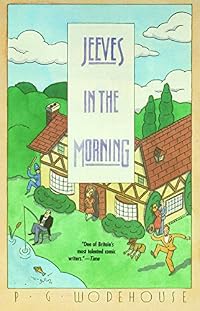
- UK title "Joy in the Morning", originally published in the US as "Jeeves in the Morning"
Classifications
Statistics
- Members
- 2,390
- Popularity
- 8,135
- Reviews
- 41
- Rating
- (4.22)
- Languages
- 9 — Catalan, Dutch, English, Finnish, French, German, Italian, Russian, Spanish
- Media
- Paper, Audiobook, Ebook
- ISBNs
- 60
- UPCs
- 2
- ASINs
- 30