On This Page
Description
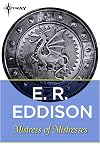
The first volume in the classic epic trilogy of parallel worlds, admired by Tolkien and the great prototype for The Lord of the Rings and modern fantasy fiction. According to legend, the Gates of Zimiamvia lead to a land 'that no mortal foot may tread, but that souls of the dead that were great upon earth do inhabit.' Here they forever live, love, do battle, and even die again. Edward Lessingham - artist, poet, king of men and lover of women - is dead. But from Aphrodite herself, the show more Mistress of Mistresses, he has earned the promise to live again with the gods in Zimiamvia in return for her own perilous future favours. This sequel to The Worm Ouroboros recounts the story of Lessingham's first day in this strange Valhalla, where a lifetime is a day and where - among enemies, enchantments, guile and triumph - his destiny can be rewritten. show lessTags
Recommendations
















Member Reviews
Like [b:The Worm Ouroboros|2910|The Worm Ouroboros |E.R. Eddison|http://photo.goodreads.com/books/1230531823s/2910.jpg|955522] _Mistress of Mistresses_ is a book that only E. R. Eddison could have written and is one that is likely to garner an even smaller following than the admittedly obscure Worm. For my part I think that this book, and its subsequent sequels that make up the Zimiamvian Trilogy, is perhaps Eddison’s best work. It may not be as approachable as the Worm (and boy is that saying something!), but I think its greater depth and scope make for what amounts to a truly impressive achievement.
The main character is Edward Lessingham, that enigmatic figure last seen in the prologue to the Worm whose dream sequence led us to show more Eddison’s Mercury and then, to most reader’s disdain and confusion, was promptly dropped. The only other obvious link between the works is in a short scene in the Worm with Lord Juss and Brandoch Daha after the two have climbed the mountain Koshtra Pivrarcha and look into the distance where they can see and ponder upon:
This scene, I think, is key to understanding the trilogy, and indeed Eddison’s worldview which permeates all of his work; more on that later.
As with the Worm we again have a prologue that moves from what seems to be our world to another and it may appear in some ways divorced from what follows, though this one is much more clearly linked to the fantasy world that makes up the rest of the book. In this prologue yet another character never to be seen again is introduced to us, a friend of Edward Lessingham’s who sits by the latter’s death-bed as the years catch up with him and reminisces about his meeting and subsequent adventures with the great man. A hidden portrait is revealed and an enigmatic poem is read and then the book proper begins as we are placed squarely next to a young Lessingham dreamily staring into a goblet of wine as his aide-de-camp Amaury berates him for a particularly impolitic deed. From here on in we will follow Lessignham in his adventures in the fabled land of Zimiamvia where an old and ruthless king has died and his somewhat less able son sits precariously upon the throne.
The basic outline of the story that follows is of the simplest: varying groups are vying for power as the long-established stranglehold of the dead King Mezentius is loosened and opportunity arises for the powerful and the clever. What elevates this story above a mere kingdom-squabbling fantasy, in my mind at least, are the characters. As the story unfolds we are introduced to a large cast of characters, each vying in different ways to be masters of their circumstances and all of whom are to play significant parts in the intrigues that follow. These characters are almost all equally fascinating (with the one glaring exception of Antiope who is something of a pill) and they live, die, love and breath with such gusto and power that it is hard not to fall in love with them a little. In addition to the heroic and danger-loving Lessingham these characters include the Duke Barganax, an illegitimate son of the dead king whose martial prowess and valour are only superseded by his love of luxury and culture; Barganax’s lover Fiorinda, a mysterious and alluring femme fatale whose very being seems to harbour secrets about the nature of existence; Dr. Vandermast a strange old courtier of the Duke’s whose learning is almost as opaque to the characters of the novel as it is to the reader and whose role in the story is nearly as mysterious as that of Fiorinda; Princess Antiope, daughter of Mezentius and possible pawn to a host of would-be regents; and last, but best, of all Horius Parry, the Vicar of Rerek, cousin-german of Lessingham, and perhaps the most delightful (dare I say delicious?) villain I have ever encountered. Pug-faced and pugnacious, the Vicar is a man we love to hate (or maybe hate to love). Bull-necked, hot-blooded and quick-tempered, the Vicar can appear on the surface to be little more than a ham-handed thug, but beneath his bristly scalp is a clever mind able to take nearly any circumstance and turn it to his benefit. Almost as good are his sycophantic and sly major domo Gabriel Flores and his pack of man-eating hounds.
Lessingham, much to the chagrin of his noble friend and lieutenant Amaury, has thrown in with his cousin the Vicar and has set himself on a knife’s edge path of trying to both fulfil his obligations to his cousin while steering these plans towards ends that will allow his own noble conscience to be satisfied. It’s a fascinating relationship as each views the other as perhaps his only valid peer and seems to hold the other in an equal amount of loving admiration and disdainful hatred. The back and forth of their machinations as each tried to retain the assistance of the other while maintaining the upper hand is fascinating and were probably my favourite parts of the book. Next would be the scenes in Barganax’s court where many of the intrigues revolving around the throne of Mezentius are hatched and we watch as the man viewed by many as a pleasure-loving fop shows himself to be a dangerous man to cross and whose role in the coming conflict will be pivotal.
Spread amongst these conspiracies and outright battles runs a strange vein of philosophical and cosmological musing based on Eddison’s own eccentric flavour of Spinozan philosophy and centring on the figures of Vandermast and Fiorinda wherein all of the events of the novel seem to be nothing more than the manifestations of the desires of the goddess Aphrodite and her lover. This is where things get weird and I imagine most readers are lost. Hints and innuendo are constantly dropped throughout the story that Lessingham, Antiope, Barganax, and Fiorinda are each manifestations of these celestial figures for whom the world of Zimiamvia was brought into existence by Vandermast as a playground wherein they might be free to experience their heart’s desires free from the ennui of godhood and immortality. Thus heroic struggle, undying but dangerous love, and the chance to both fail and succeed epically are central to everything these characters undertake. Much like the conclusion to the Worm, wherein paradise was the ability to love, hate, and fight against the greatest odds, here we have the same philosophy writ even larger and expounded upon in some detail. As I noted many readers will likely be turned off by this, either because (like Tolkien) they may find Eddison’s morality distasteful, or they simply find the long-winded and opaque meanderings of Vandermast boring. I can’t say that these are my favourite parts of the book, but upon multiple readings I have found them to be essential to the tale, and they certainly give to what might otherwise be seen as little more than an adventure power-fantasy an essence that elevates it into something a bit more substantial. The story proper of _Mistress of Mistresses_ ends in media res, and in a way that would be fully unexpected of anyone save Eddison, for here the worm ouroboros again rears his scaly head and the endless cycle of death and life, the movement from one pinnacle of great deeds leading to a paradise wherein they are re-enacted or even bettered, is again brought forth. It’s great, heady, and very weird stuff. show less
The main character is Edward Lessingham, that enigmatic figure last seen in the prologue to the Worm whose dream sequence led us to show more Eddison’s Mercury and then, to most reader’s disdain and confusion, was promptly dropped. The only other obvious link between the works is in a short scene in the Worm with Lord Juss and Brandoch Daha after the two have climbed the mountain Koshtra Pivrarcha and look into the distance where they can see and ponder upon:
…the fabled land of Zimiamvia. Is it true, thinkest thou, which philosophers tell us of that fortunate land: that no mortal foot may tread it, but the blessed souls do inhabit it of the dead that be departed, even they that were great upon earth and did great deeds when they were living, that scorned not earth and the delights and glories thereof, and yet did justly and were not dastards nor yet oppressors?
This scene, I think, is key to understanding the trilogy, and indeed Eddison’s worldview which permeates all of his work; more on that later.
As with the Worm we again have a prologue that moves from what seems to be our world to another and it may appear in some ways divorced from what follows, though this one is much more clearly linked to the fantasy world that makes up the rest of the book. In this prologue yet another character never to be seen again is introduced to us, a friend of Edward Lessingham’s who sits by the latter’s death-bed as the years catch up with him and reminisces about his meeting and subsequent adventures with the great man. A hidden portrait is revealed and an enigmatic poem is read and then the book proper begins as we are placed squarely next to a young Lessingham dreamily staring into a goblet of wine as his aide-de-camp Amaury berates him for a particularly impolitic deed. From here on in we will follow Lessignham in his adventures in the fabled land of Zimiamvia where an old and ruthless king has died and his somewhat less able son sits precariously upon the throne.
The basic outline of the story that follows is of the simplest: varying groups are vying for power as the long-established stranglehold of the dead King Mezentius is loosened and opportunity arises for the powerful and the clever. What elevates this story above a mere kingdom-squabbling fantasy, in my mind at least, are the characters. As the story unfolds we are introduced to a large cast of characters, each vying in different ways to be masters of their circumstances and all of whom are to play significant parts in the intrigues that follow. These characters are almost all equally fascinating (with the one glaring exception of Antiope who is something of a pill) and they live, die, love and breath with such gusto and power that it is hard not to fall in love with them a little. In addition to the heroic and danger-loving Lessingham these characters include the Duke Barganax, an illegitimate son of the dead king whose martial prowess and valour are only superseded by his love of luxury and culture; Barganax’s lover Fiorinda, a mysterious and alluring femme fatale whose very being seems to harbour secrets about the nature of existence; Dr. Vandermast a strange old courtier of the Duke’s whose learning is almost as opaque to the characters of the novel as it is to the reader and whose role in the story is nearly as mysterious as that of Fiorinda; Princess Antiope, daughter of Mezentius and possible pawn to a host of would-be regents; and last, but best, of all Horius Parry, the Vicar of Rerek, cousin-german of Lessingham, and perhaps the most delightful (dare I say delicious?) villain I have ever encountered. Pug-faced and pugnacious, the Vicar is a man we love to hate (or maybe hate to love). Bull-necked, hot-blooded and quick-tempered, the Vicar can appear on the surface to be little more than a ham-handed thug, but beneath his bristly scalp is a clever mind able to take nearly any circumstance and turn it to his benefit. Almost as good are his sycophantic and sly major domo Gabriel Flores and his pack of man-eating hounds.
Lessingham, much to the chagrin of his noble friend and lieutenant Amaury, has thrown in with his cousin the Vicar and has set himself on a knife’s edge path of trying to both fulfil his obligations to his cousin while steering these plans towards ends that will allow his own noble conscience to be satisfied. It’s a fascinating relationship as each views the other as perhaps his only valid peer and seems to hold the other in an equal amount of loving admiration and disdainful hatred. The back and forth of their machinations as each tried to retain the assistance of the other while maintaining the upper hand is fascinating and were probably my favourite parts of the book. Next would be the scenes in Barganax’s court where many of the intrigues revolving around the throne of Mezentius are hatched and we watch as the man viewed by many as a pleasure-loving fop shows himself to be a dangerous man to cross and whose role in the coming conflict will be pivotal.
Spread amongst these conspiracies and outright battles runs a strange vein of philosophical and cosmological musing based on Eddison’s own eccentric flavour of Spinozan philosophy and centring on the figures of Vandermast and Fiorinda wherein all of the events of the novel seem to be nothing more than the manifestations of the desires of the goddess Aphrodite and her lover. This is where things get weird and I imagine most readers are lost. Hints and innuendo are constantly dropped throughout the story that Lessingham, Antiope, Barganax, and Fiorinda are each manifestations of these celestial figures for whom the world of Zimiamvia was brought into existence by Vandermast as a playground wherein they might be free to experience their heart’s desires free from the ennui of godhood and immortality. Thus heroic struggle, undying but dangerous love, and the chance to both fail and succeed epically are central to everything these characters undertake. Much like the conclusion to the Worm, wherein paradise was the ability to love, hate, and fight against the greatest odds, here we have the same philosophy writ even larger and expounded upon in some detail. As I noted many readers will likely be turned off by this, either because (like Tolkien) they may find Eddison’s morality distasteful, or they simply find the long-winded and opaque meanderings of Vandermast boring. I can’t say that these are my favourite parts of the book, but upon multiple readings I have found them to be essential to the tale, and they certainly give to what might otherwise be seen as little more than an adventure power-fantasy an essence that elevates it into something a bit more substantial. The story proper of _Mistress of Mistresses_ ends in media res, and in a way that would be fully unexpected of anyone save Eddison, for here the worm ouroboros again rears his scaly head and the endless cycle of death and life, the movement from one pinnacle of great deeds leading to a paradise wherein they are re-enacted or even bettered, is again brought forth. It’s great, heady, and very weird stuff. show less
A very, very different book from Eddison's most famous work [The Worm Ouroborous]. The character of Lessingham is in both books, though in this one he is returned from death into a vibrant life lived on the same world, Zimiamvia. Instead of one great adventure and travel after another with mythical creatures, this book has Lessingham and his allies in friction with the bastard son of the late king. There are a number of different leaders and lesser men, a Vicar who serves as the power to the young king, and many, many beautiful women in their own kingdoms.
Perhaps it is correct to say this book is a successor to "Ouroborous" but I would hazard that it is much less a successor than an addendum. The world presented here has very little show more bearing on the world of Goldry Bluzco. The shifting alliances, the dalliances, the attempts by the king to woo his lady love (who does not want him), the Queen and her lovely young friend, all are characters presented in a work without the Elizabethan English that so captivated me in "Ouroborous." While there is an index at the back of when a character is first mentioned, it is often not the first mention that drives the story and this convoluted tale becomes increasingly hard to follow and less and less interesting as it progresses. show less
Perhaps it is correct to say this book is a successor to "Ouroborous" but I would hazard that it is much less a successor than an addendum. The world presented here has very little show more bearing on the world of Goldry Bluzco. The shifting alliances, the dalliances, the attempts by the king to woo his lady love (who does not want him), the Queen and her lovely young friend, all are characters presented in a work without the Elizabethan English that so captivated me in "Ouroborous." While there is an index at the back of when a character is first mentioned, it is often not the first mention that drives the story and this convoluted tale becomes increasingly hard to follow and less and less interesting as it progresses. show less
One of the greatest fantasy novels ever written, though less read because Eddison chosen to write it in a high renaissance style of English. It concerns a power struggle between Duke Barganax of Zayana, bastard of the late king Mezentius, and Horius Parry, Vicar of Rerek in the middle part of Mezentius' empire, who is back by his kinsman Lessingham. Both Barganax and Lessingham are in some sense avatars of an Englishman named Lessingham, and their respective lovers (Fiorinda and Antiope) are in some sense avatars of the goddess Aphrodite. The Eddison decided to work backwards from this srory instead of forwards, the later books in this series (A Fish Dinner in Memison and The Mezentian Gate describe earlier events in the history of show more Zimiamvia in the reign of Mezentius. show less
That was a tough read. Nothing like the Worm other than it's complexity, it did not endear itself to me at all though as it's predecessor did.
Could someone PuLEASE tell me what is supposed to be going on in this ...book?
There are (many) passages that remind me of the idea of giving a monkey access to a typewriter, and enough time, and he is bound to write a work of Shakespeare. This must have been one of the random works produced along the way...
There is one good idea in among the waffle, but I am in no way prepared to claim it worth all the pain. Just in case you think my half star is awarded for that one idea: it is NOT, I would award negative stars if I could.
To those who rave about it on Amazon: are you trying to make others suffer as you have suffered???
There are (many) passages that remind me of the idea of giving a monkey access to a typewriter, and enough time, and he is bound to write a work of Shakespeare. This must have been one of the random works produced along the way...
There is one good idea in among the waffle, but I am in no way prepared to claim it worth all the pain. Just in case you think my half star is awarded for that one idea: it is NOT, I would award negative stars if I could.
To those who rave about it on Amazon: are you trying to make others suffer as you have suffered???
First book in the Zimiamvian trilogy, and the best. Eddison uses this novel to begin to expound his esoteric philosophy.
That was a tough read. Nothing like the Worm other than it's complexity, it did not endear itself to me at all though as it's predecessor did.
Members
- Recently Added By
Lists

Survey of Fantasy Classics
111 works; 23 members

Books Read in 2017
4,249 works; 130 members

Ballantine Adult Fantasy Series
85 works; 8 members

Fantasy Masterworks
66 works; 5 members
Author Information

13+ Works 4,495 Members
Some Editions
Series

Belongs to Publisher Series
Work Relationships
Is contained in
Has as a commentary on the text
Common Knowledge
- Canonical title
- Mistress of Mistresses
- Original title
- Mistress of Mistresses: A Vision of Zimiamvia
- Original publication date
- 1935
- People/Characters
- Antiope; Barganax (Duke of Zayana); Campaspe; Fiorinda; Gabriel Flores; Edward Lessingham (show all 8); Horius Parry (Vicar of Rerek); Doctor Vandermast
- Important places
- Laimak, Rerek, Zimiamvia; Zayana, Mezria, Zimiamvia; Rialmar, Fingiswold, Zimiamvia; Zimiamvia
- Dedication
- Winifred Grace Eddison
To you, madonna mia,
and to my friend
Edward Abbe Niles
I dedicate
this
Vision of Zimiamvia - First words
- Let me gather my thoughts a little, sitting here alone with you for the last time, in this high western window of your castle that you built so many years ago, to overhang like a sea eagle's eyrie the grey-walled waters of yo... (show all)ur Raftsund. (The Overture)
'By all accounts, 'twas to give him line only,' said Amaury; 'and if King Mezentius had lived, would have been war between them this summer.' - Quotations
- And so I think fate has been good to you. I am glad you died this morning.
- Last words*
- (Click to show. Warning: May contain spoilers.)Wie die Glorie, so verging nun dieser Schmerz, mit dieser Glorie so wiederaufgenommen in Ihr Haus der Nacht.
- Blurbers
- Lewis, C.S.; Jones, Gwyneth
- Original language
- English
- Canonical DDC/MDS
- 823.087661
*Some information comes from Common Knowledge in other languages. Click "Edit" for more information.
Classifications
- Genres
- Fantasy, Fiction and Literature, General Fiction
- DDC/MDS
- 823.087661 — Literature & rhetoric English & Old English literatures English fiction By type Genre fiction Adventure fiction Speculative fiction Fantasy fiction High fantasy
- LCC
- PZ3 .E205 .M — Language and Literature Fiction and juvenile belles lettres Fiction and juvenile belles lettres Fiction in English
- BISAC
Statistics
- Members
- 689
- Popularity
- 41,602
- Reviews
- 10
- Rating
- (3.73)
- Languages
- English, German, Italian
- Media
- Paper, Ebook
- ISBNs
- 10
- UPCs
- 1
- ASINs
- 21