On This Page
Description
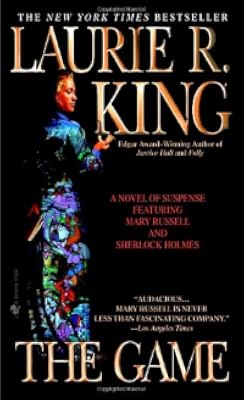
It's only the second day of 1924, but Mary Russell and her husband, Sherlock Holmes, find themselves embroiled in intrigue. It starts with a New Year's visit from Holmes's brother Mycroft, who comes bearing a strange package containing the papers of an English spy named Kimball O'Hara--the same Kimball known to the world through Kipling's famed Kim. Inexplicably, O'Hara withdrew from the "Great Game" of espionage and now he has just as inexplicably disappeared. When Russell discovers show more Holmes's own secret friendship with the spy, she knows the die is cast: she will accompany her husband to India to search for the missing operative. But Russell soon learns that in this faraway and exotic land, it's often impossible to tell friend from foe--and that some games aren't played for fun but for the highest stakes of all...life and death. show lessTags
Recommendations

Member Recommendations

Member Reviews
A birthday dinner with Mycroft on Mary's twenty-fourth birthday in January, 1924, sends Holmes and Russell to India to search for Kimball O'Hara who hasn't been seen for three years. Tensions are rising in India. The nationalist uprising under Ghandi is gaining momentum and the rivalry between Russia and the British is also fierce. The change from a Tsar to the Bolsheviks didn't really change the desire to gain control of India. Neither did the newly elected Socialist Party change Britain's.
The story begins with the ocean voyage to India where Mary undergoes a crash course in Hindustani and immersion in the Mahabharata to gain an understanding of the culture. She also meets Sunny Goodheart, her mother who is inspired by an Indian show more Teacher, and her brother who is a budding Communist. Repeated run-ins with the Goodhearts raise suspicions in both Mary and Sherlock. The suspicions reach their peak when the Goodhearts are found to be visitors to the Maharajah of Khanpur. The Maharajah is supposed to be a staunch ally of Britain but there are some questions since his country is near where O'Hara was last seen.
Holmes and Russell begin their investigation by taking on the personas of traveling magicians. They gather a young donkey boy named Bindra along with his donkey and cart and begin to make their way across India. I loved the descriptions of the land and people as seen through Mary's eyes.
Mary becomes herself again when she meets the Goodhearts and has a chance to enter Khanpur as their guest. However, Holmes and Bindra are keeping their personas and will meet her later in Khanpur. Mary gets a chance to get to know the Maharajah and finds him to be a volatile personality with a secret political agenda. He seems fascinated by Mary especially after she joined him on a hunt for feral hogs and did well. When she wants to leave, he tries to keep her there. Fortunately, she managed to resume her identity as a traveling magician and slip away from him for a while leaving him in a rage.
She and Sherlock are traveling to get out of Khanpur when the Maharajah catches up to them. He captures Sherlock but Mary is able to make her escape out of Khanpur and to a trusted British agent. Then the two of them need to find a way back in to confirm suspicions about the Maharajah's goals and, more importantly to Mary, to rescue Holmes.
This story was filled with adventure and danger and political intrigue. I loved the mystery and Mary's world. I enjoyed the ties to Rudyard Kipling's KIM and the look at India through Mary's eyes. show less
The story begins with the ocean voyage to India where Mary undergoes a crash course in Hindustani and immersion in the Mahabharata to gain an understanding of the culture. She also meets Sunny Goodheart, her mother who is inspired by an Indian show more Teacher, and her brother who is a budding Communist. Repeated run-ins with the Goodhearts raise suspicions in both Mary and Sherlock. The suspicions reach their peak when the Goodhearts are found to be visitors to the Maharajah of Khanpur. The Maharajah is supposed to be a staunch ally of Britain but there are some questions since his country is near where O'Hara was last seen.
Holmes and Russell begin their investigation by taking on the personas of traveling magicians. They gather a young donkey boy named Bindra along with his donkey and cart and begin to make their way across India. I loved the descriptions of the land and people as seen through Mary's eyes.
Mary becomes herself again when she meets the Goodhearts and has a chance to enter Khanpur as their guest. However, Holmes and Bindra are keeping their personas and will meet her later in Khanpur. Mary gets a chance to get to know the Maharajah and finds him to be a volatile personality with a secret political agenda. He seems fascinated by Mary especially after she joined him on a hunt for feral hogs and did well. When she wants to leave, he tries to keep her there. Fortunately, she managed to resume her identity as a traveling magician and slip away from him for a while leaving him in a rage.
She and Sherlock are traveling to get out of Khanpur when the Maharajah catches up to them. He captures Sherlock but Mary is able to make her escape out of Khanpur and to a trusted British agent. Then the two of them need to find a way back in to confirm suspicions about the Maharajah's goals and, more importantly to Mary, to rescue Holmes.
This story was filled with adventure and danger and political intrigue. I loved the mystery and Mary's world. I enjoyed the ties to Rudyard Kipling's KIM and the look at India through Mary's eyes. show less
I finished this yesterday, but everyone and every thing conspired against me this weekend and I was unable to update/post except in 15 seconds bursts. My apologies to Moonlight Reader for letting down the side a bit.
Talk about conflicted about a read. I both loved and hated almost every page.
As is typical of all the Mary Russell books (so far), Ms. King is not in a hurry to set the scene and the story. Almost the entire first half is setting up the events to come and until Holmes' and Russell's arrival in India the reading is rather drab, although not completely dull. Once we're in India though, the writing is so rich and illustrative and alive it's hard not to feel you're there with them, simultaneously fascinated and wishing to be show more somewhere...cleaner.
When we arrived (and it was, to me, "we" - as I said, the writing really comes alive off the page) at the maharajah's palace, the extraordinary excesses and luxury hide at first the rot underneath. Truly the rajah is the poster child for "idle hands are the devil's workshop". The level of detail the author includes when describing the rajah's "toy room" must have required an astounding amount of research into both esoteric and prurient bits of history; I can't even talk about the gun-room: it made my skin crawl.
Overall, the writing and the story are outstanding, so why was I conflicted? My personal trigger is anything involving animal cruelty and this was a prevailing thread running through the rajah's psychology. I hated every freaking word and had this not been a buddy read, I probably would have stopped. I would have missed an outstanding read, but I wouldn't have continued.
But I did and I was in for a rousing, adventure filled, fantastic ending with a very satisfying closing chapter. The author packs in so much in so few words, I was almost exhausted myself by the end.
So, an outstanding book I'll likely never, ever read again - but if you don't share my triggers, I can't sing the praises of this book's writing highly enough.
(Note: this is only the second Russell book I've actually read, as opposed to listened to. I suspect I both gain and lose something in listening vs. reading.) show less
Talk about conflicted about a read. I both loved and hated almost every page.
As is typical of all the Mary Russell books (so far), Ms. King is not in a hurry to set the scene and the story. Almost the entire first half is setting up the events to come and until Holmes' and Russell's arrival in India the reading is rather drab, although not completely dull. Once we're in India though, the writing is so rich and illustrative and alive it's hard not to feel you're there with them, simultaneously fascinated and wishing to be show more somewhere...cleaner.
When we arrived (and it was, to me, "we" - as I said, the writing really comes alive off the page) at the maharajah's palace, the extraordinary excesses and luxury hide at first the rot underneath. Truly the rajah is the poster child for "idle hands are the devil's workshop". The level of detail the author includes when describing the rajah's "toy room" must have required an astounding amount of research into both esoteric and prurient bits of history; I can't even talk about the gun-room: it made my skin crawl.
Overall, the writing and the story are outstanding, so why was I conflicted? My personal trigger is anything involving animal cruelty and this was a prevailing thread running through the rajah's psychology. I hated every freaking word and had this not been a buddy read, I probably would have stopped. I would have missed an outstanding read, but I wouldn't have continued.
But I did and I was in for a rousing, adventure filled, fantastic ending with a very satisfying closing chapter. The author packs in so much in so few words, I was almost exhausted myself by the end.
So, an outstanding book I'll likely never, ever read again - but if you don't share my triggers, I can't sing the praises of this book's writing highly enough.
(Note: this is only the second Russell book I've actually read, as opposed to listened to. I suspect I both gain and lose something in listening vs. reading.) show less
Again, a brilliant idea, beautifully executed. To repeat myself yet again, I am generally disapproving when a writer plucks up another writer's characters and makes use of them. But that's largely because it's usually done so horribly badly, and is so rarely done with any respect for the original author, the characters, or the reader. Laurie R. King can do whatever she wants, take whatever characters or historical figures she likes, and bring them into her books in whatever manner she likes, because she has earned my trust. She does her homework, she knows what she's doing, and she has complete respect for the original material or real person, as the case may be. If anyone from Tom Sawyer to Bilbo Baggins to Harrison Ford appears in a show more Holmes/Russell novel, I will have faith that she has her reasons and can pull it off. (Maybe Indiana Jones, when Russell is in her 40's …that would be awesome.)
The idea behind The Game was to me at first as wild as bringing Bilbo Baggins into the storyline, but only because I don't know the Kipling novel. (Note to self …) In any event, it's wonderful. Kimball O’Hara here is a legend among those in the know (which Holmes, of course, is, and Mycroft moreseo), and it is to find out what has become of him that Holmes and Russell make their way to India. There they face danger and adventure of quantity and quality to please even Doyle – tigers, and madmen, and those who are not what they seem, spies and daredevil pilots and a rajah who collects the unusual, be it an artifact or a human being (and Holmes is unusual). A new story arc begins with The Game, wherein a new enemy is introduced – perhaps – and Homes and Russell become aware of a new threat trailing them. Meanwhile, the story takes them in and out of various deep disguises and personas, and separates and reunites them, and causes Mary to make a change which will cause untold anguish in Holmes … It's a great yarn, and, more than that, an excellent book. show less
The idea behind The Game was to me at first as wild as bringing Bilbo Baggins into the storyline, but only because I don't know the Kipling novel. (Note to self …) In any event, it's wonderful. Kimball O’Hara here is a legend among those in the know (which Holmes, of course, is, and Mycroft moreseo), and it is to find out what has become of him that Holmes and Russell make their way to India. There they face danger and adventure of quantity and quality to please even Doyle – tigers, and madmen, and those who are not what they seem, spies and daredevil pilots and a rajah who collects the unusual, be it an artifact or a human being (and Holmes is unusual). A new story arc begins with The Game, wherein a new enemy is introduced – perhaps – and Homes and Russell become aware of a new threat trailing them. Meanwhile, the story takes them in and out of various deep disguises and personas, and separates and reunites them, and causes Mary to make a change which will cause untold anguish in Holmes … It's a great yarn, and, more than that, an excellent book. show less
A birthday dinner with Mycroft on Mary's twenty-fourth birthday in January, 1924, sends Holmes and Russell to India to search for Kimball O'Hara who hasn't been seen for three years. Tensions are rising in India. The nationalist uprising under Ghandi is gaining momentum and the rivalry between Russia and the British is also fierce. The change from a Tsar to the Bolsheviks didn't really change the desire to gain control of India. Neither did the newly elected Socialist Party change Britain's.
The story begins with the ocean voyage to India where Mary undergoes a crash course in Hindustani and immersion in the Mahabharata to gain an understanding of the culture. She also meets Sunny Goodheart, her mother who is inspired by an Indian show more Teacher, and her brother who is a budding Communist. Repeated run-ins with the Goodhearts raise suspicions in both Mary and Sherlock. The suspicions reach their peak when the Goodhearts are found to be visitors to the Maharajah of Khanpur. The Maharajah is supposed to be a staunch ally of Britain but there are some questions since his country is near where O'Hara was last seen.
Holmes and Russell begin their investigation by taking on the personas of traveling magicians. They gather a young donkey boy named Bindra along with his donkey and cart and begin to make their way across India. I loved the descriptions of the land and people as seen through Mary's eyes.
Mary becomes herself again when she meets the Goodhearts and has a chance to enter Khanpur as their guest. However, Holmes and Bindra are keeping their personas and will meet her later in Khanpur. Mary gets a chance to get to know the Maharajah and finds him to be a volatile personality with a secret political agenda. He seems fascinated by Mary especially after she joined him on a hunt for feral hogs and did well. When she wants to leave, he tries to keep her there. Fortunately, she managed to resume her identity as a traveling magician and slip away from him for a while leaving him in a rage.
She and Sherlock are traveling to get out of Khanpur when the Maharajah catches up to them. He captures Sherlock but Mary is able to make her escape out of Khanpur and to a trusted British agent. Then the two of them need to find a way back in to confirm suspicions about the Maharajah's goals and, more importantly to Mary, to rescue Holmes.
This story was filled with adventure and danger and political intrigue. I loved the mystery and Mary's world. I enjoyed the ties to Rudyard Kipling's KIM and the look at India through Mary's eyes. show less
The story begins with the ocean voyage to India where Mary undergoes a crash course in Hindustani and immersion in the Mahabharata to gain an understanding of the culture. She also meets Sunny Goodheart, her mother who is inspired by an Indian show more Teacher, and her brother who is a budding Communist. Repeated run-ins with the Goodhearts raise suspicions in both Mary and Sherlock. The suspicions reach their peak when the Goodhearts are found to be visitors to the Maharajah of Khanpur. The Maharajah is supposed to be a staunch ally of Britain but there are some questions since his country is near where O'Hara was last seen.
Holmes and Russell begin their investigation by taking on the personas of traveling magicians. They gather a young donkey boy named Bindra along with his donkey and cart and begin to make their way across India. I loved the descriptions of the land and people as seen through Mary's eyes.
Mary becomes herself again when she meets the Goodhearts and has a chance to enter Khanpur as their guest. However, Holmes and Bindra are keeping their personas and will meet her later in Khanpur. Mary gets a chance to get to know the Maharajah and finds him to be a volatile personality with a secret political agenda. He seems fascinated by Mary especially after she joined him on a hunt for feral hogs and did well. When she wants to leave, he tries to keep her there. Fortunately, she managed to resume her identity as a traveling magician and slip away from him for a while leaving him in a rage.
She and Sherlock are traveling to get out of Khanpur when the Maharajah catches up to them. He captures Sherlock but Mary is able to make her escape out of Khanpur and to a trusted British agent. Then the two of them need to find a way back in to confirm suspicions about the Maharajah's goals and, more importantly to Mary, to rescue Holmes.
This story was filled with adventure and danger and political intrigue. I loved the mystery and Mary's world. I enjoyed the ties to Rudyard Kipling's KIM and the look at India through Mary's eyes. show less
This is the seventh novel in King’s Mary Russell series and one of my favourites so far. In this instalment, Sherlock Holmes and his wife and partner Mary Russell travel to India to look for Kimball O’Hara – the hero of Rudyard Kipling’s [b:Kim|210834|Kim|Rudyard Kipling|http://photo.goodreads.com/books/1327949424s/210834.jpg|1512424]. There is concern from on high that Kim, who has been missing for some three years, has either been captured or has turned traitor in the Great Game.
The conceit of the narrative is disarming. When Mary Russell, who only knows of Kim from reading Kipling, asks if he is a real person, Holmes responds “As real as I am”. With that, the adventure begins. There’s a rush to get away from England, show more an ocean voyage through the Suez Canal, an American flapper, her possibly sinister brother, disguise and magic in India, a Maharaja with secrets and a street urchin who may have secrets of his own. And then there’s Kim – the idea of him and, ultimately, the actuality of him – as believable as Kipling’s Kim, albeit some thirty years older.
For all of my general resistance to the concept of a novelist writing books using characters created by other writers, I love this series. King knows her source material well and treats it with love and respect. Her plotting is excellent and her characters are credible and interesting. She can also evoke the time and place in which her novels are set without fussy period detail. Of course, like a lot of fiction of this genre, this is a highly implausible tale and when I finished reading the book the silliness of it all struck home. But while reading, I was completely in the narrative and totally prepared to suspend disbelief.
Knowing that Kimball O’Hara was to make an appearance in this novel made me decide to read Kipling’s Kim for the first time. It’s a book I'd previously avoided because I’m not keen on boys’ own adventure stories and I felt a bit iffy about Kipling generally because of his reputation as a supporter of the British imperialist enterprise. However, I listened to an audiobook edition of Kim and it was wonderful. (My review, is here, should anyone be interested in reading it). My enjoyment of this novel was enhanced by the experience of listening to Kim and my experience of listening to Kim was enhanced by reading King’s homage to that work. Immersing myself in India under British rule for a few days has given me lots of reading and listening enjoyment. show less
My journey to find a good British mystery series has led me to the stories of Sherlock Holmes and Mary Russell, his student and wife, by Laurie R. King. I will not hide the fact that I was extremely sceptical at first. I mean, Sherlock having a wife other than The Woman a.k.a. Irene Adler? Preposterous! How could that have happened? I am not the most open-minded person when it comes to retellings of any kind. Especially when we're talking about Shakespeare, Jane Austen and Arthur Conan Doyle. Yes, I adore the BBC Sherlock, but it took me two seasons to be convinced. Dont't start me on Elementary though, because the rant button will be triggered to no end. So, taking all these prejudices of mine into consideration, I took my time and show more read as many reviews as I could about the series. Just to be on the safe side...
I had a great difficulty in finding the previous installments, so I started with the only one that was available at the time, The Game. I enjoyed it very much, plain and simple. I will not bore you with plot details. However, I must stress that the setting of the story - India during the turbulent period of the 1920's- was a major plus. It made for an exotic read. The descriptions were vivid and rich. In fact, they were so detailed that they ended up becoming seriously tedious after a point, especially when I wanted the story to move forward. I don't need to know every single detail of decoration or dresses or plants. This was a major fault, in my opinion. A fault that continued all through the book. It was too wordy, too descriptive, and even the dialogue itself was tiring at times, although faithful to the era depicted.
Mary Russell is a very interesting character. She is clever and kind, but not obnoxious, and patient enough to deal with her genius of a husband. She is a worthy companion to Sherlock who - I am glad to say- retains his familiar characteristics. Laurie R. King created a version of Sherlock Holmes that the lifelong reader of Arthur Conan Doyle can connect with. She didn't try to make Mary appear ''smarter'' than him, nor did she make a dogmatic, all-knowing Holmes. She created a worthy couple, equal in intelligence and respect, and that was refreshing. The mystery itself was innovative, although a bit predictable, blending Kipling's Kim in the narration, and finding an equal balance between a world full of superstitions and concepts written in stone and the people who desire their freedom.
The Mary Russell series is nothing earth-shuttering or Booker Prize-worthy, but it is a quality light read with two superb characters. Thankfully, I've found the other books since I bought this one, and I intend to follow the couple's adventures.
P.S. Hey, Elementary ''writers'', pay attention! This is how you create a female companion without making Sherlock appear an idiot! show less
I had a great difficulty in finding the previous installments, so I started with the only one that was available at the time, The Game. I enjoyed it very much, plain and simple. I will not bore you with plot details. However, I must stress that the setting of the story - India during the turbulent period of the 1920's- was a major plus. It made for an exotic read. The descriptions were vivid and rich. In fact, they were so detailed that they ended up becoming seriously tedious after a point, especially when I wanted the story to move forward. I don't need to know every single detail of decoration or dresses or plants. This was a major fault, in my opinion. A fault that continued all through the book. It was too wordy, too descriptive, and even the dialogue itself was tiring at times, although faithful to the era depicted.
Mary Russell is a very interesting character. She is clever and kind, but not obnoxious, and patient enough to deal with her genius of a husband. She is a worthy companion to Sherlock who - I am glad to say- retains his familiar characteristics. Laurie R. King created a version of Sherlock Holmes that the lifelong reader of Arthur Conan Doyle can connect with. She didn't try to make Mary appear ''smarter'' than him, nor did she make a dogmatic, all-knowing Holmes. She created a worthy couple, equal in intelligence and respect, and that was refreshing. The mystery itself was innovative, although a bit predictable, blending Kipling's Kim in the narration, and finding an equal balance between a world full of superstitions and concepts written in stone and the people who desire their freedom.
The Mary Russell series is nothing earth-shuttering or Booker Prize-worthy, but it is a quality light read with two superb characters. Thankfully, I've found the other books since I bought this one, and I intend to follow the couple's adventures.
P.S. Hey, Elementary ''writers'', pay attention! This is how you create a female companion without making Sherlock appear an idiot! show less
This is the seventh book in the Mary Russell series, which involve partnering Sherlock Holmes, professionally and romantically, with an unlikely female counterpart: and I love them--ever since I discovered one of the middle books in the series, A Letter of Mary. Well, this particular book is a twofer. As King states in her Author's Thanks, "The Game may be read as a humble and profoundly felt homage to Rudyard Kipling's Kim, one of the great novels of the English language. If you, the reader, do not know the book, please do not delay that acquaintance." I hadn't read the book, and it's probably not necessary, but once I realized that The Game was based on that novel, I put this book down for a little detour to read Kim. I'm glad I did, show more not only because it was a great read in its own right, but I think doing so made this only more fun. And it seems a natural combination--Kipling's Kimball O'Hara and Doyle's Sherlock Holmes--two immortal characters of the British Empire, both with links to the "Great Game" of espionage.
A friend who also loves the Russell series says one thing she appreciates is how each book is so different, in theme and setting, so the books don't get stale. The last one, Justice Hall, was set in England, this one certainly developed a very rich and different setting--that of India during the British Raj. I didn't perhaps love this quite as much as Justice Hall, but then so far that's my favorite of the lot. This one was certainly entertaining from beginning to end--a gripping and suspenseful read. And as my friend also pointed out in her own review, I think the Holmes/Russell relationship is even more to the fore here than usual--I love the chemistry between them--and yet Holmes never seemed to me out of the bounds of the character Conan Doyle created. Now the only thing I have to decide is whether or not to go on to the next in this series immediately or begin to space them out. At this rate I'll run out of the books soon, and sadly go into withdrawal until King writes the next one. show less
A friend who also loves the Russell series says one thing she appreciates is how each book is so different, in theme and setting, so the books don't get stale. The last one, Justice Hall, was set in England, this one certainly developed a very rich and different setting--that of India during the British Raj. I didn't perhaps love this quite as much as Justice Hall, but then so far that's my favorite of the lot. This one was certainly entertaining from beginning to end--a gripping and suspenseful read. And as my friend also pointed out in her own review, I think the Holmes/Russell relationship is even more to the fore here than usual--I love the chemistry between them--and yet Holmes never seemed to me out of the bounds of the character Conan Doyle created. Now the only thing I have to decide is whether or not to go on to the next in this series immediately or begin to space them out. At this rate I'll run out of the books soon, and sadly go into withdrawal until King writes the next one. show less
Members
- Recently Added By
Lists

Crime and Mysteries to Read
746 works; 31 members

British Mystery
469 works; 14 members

Books Read in 2012 (Numbered)
168 works; 6 members

Detective Stories
343 works; 5 members

Books Read in 2016
4,666 works; 197 members
Author Information

80+ Works 46,867 Members
Laurie R. King is the bestselling author of "A Darker Place," four contemporary novels featuring Kate Martinelli, and five acclaimed Mary Russell mysteries. She lives in northern California. Her newest book is the ninth one in the Mary Russell mystery series, The Language of Bees. (Publisher Provided) Laurie R. King is a mystery writer, who holds show more a bachelor's degree and a master's degree in theology. Her first novel, Grave Talent, was published in 1993 and won the Edgar Award for Best First Novel. Since then, she has written over twenty books including the Mary Russell Mysteries series, the Stuyvesant and Grey series, the Kate Martinelli Mystery series, A Darker Place, Folly, and Keeping Watch. She has also co-authored a number of nonfiction works and anthologies including Crime Writing, The Grand Game, and Studies in Sherlock. Laurie's title, Dreaming Spies, is a 2015 New York Times Bestseller. (Bowker Author Biography) show less

Laurie R. King is a LibraryThing Author, an author who lists their personal library on LibraryThing.
Some Editions
Awards and Honors
Distinctions
Series


Work Relationships
Is contained in
Is a (non-series) sequel to
Common Knowledge
- Canonical title
- The Game
- Original title
- The Game
- Original publication date
- 2004
- People/Characters
- Mary Russell; Sherlock Holmes; Kimball O'Hara; Sunny Goodheart; Tommy Goodheart; Geoffrey Nesbit (show all 8); Bindra; Maharaja "Jimmy"
- Important places
- India
- Dedication
- For the librarians everywhere, who spend their lives in battle against the forces of darkness.
- First words
- It was a dramatic setting for a human sacrifice, give my murderer credit.
- Quotations
- I began to breathe again. After a minute, one of the men touched my arm, and we crept forward, cautious as mice in a cattery.
- Last words
- (Click to show. Warning: May contain spoilers.)And with that, Kimball O'Hara went home to his high mountains, with his son, and his rosary, and his secrets.
Classifications
Statistics
- Members
- 2,282
- Popularity
- 8,803
- Reviews
- 66
- Rating
- (4.00)
- Languages
- English, Italian
- Media
- Paper, Audiobook, Ebook
- ISBNs
- 23
- ASINs
- 12