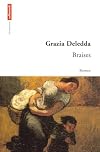
Ashes
by Grazia Deledda
On This Page
Description
Jan Kozma's English translation of Grazia Deledda's Ashes (Cenere, 1904) represents a rendering of the novel that embodies the Nobel Prize-winning author's mature style. Ashes is the story of Oli, a Sardinian unwed mother who is forced by poverty to abandon her only child. Raised by his genetic father, Ananias eventually attains social acceptability in the legal prefession yet cannot give up his obsessive search for his mother. When Oli realizes that public knowledge of her life in show more prostitution will jeopardize her son's impending marriage and professional success, she makes the ultimate maternal sacrifice to ensure his future. Deledda's novel explores the themes of filial duty, hypocritical societal expectations, the ravages of poverty, and maternal devotion. The author interweaves into the novel leitmotivs of Sardinian folklore, health issues, banditry, illegitimacy, prostitution, and the social mores of the late nineteenth century with all the attendant public opprobrium. When Henrik Schuck introduced Grazia Deledda to the Stockholm audience at the Nobel Prize ceremonies in 1926, he made a special point of mentioning that she had brought to the attention of the world certain rive show lessTags
Recommendations




















Member Reviews
This is one of my all-time favorite novels. Some may argue that After the Divorce is Deledda's best work, but I find that it does not compare to the intensity and depth of Ashes. It's a shame that this book was not translated, published, and made available to us until 2004--especially because it is still not likely to be found in your local bookstore.
As a student of Italian language and culture, I find it remarkable that Deledda wrote so substantially and so well considering the social limitations of the time and place (turn of the century Sardegna). Deledda's education was limited to three years of primary school (as Kozma mentions in her helpful introduction), yet she boldly makes references to great works of Italian literature, show more including Manzoni's famous "Addio monti" passage from I Promessi Sposi (See Part I, Chapter 7 in Deledda) and The Divine Comedy by Dante (Purg. 8.1-9; See beginning of Part II, Chapter 1 in Deledda).
The novel itself is rich in Sardegnian culture; Deledda's story follows the life of Ananias, a boy who is both hopeful and tortured by the uncertain fate of a mother he can't remember. As Ananias grows to become a man, he allows his promising future to be jeopardized by his speculative past. Symbol, madness, and insight are weaved into the scenery of this beautiful, psychological, and tragic journey.
I found a faithful translation in Kozma, not to mention a helpful introduction and notes. show less
As a student of Italian language and culture, I find it remarkable that Deledda wrote so substantially and so well considering the social limitations of the time and place (turn of the century Sardegna). Deledda's education was limited to three years of primary school (as Kozma mentions in her helpful introduction), yet she boldly makes references to great works of Italian literature, show more including Manzoni's famous "Addio monti" passage from I Promessi Sposi (See Part I, Chapter 7 in Deledda) and The Divine Comedy by Dante (Purg. 8.1-9; See beginning of Part II, Chapter 1 in Deledda).
The novel itself is rich in Sardegnian culture; Deledda's story follows the life of Ananias, a boy who is both hopeful and tortured by the uncertain fate of a mother he can't remember. As Ananias grows to become a man, he allows his promising future to be jeopardized by his speculative past. Symbol, madness, and insight are weaved into the scenery of this beautiful, psychological, and tragic journey.
I found a faithful translation in Kozma, not to mention a helpful introduction and notes. show less
853.912 DEL
Apr 13, 2020Italian
Ratings
Members
- Recently Added By
Lists

Books Set in Italy
167 works; 19 members

Italian Literature
556 works; 38 members
Books translated from Romance Languages into English
102 works; 7 members

For Further Reading: A List of 160 Novels from 15 Literatures
160 works; 4 members
Author Information

154+ Works 1,699 Members
Among the most honored women writers of modern Italy, Deledda wrote naturalistic or realistic novels, drawing upon her Sardinian background for material. Some critics hold, however, that in Deledda's formula often only the names of places and people serve to evoke a Sardinian atmosphere of strangeness. Her best works especially Elias Portolu show more (1903), Cenere (1904), and The Mother (1920) contain excellent portrayals of women. While her characters are complex, often dominated by an overwhelming sense of destiny and by nature's mythic powers, her narrative structures remain simple and classic. She was awarded the Nobel Prize for Literature in 1926. (Bowker Author Biography) show less
Series
Belongs to Publisher Series
Work Relationships
Is contained in
Common Knowledge
- Canonical title
- Ashes
- Original title
- Cenere
- Original publication date
- 1904
- People/Characters
- Anania; Rosalia Derios (Olì); Zia Grathia; Zuanne; Zia Tatàna; Bustianeddu (show all 8); Signor Carboni; Margherita Carboni
- Important places
- Sardinia, Italy; Fonni, Italy; Nuoro, Italia; Cagliari, Sardinia, Italy; Rome, Italy
- Related movies
- Cenere (1917 | IMDb)
- Original language
- Italian
Classifications
- Genres
- Fiction and Literature, General Fiction, Historical Fiction
- DDC/MDS
- 853.8 — Literature & rhetoric Italian, Romanian & related literatures Italian fiction Later 19th century 1859–1900
- LCC
- PQ4811 .E6 .C313 — Language and Literature French, Italian, Spanish and Portuguese literatures Italian literature Individual authors, 1900-1960
- BISAC
Statistics
- Members
- 59
- Popularity
- 519,948
- Reviews
- 3
- Rating
- (4.04)
- Languages
- 6 — English, French, Italian, Portuguese, Russian, Swedish
- Media
- Paper, Ebook
- ISBNs
- 16
- ASINs
- 10