On This Page
Description
If you're a fan of children's and young adult fantasy fiction, this timeless classic from author Edith Nesbit should merit a place on your must-read list. The second in a series of three thematically linked novels, The Phoenix and the Carpet details the adventures that ensue when a family discovers that their nursery's carpet is enchanted and bears within it the egg of a magical talking Phoenix.Tags
Recommendations












Member Recommendations
ed.pendragon Following Five Children and It, The Phoenix and the Carpet is the second in the so-called Psammead Trilogy, named after 'It', the sand-fairy.

Member Reviews
This sequel to "Five Children and It" is even more delightful than the first novel. This time the children come into possession of a phoenix and a magic carpet that grants them three wishes a day. Their adventures take them to all sorts of exotic places and humorous situations. There is one scene that takes place among "copper-colored natives" somewhere in a tropical location that is cringe-inducing because of the stereotyped and patronizing view of the "natives", however, I must say that the depictions of "natives" in this book, and in the prior one are not malicious. I would say the depictions are naive, as in what these turn-of-the-century children imagine from their own books. In fact, what the children were reading is mentioned show more often in both books, and, it seemed to me, the books they were reading (19th century adventure books for children-Last of the Mohicans, Robinson Crusoe, etc.) are the impetus for these encounters with "natives". The Phoenix is also a wonderful character, as is the narrator. Enjoy! show less
This was a disappointment. I really enjoyed Five Children and It, although in hindsight I don't remember it very well and if it was anything like its sequel I can't imagine why I liked it so much. Although Nesbit's wit is still at work in this book, ultimately the children are so unlikeable that it wasn't any fun to spend time with them. They are selfish, entitled brats, the boys bullies and the girls drips. I was surprised by that last part because I'm pretty sure Nesbit was a feminist and had some feminist themes in the other books of hers that I've read, but no sign of it here. The introduction also warns that she was racist and classist, so you're in for a ride. I feel really sorry for both the phoenix and the carpet and I'd rather show more never see any of these kids again. show less
Delightful shenanigans with four children who are left home alone suspiciously often. I had considered only giving it four stars, due to frequent references to savages and naive notions about burglars. Not to mention comments that it's unmanly for boys to cry. But I just can't help myself. It's just too wonderful for four stars. Many thanks go to the Librivox narrator, Helen Taylor, for her beautiful reading.
This is the sequel to Nesbit's Five Children and It that I read last month. I remembered this affectionately from a TV adaptation in the 1970s, but I must admit I didn't find this quite as engaging as its predecessor. Again, the story relies on them getting the wishes they choose wrong and ending up in various scrapes, but somehow these did not engage as much in this one. Perhaps this was partly due to there being no illustrations in my edition, which added to my enjoyment of the first novel, and of The Railway Children. All that said, still a good children's story that a reader of any age can enjoy.
The 1904 sequel to Nesbit's classic Five Children and It. Unsurprisingly, in this one the children make the acquaintance of a phoenix and a magic carpet. The phoenix is extremely vain and perhaps a little too fond of naps, but is often surprisingly useful. And the carpet can take you anywhere you wish to go, no matter how vague and abstract or how complicated and demanding your wish, although it can only do so three times per day. Needless to say, the kids have lots of little adventures and find interesting ways to get in and out of trouble.
Like the previous book, this one has a lot of charm and a wonderful, sly sense of humor. I have to say, though, that I didn't find it quite as constantly delightful as Five Children and It. Perhaps show more that's partly due to the fact that with the first one I had all the trepidation of revisiting a childhood favorite, followed by that marvelously pleasant feeling when it turns out to live up to your memories, but this time my expectations were higher going in. Still, it's a fun book, and and well worth an adult re-read.
(I do feel that I should probably point out, though, that these books suffer very slightly from changing social sensibilities. The first one features some unpleasantly stereotyped "red Indians," although arguably they're meant to represent the unrealistic figures that existed in young British children's imaginations. And this one features some scenes involving cartoony black "savages" that, while really not bad by product-of-the-time standards, may leave modern readers shaking their heads a bit.) show less
Like the previous book, this one has a lot of charm and a wonderful, sly sense of humor. I have to say, though, that I didn't find it quite as constantly delightful as Five Children and It. Perhaps show more that's partly due to the fact that with the first one I had all the trepidation of revisiting a childhood favorite, followed by that marvelously pleasant feeling when it turns out to live up to your memories, but this time my expectations were higher going in. Still, it's a fun book, and and well worth an adult re-read.
(I do feel that I should probably point out, though, that these books suffer very slightly from changing social sensibilities. The first one features some unpleasantly stereotyped "red Indians," although arguably they're meant to represent the unrealistic figures that existed in young British children's imaginations. And this one features some scenes involving cartoony black "savages" that, while really not bad by product-of-the-time standards, may leave modern readers shaking their heads a bit.) show less
The common advice to would-be fiction authors is to “write about what you know”. A phoenix and a flying carpet aren’t of course really within one’s everyday experience, but at heart the events that take place and many of this fantasy’s settings are taken from real life, a fair few of which hark back to Nesbit’s own childhood in the Victorian period.
The reminiscences in Long Ago When I Was Young, though only first published as a collection in 1966, were serialised before Nesbit embarked on her career as a children’s writer and partly the spur for her successful forays into publishing. A significant number of the incidents in The Phoenix and the Carpet can be directly traced to the memories she presents in Long Ago. A show more mysterious keep-like stone structure that appears in ‘The Topless Tower’ and ‘Doing Good’ is based on the same building that the young Edith encountered in France, as recounted in the chapter entitled ‘In Auvergne’. ‘Doing Good’ also highlights themes that she had previously visited within ‘In the Dark’ and ‘Mummies at Bordeaux’. And ‘Two Bazaars’ may well be partly based on the bazaar that Edith experiences in ‘Lessons in French’.
We will have already met the children of this novel in Five Children and It, where they spend their summer holidays in the country ‘at a white house between a sand pit and a gravel pit’. Then they encountered a sand-fairy, the Psammead; now, in early November, they discover an egg rolled up in a carpet, replacement for a previous one in their Camden Town home ruined by a firework on Bonfire Night.
The five children are now mostly four – Cyril (called Squirrel), Robert (rather more prosaically called Bobs), Anthea (Panther) and Jane (Puss). Hilary is the remaining child (the toddler maintains the animal theme by being referred to as The Lamb), though he only appears occasionally and then to unwittingly cause mayhem. (The animal theme continues when the Phoenix hatches, and again later when more creatures make their appearances – Persian cats and, bizarrely, a cow.) The two boys are typically well-mannered and well-meaning but liable to make unwise decisions. Anthea may most resemble the author – tomboyish but creative – while Jane, the youngest of the four, is more ‘girly’ and, well, wimpish, prone to burst into tears at the merest hint of danger. (Mind you, danger, real or potential, does always seem to be round the corner.) But, as Nesbit says, even though ‘boys never cry, of course,’ Cyril and Robert are also susceptible to emotion, making faces ‘in their efforts to behave in a really manly way’.
The Phoenix itself is a marvellous creation. Vain and garrulous, he tells the children about the magic Persian carpet which grants three wishes a day. They use it to transport themselves to various more or less exotic places, from France to the Middle East, from the City of London to a desert island. In keeping with their original serial publication, the chapters at first appear episodic and unrelated to each other, merely recounting separate adventures where the siblings get themselves into scrapes. But as the story progresses Nesbit starts to weave in themes from earlier chapters – the cook, the ‘topless tower’, the absent-minded curate – and naturally the overall motif of fire runs brightly through the narrative pattern, with dire consequences for the flammable flying carpet. From that first Guy Fawkes Night through the rebirth of the Phoenix from the flames, the setting alight of an increasingly frayed carpet and a visit to the Phoenix Fire Office in Lombard Street we arrive at the potentially catastrophic conflagration at the Garrick Theatre. Ironically, the last takes place at a dramatisation of Charles Kingsley’s The Water-Babies (a genuine production from 1902), and water becomes another underlying theme, as with the visit to the tropical island to alleviate the Lamb’s whooping cough or the booby-trap with a pail of water balanced on a door.
The Phoenix and the Carpet is more than just a re-run of Five Children and It with the bird and the rug substituting for the Psammead and a succession of escapades. The children become even more individual in character, especially Robert with his unexpected affection for the Phoenix; and the Phoenix itself is a distinct personage, different from the grumpy Psammead with its unintentionally entertaining if increasingly tedious chatter, inflated sense of self-importance and embarrassing avuncularism. Adults too have their part to play, but mostly they are bemused by the magic played out before their eyes, ascribing the sights they experience and the things they hear to a curious daydream. Which is, as is the way of metafiction, exactly what it is.
Above all, what I most liked is Nesbit’s humour, evident from her asides, her descriptions of the children’s thought-processes and her delight in their convoluted attempts to Do The Right Thing. Modern sensibilities may be upset by some aspects – such as her portrayal of native peoples or Jews – though, this being Nesbit, her teasing tongue-in-cheek tone and her Fabian socialist sympathies suggest she mightn’t necessarily share those common prejudices.
http://wp.me/s2oNj1-phoenix show less
The reminiscences in Long Ago When I Was Young, though only first published as a collection in 1966, were serialised before Nesbit embarked on her career as a children’s writer and partly the spur for her successful forays into publishing. A significant number of the incidents in The Phoenix and the Carpet can be directly traced to the memories she presents in Long Ago. A show more mysterious keep-like stone structure that appears in ‘The Topless Tower’ and ‘Doing Good’ is based on the same building that the young Edith encountered in France, as recounted in the chapter entitled ‘In Auvergne’. ‘Doing Good’ also highlights themes that she had previously visited within ‘In the Dark’ and ‘Mummies at Bordeaux’. And ‘Two Bazaars’ may well be partly based on the bazaar that Edith experiences in ‘Lessons in French’.
We will have already met the children of this novel in Five Children and It, where they spend their summer holidays in the country ‘at a white house between a sand pit and a gravel pit’. Then they encountered a sand-fairy, the Psammead; now, in early November, they discover an egg rolled up in a carpet, replacement for a previous one in their Camden Town home ruined by a firework on Bonfire Night.
The five children are now mostly four – Cyril (called Squirrel), Robert (rather more prosaically called Bobs), Anthea (Panther) and Jane (Puss). Hilary is the remaining child (the toddler maintains the animal theme by being referred to as The Lamb), though he only appears occasionally and then to unwittingly cause mayhem. (The animal theme continues when the Phoenix hatches, and again later when more creatures make their appearances – Persian cats and, bizarrely, a cow.) The two boys are typically well-mannered and well-meaning but liable to make unwise decisions. Anthea may most resemble the author – tomboyish but creative – while Jane, the youngest of the four, is more ‘girly’ and, well, wimpish, prone to burst into tears at the merest hint of danger. (Mind you, danger, real or potential, does always seem to be round the corner.) But, as Nesbit says, even though ‘boys never cry, of course,’ Cyril and Robert are also susceptible to emotion, making faces ‘in their efforts to behave in a really manly way’.
The Phoenix itself is a marvellous creation. Vain and garrulous, he tells the children about the magic Persian carpet which grants three wishes a day. They use it to transport themselves to various more or less exotic places, from France to the Middle East, from the City of London to a desert island. In keeping with their original serial publication, the chapters at first appear episodic and unrelated to each other, merely recounting separate adventures where the siblings get themselves into scrapes. But as the story progresses Nesbit starts to weave in themes from earlier chapters – the cook, the ‘topless tower’, the absent-minded curate – and naturally the overall motif of fire runs brightly through the narrative pattern, with dire consequences for the flammable flying carpet. From that first Guy Fawkes Night through the rebirth of the Phoenix from the flames, the setting alight of an increasingly frayed carpet and a visit to the Phoenix Fire Office in Lombard Street we arrive at the potentially catastrophic conflagration at the Garrick Theatre. Ironically, the last takes place at a dramatisation of Charles Kingsley’s The Water-Babies (a genuine production from 1902), and water becomes another underlying theme, as with the visit to the tropical island to alleviate the Lamb’s whooping cough or the booby-trap with a pail of water balanced on a door.
The Phoenix and the Carpet is more than just a re-run of Five Children and It with the bird and the rug substituting for the Psammead and a succession of escapades. The children become even more individual in character, especially Robert with his unexpected affection for the Phoenix; and the Phoenix itself is a distinct personage, different from the grumpy Psammead with its unintentionally entertaining if increasingly tedious chatter, inflated sense of self-importance and embarrassing avuncularism. Adults too have their part to play, but mostly they are bemused by the magic played out before their eyes, ascribing the sights they experience and the things they hear to a curious daydream. Which is, as is the way of metafiction, exactly what it is.
Above all, what I most liked is Nesbit’s humour, evident from her asides, her descriptions of the children’s thought-processes and her delight in their convoluted attempts to Do The Right Thing. Modern sensibilities may be upset by some aspects – such as her portrayal of native peoples or Jews – though, this being Nesbit, her teasing tongue-in-cheek tone and her Fabian socialist sympathies suggest she mightn’t necessarily share those common prejudices.
http://wp.me/s2oNj1-phoenix show less
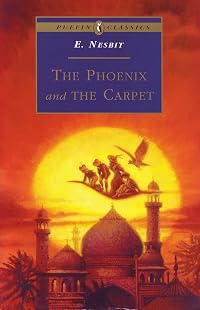
When a stone egg rolls out of the old rug that has been bought for the nursery, the children think nothing of it. A lovely glowing yellow, they place it on the mantelpiece to brighten up the room. But when the egg accidentally drops into the fire, a strange thing happens: out hatches a phoenix, resplendent in golden feathers - and very vain. If that weren't enough of a surprise, it tells them that their carpet is magic: it will take them to any place that they wish to visit - over their dusty London streets to the French coast, to tropical islands and an Indian bazaar. Guiding them throughout their adventures - though he's often more a hindrance than a help - is their new friend, the phoenix.
Members
- Recently Added By
Lists

Favorite Childhood Books
1,646 works; 518 members

Best Children's Books You've Read
197 works; 75 members

1900s (Decade, not century)
73 works; 17 members

Childhood Favorites
427 works; 24 members

Top Five Books of 2013
1,562 works; 721 members
Honey For a Child's Heart
1,152 works; 25 members
Ambleside Books
459 works; 18 members

CCE 1000 Good Books List
1,033 works; 12 members

Best middle grade books
130 works; 24 members

Put a Bird On It
75 works; 12 members

50+ Books for a 6th Grader Who Loves to Read
53 works; 4 members

al.vick-wishlist-Children's
462 works; 3 members
Children's Literature 1900 - 1950 in order
413 works; 8 members

Book Titles Mentioned In Newberry Medal And Honor Books
884 works; 3 members

HMS: Make Your Child a Lover of Books, Ages 9 & up
111 works; 2 members
Author Information

301+ Works 31,984 Members
E. Nesbit (1858-1924) wrote her first highly successful work for children, The Story of the Treasure Seekers, in 1899. Her many books for young readers, including The Magic City, Wet Magic, The Railway Children, Five Children and It, and The Enchanted Castle, gained her a popularity that has lasted for more than a century Peter Glassman is the show more owner of Books of Wonder, the New York City bookstore and publisher specializing in both new and old imaginative books for children show less
Some Editions
Series

Belongs to Publisher Series
Virago Modern Classics (692)
Work Relationships
Is contained in
The Collected Young Readers Fiction of E. Nesbit—Volume 1: The Psammead Adventures: Five Children and It, The Phoenix and the Carpet & The Story of the Amulet by E. Nesbit
Has the adaptation
Is abridged in
Common Knowledge
- Canonical title
- The Phoenix and the Carpet
- Original publication date
- 1904
- People/Characters
- Robert [Five Children And It]; Anthea; Jane; Cyril; The Lamb; Phoenix
- Related movies
- The Phoenix and the Magic Carpet (1995 | IMDb); The Phoenix and the Carpet: Part 1 - The Golden Egg (1967 | IMDb); The Phoenix and the Carpet (1976 | IMDb)
- Epigraph
- TO HUBERT
Dear Hubert, if I ever found
A wishing-carpet lying round,
I'd stand upon it, and I'd say:
'Take me to Hubert, right away!'
And then we'd travel very far
To where the magic countries are
... (show all)That you and I will never see,
And choose the loveliest gifts for you, from me.
But oh! alack! and well-a-day!
No wishing-carpets come my way,
I never found a Phoenix yet,
And Psammeads are so hard to get!
So I give you nothing fine--
Only this book, your book and mine,
And hers, whose name by yours is set:
Your book, my book, the book of Margaret!
E. NESBIT
DYMCHURCH - Dedication
- To
My Dear Godson
HUBERT GRIFFITH
and his sister
MARGARET - First words
- It began with the day when it was almost the Fifth of November, and a doubt arose in some breast—Robert's, I fancy—as to the quality of the fireworks laid in for the Guy Fawkes celebration.
- Last words
- (Click to show. Warning: May contain spoilers.)They knew that this was the fulfilment, by the powerful Psammead, of the last wish of the Phoenix, and that this glorious and delightful boxful of treasures was really the very, very, very end of the Phoenix and the Carpet.
- Original language
- English
Classifications
Statistics
- Members
- 2,135
- Popularity
- 9,589
- Reviews
- 28
- Rating
- (3.92)
- Languages
- 7 — English, German, Greek, Norwegian, Polish, Portuguese, Swedish
- Media
- Paper, Audiobook, Ebook
- ISBNs
- 143
- UPCs
- 2
- ASINs
- 42