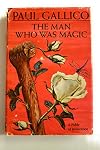
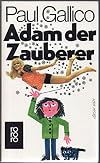
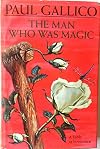
The Man Who Was Magic
by Paul Gallico
On This Page
Tags
Recommendations


















Member Reviews
"Just magic," said Adam, "the ordinary kind."
This nearly 60 year old YA novel has a surprising number of reviews, the majority five star! Unlike the magic of Penn and Teller, or of Harry Potter, I am drawn to that ageless quest for "ordinary" magic.
This is a 1966 fable about an unassuming man, Adam, capable of true magic. He travels to a fantastical place, Mageia, where he hopes to be accepted into their Guild of Magicians and with their help, learn more about magic, rating himself as only a modest beginner. When the town's master magicians witness his real magic, ironically, they consider it cheating and in their sleight-of-hand hearts and minds, they also covet his secret. He is now a threat to them and is in mortal danger.
Luckily show more author Gallico cleverly gives Adam a companion and sidekick, Mopsy, a talking dog. We all know dogs are fiercely loyal and have that near magical intuition about humans. With Adam's utterly trusting nature, he could never have survived without the cynic Mopsy.
In Mageia, he also meets a young resident, an 11 year old girl, Jane, who doesn't care to grow up to be a magician's assistant as is traditional. No, she wants to be a magician herself! That touch of early feminism tickled my female heart. She will be the only one in Mageia who learns some of the "ordinary magic" from him.
The novella Jonathan Livingston Seagull came to my mind, a book I read at around 12, another tale of transcendence. Many GR reviewers read The Man Who Was Magic at around 12, too, and kept it as a life-long memory. I think we treasured being introduced--at the perfect age--to the magic of possibility.
I added an extra star in comradery. show less
This nearly 60 year old YA novel has a surprising number of reviews, the majority five star! Unlike the magic of Penn and Teller, or of Harry Potter, I am drawn to that ageless quest for "ordinary" magic.
This is a 1966 fable about an unassuming man, Adam, capable of true magic. He travels to a fantastical place, Mageia, where he hopes to be accepted into their Guild of Magicians and with their help, learn more about magic, rating himself as only a modest beginner. When the town's master magicians witness his real magic, ironically, they consider it cheating and in their sleight-of-hand hearts and minds, they also covet his secret. He is now a threat to them and is in mortal danger.
Luckily show more author Gallico cleverly gives Adam a companion and sidekick, Mopsy, a talking dog. We all know dogs are fiercely loyal and have that near magical intuition about humans. With Adam's utterly trusting nature, he could never have survived without the cynic Mopsy.
In Mageia, he also meets a young resident, an 11 year old girl, Jane, who doesn't care to grow up to be a magician's assistant as is traditional. No, she wants to be a magician herself! That touch of early feminism tickled my female heart. She will be the only one in Mageia who learns some of the "ordinary magic" from him.
The novella Jonathan Livingston Seagull came to my mind, a book I read at around 12, another tale of transcendence. Many GR reviewers read The Man Who Was Magic at around 12, too, and kept it as a life-long memory. I think we treasured being introduced--at the perfect age--to the magic of possibility.
I added an extra star in comradery. show less
Substance: One of my favorite Gallico books, and very suitable for younger readers in need of a boost. Adults may approach it a bit more cynically, which is normal, but while it is "predictable" and two-dimensional, it isn't sappy.
NOTE: As with many older stories, the basic set-up of a mysterious stranger developing a close relationship with a child (male or female) is now considered problematic -- that does not diminish the interest or value of the story, but it puts a cloud on the inspirational mentoring that we still consider important.
Another note: this edition includes a "cast of characters," which was a common feature in many old books. I wish the lists were included in a lot more newer ones, especially huge multi-volume fantasy show more epics (some do have "name glossaries" in the back, but the need for THAT much space may indicate some of the problems with that genre).
NOTE: The jacket blurb claims the book was to be filmed; apparently that never happened -- it was not included in a Wikipedia article on Gallico, but check it out for his amazing career!
Another fun note: a contemporary performer has appropriated Gallico's title for his own show.
https://worldmagicreview.com/2025/08/02/james-phelan-the-man-who-was-magic/ show less
NOTE: As with many older stories, the basic set-up of a mysterious stranger developing a close relationship with a child (male or female) is now considered problematic -- that does not diminish the interest or value of the story, but it puts a cloud on the inspirational mentoring that we still consider important.
Another note: this edition includes a "cast of characters," which was a common feature in many old books. I wish the lists were included in a lot more newer ones, especially huge multi-volume fantasy show more epics (some do have "name glossaries" in the back, but the need for THAT much space may indicate some of the problems with that genre).
NOTE: The jacket blurb claims the book was to be filmed; apparently that never happened -- it was not included in a Wikipedia article on Gallico, but check it out for his amazing career!
Another fun note: a contemporary performer has appropriated Gallico's title for his own show.
https://worldmagicreview.com/2025/08/02/james-phelan-the-man-who-was-magic/ show less
An unusual book, but the sort of unusual that appeals to me. It's ostensibly aimed at adults, but reads like middle school fantasy to a modern reader. Gallico's gentle tone reminds me of the children's books of Beverly Nichols or Elizabeth Goudge. The protagonists are good, without a lot of depth, the bad are bad, without a lot of depth, and there's one poor sod caught in the middle who means well unless pressed otherwise, and as a result he's probably the most interesting, but he's a minor character until the denouement.
I suspect this is an allegory (I'm one of those who happily read Narnia without realising), which might explain it's aimed-at-adults focus (somebody out there thought more grown-ups would read fantasy if it were show more marketed as allegory) but it's not as in-your-face--certainly not, say, compared to Mr. Weston's Good Wine which picks up an allegory bat and beats you over the head with it every page.
My major complaint is a minor complaint: it drives me crazy when writers introduce rules then ignore them. Why break your own rule? It's clearly stated that magicians in this world require an assistant, forcing Adam to hire Jane. Yet Ninnian performs his act entirely assistant-free. Either write in an assistant, or don't force the rule upon your own story!
I have a huge soft-spot for semi-allegorical stories of mysterious magicians arriving in town and mixing things up (e.g. The Circus of Dr. Lao) and this is right in that wheelhouse.
(Note: 5 stars = amazing, wonderful, 4 = very good book, 3 = decent read, 2 = disappointing, 1 = awful, just awful. I'm fairly good at picking for myself so end up with a lot of 4s). show less
I suspect this is an allegory (I'm one of those who happily read Narnia without realising), which might explain it's aimed-at-adults focus (somebody out there thought more grown-ups would read fantasy if it were show more marketed as allegory) but it's not as in-your-face--certainly not, say, compared to Mr. Weston's Good Wine which picks up an allegory bat and beats you over the head with it every page.
My major complaint is a minor complaint: it drives me crazy when writers introduce rules then ignore them. Why break your own rule? It's clearly stated that magicians in this world require an assistant, forcing Adam to hire Jane. Yet Ninnian performs his act entirely assistant-free. Either write in an assistant, or don't force the rule upon your own story!
I have a huge soft-spot for semi-allegorical stories of mysterious magicians arriving in town and mixing things up (e.g. The Circus of Dr. Lao) and this is right in that wheelhouse.
(Note: 5 stars = amazing, wonderful, 4 = very good book, 3 = decent read, 2 = disappointing, 1 = awful, just awful. I'm fairly good at picking for myself so end up with a lot of 4s). show less
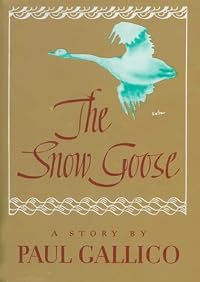
This is perhaps the most perfect story I have ever read. It has the beauty of the Snow Goose, but without any flaws.
When a genuinely magical person comes humbly to a town of conjurers and illusionists, most will find him a threat, some will find redemption and all will find their perspective changed forever. Its title and subtitle capture its character completely.
It is amazingly difficult to find copies of this book. My guess is that those who have a old copy wouldn't dream of letting it go and those who hold the rights to print it new have no idea what magic it contains.
When a genuinely magical person comes humbly to a town of conjurers and illusionists, most will find him a threat, some will find redemption and all will find their perspective changed forever. Its title and subtitle capture its character completely.
It is amazingly difficult to find copies of this book. My guess is that those who have a old copy wouldn't dream of letting it go and those who hold the rights to print it new have no idea what magic it contains.
It always amazes, and saddens, me that some of the most enjoyable and meaningful books, for adults, wind up being called "children's books" or "young adult". So it is with the majority of Paul Gallico's stories which show their amazing depth and worth when an adult reads them.
This one shows us how easy, and often, we applaud the sham and decry the true.
The Man Who Was Magic remains one of my favorite Gallico books - along with Jeannie.
This one shows us how easy, and often, we applaud the sham and decry the true.
The Man Who Was Magic remains one of my favorite Gallico books - along with Jeannie.
Posted at:
http://web.mac.com/ann163125/Table_Talk/Table_Talk_Blog/Entries/2008/5/31_The_Ma...
A conversation with another book blogger earlier this year reminded me of a book that I used to read without fail to my classes of ten and eleven year olds when I was teaching primary. Somewhere over the intervening twenty years, my copy of Paul Gallico’s The Man Who Was Magic has gone missing, but the local library service turned up trumps and managed to dig me a copy out of its archive section and so I’ve been able to visit once again the city of Mageia in the presence of the young magician, Adam and his talking dog, Mopsy.
Mageia is a city entirely populated by stage magicians and their families and every year they hold trials to elect show more three of their number to the Guild of Master Magicians. When a young man dressed from head to toe in doe-skin turns up at their gates and asks to be allowed to take part in the trials they are both sceptical and scathing. When he invites Jane, the apparently incompetent daughter of the Chief Magician to be his assistant, they openly mock him. However, their mockery turns to apprehension when, in the eliminating round, Adam performs what appears to be not stage magic but the real thing. He is saved from what could well turn out to be a very nasty situation only by the words of the senior magician, Professor Alexander.
You’ve just witnessed one of the finest pieces of sleight-of-hand I’ve seen since I was a boy. And there you are, like a bunch of dummies sitting on your hands, instead of acknowledging a master.
And there, in a nutshell, is Gallico’s basic premise. We all applaud the wonders of the mechanical and industrial world that we have created while sitting on our hands failing to recognise and applaud the miracle that is the magic of the natural world. Adam tries to explain this to Jane when they are sent by her parents on a picnic during which she is supposed to worm is secret out of him. Adam has to disappoint her as she tries to get him to reveal the ‘trick’.
‘Can’t you see, Jane.’ Adam continued, ‘that there’s magic all about us? None of it can be explained and there isn’t a single soul who really and truly knows the secret. Supposing, for instance, you tell me how this is done.’ He picked up and old, brown acorn from the ground and, holding it between thumb and forefinger, he indicated the spreading branches and shining leaves of the ancient tree towering above their heads. “From this, comes that,’ he said. ‘Well?’
‘It - it just grows.’
‘Oh, yes. But how does something so tremendous come from something so tiny? And why? And when was the first one? And how did they all begin?’
Gallico’s book is sub-titled A Fable of Innocence and perhaps at times it preaches its messages just a little to openly. This is especially the case when Adam tries to persuade Jane that she holds the key to her own success or failure.
Adam gently touched her forehead with a long finger. ‘It’s all inside there, Jane, like a box with many compartments. each one you can call upon for anything you want or desire. It contains the greatest magic of all....There are compartments ...called “I Can” and “I Will”. When you have learned to unlock them, the strong magic will help you to move mountains.’
Nevertheless, if you will excuse the pun, this is a magical tale and I defy anyone not to get caught up in the climax as Mopsy is locked in the Museum of Magic with no apparent hope of escape while Adam and Jane are stranded on stage with nothing but an old clothes rack between them and complete failure. It may not prove to be an easy book to get hold of, but if you do come across a copy in a secondhand shop find a child for whom you can buy it and then read it yourself before passing it on. show less
http://web.mac.com/ann163125/Table_Talk/Table_Talk_Blog/Entries/2008/5/31_The_Ma...
A conversation with another book blogger earlier this year reminded me of a book that I used to read without fail to my classes of ten and eleven year olds when I was teaching primary. Somewhere over the intervening twenty years, my copy of Paul Gallico’s The Man Who Was Magic has gone missing, but the local library service turned up trumps and managed to dig me a copy out of its archive section and so I’ve been able to visit once again the city of Mageia in the presence of the young magician, Adam and his talking dog, Mopsy.
Mageia is a city entirely populated by stage magicians and their families and every year they hold trials to elect show more three of their number to the Guild of Master Magicians. When a young man dressed from head to toe in doe-skin turns up at their gates and asks to be allowed to take part in the trials they are both sceptical and scathing. When he invites Jane, the apparently incompetent daughter of the Chief Magician to be his assistant, they openly mock him. However, their mockery turns to apprehension when, in the eliminating round, Adam performs what appears to be not stage magic but the real thing. He is saved from what could well turn out to be a very nasty situation only by the words of the senior magician, Professor Alexander.
You’ve just witnessed one of the finest pieces of sleight-of-hand I’ve seen since I was a boy. And there you are, like a bunch of dummies sitting on your hands, instead of acknowledging a master.
And there, in a nutshell, is Gallico’s basic premise. We all applaud the wonders of the mechanical and industrial world that we have created while sitting on our hands failing to recognise and applaud the miracle that is the magic of the natural world. Adam tries to explain this to Jane when they are sent by her parents on a picnic during which she is supposed to worm is secret out of him. Adam has to disappoint her as she tries to get him to reveal the ‘trick’.
‘Can’t you see, Jane.’ Adam continued, ‘that there’s magic all about us? None of it can be explained and there isn’t a single soul who really and truly knows the secret. Supposing, for instance, you tell me how this is done.’ He picked up and old, brown acorn from the ground and, holding it between thumb and forefinger, he indicated the spreading branches and shining leaves of the ancient tree towering above their heads. “From this, comes that,’ he said. ‘Well?’
‘It - it just grows.’
‘Oh, yes. But how does something so tremendous come from something so tiny? And why? And when was the first one? And how did they all begin?’
Gallico’s book is sub-titled A Fable of Innocence and perhaps at times it preaches its messages just a little to openly. This is especially the case when Adam tries to persuade Jane that she holds the key to her own success or failure.
Adam gently touched her forehead with a long finger. ‘It’s all inside there, Jane, like a box with many compartments. each one you can call upon for anything you want or desire. It contains the greatest magic of all....There are compartments ...called “I Can” and “I Will”. When you have learned to unlock them, the strong magic will help you to move mountains.’
Nevertheless, if you will excuse the pun, this is a magical tale and I defy anyone not to get caught up in the climax as Mopsy is locked in the Museum of Magic with no apparent hope of escape while Adam and Jane are stranded on stage with nothing but an old clothes rack between them and complete failure. It may not prove to be an easy book to get hold of, but if you do come across a copy in a secondhand shop find a child for whom you can buy it and then read it yourself before passing it on. show less
This is another of my favorite 'curl up with' books. It's fun and rather gentle in tone as the main characters learn there are many ways to view the world. Adam, the main character, and his sidekick dog comes to the the city where stage magicians live to compete in the magician tryouts. He brings real (not stage) magic, and they're not quite sure how to handle that.
Members
- Recently Added By
Lists

Books With Interesting Titles
173 works; 14 members

Books With Complete Sentence Titles
374 works; 15 members
Author Information

111+ Works 9,544 Members
Common Knowledge
- Original title
- The man who was magic
- Original publication date
- 1966
- People/Characters
- Adam; Jane; Mopsy; Ninian the Nonpareil; The Great Robert
- Important places
- The hidden city of Mageia
- Dedication
- To the child Virginia was
- First words
- Th estranger, dusty and travel-stained, accompanied by the small mop of a dog at his heels, emerged from the cool darkness of the woods where they had spend the night and paused for a moment in wonder at the first sight of th... (show all)eir goal, Mageia, the magical city.
- Last words
- (Click to show. Warning: May contain spoilers.)She turned and hurried down the path whence she had come, to keep her promise not to be away too long.
Classifications
Statistics
- Members
- 226
- Popularity
- 143,615
- Reviews
- 11
- Rating
- (4.08)
- Languages
- Dutch, English, German
- Media
- Paper
- ISBNs
- 4
- ASINs
- 5