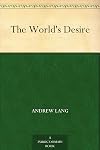
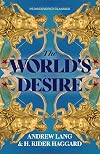
The World's Desire
by H. Rider Haggard, Andrew Lang
On This Page
Description
The World's Desire (1890) is a fantasy novel about the hero Odysseus. He return home after his second, previously untold journey, to find his home devastated. He then sets out on his last journey, during which he encounters Helen of Troy, to whom the title refers. His journey takes him to Egypt, where he witnesses the 'magician' Moses, and his power over the pharaoh..
Tags
Recommendations










Member Reviews
A sequel to The Odyssey, written by H Rider Haggard *and* Andrew Lang? It sounded like a great idea. I opened it in the middle, which was a mistake; the choice of language and sentence structure identifies it as what it is, a Victorian-era fantasy with no ties to the ancient world. But going back to it and starting from the first page, I found it much more engaging. This time I got to page 141 before the two-women-besotted-with-one-man-through-multiple-lifetimes trope annoyed me too much to continue. I already read about the misadventures and poor decisions of Odysseus throughout The Odyssey, do I need to read more? Do I want to read more about Fates and fickle gods? On the whole, I think maybe not. It's starting to remind me of Dido show more and Aeneas too. Tbh, I miss Penelope, a much more active, clever and interesting character than either of the female leads in this book. 3 stars for keeping my attention through 60% of the book is generous. show less
I'm not going to claim that Haggard even at his best is the same order of classic as the best by Charles Dickens, the Brontes, George Eliot or Thomas Hardy. But like fellow Victorians Arthur Conan Doyle or Robert Louis Stevenson or Rudyard Kipling, Haggard really could spin a good yarn, and the fantasy genre in general owes him a great debt. Ten of his books are on my bookshelves. I gobbled those up in my teens and most I remember very, very well even decades later. My favorite of his novels involve Ayesha, especially the book Wisdom's Daughter, which is also set in Ancient Egypt and like The World's Desire, could be seen as historical fantasy. This is my second favorite of the Haggard books I've read, and is actually a collaboration show more with Andrew Lang, and other.
The back cover bills this as "the third Odyssey" and involves Odysseus, Homer's hero. At the end of The Odyssey we know that Odysseus must undertake another journey to placate Poseidon. In Haggard's novel, he returns only to find Penelope slain and his home burned to the ground. He then undertakes a new quest--to find his true love Helen under the auspices of Aphrodite. In a way that irked me a bit. Goodness knows Ancient Greek literature isn't perhaps the place to find strong female characters, but I always loved Penelope, a great match for Odysseus, noted for her cunning (remember her unweaving of the shroud to fool the suitors.) Helen on the other hand, is noted for physical beauty. And certainly this isn't a classic on the order of Homer! But taken for what it is, a crackling adventure yarn and fantasy, this is a lot of fun, as long as you aren't put off by Victorian prose or political sensibilities. show less
The back cover bills this as "the third Odyssey" and involves Odysseus, Homer's hero. At the end of The Odyssey we know that Odysseus must undertake another journey to placate Poseidon. In Haggard's novel, he returns only to find Penelope slain and his home burned to the ground. He then undertakes a new quest--to find his true love Helen under the auspices of Aphrodite. In a way that irked me a bit. Goodness knows Ancient Greek literature isn't perhaps the place to find strong female characters, but I always loved Penelope, a great match for Odysseus, noted for her cunning (remember her unweaving of the shroud to fool the suitors.) Helen on the other hand, is noted for physical beauty. And certainly this isn't a classic on the order of Homer! But taken for what it is, a crackling adventure yarn and fantasy, this is a lot of fun, as long as you aren't put off by Victorian prose or political sensibilities. show less
dnf...
It has been a long time since i haven't finished a book but i feel justified on this occasion, not because the writing is particularly bad but because i've read this freaking story at least 3 or 4 times already.
Its Haggards same tired eternal love-triangle shtick same as [b:She|682681|She A History of Adventure (She, #1)|H. Rider Haggard|https://i.gr-assets.com/images/S/compressed.photo.goodreads.com/books/1388347922l/682681._SY75_.jpg|2334644] and [b:The Return of She|509858|Ayesha The Return of She (She #2)|H. Rider Haggard|https://i.gr-assets.com/images/S/compressed.photo.goodreads.com/books/1348939918l/509858._SY75_.jpg|18650125] (which is better than the original IMO) and the same as [b:The Ancient Allan|1939689|The Ancient show more Allan (Allan Quatermain #10)|H. Rider Haggard|https://i.gr-assets.com/images/S/compressed.photo.goodreads.com/books/1347856192l/1939689._SX50_.jpg|942102] and who knows ho many others.
I only made it a third of the way through but already had two different characters get a layout of events to come from different gods/spirits. As if i didn't already know.
This is built as a sequel to [b:The Odyssey|1381|The Odyssey|Homer|https://i.gr-assets.com/images/S/compressed.photo.goodreads.com/books/1390173285l/1381._SY75_.jpg|3356006] but its version of Odysseus also holds no interest. At least with Allan Quatermain you had a vulnerable slightly incompetent Indiana Jones type hero and with SHE well Ayesha had all sorts of interesting elements to her.
This version of Odysseus is very strong, very into war and very into Helen of Troy, none of which are characteristics you would see in any modern interpretation of the character.
The only thing which might be of interest if i continued would be that this uses a mix of Greek, Egyptian and Biblical mythologies, but its not enough to get me to read this plotline yet again. show less
It has been a long time since i haven't finished a book but i feel justified on this occasion, not because the writing is particularly bad but because i've read this freaking story at least 3 or 4 times already.
Its Haggards same tired eternal love-triangle shtick same as [b:She|682681|She A History of Adventure (She, #1)|H. Rider Haggard|https://i.gr-assets.com/images/S/compressed.photo.goodreads.com/books/1388347922l/682681._SY75_.jpg|2334644] and [b:The Return of She|509858|Ayesha The Return of She (She #2)|H. Rider Haggard|https://i.gr-assets.com/images/S/compressed.photo.goodreads.com/books/1348939918l/509858._SY75_.jpg|18650125] (which is better than the original IMO) and the same as [b:The Ancient Allan|1939689|The Ancient show more Allan (Allan Quatermain #10)|H. Rider Haggard|https://i.gr-assets.com/images/S/compressed.photo.goodreads.com/books/1347856192l/1939689._SX50_.jpg|942102] and who knows ho many others.
I only made it a third of the way through but already had two different characters get a layout of events to come from different gods/spirits. As if i didn't already know.
This is built as a sequel to [b:The Odyssey|1381|The Odyssey|Homer|https://i.gr-assets.com/images/S/compressed.photo.goodreads.com/books/1390173285l/1381._SY75_.jpg|3356006] but its version of Odysseus also holds no interest. At least with Allan Quatermain you had a vulnerable slightly incompetent Indiana Jones type hero and with SHE well Ayesha had all sorts of interesting elements to her.
This version of Odysseus is very strong, very into war and very into Helen of Troy, none of which are characteristics you would see in any modern interpretation of the character.
The only thing which might be of interest if i continued would be that this uses a mix of Greek, Egyptian and Biblical mythologies, but its not enough to get me to read this plotline yet again. show less
Haggard and Lang undertake a great task with this book, to write a fitting sequel to 'The Odyssey', one of the greatest tales ever told. To their credit they succeed quite well although the book drags in part when talk dominates events.
Returning from his second wandering as prophesied during his visit to The Underworld, Odyssey finds Ithaca a barren island. His wife Penelope and son Telemachus and all his people have fallen victim to a plague and those few left alive have deserted their home.
The only sign of life is in the temple of Aphrodite where she berates Odysseus for only worshipping Pallas Athene the goddess of War rather than herself, the goddess of Love.
She sends Odysseus a vision of his one true love, Helen of Troy and show more instructs him to leave Ithaca forever in search of her. His search takes him to Egypt where an ineffectual pharaoh and his domineering wife/sister are under siege from two fronts: from a mysterious goddess who has taken residence in Tanis luring men to their deaths and from a series of plagues brought down on Egypt by two unnamed conjurers in support of a slave revolt.
Students of Homer may find this book an enjoyable diversion. Old Testament scholars may be less impressed. show less
Returning from his second wandering as prophesied during his visit to The Underworld, Odyssey finds Ithaca a barren island. His wife Penelope and son Telemachus and all his people have fallen victim to a plague and those few left alive have deserted their home.
The only sign of life is in the temple of Aphrodite where she berates Odysseus for only worshipping Pallas Athene the goddess of War rather than herself, the goddess of Love.
She sends Odysseus a vision of his one true love, Helen of Troy and show more instructs him to leave Ithaca forever in search of her. His search takes him to Egypt where an ineffectual pharaoh and his domineering wife/sister are under siege from two fronts: from a mysterious goddess who has taken residence in Tanis luring men to their deaths and from a series of plagues brought down on Egypt by two unnamed conjurers in support of a slave revolt.
Students of Homer may find this book an enjoyable diversion. Old Testament scholars may be less impressed. show less
I started this novel and then set it aside for years. Upon picking it up again the second time, I finished it. It was enjoyable but not my favorite Haggard novel.
Ratings
Members
- Recently Added By
Lists

Ballantine Adult Fantasy Series
85 works; 8 members
Author Information

285+ Works 18,952 Members
Sir Henry Rider Haggard (1856-1925) is best remembered for his 34 adventure fantasy novels set in exotic locations. As a child, Haggard, whose father was an English barrister, was considered dim-witted and was inclined to daydreaming. His parents ended his formal education when he was seventeen, and he was sent to work in South Africa, where his show more imagination was inspired by the people, animals, and jungle. He became close friends with authors Rudyard Kipling and Andrew Lang. Haggard's most popular books are King Solomon's Mines (1886) and She (1887). He also wrote short stories, as well as nonfiction on topics such as gardening, English farming, and rural life, interests which led to duties on government commissions concerned with land maintenance. For his literary contributions and his government service, Haggard was knighted in 1912. Several of Haggard's novels have been filmed. She was filmed in 1965, starring Ursula Andress. King Solomon's Mines was filmed with Stewart Granger and Deborah Kerr in 1950, and again with Richard Chamberlain and Sharon Stone in 1985. Also, the novel Allan Quatermain was filmed as Allan Quatermain and the Lost City of Gold with Richard Chamberlain and Sharon Stone in 1986. (Bowker Author Biography) show less

392+ Works 24,465 Members
Andrew Lang was born at Selkirk in Scotland on March 31, 1844. He was a historian, poet, novelist, journalist, translator, and anthropologist, in connection with his work on literary texts. He was educated at Edinburgh Academy, St. Andrews University, and Balliol College, Oxford University, becoming a fellow at Merton College. His poetry includes show more Ballads and Lyrics of Old France (1872), Ballades in Blue China (1880--81), and Grass of Parnassus (1888--92). His anthropology and his defense of the value of folklore as the basis of religion is expressed in his works Custom and Myth (1884), Myth, Ritual and Religion (1887), and The Making of Religion (1898). He also translated Homer and critiqued James G. Frazer's views of mythology as expressed in The Golden Bough. He was considered a good historian, with a readable narrative style and knowledge of the original sources including his works A History of Scotland (1900-7), James VI and the Gowrie Mystery (1902), and Sir George Mackenzie (1909). He was one of the most important collectors of folk and fairy tales. His collections of Fairy books, including The Blue Fairy Book, preserved and handed down many of the better-known folk tales from the time. He died of angina pectoris on July 20, 1912. (Bowker Author Biography) show less
Series
Belongs to Publisher Series
Henry Rider Haggard (Band 09)
Heyne Science Fiction & Fantasy (06/4138)
Work Relationships
Common Knowledge
- Canonical title*
- Das Sehnen der Welt
- Original title
- The World's Desire
- Original publication date
- 1890
- People/Characters
- Odysseus; Helen of Troy
- Important places
- Egypt (Ancient)
*Some information comes from Common Knowledge in other languages. Click "Edit" for more information.
Classifications
Statistics
- Members
- 247
- Popularity
- 131,225
- Reviews
- 5
- Rating
- (3.30)
- Languages
- English, German, Russian, Spanish
- Media
- Paper, Ebook
- ISBNs
- 48
- ASINs
- 18