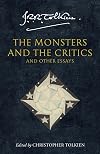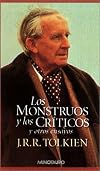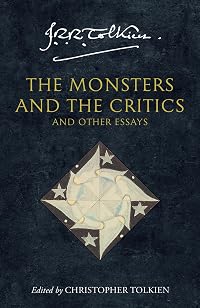
The Monsters and the Critics
by J. R. R. Tolkien
On This Page
Description
Complete collection of Tolkien's essays, including two on Beowulf, which span three decades beginning six years before The Hobbit to five years after The Lord of the Rings. The seven 'essays' by J.R.R. Tolkien assembled in this new paperback edition were with one exception delivered as general lectures on particular occasions; and while they mostly arose out of Tolkien's work in medieval literature, they are accessible to all. Two of them are concerned with Beowulf, including the well-known show more lecture whose title is taken for this book, and one with Sir Gawain and the Green Knight, given in the University of Glasgow in 1953. Also included in this volume is the lecture English and Welsh; the Valedictory Address to the University of Oxford in 1959; and a paper on Invented Languages delivered in 1931, with exemplification from poems in the Elvish tongues. Most famous of all is On Fairy-Stories, a discussion of the nature of fairy-tales and fantasy, which gives insight into Tolkien's approach to the whole genre. The pieces in this collection cover a period of nearly thirty years, beginning six years before the publication of The Hobbit, with a unique 'academic' lecture on his invention (calling it A Secret Vice) and concluding with his farewell to professorship, five years after the publication of The Lord of the Rings. show lessTags
Recommendations








Member Reviews
http://nwhyte.livejournal.com/2154968.html
This is a collection of seven lectures by Tolkien, of which I think I had previously read only "On Fairy Stories" and "A Secret Vice". As always, they are an interesting insight into how his mind worked, or at least how he wanted us to think it worked. The more academic pieces (in particular the second, "On Translating Beowulf") are somewhat moored in academic controversies of their time, which may or may not have subsided by now and which in any case I am not close to. But the title piece rises above that to give an argument for appreciating Beowulf as a real story with serious monsters, rather than just a source for scholarly discussion on vaguely related topics, and that is the point made in show more the vivid metaphor of the man who built his tower on inherited land.
The other highlight for me, even as a non-Welsh speaker, is the lecture "English and Welsh" urging those with an interest in the history of the English language not to ignore its nearest geographical neighbour. He makes the same general point made much later by McWhorter, that English shares a significant substratum with Welsh (and he is very insistent that it is Welsh/British rather than the Goidelic languages), though interestingly uses a completely different set of linguistic/grammatical clues to McWhorter in making the argument. So there may well be something to it.
"On Fairy Stories" has quite a lot of information about Tolkien's views of other works of fantasy literature, ancient and modern; it is a bit less successful at setting up an analytical framework for looking at fairy stories as a whole (Farah Mendlesohn seems to me to have a more useful and more widely applicable approach), but again he makes a convincing emotional appeal to treat the stories first and foremost as stories for an intended audience, rather than for anything else. His valedictory address, at the end of the book, is an amusing but somewhat rambling justification for wandering off the point for most of his career, but in fact a commitment to an aesthetic of narrative seems to have been precisely the point, one which he successfully communicated through both his fiction and his non-fiction. show less
This is a collection of seven lectures by Tolkien, of which I think I had previously read only "On Fairy Stories" and "A Secret Vice". As always, they are an interesting insight into how his mind worked, or at least how he wanted us to think it worked. The more academic pieces (in particular the second, "On Translating Beowulf") are somewhat moored in academic controversies of their time, which may or may not have subsided by now and which in any case I am not close to. But the title piece rises above that to give an argument for appreciating Beowulf as a real story with serious monsters, rather than just a source for scholarly discussion on vaguely related topics, and that is the point made in show more the vivid metaphor of the man who built his tower on inherited land.
The other highlight for me, even as a non-Welsh speaker, is the lecture "English and Welsh" urging those with an interest in the history of the English language not to ignore its nearest geographical neighbour. He makes the same general point made much later by McWhorter, that English shares a significant substratum with Welsh (and he is very insistent that it is Welsh/British rather than the Goidelic languages), though interestingly uses a completely different set of linguistic/grammatical clues to McWhorter in making the argument. So there may well be something to it.
"On Fairy Stories" has quite a lot of information about Tolkien's views of other works of fantasy literature, ancient and modern; it is a bit less successful at setting up an analytical framework for looking at fairy stories as a whole (Farah Mendlesohn seems to me to have a more useful and more widely applicable approach), but again he makes a convincing emotional appeal to treat the stories first and foremost as stories for an intended audience, rather than for anything else. His valedictory address, at the end of the book, is an amusing but somewhat rambling justification for wandering off the point for most of his career, but in fact a commitment to an aesthetic of narrative seems to have been precisely the point, one which he successfully communicated through both his fiction and his non-fiction. show less
I won't give a rating. I read (parts of) the German translation, and it was very peculiar to read comments on translating Beowulf from Anglo-Saxon into Modern English - in German. It's not that the translation itself is bad, (in fact it is very well done) just that this is something that isn't really suitable for translating.
It might be interesting to read the English if it were easily available, but I have no desire to search for it.
It might be interesting to read the English if it were easily available, but I have no desire to search for it.
Not exactly scintillating reading, especially if not already a fan of Tolkien. As he himself admits in one of the lectures (for which these essays were the manuscripts), he was not a particularly interesting lecturer. The only essays likely of broader interest are his famous "On Fairy Stories", and "A Secret Vice" (on invented language). Gladly, these are also the most readable of the bunch, and "On Fairy Stories" alone is with the price of the volume. I'm glad to have it on my shelf, but doubt I'll be reading it regularly, apart from referencing that jewel in the middle.
These essays by Tolkien are thought-provoking and quite readable by the general reader. This essay was instrumental in Beowulf criticism to get the work analyzed on its own merits.
This is an academic text that focuses on Tolkien's approach to critical analysis of literature. This book along with "Beowulf and the Critics" is credited with being one of the best and possible the first in describing the way to perform critical analysis on literature. It is a little hard to follow but if you are interested in Beowulf and critical review than this is well worth the time required.
This collection of essays include some that have influenced my understanding of the history of the languages and literatures of Great Britain, as well as the uses and misunderstandings of Fantasy.
Fascinating subject material, albeit slightly difficult to follow.
Members
- Recently Added By
Author Information

600+ Works 516,407 Members
A writer of fantasies, Tolkien, a professor of language and literature at Oxford University, was always intrigued by early English and the imaginative use of language. In his greatest story, the trilogy The Lord of the Rings (1954--56), Tolkien invented a language with vocabulary, grammar, syntax, even poetry of its own. Though readers have show more created various possible allegorical interpretations, Tolkien has said: "It is not about anything but itself. (Certainly it has no allegorical intentions, general, particular or topical, moral, religious or political.)" In The Adventures of Tom Bombadil (1962), Tolkien tells the story of the "master of wood, water, and hill," a jolly teller of tales and singer of songs, one of the multitude of characters in his romance, saga, epic, or fairy tales about his country of the Hobbits. Tolkien was also a formidable medieval scholar, as evidenced by his work, Beowulf: The Monster and the Critics (1936) and his edition of Anciene Wisse: English Text of the Anciene Riwle. Among his works published posthumously, are The Legend of Sigurd and Gudrún and The Fall of Arthur, which was edited by his son, Christopher. In 2013, his title, TheHobbit (Movie Tie-In) made The New York Times Best Seller List. (Bowker Author Biography) show less
All Editions
Some Editions
Series
Belongs to Publisher Series
Tascabili [Bompiani] (888)
Work Relationships
Contains
Is abridged in
Is a commentary on the text of
Common Knowledge
- Canonical title*
- Los Monstruos y los Críticos y Otros Ensayos
- Original title
- The Monsters and the Critics and Other Essays
- Original publication date
- 1983
- People/Characters
- J. R. R. Tolkien; Beowulf; Beowulf-Poet; Sir Gawain; Gawain-Poet
- First words
- FOREWORD
With one exception, all the 'essays' by J. R. R. Tolkien collected in this book were in fact lectures, delivered on special occasions; and while all were on specific topics, literary or linguistic, the whole audie... (show all)nce on those occasions could in no case (save perhaps that of the Valedictory Address) be presumed to have more than a general knowledge of or interest in the subject -- and the one piece in this collection that was not a lecture, On Translating Beowulf, was not addressed to experts on the study of the poem. - Quotations
- [O]ne must feel a grave disquiet, when the legitimate inspiration is not there; when the subject or topic of ‘research' is imposed, or is ‘found' for a candidate out of someone else's bag of curiosities, or is thought by ... (show all)a committee to be a sufficient exercise for a degree. Whatever may have been found useful in other spheres, there is a distinction between accepting the willing labour of many humble persons in building an English house and the erection of a pyramid with the sweat of degree-slaves.
For you are the heir of the ages. You have not to grope after the dazzling brilliance of invention of the free adjective, to which all human language has not yet fully attained. You may say
green sun
or dead life
and set the imagination leaping.
Language has both strengthened imagination and been freed by it. Who shall say whether the free adjective has created images bizarre and beautiful, or the adjective been freed by strange and beautiful pictures in the mind?
In any case, the expression ‘real life' in this context seems to fall short of academic standards. The notion that motor-cars are more ‘alive' than, say, centaurs or dragons is curious; that they are more ‘real' than, s... (show all)ay, horses is pathetically absurd. How real, how startingly alive is a factory chimney compared with an elm tree: poor obsolete thing, insubstantial dream of an escapist!
For my part, I cannot convince myself that the roof of Bletchley station is more ‘real' than the clouds. And as an artefact I find it less inspiring than the legendary dome of heaven. The bridge to platform 4 is to me less interesting than Bifröst guarded by Heimdall with the Gjallarhorn. From the wildness of my heart I cannot exclude the question whether railway-engineers, if they had been brought up on more fantasy, might not have done better with all their abundant means than they commonly do.
In Faërie one can indeed conceive of an ogre who possesses a castle hideous as a nightmare (for the evil of the ogre wills it so), but one cannot conceive of a house built with a good purpose – an inn, a hostel for travell... (show all)ers, the hall of a virtuous and noble king – that is yet sickeningly ugly. At the present day it would be rash to hope to see one that was not – unless it was built before our time.
In describing a fairy-story which they think adults might possibly read for their own entertainment, reviewers frequently indulge in such waggeries as: ‘this book is for children from the ages of six to sixty'. But I have n... (show all)ever yet seen the puff of a new motor-model that began thus: ‘this toy will amuse infants from seventeen to seventy'; though that to my mind would be much more appropriate. - Publisher's editor
- Christopher Reuel Tolkien
- Disambiguation notice
- A collection of Essays including "Beowulf: The Monsters and the Critics". Do not combine with the essay published by itself or with "Beowulf and the Critics" which is Michael Drout's analysis of the essay.
*Some information comes from Common Knowledge in other languages. Click "Edit" for more information.
Classifications
Statistics
- Members
- 931
- Popularity
- 28,347
- Reviews
- 7
- Rating
- (4.12)
- Languages
- 8 — Czech, English, French, German, Italian, Polish, Russian, Spanish
- Media
- Paper, Ebook
- ISBNs
- 17
- ASINs
- 6