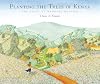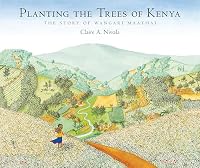
Planting the Trees of Kenya: The Story of Wangari Maathai
by Claire A. Nivola
On This Page
Description
"This is the story of Wangari Maathai, winner of the 2004 Nobel Peace Prize and founder of the Green Belt Movement, Wangari came home from college to find the streams dry, the people malnourished, and the trees gone. How could she alone bring back the trees and restore the gardens and the people?"--Jacket.Tags
Recommendations



























Member Reviews
What an incredible narrative. It manages to show the ecological benefits of small scale farming and maintaining local fauna, as well as depicting strong role models for young girls, all while maintaining accessibility and avoiding pretention. The book paints a portrait of Wagnari Maathai as a determined and intellectual leader and other Kenyan women, regardless of educational background, as key players in this national environmental movement. The illustrations maintain the lightness of the watercolor medium while still having intricate details and interesting textures, making the sweeping landscapes captivating without being overdone or too heavy handed. The same can be said for the book’s language: some direct quotes from Maathai show more provide moving imagery. This is not just a good book, but it is an important message full of positive and inspiring ideas. show less
Awarded the Nobel Peace Prize in 2004 - the first African woman to be so honored - Kenyan activist Wangari Maathai's struggle to reverse the environmental degradation of her homeland, and the resultant increase in in rural poverty that followed it, is related for younger readers in Claire A. Nivola's Planting the Trees of Kenya. An inspirational tale, of one woman's crusade to improve the life of her people, by teaching them to be better stewards of the land, it also offers a clear lesson on the connection between human welfare and environmental protection.
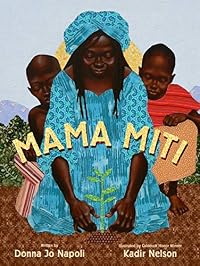
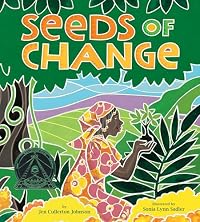
The first of four picture-book biographies of Maathai - it was followed by Wangari's Trees of Peace: A True Story from Africa, Mama Miti: Wangari Maathai and the Trees of Kenya and show more Seeds of Change: Wangari's Gift to the World - Planting the Trees of Kenya follows its subject from her early childhood, when she learned to love the natural world around her, through her college education in the United States, and her return to Kenya, where she founded the Green Belt Movement, in response to the social and environmental changes she observed. An afterword provides more detailed information.
Chosen as one of the March selections in The Picture-Book Club to which I belong, this lovely book reads well, capturing the power of Maathai's simple plan, to replant trees, and teach the people to value them. The illustrations, also by Nivola, are simply charming! I think I might try to track down some of the other children's titles about Maathai, but it's hard to imagine any of them exceeding this one! Highly recommended! show less
The first of four picture-book biographies of Maathai - it was followed by Wangari's Trees of Peace: A True Story from Africa, Mama Miti: Wangari Maathai and the Trees of Kenya and show more Seeds of Change: Wangari's Gift to the World - Planting the Trees of Kenya follows its subject from her early childhood, when she learned to love the natural world around her, through her college education in the United States, and her return to Kenya, where she founded the Green Belt Movement, in response to the social and environmental changes she observed. An afterword provides more detailed information.
Chosen as one of the March selections in The Picture-Book Club to which I belong, this lovely book reads well, capturing the power of Maathai's simple plan, to replant trees, and teach the people to value them. The illustrations, also by Nivola, are simply charming! I think I might try to track down some of the other children's titles about Maathai, but it's hard to imagine any of them exceeding this one! Highly recommended! show less
'Mutter der Bäume' wird die Kenianerin Wangari Maathai genannt, die den Frauen ihres Landes beibrachte, ihr Land wieder aufzuforsten. 30 Millionen Bäume wurden durch sie neu gepflanzt. 2004 erhielt sie als erste Afrikanerin den Friedensnobelpreis. Claire A. Nivola erzählt in fließender Sprache und leuchtenden Aquarellbildern die einzigartige Geschichte dieser Frau. Ein wunderschönes Buch, das zeigt, wie jeder dabei mithelfen kann, die Erde zu pflegen und zu erhalten.
This is the story of Wangari Maathai, who grew up in the green hills of Kenya. She knew as a young girl to honor nature. When she grew up, she went to college for five years in America studying biology. When she returned to Kenya, she found those once green hills were no longer green. The land was as bare as a desert making the people of the land poorer than ever. Wangari took a stand and said, "When we see that we are part of the problem, we can become part of the solution." From then on Wangari started teaching the women among the land to plant trees. "When the soil is exposed, it is crying out for help, it is naked and needs to be clothed in its dress. That is the nature of the land. It needs color, it needs its cloth of green."
I show more absolutely adore this book and the incredible message that it shares to young readers. This book teaches children that they can make a difference, one person at a time. This book also teaches children the importance and sacredness of the environment, how easily it can be taken advantage of, and how different life would be without a healthy and stable environment. show less
I show more absolutely adore this book and the incredible message that it shares to young readers. This book teaches children that they can make a difference, one person at a time. This book also teaches children the importance and sacredness of the environment, how easily it can be taken advantage of, and how different life would be without a healthy and stable environment. show less
“Planting the Trees of Kenya”
“Planting the Trees of Kenya” is about Wangari and her journey to restore her homeland, Kenya. In the beginning of the story, Wangari describes Kenya as a beautiful where everyone is able to live off of the land. Then Wangari goes to school abroad and while she is away, the land is corrupted because many of the trees have been cut down, which then ruins the rest of the land. Wangari then uses whatshe learned at school to work with the people of Kenya to plant more trees to restore the land. There are two reasons I liked this book. I liked Wangari’s character. I liked how she used what she learned abroad to improve the conditions of her homeland. I also liked how determined Wangari was. When they show more first tried to plant the trees, they had trouble being successful, and some people thought that planting trees was a waste of time. Planting trees is also hard work. I could tell how much Kenya meant to Wangari because of her determination.
I also liked how the book pushes readers to think about climate change and what they can do to reverse the damaging effects altering the environment to fit our needs. It also shed light on how important education is because if Wangari had not gone to school, she wouldn’t have known how to fix their land. It also pushes readers to think about what they can do to stop/reverse climate change, or any issue. Wangari was one person that used her knowledge to inform a community of people of a problem and how to fix it. They then found a problem and solution to the problem, which shows readers that they can also change their communities as well.
The big idea of this story is that we must use what we learn to make the world a better place. show less
“Planting the Trees of Kenya” is about Wangari and her journey to restore her homeland, Kenya. In the beginning of the story, Wangari describes Kenya as a beautiful where everyone is able to live off of the land. Then Wangari goes to school abroad and while she is away, the land is corrupted because many of the trees have been cut down, which then ruins the rest of the land. Wangari then uses whatshe learned at school to work with the people of Kenya to plant more trees to restore the land. There are two reasons I liked this book. I liked Wangari’s character. I liked how she used what she learned abroad to improve the conditions of her homeland. I also liked how determined Wangari was. When they show more first tried to plant the trees, they had trouble being successful, and some people thought that planting trees was a waste of time. Planting trees is also hard work. I could tell how much Kenya meant to Wangari because of her determination.
I also liked how the book pushes readers to think about climate change and what they can do to reverse the damaging effects altering the environment to fit our needs. It also shed light on how important education is because if Wangari had not gone to school, she wouldn’t have known how to fix their land. It also pushes readers to think about what they can do to stop/reverse climate change, or any issue. Wangari was one person that used her knowledge to inform a community of people of a problem and how to fix it. They then found a problem and solution to the problem, which shows readers that they can also change their communities as well.
The big idea of this story is that we must use what we learn to make the world a better place. show less
Wangari Maathai loved her native Kenya. She also loved biology and the natural world. She left Kenya to go to college in the U.S. When she returned, the land she remembered for its natural beauty had been stripped of its "dress of green." Rather than wait for the government or someone else to do something, she took matters into her own hands. This is the story of what she did and how she did it. This is a story of one person affecting sweeping change and helping the land and people she loved. This book is illustrated beautifully.
While I appreciated Nivola's way of telling the story of Wangari Maathai, I felt that Nivola did not do her story justice. So many details were skimmed over or left out - I wanted to know more. However, I really enjoyed and was inspired by her effort in making her home Kenya feel like home. I learned that at a young age, she left Kenya to receive an education in America. She had only been gone for 5 years, but by the time she had returned everything had changed. A fig tree that was once deemed sacred had now been cut down, all of her childhood magic went with it. She led the reform of planting trees, getting many women and students in Kenya involved as well.
Members
- Recently Added By
Lists

A Child's Book Tour of East Africa ::: Ethiopia, Kenya, Sudan, Uganda
68 works; 4 members
Author Information

9+ Works 2,022 Members
Awards and Honors
Awards
Distinctions
Notable Lists
Common Knowledge
- Canonical title
- Planting the Trees of Kenya: The Story of Wangari Maathai
- Original publication date
- 2008
- People/Characters
- Wangari Maathai
- Important places
- Africa; East Africa; Kansas, USA; Kenya
- First words
- As Wangari Maathai tells it, when she was growing up on a farm in the hills of central Kenya, the earth was clothed in its dress of green.
- Quotations
- She had been away for five years, only five years, but it might have been twenty-so changed was the landscape of Kenya.
- Last words
- (Click to show. Warning: May contain spoilers.)"It needs color, it needs its cloth of green."
Classifications
- Genres
- Nonfiction, Picture Books
- DDC/MDS
- 333.72092 — Society, Government, and Culture Economics Economics of land and energy Conservation, Alternative Energy Sources Conservation & protection Biography And History Biography
- LCC
- SB63 .M22 .N58 — Agriculture Horticulture. Plant propagation. Plant breeding Plant culture
- BISAC
Statistics
- Members
- 705
- Popularity
- 40,196
- Reviews
- 46
- Rating
- (4.16)
- Languages
- 9 — Catalan, Chinese, English, French, German, Japanese, Korean, Portuguese, Spanish
- Media
- Paper
- ISBNs
- 14
- ASINs
- 2