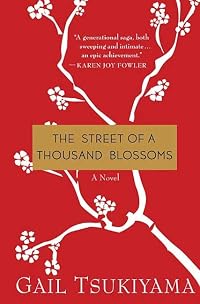
The Street of a Thousand Blossoms
by Gail Tsukiyama
On This Page
Description
It is Tokyo in 1939. On the Street of a Thousand Blossoms, two orphaned brothers dream of a future firmly rooted in tradition. The older boy, Hiroshi, shows early signs of promise at the national obsession of sumo wrestling, while Kenji is fascinated by the art of Noh theater masks. But as the ripples of war spread to their quiet neighborhood, the brothers must put their dreams on hold and forge their own paths in a new Japan. Meanwhile, the two young daughters of a renowned sumo master find show more their lives increasingly intertwined with the fortunes of their father's star pupil, Hiroshi. show lessTags
Recommendations





Member Reviews
i feel like this is one of those novels that sits with you for a while and improves with distance. so i rounded up.
this is a melancholy story - early on i wasn't sure if i was really getting into the novel and whether what i was feeling was a bit of ennui at the fault of my own disposition or because of the writing. but as i kept going tsuyikama's writing made it worthwhile and i realized that her style was very purposeful and deliberate. the novel is a story about endurance and recovery but it is told so quietly. covering the time in japan from world war II through until the mid- to late-60s, this book is quite a saga of two families. i enjoyed very much the way traditional customs and story-telling were woven into the plot. my heart show more broke a couple of times and my eyes even welled up a bit, though they didn't spill over. (and i am not one who cries when it comes to reading, so on the very few occasions when a story causes this reaction, i am surprised.) a couple of things i would have loved, as complements to the story: a) a map; and b) family trees or a character chart. mostly because i am a sucker for these things when they do appear in historical fiction.
i think if you are a careful reader, one who doesn't mind giving focused time to a special story, you will like this novel. show less
this is a melancholy story - early on i wasn't sure if i was really getting into the novel and whether what i was feeling was a bit of ennui at the fault of my own disposition or because of the writing. but as i kept going tsuyikama's writing made it worthwhile and i realized that her style was very purposeful and deliberate. the novel is a story about endurance and recovery but it is told so quietly. covering the time in japan from world war II through until the mid- to late-60s, this book is quite a saga of two families. i enjoyed very much the way traditional customs and story-telling were woven into the plot. my heart show more broke a couple of times and my eyes even welled up a bit, though they didn't spill over. (and i am not one who cries when it comes to reading, so on the very few occasions when a story causes this reaction, i am surprised.) a couple of things i would have loved, as complements to the story: a) a map; and b) family trees or a character chart. mostly because i am a sucker for these things when they do appear in historical fiction.
i think if you are a careful reader, one who doesn't mind giving focused time to a special story, you will like this novel. show less
Just when you think you've read the best that Gail Tsukiyama has written, you read another and it threatens to trump the others. I don't think Ms Tsukiyama is capable of writing even a mediocre book.
The Street of a Thousand Blossoms covers the world of sumo wrestling and Noh theater. Both traditional sporting and artistic performances to have survived WWII. In pre-war Japan, we are introduced to a pair of grandparents bringing up their 2 young grandsons after their parents died in a boating accident, an esteemed mask artist and the owner and manager of a stable of sumo wrestlers and his 2 daughters.
Even as the Japanese armies gain more victories around the Asia Pacific, hardship descends on the Japanese people at home. Rations, military show more police harassment and abuse, hunger,fear and the horrors of the atomic bombs change families and people as no one could have foretold.
Through the war, through American occupation and through the gradual rebuilding of Japan, the reader is provided ring-side seats into the lives of everyday Japanese. We are given the privilege of understanding the thoughts and feelings of each person. We learn their secrets, their fears, their hopes, their dreams and their aspirations. While the 2 orphaned boys grow up to become confident men in their chosen profession of sumo wrestling and mask making, happiness wars with grief. You celebrate their triumphs and you grieve with their tragedies. What you don't do, is lose hope because they don't lose hope. What's subtly weaved through is that of balance.
The cadence throughout the book is one of respect, quiet determination and acceptance. You lose yourself among the pages and you forget that these people aren't real. You can see them in your mind's eye and you want to reach out and hug them.
This is a book that leaves a soothing calmness in you even as you close it. show less
The Street of a Thousand Blossoms covers the world of sumo wrestling and Noh theater. Both traditional sporting and artistic performances to have survived WWII. In pre-war Japan, we are introduced to a pair of grandparents bringing up their 2 young grandsons after their parents died in a boating accident, an esteemed mask artist and the owner and manager of a stable of sumo wrestlers and his 2 daughters.
Even as the Japanese armies gain more victories around the Asia Pacific, hardship descends on the Japanese people at home. Rations, military show more police harassment and abuse, hunger,fear and the horrors of the atomic bombs change families and people as no one could have foretold.
Through the war, through American occupation and through the gradual rebuilding of Japan, the reader is provided ring-side seats into the lives of everyday Japanese. We are given the privilege of understanding the thoughts and feelings of each person. We learn their secrets, their fears, their hopes, their dreams and their aspirations. While the 2 orphaned boys grow up to become confident men in their chosen profession of sumo wrestling and mask making, happiness wars with grief. You celebrate their triumphs and you grieve with their tragedies. What you don't do, is lose hope because they don't lose hope. What's subtly weaved through is that of balance.
The cadence throughout the book is one of respect, quiet determination and acceptance. You lose yourself among the pages and you forget that these people aren't real. You can see them in your mind's eye and you want to reach out and hug them.
This is a book that leaves a soothing calmness in you even as you close it. show less
The novel essentially tells the story of two orphaned brothers, Hiroshi and Kenji living in Tokyo and growing up under the care of their beloved grandparents. The readers follow the boy from their childhood, through the teenage years until their adulthood. In the thirty years much is happening. Tragedy strikes more than once, or even twice. Japan goes through tragic times together with the rest of the world fighting in WWII, millions of people die as a result of Hiroshima's and Nagasaki's nuclear bombing and in the midst of all that two boys grow up with dreams to become something more than just two more dutiful Japanese citizens.
As I have already mentioned in my bookclub, I fell absolutely and irrevocably under Gail Tsukiyama's spell. show more Her writing is exactly what I expect from the best literary fiction, it's very lyrical, with a lot of passages that I woud want to commit to memory and with wonderful characters. Why are they so wonderful, you ask? Because they are painfully human and very real. Not only Hiroshi and Kenji, but their friends, their grandparents and everyone they meet on the road of life, deal with life, death, loss, tragedy and happiness in their own ways and the more I got to read about them the more they seemed like people I'd love to know and the less like a characters on the pages of the book. Some are strong and determined to get what they want despite the circumstances, others just 'go with the flow' simply to survive and a few can't make it at all.
The Street of a Thousand Blossoms is not an action packed book, it's rather a panorama of people's lives in the midst and aftereffects of great tragedy. And because it's Japanese, the author imparts a lot of wisdom that I think I always like the most about Asian fiction. Most of it is simple but it has stronger impact on my own thoughts and actions than any self-help book out there. I know that not everyone will appreciate this novel for precisely the same reasons I loved it so much: it's not about one main plot so much as about the characters, relationships and dealing or not dealing with whatever may come. It's one of those books that once you get familiarized with the people in there, you pick your favorites, most intriguing or most tragic and then you just want the story to go on and on. You want to know what happens in their lives after you turn the last page. I am now ready to go to the bookstore and get every single book Ms. Tsukiyama penned. show less
As I have already mentioned in my bookclub, I fell absolutely and irrevocably under Gail Tsukiyama's spell. show more Her writing is exactly what I expect from the best literary fiction, it's very lyrical, with a lot of passages that I woud want to commit to memory and with wonderful characters. Why are they so wonderful, you ask? Because they are painfully human and very real. Not only Hiroshi and Kenji, but their friends, their grandparents and everyone they meet on the road of life, deal with life, death, loss, tragedy and happiness in their own ways and the more I got to read about them the more they seemed like people I'd love to know and the less like a characters on the pages of the book. Some are strong and determined to get what they want despite the circumstances, others just 'go with the flow' simply to survive and a few can't make it at all.
The Street of a Thousand Blossoms is not an action packed book, it's rather a panorama of people's lives in the midst and aftereffects of great tragedy. And because it's Japanese, the author imparts a lot of wisdom that I think I always like the most about Asian fiction. Most of it is simple but it has stronger impact on my own thoughts and actions than any self-help book out there. I know that not everyone will appreciate this novel for precisely the same reasons I loved it so much: it's not about one main plot so much as about the characters, relationships and dealing or not dealing with whatever may come. It's one of those books that once you get familiarized with the people in there, you pick your favorites, most intriguing or most tragic and then you just want the story to go on and on. You want to know what happens in their lives after you turn the last page. I am now ready to go to the bookstore and get every single book Ms. Tsukiyama penned. show less
The Street of a Thousand Blossoms – Gail Tsukiyama
4 stars
The orphaned brothers, Hiroshi and Kenji, are being raised in a traditional Japanese household by their grandparents. Their story begins in 1939 and continues through the war and its aftermath. Considerably different in appearance and temperament, the brother’s choose traditional careers during the years of Japan’s greatest upheaval. Hiroshi becomes a famous Sumo wrestler while Kenji becomes a master craftsman of Noh masks. The story follows their family through tragedies and triumphs that parallel the reconstruction of postwar Japan.
The book begins in 1966 as Hiroshi is retiring from a victorious sumo career. Although the rest of the story is told in present tense there is show more a sense of distance and nostalgia throughout. Events progress fairly rapidly through the decades. Sometimes, I felt I wanted a bit more detail. Tsukiyama tends to depict a climatic event, such as a bombing, an accident or a death, and then shift scenes fairly quickly to show how the character has been affected by the event years later.
I found this book very hard to put down. All of the characters felt authentic. They had a completely universal familiarity of people who suffer and survive the hard times. Like,The Book Thief, this book shows how common citizens suffer in a country controlled by on oppressive, militaristic government. The dual careers of Sumo and Noh Theater were perfect to convey the atmosphere of Japan during the 1950’s as the country began to recover its pride and identity. show less
4 stars
The orphaned brothers, Hiroshi and Kenji, are being raised in a traditional Japanese household by their grandparents. Their story begins in 1939 and continues through the war and its aftermath. Considerably different in appearance and temperament, the brother’s choose traditional careers during the years of Japan’s greatest upheaval. Hiroshi becomes a famous Sumo wrestler while Kenji becomes a master craftsman of Noh masks. The story follows their family through tragedies and triumphs that parallel the reconstruction of postwar Japan.
The book begins in 1966 as Hiroshi is retiring from a victorious sumo career. Although the rest of the story is told in present tense there is show more a sense of distance and nostalgia throughout. Events progress fairly rapidly through the decades. Sometimes, I felt I wanted a bit more detail. Tsukiyama tends to depict a climatic event, such as a bombing, an accident or a death, and then shift scenes fairly quickly to show how the character has been affected by the event years later.
I found this book very hard to put down. All of the characters felt authentic. They had a completely universal familiarity of people who suffer and survive the hard times. Like,The Book Thief, this book shows how common citizens suffer in a country controlled by on oppressive, militaristic government. The dual careers of Sumo and Noh Theater were perfect to convey the atmosphere of Japan during the 1950’s as the country began to recover its pride and identity. show less
When I started The Street of a Thousand Blossoms I thought I was going to have some issues with it. The characters seemed stiff and distant. My reaction might have had more to do with Japanese culture than with Gail Tsukiyama's writing, but either way it took me awhile to get to know and care for the people in her story. But I couldn't stop listening (I had the audio version of the book read by Stephen Park). The novel is filled with careful descriptions of aspects of Japanese culture, creating a picture of life in Japan during and after World War II that is fascinating.
Then, as I read further, the characters began to come alive. I read another review that criticized the novel for going on too long after the war, but I found the show more personal tragedies that occurred at the end to be the best part. The characters had interesting reactions to the events they experienced, which made me care for them.
The story is about two brothers whose parents are killed in a ferry accident, so they are raised by their grandparents. One of the brothers, Hiroshi, is a talented sumo wrestler. The other, Kenji, is drawn to make Noh theater masks. Because the brothers are both interested in careers that are important to Japanese culture, Tsukiyama can spend a great deal of time describing those pastimes. Sumo wrestling gets a little more space than Noh theater, which disappointed me a bit. But all the descriptions were interesting to me.
I had some trouble with the names. I don't speak Japanese, so the sounds didn't stick with me as well as English names would. Combine that with the fact that the author used nicknames, surnames, and titles as well as the common names for some of the characters and I was confused. But after I listened to the narrative for awhile, the story always straightened itself out.
I would recommend this novel to anyone who would like to learn more about Japanese culture, especially around World War II.
Steve Lindahl – author of Motherless Soul and White Horse Regressions show less
Then, as I read further, the characters began to come alive. I read another review that criticized the novel for going on too long after the war, but I found the show more personal tragedies that occurred at the end to be the best part. The characters had interesting reactions to the events they experienced, which made me care for them.
The story is about two brothers whose parents are killed in a ferry accident, so they are raised by their grandparents. One of the brothers, Hiroshi, is a talented sumo wrestler. The other, Kenji, is drawn to make Noh theater masks. Because the brothers are both interested in careers that are important to Japanese culture, Tsukiyama can spend a great deal of time describing those pastimes. Sumo wrestling gets a little more space than Noh theater, which disappointed me a bit. But all the descriptions were interesting to me.
I had some trouble with the names. I don't speak Japanese, so the sounds didn't stick with me as well as English names would. Combine that with the fact that the author used nicknames, surnames, and titles as well as the common names for some of the characters and I was confused. But after I listened to the narrative for awhile, the story always straightened itself out.
I would recommend this novel to anyone who would like to learn more about Japanese culture, especially around World War II.
Steve Lindahl – author of Motherless Soul and White Horse Regressions show less
A Japanese-POV, teenage romance history of horror and recovery with some chaste babymaking and a kiss or two, but they were long after the bombs and firestorms over Tokyo. A tour of tradition with sumo stables and noh masks, a trainride to the mountains and Nara, hunger during the War, and everyone being better than anyone should. OK, a couple of bad guys but not many.
An orange soda of a book. Sweet and easy to sip at on a hot day. But not filling.
BTW even though Michael Chabon blurbed the book, it has no flashy writing. It plods on cliche after cliche, and never gallops, rears up, or takes a bad turn.
An orange soda of a book. Sweet and easy to sip at on a hot day. But not filling.
BTW even though Michael Chabon blurbed the book, it has no flashy writing. It plods on cliche after cliche, and never gallops, rears up, or takes a bad turn.
A 1930s-1960s family saga. Two boys in Tokyo are raised by their maternal grandparents after their parent's deaths in a boating accident. World War 2, the American occupation, the rebuilding of Japan--it's all here. One of the boys wants to be a sumo wrestler, the other wants to carve masks for traditional plays. Each has his dreams disrupted by the war--but they are just young enough to not need to fight.
There is a little bit of everything here--traditional Japan, modern Japan, love, loss, achievement, grief. An easy read that is hard to put down.
There is a little bit of everything here--traditional Japan, modern Japan, love, loss, achievement, grief. An easy read that is hard to put down.
Members
- Recently Added By
Author Information

12 Works 7,365 Members
Gail Tsukiyama was born in San Francisco, where she later pursued her B. A. and M. A. at San Francisco State University. Tsukiyama is a lecturer at the San Francisco State University and a book reviewer for the San Francisco Chronicle. Tsukiyama has written Night of Many Dreams, Women of the Silk, and The Samurai's Garden. She is also the show more recipient of an Academy of American Poets award. (Bowker Author Biography) show less
Awards and Honors
Distinctions
Common Knowledge
- Canonical title*
- Die Strasse der tausend Blüten
- Original title
- The Street of a Thousand Blossoms
- Original publication date
- 2007
- People/Characters
- Hiroshi; Kenji
- Important places
- Tokyo, Japan
- Important events
- World War II
- Dedication
- For Grace Yam TsukiyamaIn Loving Memory
- First words
- A white light seeped through the shoji windows and into the room, along with the morning chill.
- Blurbers
- Fowler, Karen Joy; See, Lisa; Chabon, Michael; George, Elizabeth; Hamilton, Jane
- Original language*
- Amerikanisch
*Some information comes from Common Knowledge in other languages. Click "Edit" for more information.
Classifications
Statistics
- Members
- 1,027
- Popularity
- 25,126
- Reviews
- 32
- Rating
- (3.86)
- Languages
- 6 — Czech, Dutch, English, German, Polish, Spanish
- Media
- Paper, Audiobook, Ebook
- ISBNs
- 21
- ASINs
- 12