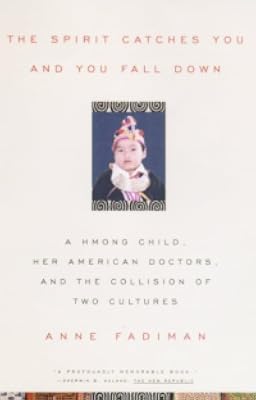
The Spirit Catches You and You Fall Down
by Anne Fadiman
On This Page
Description
When three-month-old Lia Lee arrived at the county hospital emergency room in Merced, California, a chain of events was set in motion from which neither she nor her parents nor her doctors would ever recover. Lia's parents, Foua and Nao Kao, were part of a large Hmong community in Merced, refugees from the CIA-run "Quiet War" in Laos. The Hmong, traditionally a close-knit and fiercely proud people, have been less amenable to assimilation than most immigrants, adhering steadfastly to the show more rituals and beliefs of their ancestors. Lia's pediatricians, Neil Ernst and his wife, Peggy Philip, cleaved just as strongly to another tradition: that of Western medicine. When Lia Lee entered the American medical system, diagnosed as an epileptic, her story became a tragic case history of cultural miscommunication. Parents and doctors both wanted the best for Lia, but their ideas about the causes of her illness and its treatment could hardly have been more different. The Hmong see illness and healing as spiritual matters linked to virtually everything in the universe, while medical community marks a division between body and soul, and concerns itself almost exclusively with the former. Lia's doctors ascribed her seizures to the misfiring of her cerebral neurons; her parents called her illness, qaug dab peg--the spirit catches you and you fall down--and ascribed it to the wandering of her soul. The doctors prescribed anticonvulsants; her parents preferred animal sacrifices. show lessTags
Recommendations

















Member Recommendations
Member Reviews
This book broke my heart. It made me angry. It enlightened me. I came out of the reading of it a different person. And it had me scratching my head, once again, at the inept handling of an immigrant issue by the United States government.
On the surface, the book is about the care that Lia Lee, an infant Hmong immigrant in the early 1980s, who suffers from severe seizure disorder, received at a California hospital. But, more deeply, it investigates and reveals the long history of the proud Hmong people. And what Fadiman does so brilliantly is to make clear how that history affected the plight of one family.
First, a little bit about that history. The Hmong originally hailed from the mountains of China, but over centuries of being forced show more out of the lands they settled in they finally end up in Laos. In the 1960s and early 70s they fight on behalf of the U.S. against the Communist regime. In exchange for bearing arms for the Americans specifically as agents for the CIA:
”Every Hmong has a different version of what is commonly called ‘The promise’: a written or oral contract, made by CIA personnel in Laos, that if they fought for the Americans, the Americans would aid them if the Pathet Lao won the war. After risking their lives to rescue downed American pilots, seeing their villages flattened by incidental American bombs, and being forced to flee their country because they had supported the ‘American War,’ the Hmong expected a hero’s welcome here.” (Page 201)
Needless to say, they didn’t get what they expected. Instead here’s what happened: the U.S. government removed people from Laos who spoke no English and who were self-sufficient farmers from mountain regions. They plopped them into urban areas where they had no way to make a living therefore, forcing them to accept welfare. American neighbors immediately resented these immigrants for “eating welfare.”
Enter infant Lia Lee and her parents Foua and Nao Kao. As welfare recipients, they are entitled to Medicaid for Lia’s care at the hospital. The fact that they don’t speak English and the hospital doesn’t employ any qualified translators spells trouble. Throw in the fact that Lia’s case is very, very complicated and add to that a clash of cultures: western medicine versus Hmong customs and mores. The storm that ensues leads to a tragedy that is heartbreaking.
Fadiman’s narrative makes it easy to empathize with these parents and the plight of the Hmong. Even dedicated, well-meaning doctors cannot overcome severe communication problems and the daunting challenge of bridging the culture gap. Highly recommended. show less
On the surface, the book is about the care that Lia Lee, an infant Hmong immigrant in the early 1980s, who suffers from severe seizure disorder, received at a California hospital. But, more deeply, it investigates and reveals the long history of the proud Hmong people. And what Fadiman does so brilliantly is to make clear how that history affected the plight of one family.
First, a little bit about that history. The Hmong originally hailed from the mountains of China, but over centuries of being forced show more out of the lands they settled in they finally end up in Laos. In the 1960s and early 70s they fight on behalf of the U.S. against the Communist regime. In exchange for bearing arms for the Americans specifically as agents for the CIA:
”Every Hmong has a different version of what is commonly called ‘The promise’: a written or oral contract, made by CIA personnel in Laos, that if they fought for the Americans, the Americans would aid them if the Pathet Lao won the war. After risking their lives to rescue downed American pilots, seeing their villages flattened by incidental American bombs, and being forced to flee their country because they had supported the ‘American War,’ the Hmong expected a hero’s welcome here.” (Page 201)
Needless to say, they didn’t get what they expected. Instead here’s what happened: the U.S. government removed people from Laos who spoke no English and who were self-sufficient farmers from mountain regions. They plopped them into urban areas where they had no way to make a living therefore, forcing them to accept welfare. American neighbors immediately resented these immigrants for “eating welfare.”
Enter infant Lia Lee and her parents Foua and Nao Kao. As welfare recipients, they are entitled to Medicaid for Lia’s care at the hospital. The fact that they don’t speak English and the hospital doesn’t employ any qualified translators spells trouble. Throw in the fact that Lia’s case is very, very complicated and add to that a clash of cultures: western medicine versus Hmong customs and mores. The storm that ensues leads to a tragedy that is heartbreaking.
Fadiman’s narrative makes it easy to empathize with these parents and the plight of the Hmong. Even dedicated, well-meaning doctors cannot overcome severe communication problems and the daunting challenge of bridging the culture gap. Highly recommended. show less
In the 1980s, a young Hmong child – whose people fought for the Americans during the Vietnam War – had epilepsy after her parents were relocated to California as refugees. Tragically, her parents never adapted to the American medical system, and equally tragically, the American medical system never adapted to them either. The child Lia Lee’s case resulted in a negative outcome, and the Lee family’s difficulty appears utterly humane upon further investigation. In this classic book, Anne Fadiman tries to learn lessons to instruct us all how to avoid such outcomes in the future.
This book fortunately received many accolades when first published in the late 1990s and has brought about significant change across the American medical show more system. It taught us – and continues to teach us – to be mindful of culture’s role in medical encounters. Medicine itself is a culture, and those new to Western medicine have their own culture with their own integrity. Learning to effectively mediate between cultures, for some patients, is at least as vital as the right diagnosis and treatment.
In a less heralded contribution, this book highlights the need for cultural brokers, especially among refugees. Refugees are people without a home. Unlike most immigrants, they come to America not as a goal but merely as an act of survival. They seek to leave a substandard refugee camp to anyplace else because they no longer have a home. Unlike other immigrants, they do not run to American culture and its Western medicine; indeed, they may harbor some suspicions of it. Refugee and other social organizations need to be mindful of this dynamic when refugees encounter foreign medical systems. Education and support are certainly required for those new to any land.
With the rising challenge of climate change and continuing wars around the globe, the problem of refugees will likely rise throughout this century. Cultural attitudes towards medicine is but a part of this complex problem, along with aspects like nativism, racism, international law, and homophobia. This book eloquently depicts what this looks like. It does not take sides but rather extrapolates both sides’ full practical and ethical ramifications. It concludes that this is an utter tragedy, one that must be learned from.
My wife has dedicated her career to educating refugee children, and having spent time on medical wards, I work in the healthcare arena. Thus, my family is familiar with both sides that this saga addresses. Let’s all hope this story is a “worst case scenario.” It seems that American healthcare has grown as has the communities supporting refugees. Reading this book can remind us of why we cannot go back but must push forward. show less
This book fortunately received many accolades when first published in the late 1990s and has brought about significant change across the American medical show more system. It taught us – and continues to teach us – to be mindful of culture’s role in medical encounters. Medicine itself is a culture, and those new to Western medicine have their own culture with their own integrity. Learning to effectively mediate between cultures, for some patients, is at least as vital as the right diagnosis and treatment.
In a less heralded contribution, this book highlights the need for cultural brokers, especially among refugees. Refugees are people without a home. Unlike most immigrants, they come to America not as a goal but merely as an act of survival. They seek to leave a substandard refugee camp to anyplace else because they no longer have a home. Unlike other immigrants, they do not run to American culture and its Western medicine; indeed, they may harbor some suspicions of it. Refugee and other social organizations need to be mindful of this dynamic when refugees encounter foreign medical systems. Education and support are certainly required for those new to any land.
With the rising challenge of climate change and continuing wars around the globe, the problem of refugees will likely rise throughout this century. Cultural attitudes towards medicine is but a part of this complex problem, along with aspects like nativism, racism, international law, and homophobia. This book eloquently depicts what this looks like. It does not take sides but rather extrapolates both sides’ full practical and ethical ramifications. It concludes that this is an utter tragedy, one that must be learned from.
My wife has dedicated her career to educating refugee children, and having spent time on medical wards, I work in the healthcare arena. Thus, my family is familiar with both sides that this saga addresses. Let’s all hope this story is a “worst case scenario.” It seems that American healthcare has grown as has the communities supporting refugees. Reading this book can remind us of why we cannot go back but must push forward. show less
this is such an excellent example of journalism and of (what certainly seems to be) the full telling of "both sides" of this story and issue. to see such compassion for everyone involved in this tragic story, such understanding about something that was so misunderstood in the moment, is truly beautiful. the lack of cultural understanding, or even curiosity, was awful to read about. but both sides had those misunderstandings and misconceptions, and made decisions that, while understandable, made this more of a tragedy.
in the end, while this is about a specific story and family and the medical system they encountered at the time, and how things have since changed to better accommodate and understand other cultures and belief systems, this show more really is about how we can do better to bridge the gap of understanding that comes up all the time, in various situations. how we can strive to understand the foundation of where someone is coming from, and how that is being expressed. i'm grateful for this desire that fadiman had to understand what both the family and the medical establishment were thinking because this book is an incredible testament to how we can learn from each other and treat each other's beliefs - even as they contradict with what we know/believe - with a respect that opens communication and community, rather than cutting it off, as happened in this case (and as happens in most cases).
this is about so much more than this case she details, but this case is such an incredible story and metaphor that i'd imagine reading it over and over again it'll always feel fresh and relevant, in spite of the changes in medicine since this happened. an extraordinary book. show less
in the end, while this is about a specific story and family and the medical system they encountered at the time, and how things have since changed to better accommodate and understand other cultures and belief systems, this show more really is about how we can do better to bridge the gap of understanding that comes up all the time, in various situations. how we can strive to understand the foundation of where someone is coming from, and how that is being expressed. i'm grateful for this desire that fadiman had to understand what both the family and the medical establishment were thinking because this book is an incredible testament to how we can learn from each other and treat each other's beliefs - even as they contradict with what we know/believe - with a respect that opens communication and community, rather than cutting it off, as happened in this case (and as happens in most cases).
this is about so much more than this case she details, but this case is such an incredible story and metaphor that i'd imagine reading it over and over again it'll always feel fresh and relevant, in spite of the changes in medicine since this happened. an extraordinary book. show less
A young Hmong girl in California with severe epilepsy is caught between her family's Hmong culture and the culture of a modern medical facility with its doctors. I wasn't sure I would like it at first, but Fadiman (quickly becoming one of my favorite authors) presents the dilemma with such an even hand. She sees both sides of the issue, and doesn't come out and preach one over the other. Truly a thought-provoking book.
I received a copy of the 25th anniversary edition of this book through First Reads. This was a wrenching read, deftly handling the disparate points of view of the Hmong immigrants, the medical practitioners, and the various intermediaries during the saga of Lia Lee's fraught health conditions. A great deal has changed since the 1980s, in part due to the publicity this book brought to cultural issues in the health system although increased awareness of the Hmong's role during the secret war in Laos and their subsequent exodus to this country is really not one of them. I'm also not sure that there is really a much better understanding of what it's like to live with grand mal epilepsy. The most hopeful note I noticed when reading this was show more the evidence of extraordinary reserves of good will available on all sides despite a desperate life-threatening series of medical emergencies. show less
"They wore strange clothes - often children's clothes, which were approximately the right size - acquired at the local Goodwill. When they undressed for an examination, the women were sometimes wearing Jockey shorts and the men were sometimes wearing bikini underpants with little pink butterflies. They wore amulets around their necks and cotton strings around their wrists (the sicker the patient, the more numerous the strings). They smelled of camphor, mentholatum, Tiger Balm, and herbs. When they were admitted to the hospital, they brought their own food and medicines. . . . Hmong patients made a lot of noise. Sometimes they wanted to slaughter live animals in the hospital. Tom Sult, a former MCMC resident, recalled, "They'd bang the show more crap out of some kind of musical instrument, and the American patients would complain. Finally we had to talk to them. No gongs. And no dead chickens."
This is such a well-written and extensively lived/researched book. What an impressive author Fadiman is. It's required reading now for incoming students at Yale School of Medicine (which certainly makes me think well of that school). Much of the book is about the Hmong and the western doctors taking away completely different understandings of their exchanges, and the doctors needing to better understand and respect the very different Hmong point of view. Fadiman explains how a large population of Hmong migrated from Laos (after supporting the U.S. in the war) to the small town of Merced, California, and gives a great depth of understanding to the spiritual and cultural underpinnings of their existence - they have survived oppression from the Chinese and others by stubbornly maintaining their identity and refusing to assimilate - they either fight or flee. That attitude, however, makes them unusual U.S. immigrants who have little interest in becoming part of the famed U.S. melting pot.
The title refers to a Hmong family's understanding of their little girl's epilepsy - a demon spirit caught her, and she fell down. But the severity of her symptoms cause them to take her to a nearby hospital, with very capable doctors. At that point, the misunderstandings begin, and her treatment suffers. The Lees attribute different motivations and meanings to what the doctors are saying, and the doctors do not sufficiently respect or have interest in traditional Hmong healing techniques or how the family views the situation. The failure to properly listen to the person(s) most concerned made me think of Being Mortal. Fadiman is scrupulously fair to both the Hmong and the medical professionals.
For those who have read the book already, this is an interesting article about it written 15 years after publication (those who haven't read it will want to avoid this article until they have): https://www.nytimes.com/2012/09/15/us/life-went-on-around-her-redefining-care-by... show less
This is such a well-written and extensively lived/researched book. What an impressive author Fadiman is. It's required reading now for incoming students at Yale School of Medicine (which certainly makes me think well of that school). Much of the book is about the Hmong and the western doctors taking away completely different understandings of their exchanges, and the doctors needing to better understand and respect the very different Hmong point of view. Fadiman explains how a large population of Hmong migrated from Laos (after supporting the U.S. in the war) to the small town of Merced, California, and gives a great depth of understanding to the spiritual and cultural underpinnings of their existence - they have survived oppression from the Chinese and others by stubbornly maintaining their identity and refusing to assimilate - they either fight or flee. That attitude, however, makes them unusual U.S. immigrants who have little interest in becoming part of the famed U.S. melting pot.
The title refers to a Hmong family's understanding of their little girl's epilepsy - a demon spirit caught her, and she fell down. But the severity of her symptoms cause them to take her to a nearby hospital, with very capable doctors. At that point, the misunderstandings begin, and her treatment suffers. The Lees attribute different motivations and meanings to what the doctors are saying, and the doctors do not sufficiently respect or have interest in traditional Hmong healing techniques or how the family views the situation. The failure to properly listen to the person(s) most concerned made me think of Being Mortal. Fadiman is scrupulously fair to both the Hmong and the medical professionals.
For those who have read the book already, this is an interesting article about it written 15 years after publication (those who haven't read it will want to avoid this article until they have): https://www.nytimes.com/2012/09/15/us/life-went-on-around-her-redefining-care-by... show less
I loved everything about this book: the story of Lia Lee, the description of the medical dilemma facing the doctors, the theorizing about cultural clashes, the history of the Hmong. Anne Fadiman writes clearly and compellingly about a complex case, and it reads like fiction. I was fascinated by the glimpses of Hmong life both in Laos and in the US, of the Hmong language, and of Hmong music and how it can imitate speech. But most importantly, the book is well researched and balanced, showing how both doctors and parents were trying to do their best by the child.
As the author says, to tell a Hmong story, you need to go back to one of the many beginnings. I'll start with the war the CIA fomented and funded in Laos against the communists. I show more wasn't aware that the soldiers in this "quiet war" were Hmong, and that when the CIA tired of the game and pulled out, they left behind tens of thousands of targeted Hmong. The Lees were one of the families that emigrated to the US after a harrowing flight, ending up in Merced, California.
Lia was their youngest child, and particularly beloved, in part perhaps because she was the youngest and they had lost some of their older children to starvation and other horrors of war. But Lia was also loved because she was special. She was subjected to qaug dab peg, the spirit catches you and you fall down, or what Western doctors call epilepsy. This condition marked Lia, perhaps even destined her to become a shaman to her people. When her seizures were bad, Lia's parents took her to the clinic to receive medicine to help her in the moment, but not to cure her.
Lia's doctors, on the other hand, saw the epilepsy as a serious disease needing a drastic cure. Complicated schedules of stronger and stronger medicines were devised, spinal fluid was analyzed, veins were cut when IV's could no longer be inserted in the normal fashion. As her treatment became more complex and invasive, Lia's parents became more and more resistant. Often being without a translator, doctors and parents talked at each other with no comprehension on either side of the cultural barrier. And in the meantime, Lia gets worse.
The author does a wonderful job of portraying the doctors as caring, intelligent, dedicated people frazzled by overwork and what they see as noncompliance; and the Lees as caring, devoted parents doing their best to find a compromise between this confusing world and the known world they left behind. Since the book was published fifteen years ago, cultural differences are more acknowledged now, I think, even if the bridges between cultures are still far and few between. For this reason, the book is as relevant today as when it was written. Highly recommended. show less
As the author says, to tell a Hmong story, you need to go back to one of the many beginnings. I'll start with the war the CIA fomented and funded in Laos against the communists. I show more wasn't aware that the soldiers in this "quiet war" were Hmong, and that when the CIA tired of the game and pulled out, they left behind tens of thousands of targeted Hmong. The Lees were one of the families that emigrated to the US after a harrowing flight, ending up in Merced, California.
Lia was their youngest child, and particularly beloved, in part perhaps because she was the youngest and they had lost some of their older children to starvation and other horrors of war. But Lia was also loved because she was special. She was subjected to qaug dab peg, the spirit catches you and you fall down, or what Western doctors call epilepsy. This condition marked Lia, perhaps even destined her to become a shaman to her people. When her seizures were bad, Lia's parents took her to the clinic to receive medicine to help her in the moment, but not to cure her.
Lia's doctors, on the other hand, saw the epilepsy as a serious disease needing a drastic cure. Complicated schedules of stronger and stronger medicines were devised, spinal fluid was analyzed, veins were cut when IV's could no longer be inserted in the normal fashion. As her treatment became more complex and invasive, Lia's parents became more and more resistant. Often being without a translator, doctors and parents talked at each other with no comprehension on either side of the cultural barrier. And in the meantime, Lia gets worse.
The author does a wonderful job of portraying the doctors as caring, intelligent, dedicated people frazzled by overwork and what they see as noncompliance; and the Lees as caring, devoted parents doing their best to find a compromise between this confusing world and the known world they left behind. Since the book was published fifteen years ago, cultural differences are more acknowledged now, I think, even if the bridges between cultures are still far and few between. For this reason, the book is as relevant today as when it was written. Highly recommended. show less
Members
- Recently Added By
Published Reviews
ThingScore 75
If tragedy is a conflict of two goods, if it entails the unfolding of deep human tendencies in a cultural context that makes the outcome seem inevitable, if it moves us more than melodrama, then this fine book recounts a poignant tragedy.
added by jlelliott
Ms. Fadiman tells her story with a novelist's grace, playing the role of cultural broker, comprehending those who do not comprehend each other and perceiving what might have been done or said to make the outcome different.
added by jlelliott
Lists

Best Medical Nonfiction
79 works; 29 members

Really Good Narrative Non-Fiction
65 works; 24 members

Non-Fiction Worth Reading
1,015 works; 254 members

Top Five Books of 2018
802 works; 264 members

So you want to get into medicine
29 works; 6 members

100 New Classics
101 works; 13 members

Research/Inquiry - mentor texts
43 works; 2 members

Blue Pyramid 1,276 Best Books of All Time
1,248 works; 32 members

Books That Made Me Cry
199 works; 105 members

Ambleside Books
459 works; 18 members

tell me where it hurts
36 works; 7 members

50 Books by Women Authors
50 works; 10 members

Started, Not Finished
7 works; 1 member

Books Read in 2022
5,168 works; 114 members

Mustich's 1000 Books to Read Before You Die: A Life Changing List
1,001 works; 19 members

Books Read in 2017
4,249 works; 130 members

Club Read's Recommended Nonfiction Written by Women
618 works; 30 members
Author Information

28+ Works 12,473 Members
Anne Fadima is the editor of The American Scholar, Recipient of a National Magazine Award for Reporting, she has written for Civilization, Harper's, Life, and The New York Times, among other publications. She lives in New York City. (Bowker Author Biography)
Awards and Honors
Work Relationships
Has as a student's study guide
Common Knowledge
- Canonical title
- The Spirit Catches You and You Fall Down
- Original publication date
- 1997
- People/Characters
- Lia Lee; Anne Fadiman; Neil Ernst; Peggy Philp; Foua Yang; Nao Kao Lee (show all 7); Jeanine Hilt
- Important places
- Merced, California, USA; Laos
- Important events
- Laotian Civil War
- First words
- If Lia Lee had been born in the highlands of Laos, where her parents and twelve of her brothers and sisters were born, her mother would have squatted on the floor of the house that her father had built from ax-hewn planks tha... (show all)tched with bamboo and grass. (Chapter 1 - Birth)
- Quotations
- "Of course, Martin had undergone an equally unseemly metamorphosis himself, from savant to bumbler. It was as if, by a process of reverse alchemy, each party in this doomed relationship had managed to convert each other's g... (show all)old into dross." pg. 223
- Last words
- (Click to show. Warning: May contain spoilers.) Where are you?
Where have you gone?
Come home. - Blurbers
- Nuland, Sherwin B.; Konner, Melvin; Horn, Carole; Santoli, Al; Steinman, Louise; Coles, Robert (show all 13); Weinberg, Steve; Frucht, Abby; Kim, Jae-Ha; Mark, David H.; Van Ogtrop, Kristin; Adams, Wanda A.; Klass, Perri
- Canonical DDC/MDS
- 306.461
- Canonical LCC
- RA418.5.T73
Classifications
- Genres
- Anthropology, General Nonfiction, Nonfiction, Biography & Memoir
- DDC/MDS
- 306.461 — Society, government, & culture Social sciences, sociology & anthropology Social Behavior - Dating, Marriage, Divorce Specific aspects of culture Technology Medicine and health
- LCC
- RA418.5 .T73 — Medicine Public aspects of medicine Public aspects of medicine Medicine and the state Medicine and society. Social medicine. Medical sociology
- BISAC
Statistics
- Members
- 5,319
- Popularity
- 2,551
- Reviews
- 133
- Rating
- (4.23)
- Languages
- English, German
- Media
- Paper, Audiobook, Ebook
- ISBNs
- 13
- ASINs
- 16