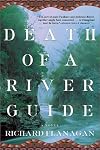
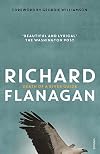
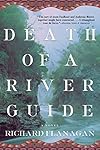
Death of a River Guide
by Richard Flanagan
On This Page
Description
Beneath a waterfall on the Franklin, Aljaz Cosini, river guide, lies drowning. Best by visions at once horrible and fabulous, he relives not just his own life but that of his family and forebears. In the rainforest waters that rush over him he sees those lives stripped of their surface realities, and finds a world where dreaming reasserts its power over thinking. As the river rises, his visions grow more turbulent, and in the flood of his past Aljaz discovers the soul history of his country. show more Richard Flanagan's 1994 debut about a mythical Tasmania dazzled readers around the world, and is now recognised as one of the most powerful and original Australian novels of recent decades. show lessTags
Recommendations




















Member Reviews
I think I'm justified in calling the genre of this book magic realism. However, it's a sort of magic-realism-lite, since it's written by a white English-speaking man with no particular religious background. Yes, there are ghost animals at the dinner table, but they don't actually talk. Yes, there's knowing of the unknowable, but the protagonist is aware he's having a vision and he admits that it might all be imagined. For this reason, it's probably about as palatable to me as magic realism will ever be. It's also wonderfully written, with genuinely beautiful passages and a sensitivity to emotion that is incisive, but used with exquisite restraint. The Tasmanian bush comes alive, as does the sad history of that island and its eerie show more echoes today. This book stands as one of the literary milestones of the last twenty years and is essential reading for anyone visiting Tasmania or who loves to venture into the bush (especially white-water rafting). show less
Against his better judgment, but needing the money, Aljaz Cosini agrees to take on one more river excursion, guiding a group of tourists down the remote Tasmanian Franklin with its treacherous rapids, magnificent gorges and waterfalls, challenging portage and marginal campsites. Despite having been born with a caul, which is purported to protect against such an end, Aljaz finds himself trapped between unyielding rocks in rising water, beyond the reach of assistance, and unquestionably drowning. He experiences not only his own life, but those of several ancestors playing out in visions as his end approaches. Elements of magical realism allow this framework to support over 300 pages of beautiful writing in which the subject is often show more death. Many of the stories we see through Aljaz's closed eyes are as new to him as they are to us; the unfolding history of his family reveals an identity he had not known was his, and is not immediately inclined to embrace. "I could, of course, be mad. That is a possibility. That is also a form of hope. If insane, this entire horror is nothing more than a delusion, a malfunction of nerve endings and electrochemical impulses. If sane, I am in true agony. In hell. If sane, I am dying. And being humiliated by memory at the same time. For I am none too happy with what this moving weight of water, this river is showing me." Although the book has a definite beginning and end, the middle is fluid, and non-linear, so that I found myself reading, re-reading, moving back and forth through the various narratives picking up bits that meant nothing the first time around but were sparkling with revelation the next. The language is ne'er so convoluted, but the experience was something like reading Faulkner for me. Came the end, and I wanted to start all over again. I will put it aside for now, but there is no doubt that I will step into this river again one day. show less
This book is like a sneaker wave. For the first two-thirds, I liked it; his writing is wonderful, and the story interesting, but doesn't always completely work. Then, as the book comes to an end, Flanagan pulls the different threads together, made me laugh and cry, and I couldn't put the book down. Pretty amazingly, he made me desperate to finish even though the conclusion is in the title, after all.
The book takes place in the visions of the river guide, Aljaz Cosini; who is drowning in the Franklin River, and who sees, in flashes his life, and also the lives of his parents and more distant ancestors. Flanagan is very creative in his descriptions of Australian history, and there are lots of surprises along the way. Plus, just beautiful show more language as in this description:
"They passed snakes swimming, unraveling ripples in warm flat pools. They passed platypuses that floated like sticks as the rafts approached, then sank likes tones at the sound of a punter's exclamation, leaving only a few fatty bubbles on the water's surface. They startled a flock of swifts from a cliff face and saw a giant lobster sitting on a log at the river's edge, glistening iridescent greens and purples and blues in the sunlight, and even the punters did not have an immediate response to its proud perfection."
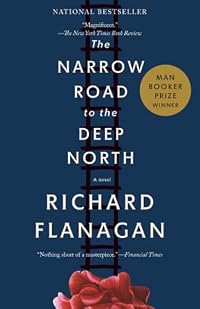
I read this because I loved The Narrow Road to the Deep North, this earlier book lacks the focus of that Booker Prize winner, but it does have a lot of heart. In the end, I liked it almost as much. show less
The book takes place in the visions of the river guide, Aljaz Cosini; who is drowning in the Franklin River, and who sees, in flashes his life, and also the lives of his parents and more distant ancestors. Flanagan is very creative in his descriptions of Australian history, and there are lots of surprises along the way. Plus, just beautiful show more language as in this description:
"They passed snakes swimming, unraveling ripples in warm flat pools. They passed platypuses that floated like sticks as the rafts approached, then sank likes tones at the sound of a punter's exclamation, leaving only a few fatty bubbles on the water's surface. They startled a flock of swifts from a cliff face and saw a giant lobster sitting on a log at the river's edge, glistening iridescent greens and purples and blues in the sunlight, and even the punters did not have an immediate response to its proud perfection."
I read this because I loved The Narrow Road to the Deep North, this earlier book lacks the focus of that Booker Prize winner, but it does have a lot of heart. In the end, I liked it almost as much. show less
‘’One generation passeth away, and another generation cometh. But what connects the two? What remains? What abideth in the earth forever?’’
My introduction to Richard Flanagan’s work was the award-winning The Narrow Road to the Deep North which didn’t particularly excite me. I was impressed with his talent for description and the communication of his characters’ thoughts but the story left me cold. Now, I have the blessing to have a wonderful boss. She adores books as much as I do and Death of a River Guide was her Easter gift to me. I can verify that I am glad because this novel, the debut of Richard Flanagan back in 1994, was one of the most beautiful and atmospheric reading moments of the year.
‘’You are given the show more gift of life and what happens? You want to throw it away!’’
Aljaz Cosini, a river guide of European origin, is trapped in Franklin River in Tasmania. Aljaz is waiting to be rescued and narrates his story and the course of his ancestors. Aljaz is waiting to be rescued and narrates his story and the curse of his ancestors. Because Aljaz is blessed and cursed by visions that demonstrate his past and the tumultuous journey of Tasmania, a land that remains a mystery to most of us. The immigrants, the native people whose home is snatched violently, the relationships, the thoughts of the tourists that desire to verify their preconceived notions of a country they know nothing about.
‘’My vessel is stopped and making no way through the water.’’
In ethereal, mystical, moving prose, Flanagan gives us a man that has seen and felt everything. The persecution of his ancestors, the first meeting of his parents, the life of the ones who shape his own course. He narrates his childhood under the guidance of a wise woman, Maria Magdalena, his love affair with an impressive girl, and the terrible loss he had to face. Aljaz becomes the instrument through which Flanagan comments on themes related to immigration, culture, imperialism, overcoming hardships. No theme is stronger, though, than the effervescent, instinctive will of the human being to push further, to resist the tendency to despair and start again. Sometimes, however, this proves to be a Herculean task.
Aljaz is a beautiful character, a man who fights against his fate. Surrounding him are characters that are rich and complex. Sonja and Harry, Couta Ho, Maria Magdalena, the Cockroach. Each one of them represents a human tendency, our feelings and our goals, our thoughts and deeds. With very little dialogue and haunting descriptive passages, Flanagan draws the portrait of a man and the story of a land as fascinating as it is mysterious.
‘’Children denied their parents and invented new lineages of respectable free settlers to replace the true genealogy of shame. The descendants of the convicts and the blackfellas became service-station attendants or shop assistants or lorry drivers or waitresses or clerks, if they were lucky. No one spoke. No one spoke.’’
My reviews can also be found on: https://theopinionatedreaderblog.wordpress.com/ show less
My introduction to Richard Flanagan’s work was the award-winning The Narrow Road to the Deep North which didn’t particularly excite me. I was impressed with his talent for description and the communication of his characters’ thoughts but the story left me cold. Now, I have the blessing to have a wonderful boss. She adores books as much as I do and Death of a River Guide was her Easter gift to me. I can verify that I am glad because this novel, the debut of Richard Flanagan back in 1994, was one of the most beautiful and atmospheric reading moments of the year.
‘’You are given the show more gift of life and what happens? You want to throw it away!’’
Aljaz Cosini, a river guide of European origin, is trapped in Franklin River in Tasmania. Aljaz is waiting to be rescued and narrates his story and the course of his ancestors. Aljaz is waiting to be rescued and narrates his story and the curse of his ancestors. Because Aljaz is blessed and cursed by visions that demonstrate his past and the tumultuous journey of Tasmania, a land that remains a mystery to most of us. The immigrants, the native people whose home is snatched violently, the relationships, the thoughts of the tourists that desire to verify their preconceived notions of a country they know nothing about.
‘’My vessel is stopped and making no way through the water.’’
In ethereal, mystical, moving prose, Flanagan gives us a man that has seen and felt everything. The persecution of his ancestors, the first meeting of his parents, the life of the ones who shape his own course. He narrates his childhood under the guidance of a wise woman, Maria Magdalena, his love affair with an impressive girl, and the terrible loss he had to face. Aljaz becomes the instrument through which Flanagan comments on themes related to immigration, culture, imperialism, overcoming hardships. No theme is stronger, though, than the effervescent, instinctive will of the human being to push further, to resist the tendency to despair and start again. Sometimes, however, this proves to be a Herculean task.
Aljaz is a beautiful character, a man who fights against his fate. Surrounding him are characters that are rich and complex. Sonja and Harry, Couta Ho, Maria Magdalena, the Cockroach. Each one of them represents a human tendency, our feelings and our goals, our thoughts and deeds. With very little dialogue and haunting descriptive passages, Flanagan draws the portrait of a man and the story of a land as fascinating as it is mysterious.
‘’Children denied their parents and invented new lineages of respectable free settlers to replace the true genealogy of shame. The descendants of the convicts and the blackfellas became service-station attendants or shop assistants or lorry drivers or waitresses or clerks, if they were lucky. No one spoke. No one spoke.’’
My reviews can also be found on: https://theopinionatedreaderblog.wordpress.com/ show less
Death of a River Guide is the fourth novel that I have read by Tasmanian author Richard Flanagan, who ranks – along with Cormac McCarthy and Haruki Murakami – as one of my top three living authors of literary fiction. I am not alone in my admiration: Flanagan has won a number of prominent awards for his work, and his most recent tour de force, The Narrow Road to the Deep North, was the recipient of the prestigious Man Booker Prize. [My review of The Narrow Road to the Deep North is here: http://regarp.com/2015/02/02/review-of-the-narrow-road-to-the-deep-north-by-rich...
My first encounter with Flanagan was a serendipitous stumble upon Gould’s Book of Fish, truly one of the finest works of literature of the new millennium in my show more opinion, which boasts a distinctive brand of magical realism that perhaps can be said to sail in the same sea of this genre with a Murakami or a Gabriel Garcia Marquez yet remains a unique vessel of unmatched craft. Gould’s has the distinction of being the only novel that I have ever read through and then – after the final paragraph on the final page – turned back to page one and started all over, reading it straight through for a second time!
Death of a River Guide may not qualify as the same brand of masterpiece as Gould’s, but yet it handily earns superlatives in its own right, especially because it was Flanagan’s first novel. It is truly so rare as to be remarkable for a first novel to contain such kinds of complexity, characterization, narrative structure and commanding prose. I do not typically cite other critics in my own reviews, but in this case the blurb on the jacket cover – “The sort of stunt Faulkner and Ambrose Bierce together might have concocted …” (Raleigh News & Observer) – is worth reiterating because it is both telling and spot on the mark. Like Faulkner’s Sound and the Fury, for instance, Death of a River Guide time hops effortlessly, although here the very dimension of time is far more epic. Like Bierce, there is imagination, irony and sometimes horror. I might also add to that the comedic mockery of a Kurt Vonnegut and the biting sarcasm of a Mark Twain. Yet, none of it is derivative. Readers of Gould’s will no doubt detect the roots of the magical realism that come to define the latter work, the echoes of passion and tragedy that form surprising links between individuals in disparate times and places who otherwise might appear unrelated yet in fact share human experiences – often heartbreaking – that despite their distances resonate profoundly among them.
It has long been alleged that during the drowning process the victim sees their life "flash before their eyes,” and this imaginary mechanism is the foundation of the narrative structure in Death of a River Guide, which also employs the more familiar literary device of the “journey motif,” as the protagonist, hapless river guide Aljaz Cossini – who has known far more misfortune than not in his life to that point – finds a rare moment of courage and purpose rewarded with the awful calamity of finding his head trapped between rocks beneath the violent waters of a rushing river, awaiting certain death yet granted dramatic yet disjointed visions that showcase his own history and the lives of those who preceded him, both immediate antecedents and far distant ancestors, which reverberate with the palpable atavism of sometimes unlikely forerunners not only of kinship but of geography and spiritual commonality.
Make no mistake, this novel contains great complexity on multiple levels, and as such while the prose is quite engaging this is by no means an easy read. As in Faulkner’s Sartoris-Sutpen novels, critical details of similar but related characters over several generations are subtly revealed throughout the narrative, so I found myself more than once thumbing back through the pages wondering if I had missed a key particular that in fact had not yet been disclosed. But it is truly worth the effort. In the final chapter, I pondered whether the tale had not perhaps gone on too long after all, if I was about to happen upon some jagged flaw that would reduce the fine estimation I had for the novel thus far. Then, reading the second to the last paragraph on the penultimate page, my eyes suddenly and quite unexpectedly filled with tears. And it was not cheap. And it was not sentimental. Flanagan can do that … and he does. Death of a River Guide is a truly great novel. Don’t miss it.
http://regarp.com/2015/07/23/review-of-death-of-a-river-guide-by-richard-flanaga... show less
My first encounter with Flanagan was a serendipitous stumble upon Gould’s Book of Fish, truly one of the finest works of literature of the new millennium in my show more opinion, which boasts a distinctive brand of magical realism that perhaps can be said to sail in the same sea of this genre with a Murakami or a Gabriel Garcia Marquez yet remains a unique vessel of unmatched craft. Gould’s has the distinction of being the only novel that I have ever read through and then – after the final paragraph on the final page – turned back to page one and started all over, reading it straight through for a second time!
Death of a River Guide may not qualify as the same brand of masterpiece as Gould’s, but yet it handily earns superlatives in its own right, especially because it was Flanagan’s first novel. It is truly so rare as to be remarkable for a first novel to contain such kinds of complexity, characterization, narrative structure and commanding prose. I do not typically cite other critics in my own reviews, but in this case the blurb on the jacket cover – “The sort of stunt Faulkner and Ambrose Bierce together might have concocted …” (Raleigh News & Observer) – is worth reiterating because it is both telling and spot on the mark. Like Faulkner’s Sound and the Fury, for instance, Death of a River Guide time hops effortlessly, although here the very dimension of time is far more epic. Like Bierce, there is imagination, irony and sometimes horror. I might also add to that the comedic mockery of a Kurt Vonnegut and the biting sarcasm of a Mark Twain. Yet, none of it is derivative. Readers of Gould’s will no doubt detect the roots of the magical realism that come to define the latter work, the echoes of passion and tragedy that form surprising links between individuals in disparate times and places who otherwise might appear unrelated yet in fact share human experiences – often heartbreaking – that despite their distances resonate profoundly among them.
It has long been alleged that during the drowning process the victim sees their life "flash before their eyes,” and this imaginary mechanism is the foundation of the narrative structure in Death of a River Guide, which also employs the more familiar literary device of the “journey motif,” as the protagonist, hapless river guide Aljaz Cossini – who has known far more misfortune than not in his life to that point – finds a rare moment of courage and purpose rewarded with the awful calamity of finding his head trapped between rocks beneath the violent waters of a rushing river, awaiting certain death yet granted dramatic yet disjointed visions that showcase his own history and the lives of those who preceded him, both immediate antecedents and far distant ancestors, which reverberate with the palpable atavism of sometimes unlikely forerunners not only of kinship but of geography and spiritual commonality.
Make no mistake, this novel contains great complexity on multiple levels, and as such while the prose is quite engaging this is by no means an easy read. As in Faulkner’s Sartoris-Sutpen novels, critical details of similar but related characters over several generations are subtly revealed throughout the narrative, so I found myself more than once thumbing back through the pages wondering if I had missed a key particular that in fact had not yet been disclosed. But it is truly worth the effort. In the final chapter, I pondered whether the tale had not perhaps gone on too long after all, if I was about to happen upon some jagged flaw that would reduce the fine estimation I had for the novel thus far. Then, reading the second to the last paragraph on the penultimate page, my eyes suddenly and quite unexpectedly filled with tears. And it was not cheap. And it was not sentimental. Flanagan can do that … and he does. Death of a River Guide is a truly great novel. Don’t miss it.
http://regarp.com/2015/07/23/review-of-death-of-a-river-guide-by-richard-flanaga... show less
The narrative frame of this a Tasmanian river guide who is trapped underwater, without hope of rescue, and has flashbacks of his life and visions of his ancestors' lives (which exposes the truth behind some family myths). This is Richard Flanagan's first novel, and he went on to win many illustrious awards and nominations.
The strength of this book is in the stories of what happens on that trip down the Franklin River. When I lived in Australia in 1982-83, the demonstrations against damming the river were a hot news story, so I had a slight personal connection to this story; a story that brought my attention to the wilderness of Tasmania. Flanagan does a fabulous job of bringing the reader into the damp verdant black and green temperate show more rainforest.
The other area he covers really effectively is the history of Tasmania; specifically, the convict culture and bit of Aboriginal culture. Not pretty. I definitely want to learn more about this area of the world and its history.
What didn't work for me were a lot of the tangents, general wordiness, and going on about the character's philosophy. Whatever, let's move along. Also, I'm not sure about the narrative frame of the guy being held underwater telling these stories. Hmmm.
This novel takes concentration and definitely could have been sharpened down with the help of a good editor. However, it was unusual, and showed me a very different corner of the world, and I really like that.
Recommended for: anyone interested in Tasmania and anyone interested in exploring contemporary Australian literature.
I wish this book was more widely known by people who read literary works and like to talk about them, because I'd like to talk about it. However, it would be a fail with my book club because it's not the type of book they'd want to read--half of them would say "I couldn't get into it". show less
The strength of this book is in the stories of what happens on that trip down the Franklin River. When I lived in Australia in 1982-83, the demonstrations against damming the river were a hot news story, so I had a slight personal connection to this story; a story that brought my attention to the wilderness of Tasmania. Flanagan does a fabulous job of bringing the reader into the damp verdant black and green temperate show more rainforest.
The other area he covers really effectively is the history of Tasmania; specifically, the convict culture and bit of Aboriginal culture. Not pretty. I definitely want to learn more about this area of the world and its history.
What didn't work for me were a lot of the tangents, general wordiness, and going on about the character's philosophy. Whatever, let's move along. Also, I'm not sure about the narrative frame of the guy being held underwater telling these stories. Hmmm.
This novel takes concentration and definitely could have been sharpened down with the help of a good editor. However, it was unusual, and showed me a very different corner of the world, and I really like that.
Recommended for: anyone interested in Tasmania and anyone interested in exploring contemporary Australian literature.
I wish this book was more widely known by people who read literary works and like to talk about them, because I'd like to talk about it. However, it would be a fail with my book club because it's not the type of book they'd want to read--half of them would say "I couldn't get into it". show less
Typical Flanagan sad-beauty, this strange series of visions managed to both disorient and pull me irresistibly in its wake (river analogy there; a poor one I know.) I wish I'd been able to give it my attention more fully, as I felt that stretching it out over almost a month did not help when it came to keeping track of who's who in the lengthy cast of characters. Nevertheless, I would not hesitate to recommend this haunting first novel.
Members
- Recently Added By
Lists

Books Read in 2017
4,249 works; 129 members
Author Information

21+ Works 9,947 Members
Richard Flanagan was born in Longford, Tasmania, in 1961. He received a Master of Letters degree from Oxford University. His first novel, Death of a River Guide, won Australia's National Fiction Award. His works include The Sound of One Hand Clapping, The Unknown Terrorist, and four history books. He has received numerous awards including the show more Commonwealth Writers Prize for Gould's Book of Fish, the 2011 Tasmania Book Prize for Wanting, and the 2014 Man Booker Prize for The Narrow Road to the Deep North. He directed a feature film version of The Sound of One Hand Clapping. He was also shortlisted for the UK Indie Booksellers Award with The Narrow Road to the Deep North. This same title was won the Margaret Scott Prize for best book by a Tasmanian writer 2015. In 2018, The Narrow Road to the Deep North will be made into an international television series. The University of Melbourne has appointed him as the Boisbouvier Founding Chair in Australian Literature at the University of Melbourne, a new professorship to 'advance the teaching, understanding and public appreciation of Australian literature'. (Bowker Author Biography) show less
Some Editions
Awards and Honors
Awards
Distinctions
Series
Belongs to Publisher Series
Common Knowledge
- Canonical title*
- Tod auf dem Fluss
- Original title
- Death of a River Guide
- Alternate titles
- Mort d'un guia de riu
- Original publication date
- 1994
- People/Characters*
- Aljaz Cosini
- Important places
- Australia; Tasmania, Australia
*Some information comes from Common Knowledge in other languages. Click "Edit" for more information.
Classifications
Statistics
- Members
- 544
- Popularity
- 54,340
- Reviews
- 23
- Rating
- (3.92)
- Languages
- 9 — Catalan, Dutch, English, French, German, Italian, Polish, Romanian, Slovenian
- Media
- Paper, Audiobook, Ebook
- ISBNs
- 33
- ASINs
- 8