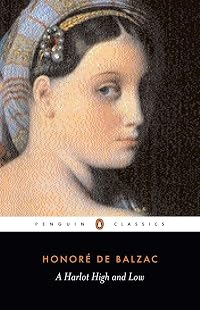
A Harlot High and Low
by Honoré de Balzac
Scenes from Parisian Life (3), Studies of Manners (40), The Human Comedy (Études de Moeurs - Scènes de la vie parisienne III | 48)
On This Page
Description
Hardened criminal Jacques Collin has been hiding under the guise of a false identity in order to escape the long arm of the law. In the novel Scenes from a Courtesan's Life, however, Collin's deceptions seem finally to have caught up with him. Will he be able to pull off the labyrinthine scheme cooked up to secure his freedom?.
Tags
Recommendations













Member Recommendations
Member Reviews
Published in four parts between 1838 and 1847, this was the direct continuation both of Vautrin's story from Le père Goriot and Lucien's from Illusions perdues. We last saw Lucien, at the lowest point in his life to date, getting into a carriage with a strange man, the mysterious Spanish diplomat Father Carlos Herrera, in whom we were evidently meant to recognise our old friend the master-criminal Vautrin alias Jacques Collin alias Trompe-le-Mort. When this book opens, we're a few months further along, and Lucien, under Father Herrera's patronage, has been rehabilitated into Paris society. There's a minor hiccup when some of his dissolute writer acquaintances recognise the girl he's been seeing, Esther, as a celebrated former rat show more (child-prostitute) known as La Torpille because of the electrifying effect she exerted on her elderly clients (this was before the days of naval torpedos, of course). Before word gets out, Herrera is able to whisk her away to a friendly convent to be cleaned up, baptised (!) and given a new identity, so that Lucien can resume his affair with her in secret, without prejudicing his chance of an aristocratic marriage.
Four years on, Lucien has a duke's daughter dangling on the hook, but Herrera's money is almost exhausted, and Lucien needs a cool million to buy a piece of land and establish his credentials with his prospective fiancée's family. The only saleable asset they have left is poor old Esther, so they set up a complicated scheme to use her to extract large amounts of cash from the elderly banker, Baron de Nucingen. Needless to say, it doesn't work out well for any of them: Lucien and Herrera end up behind bars, and in Part III Balzac starts what is essentially a new novel, a crime story set in and around the Palace of Justice and the Conciergerie prison.
Lots of fun, of all kinds: as well as the insight into the evils of the "kept mistress" system (which Balzac develops further in La Cousine Bette) we get more shady financial transactions than we know what to do with, some beautiful duchesses and countesses, lots of shady underworld figures and more-or-less-secret, more-or-less-corrupt judges and police officers, several Masters of Disguise, a Little-Known Oriental Poison, Buried Treasure, suicide notes so voluminous that you would need Balzacian quantities of coffee to write them in the time available - you name it, it's there somewhere! Balzac had the immeasurable advantage that none of these things was a cliché (in mainstream fiction) at the time he was writing, so he could deploy all his early training as a pulp-writer freely, and we can enjoy it all without needing to feel superior about it.
An obvious point of controversy we do need to think about is the way he treats the two important Jewish characters in the story. Esther is essentially Scott's Rebecca updated to the 19th century: stunning "levantine" beauty, an unfeminine gift for repartee, and an earnest desire to reform and be a good Christian which is frustrated at every turn by the author and by the trauma inflicted on her in childhood. Balzac can't really be blamed for copying such a marketable idea, and he wouldn't be Balzac if he'd given her a happy-end... On the other hand, the banker Baron de Nucingen is (much of the time) the worst kind of stereotype of the heartless Jewish usurer, and he irritates the reader unnecessarily by talking throughout in a hideous and difficult to read "Polish-Jewish" version of French, which Balzac achieves mostly by the lazy expedient of switching around consonant pairs like "d" and "t", "b" and "p", etc. and randomly mangling vowels. He obviously got some stick for this, as Nucingen doesn't reappear after the end of Part II, and when a further dialect character turns up in Part III, Balzac tells us he's not going to annoy us with a phonetic representation this time. Maybe Eveline had some influence - there are also a couple of pro-Polish asides in Part IV.
It's a shame about the bad parts of Nucingen, because he does get some very good scenes, both with Esther and with his bizarrely complaisant wife Delphine, who amuses herself by giving him fashion advice when he's going out courting. Balzac obviously has a lot of compassion for an old man who finds himself - for the first time in his life - dealing with a sexual obsession he can't control.
Vautrin is the star of the show, obviously, moving from a background role in the early part of the book to being the overt centre of the story in Part IV. Balzac explicitly attributes Vautrin's ability to sustain his power over others to his invulnerability to the debilitating influence of women, so he's presumably meant to be read as a sort of anti-Nucingen. Maybe he's not quite the role-model for gay-lib, but he's always fun to watch. And keep an eye out for the fixer "Asie", who starts out as a Malay cook - who is obviously a man in drag - to become, by Part IV, Vautrin's Tante Jacqueline, with Balzac insisting that "tante" actually means "aunt" here, and not whatever else it might mean in street-French... show less
Four years on, Lucien has a duke's daughter dangling on the hook, but Herrera's money is almost exhausted, and Lucien needs a cool million to buy a piece of land and establish his credentials with his prospective fiancée's family. The only saleable asset they have left is poor old Esther, so they set up a complicated scheme to use her to extract large amounts of cash from the elderly banker, Baron de Nucingen. Needless to say, it doesn't work out well for any of them: Lucien and Herrera end up behind bars, and in Part III Balzac starts what is essentially a new novel, a crime story set in and around the Palace of Justice and the Conciergerie prison.
Lots of fun, of all kinds: as well as the insight into the evils of the "kept mistress" system (which Balzac develops further in La Cousine Bette) we get more shady financial transactions than we know what to do with, some beautiful duchesses and countesses, lots of shady underworld figures and more-or-less-secret, more-or-less-corrupt judges and police officers, several Masters of Disguise, a Little-Known Oriental Poison, Buried Treasure, suicide notes so voluminous that you would need Balzacian quantities of coffee to write them in the time available - you name it, it's there somewhere! Balzac had the immeasurable advantage that none of these things was a cliché (in mainstream fiction) at the time he was writing, so he could deploy all his early training as a pulp-writer freely, and we can enjoy it all without needing to feel superior about it.
An obvious point of controversy we do need to think about is the way he treats the two important Jewish characters in the story. Esther is essentially Scott's Rebecca updated to the 19th century: stunning "levantine" beauty, an unfeminine gift for repartee, and an earnest desire to reform and be a good Christian which is frustrated at every turn by the author and by the trauma inflicted on her in childhood. Balzac can't really be blamed for copying such a marketable idea, and he wouldn't be Balzac if he'd given her a happy-end... On the other hand, the banker Baron de Nucingen is (much of the time) the worst kind of stereotype of the heartless Jewish usurer, and he irritates the reader unnecessarily by talking throughout in a hideous and difficult to read "Polish-Jewish" version of French, which Balzac achieves mostly by the lazy expedient of switching around consonant pairs like "d" and "t", "b" and "p", etc. and randomly mangling vowels. He obviously got some stick for this, as Nucingen doesn't reappear after the end of Part II, and when a further dialect character turns up in Part III, Balzac tells us he's not going to annoy us with a phonetic representation this time. Maybe Eveline had some influence - there are also a couple of pro-Polish asides in Part IV.
It's a shame about the bad parts of Nucingen, because he does get some very good scenes, both with Esther and with his bizarrely complaisant wife Delphine, who amuses herself by giving him fashion advice when he's going out courting. Balzac obviously has a lot of compassion for an old man who finds himself - for the first time in his life - dealing with a sexual obsession he can't control.
Vautrin is the star of the show, obviously, moving from a background role in the early part of the book to being the overt centre of the story in Part IV. Balzac explicitly attributes Vautrin's ability to sustain his power over others to his invulnerability to the debilitating influence of women, so he's presumably meant to be read as a sort of anti-Nucingen. Maybe he's not quite the role-model for gay-lib, but he's always fun to watch. And keep an eye out for the fixer "Asie", who starts out as a Malay cook - who is obviously a man in drag - to become, by Part IV, Vautrin's Tante Jacqueline, with Balzac insisting that "tante" actually means "aunt" here, and not whatever else it might mean in street-French... show less
There is a singular "textual pleasure" in reading Balzac, once you've acquired the taste. It's decadent.
In this unofficial sequel to Lost Illusions, Balzac exercises his capacity to depict psychological tortures. Though I have not read the first novel in this sequence, the four parts of Harlot High and Low vary in quality. There are 43 characters in this volume, many of whom appear elsewhere in the Comedy under other aliases or simply the same name. It is a crucial work in the body of Balzac's writings, but probably not as important as Lost Illusions, which is his longest single book.
Has there ever been a time when the justice system was not in need of reform? Reading this got me thinking back to other books. People have a habit of show more writing about all the harm the prison system does to a person, rather than any good it might have ever accomplished. This has been true, seemingly to a greater degree, since Balzac's France.
How dismaying it is to see everyone, time after time, looking out for themselves in exclusion to everyone else. The author has cast light on the ugly bits of the human psyche before, but in this iteration, human vice is the modus operandi of the novel.
The ins and outs of financial corruption are also reminiscent of our own time. Have our human flaws remained consistent since 4000 BC? Balzac posits it is so. Every form of bribe, fudging the accounts, graft, and other financial trickery is represented here in spades.
The common subjects to be found in Balzac include: finance, business, history, fashion, drama, religion, ideal love, familial relations, and social hierarchies.
As usual, he is waxing poetic on every other page. His languorous prose, deep in pathos, gravitas, and dependably deep themes, is rapturous. Can a person be purified? We have been asking this question for millennia. Harlot High and Low explores the reasons why people fall into sin, despair, depravity, or how in turn they might ascend to the ideal, the divine, attain man's higher nature, the angelic, and what part, if any, money plays in the equation. Man's material obsession is inescapable, his lust for power and satiation, mingled with the chimerical forms of love correspond to our darkest discontents and our holiest dreams. The methodology of the devil, in human form, is expounded in the well-rounded characters, each of whom have their own stakes and motives for seeking to control others.
The very clear references and connections to Romeo and Juliet may seem trite nowadays, but there is also the oft-used archetype of Mephistopheles and Faust. This book is not simple enough to be summed up as a retelling of anything. It is in fact, quite convoluted. The structure of Balzac's human labyrinth fits in well with the style of what he calls the "severe luxury" of the aristocrats he satirizes.
The flitting play of vanity is occasionally amusing to watch, but after a while, the joke grows stale. Various incarnations of greed in endless forms, make their appearance throughout literature, and they must be expressed through interesting characters in order to be relevant. Most of the time, this book accomplishes that. These scandalous characters cultivate scandal like some people raise tomatoes.
Part of the author's method is contrast and juxtaposition: Sin and baptism, prostitution and marriage, crime and charity, often mingling virtue with vice in the same character. There is a prevalent double-standard, wicked dames and masters of disguise, to add intrigue and Dumas-ian grandiosity.
The male characters have a very serious weakness for women. No surprise there. And most of the women have a weakness for Lucien. This felt odd to me. Probably because I have not yet read Lost Illusions. Anyone who is human has a weakness for money, except for the Baron, for whom money is a defining character trait, a strength, mere bird seed to be distributed liberally to the flocking hordes.
The book also contains rich interpretation of Rabelais, mentions of Moliere, Dante, Shakespeare, and Cervantes. In these we can detect some of Balzac's literary idols. Then there is the satire on police, politicians, aristocrats, prostitutes, priests, and bankers.
Subtlety, where warranted, and ever-present humor of the dry, witty variety. The powerful men are in thrall to the women whose only source of power is their beauty. They wield it with the same ruthlessness as the men wield their inherited powers. It was nice to see the character of Asia play a major part. Her manipulations resulted in much of the novel's powerful interactions.
In Balzac's time, social status came with proscribed behavior. Etiquette was paramount. Class, wealth, position: these were the pursuits of men and "great" ladies, and so often led to a lack of virtue, sympathy, a dearth of wisdom and inflexible greed.
The obsession with money and beauty can only go so far in a novel. Luckily, there is charm and tension to spare. I won't lie and claim that parts of it did not bore me. It is a long book, and requires analysis to best be appreciated. One of the challenges is the fact that the 4 parts do not sync up perfectly. Balzac did not write them all at once, and their focus, where they do not intersect, can swerve far afield.
There are plenty of fancy dress balls and snooty operas if that's what you were hoping for. I preferred Part 3. It was both morbid and mundane.
Part 4 went on an interesting tangent about argot and its uses. This part either inspired a little of Les Miserables, or borrowed from the same sources. Mesmerism makes another appearance. Aliases come into play heavily in the latter part of the book. It was nice to finally leave the character of the Baron behind. His excessive display of groveling was unbearable. I greatly disliked this character and and hold him solely responsible for what might be considered the flaws in this near masterpiece.
Some police procedural segments occupy the second half as well. It relies more on Lucien and Herrera than our titular harlot. I plan to read Lost Illusions, to get a glimpse of some of these characters at earlier stages in their tragic careers.
The trope of the great police inspector was just emerging. Les Miserables made use of the same real life examples as did Balzac, as the translator claims. I would however, recommend Hugo's book over this one.
The unintelligible accent of the Baron, which the translator assures us, is just as execrable in French was the defining unpleasantness of my reading experience. It was the bird poop in the soup, the anchovies on the pizza. I consider it a flaw in translation. Even if Balzac made a mess of the Alsatian accent, the same accent can be approximated with verisimilitude and still be readable. It is not necessary to switch around the letters of every word to give the sense of an accent. Dickens offers many examples of how to switch a couple words in a sentence to convey just the right amount of accent.
As another examination of the animal in man, of the concept of the clothes make the man, there are few examples which shine as brightly as Balzac's. However, I would by no means consider this a must-read, even within the Human Comedy. I think he touches on most of these themes elsewhere more succinctly. Chivalry is not exactly thriving in Paris at this time. I felt the same sickness of boredom as his characters on occasion, but it was nonetheless pleasant to luxuriate in the atmosphere he flawlessly conjures in his fiction. The Torpedo is an entertaining character and her rippling affect on the men around her is highly amusing. This is, at bottom, an unconventional portrayal of prostitution for its time, which has been superseded by other novels which trade classical tropes for accuracy.
Men of action incline toward Fatalism, Balzac warns us. Watching Nucingen being bled dry was disheartening, considering how many of the upper-class elderly are so often preyed upon by the younger generation. But how much of his situation was his own fault, resulting from his petty animal instincts? "Prettiness conceals horror." This line stands out as representative of his plight, which he chooses over his own security.
"A bit of morality does nobody any harm. It's the salt of life to people like me, just as vice is to the pious." Lines like this make up the bulk of Balzac's dialogue. As impossible as it is to imagine real people speaking so eloquently, the conciseness adds to the rhythm. You can easily see the havoc a properly worded letter can wreak on a person's life in this book. It makes it easier to reflect on our own time, having perused the accounts from previous centuries. With our faces glued to our phones and screens, sending thousands of messages per day, receiving information from all sources like living computers, yet preserving many of our basic functions, our changing family structures, the differences in lifestyle, art and how we distribute our wealth. These comparisons keep Balzac relevant. show less
In this unofficial sequel to Lost Illusions, Balzac exercises his capacity to depict psychological tortures. Though I have not read the first novel in this sequence, the four parts of Harlot High and Low vary in quality. There are 43 characters in this volume, many of whom appear elsewhere in the Comedy under other aliases or simply the same name. It is a crucial work in the body of Balzac's writings, but probably not as important as Lost Illusions, which is his longest single book.
Has there ever been a time when the justice system was not in need of reform? Reading this got me thinking back to other books. People have a habit of show more writing about all the harm the prison system does to a person, rather than any good it might have ever accomplished. This has been true, seemingly to a greater degree, since Balzac's France.
How dismaying it is to see everyone, time after time, looking out for themselves in exclusion to everyone else. The author has cast light on the ugly bits of the human psyche before, but in this iteration, human vice is the modus operandi of the novel.
The ins and outs of financial corruption are also reminiscent of our own time. Have our human flaws remained consistent since 4000 BC? Balzac posits it is so. Every form of bribe, fudging the accounts, graft, and other financial trickery is represented here in spades.
The common subjects to be found in Balzac include: finance, business, history, fashion, drama, religion, ideal love, familial relations, and social hierarchies.
As usual, he is waxing poetic on every other page. His languorous prose, deep in pathos, gravitas, and dependably deep themes, is rapturous. Can a person be purified? We have been asking this question for millennia. Harlot High and Low explores the reasons why people fall into sin, despair, depravity, or how in turn they might ascend to the ideal, the divine, attain man's higher nature, the angelic, and what part, if any, money plays in the equation. Man's material obsession is inescapable, his lust for power and satiation, mingled with the chimerical forms of love correspond to our darkest discontents and our holiest dreams. The methodology of the devil, in human form, is expounded in the well-rounded characters, each of whom have their own stakes and motives for seeking to control others.
The very clear references and connections to Romeo and Juliet may seem trite nowadays, but there is also the oft-used archetype of Mephistopheles and Faust. This book is not simple enough to be summed up as a retelling of anything. It is in fact, quite convoluted. The structure of Balzac's human labyrinth fits in well with the style of what he calls the "severe luxury" of the aristocrats he satirizes.
The flitting play of vanity is occasionally amusing to watch, but after a while, the joke grows stale. Various incarnations of greed in endless forms, make their appearance throughout literature, and they must be expressed through interesting characters in order to be relevant. Most of the time, this book accomplishes that. These scandalous characters cultivate scandal like some people raise tomatoes.
Part of the author's method is contrast and juxtaposition: Sin and baptism, prostitution and marriage, crime and charity, often mingling virtue with vice in the same character. There is a prevalent double-standard, wicked dames and masters of disguise, to add intrigue and Dumas-ian grandiosity.
The male characters have a very serious weakness for women. No surprise there. And most of the women have a weakness for Lucien. This felt odd to me. Probably because I have not yet read Lost Illusions. Anyone who is human has a weakness for money, except for the Baron, for whom money is a defining character trait, a strength, mere bird seed to be distributed liberally to the flocking hordes.
The book also contains rich interpretation of Rabelais, mentions of Moliere, Dante, Shakespeare, and Cervantes. In these we can detect some of Balzac's literary idols. Then there is the satire on police, politicians, aristocrats, prostitutes, priests, and bankers.
Subtlety, where warranted, and ever-present humor of the dry, witty variety. The powerful men are in thrall to the women whose only source of power is their beauty. They wield it with the same ruthlessness as the men wield their inherited powers. It was nice to see the character of Asia play a major part. Her manipulations resulted in much of the novel's powerful interactions.
In Balzac's time, social status came with proscribed behavior. Etiquette was paramount. Class, wealth, position: these were the pursuits of men and "great" ladies, and so often led to a lack of virtue, sympathy, a dearth of wisdom and inflexible greed.
The obsession with money and beauty can only go so far in a novel. Luckily, there is charm and tension to spare. I won't lie and claim that parts of it did not bore me. It is a long book, and requires analysis to best be appreciated. One of the challenges is the fact that the 4 parts do not sync up perfectly. Balzac did not write them all at once, and their focus, where they do not intersect, can swerve far afield.
There are plenty of fancy dress balls and snooty operas if that's what you were hoping for. I preferred Part 3. It was both morbid and mundane.
Part 4 went on an interesting tangent about argot and its uses. This part either inspired a little of Les Miserables, or borrowed from the same sources. Mesmerism makes another appearance. Aliases come into play heavily in the latter part of the book. It was nice to finally leave the character of the Baron behind. His excessive display of groveling was unbearable. I greatly disliked this character and and hold him solely responsible for what might be considered the flaws in this near masterpiece.
Some police procedural segments occupy the second half as well. It relies more on Lucien and Herrera than our titular harlot. I plan to read Lost Illusions, to get a glimpse of some of these characters at earlier stages in their tragic careers.
The trope of the great police inspector was just emerging. Les Miserables made use of the same real life examples as did Balzac, as the translator claims. I would however, recommend Hugo's book over this one.
The unintelligible accent of the Baron, which the translator assures us, is just as execrable in French was the defining unpleasantness of my reading experience. It was the bird poop in the soup, the anchovies on the pizza. I consider it a flaw in translation. Even if Balzac made a mess of the Alsatian accent, the same accent can be approximated with verisimilitude and still be readable. It is not necessary to switch around the letters of every word to give the sense of an accent. Dickens offers many examples of how to switch a couple words in a sentence to convey just the right amount of accent.
As another examination of the animal in man, of the concept of the clothes make the man, there are few examples which shine as brightly as Balzac's. However, I would by no means consider this a must-read, even within the Human Comedy. I think he touches on most of these themes elsewhere more succinctly. Chivalry is not exactly thriving in Paris at this time. I felt the same sickness of boredom as his characters on occasion, but it was nonetheless pleasant to luxuriate in the atmosphere he flawlessly conjures in his fiction. The Torpedo is an entertaining character and her rippling affect on the men around her is highly amusing. This is, at bottom, an unconventional portrayal of prostitution for its time, which has been superseded by other novels which trade classical tropes for accuracy.
Men of action incline toward Fatalism, Balzac warns us. Watching Nucingen being bled dry was disheartening, considering how many of the upper-class elderly are so often preyed upon by the younger generation. But how much of his situation was his own fault, resulting from his petty animal instincts? "Prettiness conceals horror." This line stands out as representative of his plight, which he chooses over his own security.
"A bit of morality does nobody any harm. It's the salt of life to people like me, just as vice is to the pious." Lines like this make up the bulk of Balzac's dialogue. As impossible as it is to imagine real people speaking so eloquently, the conciseness adds to the rhythm. You can easily see the havoc a properly worded letter can wreak on a person's life in this book. It makes it easier to reflect on our own time, having perused the accounts from previous centuries. With our faces glued to our phones and screens, sending thousands of messages per day, receiving information from all sources like living computers, yet preserving many of our basic functions, our changing family structures, the differences in lifestyle, art and how we distribute our wealth. These comparisons keep Balzac relevant. show less
Pobre Lucien! Se viu enredado pelo que Mefisto_Vautrin_Herrera_Jacques tinha o oferecer, deu uma volta enorme para terminar exatamente onde havia estado ao final de Ilusões Perdidas! Fechando a trilogia de Jacques Collin, começada por Goriot e Ilusões, Esplendores mantêm a qualidade do primeiro e fica aquem do segundo, mas aqui temos a certeza de que se as mulheres de Balzac são estupendas, o seu melhor personagem é mesmo o maquiavélico Collin.
This novel picks up the story of Lucien Chambron de Rubempré and the mysterious Spanish priest, Carlos Herrera, who rescues him from where it left off at the end of Lost Illusions. They have returned to Paris, and the priest's wealth and other forms of support help Lucien enter the world of Parisian nobility; he seems to have given up his interest in poetry. As the novel opens, he is in love with Esther, a beautiful former prostitute, having an affair with the married countess Madame de Sérisy, and hoping to marry Clotilde de Grandlieu, the daughter of a duke. Herrera, who the reader who has read other Balzacs soon realizes is Vautrin from Père Goriot, another name for the notorious escaped convict and criminal mastermind Jacques show more Collin, is out to make Lucien's fortune.
Herrera, along with his henchmen and -women, spins complicated plots and counterplots to "reform" Esther and then, after a period referred to as "A boring chapter, since it describes four years of happiness" in which Esther and Lucien live together, sets Esther up to entrap a rich banker, Nucingen, who has become obsessed with her after an incredibly brief chance sighting, and get enough money from him to enable Lucien to marry Clotilde. While all this is unfolding, a multitude of other characters, including competing police spies hired by characters with competing interests, complicate matters, as do Herrera and his associates. The plot can be confusing, if not melodramatic at times, and I don't want to say too much to avoid spoilers.
Balzac uses this novel to explore how the police and legal systems work, how police spies disguise themselves and take private commissions, how the criminal underworld and prison society work, how the nobility have their own methods and language and how they feel entitled to interfere with the legal system, and how public servants scheme to get ahead.
The French title of this book translates literally as "Splendors and miseries of courtesans," which I think is a better title than "A harlot high and low," but still doesn't capture what is for me the real heart of the novel, the story of Herrera/Vautrin/Collin, who has an astounding understanding of the different levels of French, especially Parisian, society, and a horrifying ability to take advantage of everything that presents itself to him. The question emerges of of the nature of his relationship with Lucien, as it is clear at the end of Lost Illusions that he is homosexual and has proposed to Lucien that he will help him attain status in Parisian society if they become lovers. This isn't mentioned explicitly in this novel, but Herrera certainly has strong feelings for Lucien and for another attractive young man who appears late in the plot. The translator of my edition, in his introduction, rejects this interpretation (he was writing in 1970), but it seems obvious, if veiled by the restrictions of the era, to me.
Although I was eager to read this novel, because Vautrin was such a compelling character in Père Goriot, it was a little overly melodramatic for me, although I really enjoyed following Herrera's schemes (and his remarkable "assistants," "Europe" and "Asia"), and learning about the French criminal, legal, and prison systems.
Finally, I was very disappointed that this Penguin edition did not have notes. There were many times when I had to resort to Wikipedia to look up a reference to people or works of literature, but many many more times when I didn't bother and just read without fully understanding what Balzac was trying to say. This is a novel that cries our for explanatory endnotes! show less
Herrera, along with his henchmen and -women, spins complicated plots and counterplots to "reform" Esther and then, after a period referred to as "A boring chapter, since it describes four years of happiness" in which Esther and Lucien live together, sets Esther up to entrap a rich banker, Nucingen, who has become obsessed with her after an incredibly brief chance sighting, and get enough money from him to enable Lucien to marry Clotilde. While all this is unfolding, a multitude of other characters, including competing police spies hired by characters with competing interests, complicate matters, as do Herrera and his associates. The plot can be confusing, if not melodramatic at times, and I don't want to say too much to avoid spoilers.
Balzac uses this novel to explore how the police and legal systems work, how police spies disguise themselves and take private commissions, how the criminal underworld and prison society work, how the nobility have their own methods and language and how they feel entitled to interfere with the legal system, and how public servants scheme to get ahead.
The French title of this book translates literally as "Splendors and miseries of courtesans," which I think is a better title than "A harlot high and low," but still doesn't capture what is for me the real heart of the novel, the story of Herrera/Vautrin/Collin, who has an astounding understanding of the different levels of French, especially Parisian, society, and a horrifying ability to take advantage of everything that presents itself to him. The question emerges of of the nature of his relationship with Lucien, as it is clear at the end of Lost Illusions that he is homosexual and has proposed to Lucien that he will help him attain status in Parisian society if they become lovers. This isn't mentioned explicitly in this novel, but Herrera certainly has strong feelings for Lucien and for another attractive young man who appears late in the plot. The translator of my edition, in his introduction, rejects this interpretation (he was writing in 1970), but it seems obvious, if veiled by the restrictions of the era, to me.
Although I was eager to read this novel, because Vautrin was such a compelling character in Père Goriot, it was a little overly melodramatic for me, although I really enjoyed following Herrera's schemes (and his remarkable "assistants," "Europe" and "Asia"), and learning about the French criminal, legal, and prison systems.
Finally, I was very disappointed that this Penguin edition did not have notes. There were many times when I had to resort to Wikipedia to look up a reference to people or works of literature, but many many more times when I didn't bother and just read without fully understanding what Balzac was trying to say. This is a novel that cries our for explanatory endnotes! show less
"A Harlot High and Low" is, if nothing else, quite the story. A long read, a complex plot (actually several plots), multifarious characters, and lots and lots of details about Paris in the early decades of the 19th century.
"A Harlot" is markedly different from the novel placed as it's predecessor, "Lost Illusions". This novel is not really a romance or a story of ambition. It is a lengthy presentation of multiple machinations involving Parisian society, infamous criminals, and instruments of the French state. Following these intricate plots and counter-plots is a task in itself.
What saves the novel and continues its appeal are Balzac's skill as a writer, his knowledge of his subject, and his intellect. Some characters seem, at times, to show more be somewhat stereotypical, flat, and labile. However, the exploration of the central character, Vautrin, aka, Father Carlos Herrera is intriguing.
Provided one can get past the to-be-expected sexism typical of the historical setting, "The Harlot" is worthwhile (but not easy) read. show less
"A Harlot" is markedly different from the novel placed as it's predecessor, "Lost Illusions". This novel is not really a romance or a story of ambition. It is a lengthy presentation of multiple machinations involving Parisian society, infamous criminals, and instruments of the French state. Following these intricate plots and counter-plots is a task in itself.
What saves the novel and continues its appeal are Balzac's skill as a writer, his knowledge of his subject, and his intellect. Some characters seem, at times, to show more be somewhat stereotypical, flat, and labile. However, the exploration of the central character, Vautrin, aka, Father Carlos Herrera is intriguing.
Provided one can get past the to-be-expected sexism typical of the historical setting, "The Harlot" is worthwhile (but not easy) read. show less
Peak Balzac: a throbbing plot, but also scores of pages you can skim over without any loss to the novel whatsoever.
So Balzac's father added the "de". It was invented not inherited. Actually it the author himself, not his bourgeois father.Such utility is brought to bear in the two novels Lost Illusions and A Harlot High and Low. Both chronicle the verve of self-creation, first in Lost Illusions in a literary/journalistic context and later in this novel with simple grift. The entire novel is serial cons against the Church, society, the bourgeois and finally the Courts. I obviously didn't swallow this novel whole. This approach necessitated ongoing rereading to reorient. I'd like to think this enriched the experience.
Members
- Recently Added By
Published Reviews
ThingScore 100
35 livres cultes à lire au moins une fois dans sa vie
Quels sont les romans qu'il faut avoir lu absolument ? Un livre culte qui transcende, fait réfléchir, frissonner, rire ou pleurer… La littérature est indéniablement créatrice d’émotions. Si vous êtes adeptes des classiques, ces titres devraient vous plaire.
De temps en temps, il n'y a vraiment rien de mieux que de se poser devant show more un bon bouquin, et d'oublier un instant le monde réel. Mais si vous êtes une grosse lectrice ou un gros lecteur, et que vous avez épuisé le stock de votre bibliothèque personnelle, laissez-vous tenter par ces quelques classiques de la littérature. show less
Quels sont les romans qu'il faut avoir lu absolument ? Un livre culte qui transcende, fait réfléchir, frissonner, rire ou pleurer… La littérature est indéniablement créatrice d’émotions. Si vous êtes adeptes des classiques, ces titres devraient vous plaire.
De temps en temps, il n'y a vraiment rien de mieux que de se poser devant show more un bon bouquin, et d'oublier un instant le monde réel. Mais si vous êtes une grosse lectrice ou un gros lecteur, et que vous avez épuisé le stock de votre bibliothèque personnelle, laissez-vous tenter par ces quelques classiques de la littérature. show less
added by Joop-le-philosophe
One of Balzac's best novels. The book was concerned as much with secret police as with the prostitutes who passed through its pages, but then whores and political agents made a fair association for Balzac. The harlot, after all, inhabited the world of as if. You paid your money and the harlot acted for a little while -- when she was a good harlot -- as if she loved you, and that was a more show more mysterious proposition than one would think, for it is always mysterious to play a role. It is equal in a sense to living under cover. At her best, the harlot was a different embodiment of a fantasy for each client, and at those moments of existence most intense for herself, the role she assumed became more real than the reality of her profession. show less
added by SnootyBaronet
Lists

Books I've Read More Than Once
602 works; 49 members

Paris, City of Lights
103 works; 17 members
Harold Bloom - The Western Canon: C. The Democratic Age
336 works; 15 members

.
396 works; 1 member
Talk Discussions
Past Discussions
Balzac: Splendeurs et misères des courtisanes (A Harlot High and Low) in Author Theme Reads (March 2013)
Author Information

Born on May 20, 1799, Honore de Balzac is considered one of the greatest French writers of all time. Balzac studied in Paris and worked as a law clerk while pursuing an unsuccessful career as an author. He soon accumulated enormous debts that haunted him most of his life. A prolific writer, Balzac would often write for 14 to-16 hours at a time. show more His writing is marked by realistic portrayals of ordinary, but exaggerated characters and intricate detail. In 1834, Balzac began organizing his works into a collection called The Human Comedy, an attempt to group his novels to present a complete social history of France. Characters in this project reappeared throughout various volumes, which ultimately consisted of approximately 90 works. Some of his works include Cesar Birotteau, Le Cousin Pons, Seraphita, and Le Cousine Bette. Balzac wed his lifelong love, Eveline Hanska in March 1850 although he was gravely ill at the time. Balzac died in August of that year. (Bowker Author Biography) show less
Some Editions
Awards and Honors
Series

Scenes from Parisian Life
16 works (3)

Studies of Manners
60 works (40)

The Human Comedy
86 works (Études de Moeurs - Scènes de la vie parisienne III | 48)
Belongs to Publisher Series
Work Relationships
Common Knowledge
- Canonical title
- A Harlot High and Low
- Original title
- Splendeurs et misères des courtisanes; Splendeurs et miséres de courtisanes
- Alternate titles
- Scenes from a Courtesan's Life
- Original publication date
- 1847
- People/Characters
- Vautrin
- Important places
- Paris, France
- Related movies*
- Splendeurs et misères des courtisanes (1975-1976 | IMDb)
- First words*
- En 1824, au dernier bal de l'Opéra, plusieurs masques furent frappés de la beauté d'un jeune homme qui se promenait dans les corridors et dans le foyer, avec l'allure des gens en quête d'une femme que des circonstances im... (show all)prévues retiennent au logis.
- Last words*
- (Click to show. Warning: May contain spoilers.)Après avoir exercé ses fonctions pendant environ quinze ans, Jacques Collin s'est retiré vers 1845.
- Original language
- French
*Some information comes from Common Knowledge in other languages. Click "Edit" for more information.
Classifications
Statistics
- Members
- 1,077
- Popularity
- 23,836
- Reviews
- 20
- Rating
- (3.98)
- Languages
- 21 — Catalan, Czech, Danish, English, Estonian, Finnish, French, German, Greek, Hungarian, Italian, Lithuanian, Norwegian (Bokmål), Norwegian, Polish, Portuguese, Russian, Croatian, Spanish, Swedish, Turkish
- Media
- Paper, Audiobook, Ebook
- ISBNs
- 107
- UPCs
- 1
- ASINs
- 50