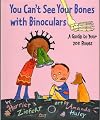
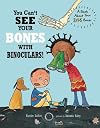
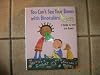
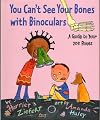
You Can't See Your Bones with Binoculars: A Guide to Your 206 Bones
by Harriet Ziefert
On This Page
Description
Text and illustrations, including xrays, provide a guided tour of the human skeleton, encouraging the reader to find and feel each bone as it is described.Tags
Recommendations















Member Reviews
You Can't See Your Bones with Binoculars is very true to a young child's innate curiosity to the human body and what it's all made up of. It's illustrated to help readers made the connections necessary to process the what and why's of their little frames.
I love the author's "hands-on" approach to discovering the vertebrae and skull - suggesting readers feel it on their own bodies as "proof". Along with each individual page is a verse of the ever popular children's song "Them Bones"....great way to tie it all in.
I love the author's "hands-on" approach to discovering the vertebrae and skull - suggesting readers feel it on their own bodies as "proof". Along with each individual page is a verse of the ever popular children's song "Them Bones"....great way to tie it all in.
My favorite book! Awesome book to use to teach young children about the anatomy of our bodies. Ziefert describes each bone in our body by describing its name, shape and location. This book is also hands on, Ziefert tells the reader where to out their fingers so they can feel the bone themself in their own body. On each top page, each new bones is introduced by saying whatever bone that was on the page before is connected to the bone on the next page which I thought was a great idea.
You really cannot see your bones with binoculars would be a great interactive read aloud for a human body bones unit. The book itself is engaging and interactive asking thee students to find and feel some of the bone it is talking about. The pictures are a mixture of cartoon drawings and x-rays that go over the drawings. The book starts at the head and works its way down to the toes. This book does have many technical terms so there would be a lot of scaffolding and pre-teaching so I would not read this book at once. However, the book does do a good job with the term the child may know and then connects it with the technical term for the bone.
You Can't See Your Bones with Binoculars is an interactive book that guides students through the skeletal system.The reader is invited to feel for each bone as the book explains their location and function. It is a fun, easy to read resource for bone names and uses that also relates the use of each bone to real life experiences. Although there are x ray photos for some bones not all bones are represented accurately through illustration.
This is an excellent book that explains the physiology of our bone structure. It explains the functions of skeletal system, how to protect it, and how to take care of it. This book has delightful cartoon illustrations along with x-rays of bone groups in the body. It has wonderful content.
This book acts as a brief guide to understanding the bones in our bodies. It provides a lot of interesting facts about some of the major bones and their uses as well as a lot of other information. What makes this especially useful to children is the fact that it uses the song "the head bone's connected to the neck bone" on each page while also using alot of the correct vocabulary. By doing this, they are more likely to remember some of the bigger words by putting them to a song. This book would probably be best used in a classroom setting or with a parent or guardian.
This would be good for primary students.
This book introduces kids to their bones and their purposes. It has kids interact with their bodies to feel different bones and learn what they are.
With this book, I would have kids follow along by feeling their bones. A bone-related version of head, shoulders, knees, and toes could also be a fun activity. Or we could learn a song about the bones being connected, using the words at the top of each page describing which bone connects to which.
This book introduces kids to their bones and their purposes. It has kids interact with their bodies to feel different bones and learn what they are.
With this book, I would have kids follow along by feeling their bones. A bone-related version of head, shoulders, knees, and toes could also be a fun activity. Or we could learn a song about the bones being connected, using the words at the top of each page describing which bone connects to which.
Members
- Recently Added By
Author Information

543+ Works 24,387 Members
Harriet Ziefert is a children's author born in 1941 in New Jersey. She has written several hundred children's books, including the Little Hippo series. Ziefert and illustrator Emilie Bon have collaborated on a series of "Little Hippo" books, the first of which was published in 1988 by Viking Penguin. The books are written for children between 1 show more 1/2 to 5 years-of-age. They are intended to help children deal with change, like the addition of a new baby to the family or moving to a new house. Her titles include Little Hippo's New Baby, Little Hippo's New Friend, Little Hippo's New School and Grandpa, Will You Play With Me? (Bowker Author Biography) show less
All Editions
Awards and Honors
Notable Lists
Classifications
Statistics
- Members
- 460
- Popularity
- 66,478
- Reviews
- 9
- Rating
- (3.89)
- Languages
- English
- Media
- Paper
- ISBNs
- 7
- UPCs
- 1
- ASINs
- 2