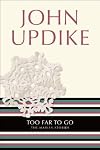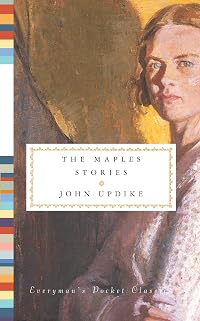
The Maples Stories
by John Updike
On This Page
Description
Collected together for the first time in hardcover, these eighteen classic stories from across John Updike’s career form a luminous chronicle of the life and times of one marriage in all its rich emotional complexity.In 1956, Updike published a story, “Snowing in Greenwich Village,” about a young couple, Joan and Richard Maple, at the beginning of their marriage. Over the next two decades, he returned to these characters again and again, tracing their years together raising show more children, finding moments of intermittent happiness, and facing the heartbreak of infidelity and estrangement. Seventeen Maples stories were collected in 1979 in a paperback edition titled Too Far to Go, prompted by a television adaptation. Now those stories appear in hardcover for the first time, with the addition of a later story, “Grandparenting,” which returns us to the Maples’s lives long after their wrenching divorce.
. show less
Tags
Recommendations







Member Reviews
Didn't expect to like this as much as I do. Don't get me wrong: there are portions that are cringe-worthy, not only because they are so stuck in a particular time, but because they feel like they arise from a particular insulated and self-absorbed mind-set. And still, there are other portions that are transcendent in capturing a gesture, an expression, a hard-to-pin-down feeling (and yet Updike pins it as well as anyone could). The subtleties and clumsiness of how we communicate with one another and the wonder that we are able to communicate in spite of our clumsiness...I will seek out the Maples story that is not included here.
Stunning. One of the early chapters - "Wife Wooing" provided the feeling I got when reading Ulysses or Faulkner. That feeling of needing to sit up straighter and to pay more attention. Especially in Wife Wooing, the alliteration, the word selection, the sentence construction were extraordinary. I found my self shaking may head in admiration. Later, I was really put off by "Marching Through Boston" - it was just downright racist. I could have accepted - maybe - an inflection, an allusion but this went on and on and was just not funny, or enlightening. That was about the time I began to think, "wow, this guy is really a dick" and was unable to determine whether I was felling that entirely about Richard the main character or about Updike. show more It came back around over the next few chapters and I suppose some of that - for me- was the familiarity with divorce and separation and the way in which it was captured. Astute, in a word. This was a rewarding experience and I believe it'll be a while before anything else measures up. show less
When you're reading a book while riding a bus and miss not one, not two, but three of your stops because you're too engrossed in the book, then you have to admit to yourself it's a pretty good book,even if you can't stand either one of the two main characters.
Richard and Joan Maple are a fictional couple who author John Updike revisited, in short-story form, many times over the span of Updike's long and productive literary career. All of the Maples stories are gathered together here in this Everyman's Pocket Classics edition, in basic chronological order. Therefore, we first see Richard and Joan early in their marriage, then in the next story when their four children are very young, then we see their marriage disintegrating over several stories. Finally, in the last story, they are divorced and married to others and awaiting the birth of their first grand child.
I've read a few of the Maple stories here and there in other Updike short story collection. They definitely pack more of a punch show more being collected together in this format. In this way, it reads much more like a novel than a series of short stories.
While reading The Maples Stories, I had the sense that the characters were real, the dialogue real, the feelings real. Updike was known to carry over much from his real-life experiences into his writings, and this is especially evident in these stories. As a result, Richard and Joan Maple become real people and quite unforgettable. show less
I've read a few of the Maple stories here and there in other Updike short story collection. They definitely pack more of a punch show more being collected together in this format. In this way, it reads much more like a novel than a series of short stories.
While reading The Maples Stories, I had the sense that the characters were real, the dialogue real, the feelings real. Updike was known to carry over much from his real-life experiences into his writings, and this is especially evident in these stories. As a result, Richard and Joan Maple become real people and quite unforgettable. show less
In the introduction to this collection of stories about the disintegration of the marriage of Richard and Joan Maple, Updike says their moral is that "nothing is perfect." That is of course true in a sense, but such a trivial one that we hardly need Updike to tell us so. The real message is that nothing is even good, as most of these stories are simply about how poorly his fictional couple treat one another without giving us more than a glimpse at any other side of their characters, making it almost impossible to sympathize with them---though there are a couple of exceptions that almost make the rest of them worth slogging through. And they are, for the most part, beautifully written, which is of value in and of itself.
A pretty amazing collection of stories. Updike created the Maples in 1956 and periodically updated the reader about their lives over twenty-three years. There is a polished brashness to the writing which seems to counter the happy married life we come to expect from couples in the period. The Maples are no Rob and Laura Petrie but they trudge along and make the best or suffer through it trying to numb their way at times. Enjoyable, but in sometimes a sad or angry way.
Read strictly for recreation
Read strictly for recreation
The book was sad. I never read any of Updike's works before so I'm not sure what I was expecting but I was surprised by the content and his style of writing. I expected someone more sombre I guess and I'm not quite sure why. I enjoyed his writing. He does like long sentences and they take surprising turns at times. I was entertained and challenged. The content like I said is sad, it's about the demise of a marriage. I loved a few chapters - the one where he's in love with his wife shortly after they're married with kids, the one where they are selling their house and he is reminiscing in the empty house and the one where they break the news to their kids. I didn't like the one on Grandparents, it felt uncomfortable, un-real or perhaps I show more just could not accept it. The couple belonged together or you fall in love with their flawed selves enough that you want them to be together and that is perhaps what makes Updike such a good writer. show less
Members
- Recently Added By
Lists

Books Read in 2022
5,166 works; 114 members

Mustich's 1000 Books to Read Before You Die: A Life Changing List
1,001 works; 19 members
Author Information

340+ Works 53,370 Members
American novelist, poet, and critic John Updike was born in Reading, Pennsylvania on March 18, 1932. He received an A.B. degree from Harvard University, which he attended on a scholarship, in 1954. After graduation, he accepted a one-year fellowship to study painting at the Ruskin School of Drawing and Fine Art in Oxford, England. After returning show more from England in 1955, he worked for two years on the staff of The New Yorker. This marked the beginning of a long relationship with the magazine, during which he has contributed numerous short stories, poems, and book reviews. Although Updike's first published book was a collection of verse, The Carpentered Hen and Other Tame Creatures (1958), his renown as a writer is based on his fiction, beginning with The Poorhouse Fair (1959). During his lifetime, he wrote more than 50 books and primarily focused on middle-class America and their major concerns---marriage, divorce, religion, materialism, and sex. Among his best-known works are the Rabbit tetrology---Rabbit, Run (1960), Rabbit Redux (1971), Rabbit Is Rich (1981), and Rabbit at Rest (1988). Rabbit, Run introduces Harry "Rabbit" Angstrom as a 26-year-old salesman of dime-store gadgets trapped in an unhappy marriage in a dismal Pennsylvania town, looking back wistfully on his days as a high school basketball star. Rabbit Redux takes up the story 10 years later, and Rabbit's relationship with representative figures of the 1960s enables Updike to provide social commentary in a story marked by mellow wisdom and compassion in spite of some shocking jolts. In Rabbit Is Rich, Harry is comfortably middle-aged and complacent, and much of the book seems to satirize the country-club set and the swinging sexual/social life of Rabbit and his friends. Finally, in Rabbit at Rest, Harry arrives at the age where he must confront his mortality. Updike won the Pulitzer Prize for both Rabbit Is Rich and Rabbit at Rest. Updike's other novels range widely in subject and locale, from The Poorhouse Fair, about a home for the aged that seems to be a microcosm for society as a whole, through The Court (1978), about a revolution in Africa, to The Witches of Eastwick (1984), in which Updike tries to write from inside the sensibilities of three witches in contemporary New England. The Centaur (1963) is a subtle, complicated allegorical novel that won Updike the National Book Award in 1964. In addition to his novels, Updike also has written short stories, poems, critical essays, and reviews. Self-Consciousness (1989) is a memoir of his early life, his thoughts on issues such as the Vietnam War, and his attitude toward religion. He was elected to the American Academy of Arts and Letters in 1977. He died of lung cancer on January 27, 2009 at the age of 76. (Bowker Author Biography) John Updike was born in 1932, in Shillington, Pennsylvania. Since 1957 he has lived in Massachusetts. His novels have won the Pulitzer Prize, the National Book Award, the National Book Critics Circle Award, & the Howells Medal. (Publisher Provided) John Updike was born in 1932 and attended Harvard College and the Ruskin School of Drawing and Fine Art in Oxford, England. Form 1955 to 1957 he was a staff member of The New Yorker, which he contributed numerous writings. Updike's art criticism has appeared in publications including Arts and Antiques, The New Republic, The New York Times Book Review, and Realites, among many others. He is the author of such best-selling novels as Rabbit Run and Rabbit is Rich. His many works of fiction, poetry and criticism have been awarded the Pulitzer Prize, the National Book Award, the American Book Award, and the National Book Critics Circle Award. For the past 40 years he has lived in Massachusetts. (Publisher Provided) John Updike is the author of some 50 books, including collections of short stories, poems, & criticism. His novels have won the Pulitzer Prize, the National Book Award, the National Book Critics Circle Award, & the Howells Medal. Born in Shillington, Pennsylvania, in 1932, he has lived in Massachusetts since 1957. (Publisher Provided) show less
Some Editions
Awards and Honors
Awards
Distinctions
Notable Lists
Series
Belongs to Publisher Series
Contemporánea [Alba] (40)
Gallimard, Folio (1757)
Work Relationships
Common Knowledge
- Canonical title
- Too Far to Go: The Maples Stories; The Maples Stories
- Original title
- Too Far to Go. The Maples Stories
- Original publication date
- 1979
- Publisher's editor
- Jones, Judith
Classifications
Statistics
- Members
- 485
- Popularity
- 62,263
- Reviews
- 11
- Rating
- (3.96)
- Languages
- 6 — Dutch, English, French, German, Serbian, Spanish
- Media
- Paper, Audiobook, Ebook
- ISBNs
- 20
- UPCs
- 1
- ASINs
- 5