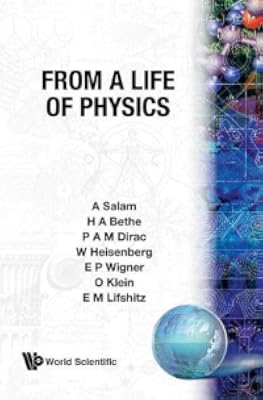
From a Life of Physics
by Hans A. Bethe (Contributor), P. A. M. Dirac (Contributor), W. Heisenberg (Contributor), O. Klein (Contributor), E. M. Lifshitz (Contributor), Abdus Salam (Foreword), Eugene Paul Wigner (Contributor)
17 Members (3.50)
On This Page
Description
A compilation of previously unpublished lectures delivered at the International Centre for Theoretical Physics by the pioneers and creators of modern physics --Bethe, Dirac, Heisenberg, Wigner, Klein and Landau (the sixth delivered by E Lifshitz). By sharing with us their own lives of physics, these outstanding physicists convey the sense of total dedication, the pleasure and elegance of scientific creation at its peak. Readers would acquire a deeper sense of the scope and nature of physics, show more and the insights of its fascinating diverse disciplines as the developments of modern physics are being show lessTags
Member Reviews
Members
- Recently Added By
Author Information

Born in Germany 1906, Hans Bethe was the son of a university professor. He received a Ph.D. in physics from the University of Munich and lectured in physics throughout various German universities until 1933, when he moved to England because of the rise to power of Hitler and the Nazi party. (His mother was Jewish.) In 1935 Bethe immigrated to the show more United States to join the physics faculty at Cornell University. In 1938 Bethe determined the sequences of nuclear reactions that power the stars, a problem that had remained unsolved for 75 years since William Thomson Kelvin and Hermann Helmholtz first described it. For this research, Bethe received the Nobel Prize in 1967. In addition to these accomplishments, he researched a wide range of other problems, such as electron densities in crystals and operational conditions in nuclear reactors. He was the director of the Theoretical Physics Division of the Los Alamos Laboratory from 1943 to 1946, working on the Manhattan Project to develop the atomic bomb. Bethe has been active in science policy discussions for several decades. In 1958 he served as a delegate to the first International Test Ban Conference at Geneva, and was a leader in the nuclear disarmament movement. Bethe also played an active role in the national debate on the "Star Wars" defense proposal. (Bowker Author Biography) show less

Paul Dirac, a British theoretical physicist, was a central figure in the development of quantum electrodynamics. For example, he introduced important concepts, such as magnetic monopole and electron spin, and predicted the existence of antiparticles. Dirac was well known for his creativity as a graduate student in the 1920s. After reading Werner show more Heisenberg's first paper on relativity in 1925, for example, he promptly devised a more general form of the theory. The next year, he formulated Wolfgang Pauli's exclusion principle in terms of quantum mechanics. Specifically, he formulated useful statistical rules for particles that obey the Pauli exclusion principle. He received his Ph.D. in physics from Cambridge University in 1926. Dirac's most important contribution occurred in 1928, when he joined special relativity to quantum theory. His theory of the electron permitted scientists to calculate its spin and magnetic moment and to predict the existence of positively charged electrons, or positrons. (Positrons were observed in 1932.) In 1933 Dirac shared the Nobel Prize in physics with Erwin Schrodinger for his theory of the electron and prediction of the positron. Dirac's theoretical considerations in predicting the positron were sufficiently general to apply to all particles. This constituted an argument for the existence of antimatter. In later years, Dirac worked on "large-number coincidences," or relationships that appear to exist between some cosmological constants. He also taught mathematics at Cambridge University from 1932 until 1969. From 1968, when he retired from Cambridge, until his death in 1984, Dirac was a professor at the University of Florida in Tallahassee. (Bowker Author Biography) show less


Abdus Salam received an M.A. in 1946 from Government College, Punjab University, in Lahore, where he later was a professor of mathematics. After receiving his Ph.D. from the Cavendish Laboratory in Cambridge in 1952, this Pakistani physicist went on to make significant contributions in the theory of particle physics, in particular, for his theory show more that unified the weak force and the electromagnetic force of nature. For this theory, Salam shared the 1979 Nobel Prize with Sheldon Lee Glashow and Steven Weinberg, although each researcher did his work independently. Salam was the first Pakistani to win a Nobel Prize. In 1964 Salam established the International Center for Theoretical Physicists in Trieste, Italy, to encourage scientists in emerging countries. Salam divides his time between the International Center and the Imperial College of Science and Technology in London, where he has been a professor since 1957. Salam also has promoted scientific training and research in developing countries. He has been active in UN and UNESCO committees and panels since the 1950s. (Bowker Author Biography) show less
Common Knowledge
- People/Characters
- Hans Bethe
Classifications
- Genres
- Science & Nature, Nonfiction, Biography & Memoir
- DDC/MDS
- 530 — Natural sciences & mathematics Physics Physics
- LCC
- QC71 .F74 — Science Physics Physics General
- BISAC
Statistics
- Members
- 17
- Popularity
- 1,453,105
- Rating
- (3.50)
- Languages
- English
- Media
- Paper, Ebook
- ISBNs
- 2