Nostalgia
by Mircea Cărtărescu
On This Page
Description
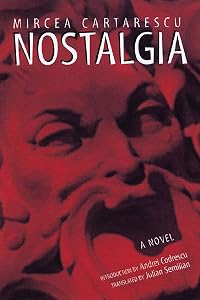
"Mircea Cartarescu, born in 1956, is one of Romania's leading novelists and poets. This translation of his 1989 novel Nostalgia, writes Andrei Codrescu, 'introduces to English a writer who has always had a place reserved for him in a constellation that includes the Brothers Grimm, Franz Kafka, Jorge Luis Borges, Bruno Schulz, Julio Cortazar, Gabriel Garcia Marquez, Milan Kundera, and Milorad Pavic, to mention just a few.'"--Description from Amazon.com.Tags
Recommendations










Member Recommendations
Member Reviews
Ten minutes in, the ticket inspector slides open the carriage door, casts a contempuous look about, and starts handing out pairs of binoculars that he extracts from his coat pocket. Turns out, the binoculars are a good call, creating as they do a feeling of camaraderie among the slightly anxious-looking passengers—we lay them side by side, brag about who has the bigest ones, and feel suddenly bonded in a covert and sacred mission. There's a weight to the clammy air that makes my ears pop. Some of the passengers have taken out snacks and appear to be looking out for whales. Personally, I'm not convinced we're underwater; we appear to be moving upwards, though. I press the binoculars to my eyes, but wondrous sights are hinted at only in show more glimmerring contour—the occasional golden spire twinkling through the mucky gray fog. This train ride is weird. I decide this can't be the main bit and take out a guidebook. The lady with the feathery hat appears to want to draw my attention to something, so I put my-whoa! What just happened there? What? Who said that?
Oh, it's You. I wasn't sure if you were going to show up. Some writers do, you know, but others find it intrusive: 'a good conductor should never be seen.' But You want to guide me. You're telling me to prepare myself, because the ride is about to begin—what I'll get out of it, you don't know. It's up to me. You tell me you will try to show me, try to make me understand. But you have tears in your eyes. "You would like to turn the reader's heart inside out," you growl, "and what does he do? At three he's done with your book, at four he takes up another—no matter how great the book you placed in his hands." The sign ahead says "First Chapter: The Roulette Player" and the train is still dragging its weels along. Chug-a-chug-a-chug-a-chug. I dig my face into the sweaty binoculars and look out again - the fog is gone; the picture clear. And then I see it. A near-vertical track has reached its peak and in one blink of an eye the train will start speeding downwards, laughing and choo-chooing—a long mad worm doing somersaults through the air (water?). I didn't think it would happen this way, so wild-wild-wild and, my God, for a few minutes it feels wonderful! And every time we slow down and I start getting bored, I think of you, and remember what you said about wanting to rip my heart out. And I feel guilty for the parts that I'm skimming, the minutes slipping away, the pages getting me closer to the end of the book. It's been a fun ride and all, but you haven't done it yet, no, and you so wanted to, and just when I think "it's too late, it's almost three o'clock" the last sign comes up ahead announcing the last chapter "The Architect". 'Oh well,' I think before I brace myself once again and this time—yes!—this time you rip my heart out with one quick move, one quick final story about the creation of the Universe, a sci-fi story as strange as it is wonderful. And man, I'm so glad you had a chance to do it because it's almost four now – time for a new book. show less
Oh, it's You. I wasn't sure if you were going to show up. Some writers do, you know, but others find it intrusive: 'a good conductor should never be seen.' But You want to guide me. You're telling me to prepare myself, because the ride is about to begin—what I'll get out of it, you don't know. It's up to me. You tell me you will try to show me, try to make me understand. But you have tears in your eyes. "You would like to turn the reader's heart inside out," you growl, "and what does he do? At three he's done with your book, at four he takes up another—no matter how great the book you placed in his hands." The sign ahead says "First Chapter: The Roulette Player" and the train is still dragging its weels along. Chug-a-chug-a-chug-a-chug. I dig my face into the sweaty binoculars and look out again - the fog is gone; the picture clear. And then I see it. A near-vertical track has reached its peak and in one blink of an eye the train will start speeding downwards, laughing and choo-chooing—a long mad worm doing somersaults through the air (water?). I didn't think it would happen this way, so wild-wild-wild and, my God, for a few minutes it feels wonderful! And every time we slow down and I start getting bored, I think of you, and remember what you said about wanting to rip my heart out. And I feel guilty for the parts that I'm skimming, the minutes slipping away, the pages getting me closer to the end of the book. It's been a fun ride and all, but you haven't done it yet, no, and you so wanted to, and just when I think "it's too late, it's almost three o'clock" the last sign comes up ahead announcing the last chapter "The Architect". 'Oh well,' I think before I brace myself once again and this time—yes!—this time you rip my heart out with one quick move, one quick final story about the creation of the Universe, a sci-fi story as strange as it is wonderful. And man, I'm so glad you had a chance to do it because it's almost four now – time for a new book. show less
3.75/5
A collection of surrealistic short stories revolving around fantasy worlds stirred up through childhood dreams and fantasies that become real in the world of literature. I enjoyed the prose, the description and imagery is beautiful. The stories in itself were charming, I especially loved REM.
However, the writing, at times, felt too tedious and bloated to me, especially at the beginning of the three main stories, the build up is slow.
Nonetheless, after the initial set up the stories did immerse me in a fascinating fever dream I did not want to wake up from.
A collection of surrealistic short stories revolving around fantasy worlds stirred up through childhood dreams and fantasies that become real in the world of literature. I enjoyed the prose, the description and imagery is beautiful. The stories in itself were charming, I especially loved REM.
However, the writing, at times, felt too tedious and bloated to me, especially at the beginning of the three main stories, the build up is slow.
Nonetheless, after the initial set up the stories did immerse me in a fascinating fever dream I did not want to wake up from.
It was an interesting read, out of five stories, I've really liked only two - the first and the last - the 3 stories in the middle were mostly either okay or boring. The last one, made a huge impression on me because it's such a weird, interesting story. The first one is also 5/5. The rest, they're just there. But I've noticed that it's often the case with short stories collections that I usually like the ones that are actually short (40 pages max) than the ones that are short stories but are 100 pages long.
Părerea mea este că dacă vrei să vezi idei bune care ajung să fie stricate de insuși autorul lor, trebuie să citești Nostalgia. Cel mai lung și distrugător capitol a fost REM, așa că mi-am permis să trec peste anumite pagini ca să ajung cât mai repede la sfârșitul său.
Cu toate că în general mi-a displăcut cartea, trebuie să recunosc că povestirea Ruletistul și povestirea Arhitectul au fost destul de bune.
Știu că mulți îndrăgesc cartea aceasta dar, pur și simplu, nu mă fascinează deloc imaginea Bucureștiului de mai demult și blocurile pe care el le vede de la geam.
Cu toate că în general mi-a displăcut cartea, trebuie să recunosc că povestirea Ruletistul și povestirea Arhitectul au fost destul de bune.
Știu că mulți îndrăgesc cartea aceasta dar, pur și simplu, nu mă fascinează deloc imaginea Bucureștiului de mai demult și blocurile pe care el le vede de la geam.
Inquietante. Es un maestro de las palabras, crea sensaciones increíbles e imágenes impagables.
From Publishers Weekly
"Romania's leading poet plays with ideas of authorship and authority in this collection of five unconnected stories—his English debut—which he contrarily subtitled "a novel," asserting that "each part reflects all the others." Given the author's pedigree, it's disappointing that the book, extracted from its cultural context, loses much of its power. Cartarescu employs postmodern effects—shifting points of view, blurring of dreams and reality, episodes of magical realism—without enlarging in a meaningful way on the experiments of Kafka, Borges or García Márquez (all invoked by the book's narrators). The first story involves a roulette player who survives against astonishing odds and a narrator who admits show more the roulette player could not have existed, but did, because "there is a place in the world where the impossible is possible, namely in fiction, that is, literature." "The Twins" consists of a fairly banal adolescent romance sandwiched between long descriptions of a man dressing in drag. Occasionally Cartarescu's prose shines, as with the description of a suicide on the pavement in "Mentardy": "his noble profile displaying its contour against a cheery stain, light purple and widening leisurely." But the self-conscious postmodernism of this collection may prove off-putting for American readers accustomed to conventions of realist fiction. (Nov. 29)
Copyright "
© Reed Business Information, a division of Reed Elsevier Inc. All rights reserved.
http://sfgate.com/cgi-bin/article.cgi?f=/c/a/2006/01/01/RVGQFGC5DM1.DTL show less
"Romania's leading poet plays with ideas of authorship and authority in this collection of five unconnected stories—his English debut—which he contrarily subtitled "a novel," asserting that "each part reflects all the others." Given the author's pedigree, it's disappointing that the book, extracted from its cultural context, loses much of its power. Cartarescu employs postmodern effects—shifting points of view, blurring of dreams and reality, episodes of magical realism—without enlarging in a meaningful way on the experiments of Kafka, Borges or García Márquez (all invoked by the book's narrators). The first story involves a roulette player who survives against astonishing odds and a narrator who admits show more the roulette player could not have existed, but did, because "there is a place in the world where the impossible is possible, namely in fiction, that is, literature." "The Twins" consists of a fairly banal adolescent romance sandwiched between long descriptions of a man dressing in drag. Occasionally Cartarescu's prose shines, as with the description of a suicide on the pavement in "Mentardy": "his noble profile displaying its contour against a cheery stain, light purple and widening leisurely." But the self-conscious postmodernism of this collection may prove off-putting for American readers accustomed to conventions of realist fiction. (Nov. 29)
Copyright "
© Reed Business Information, a division of Reed Elsevier Inc. All rights reserved.
http://sfgate.com/cgi-bin/article.cgi?f=/c/a/2006/01/01/RVGQFGC5DM1.DTL show less
Nostalgia comprises three short(ish) stories, and two novellas, each told by a different first-person narrator. A censored version (entitled Visul, ‘The Dream’) appeared in 1989 and the full work as Nostalgia in 1993. An English version was not available until Julian Semilian’s 2005 translation. A shallow internet search brought up two reviews, both of which seemed to miss essential points of the work. Kirkus compared Cărtărescu’s “phantasmagorical world” to Dalí’s images, but this loses the deep-seated uncanniness of Cărtărescu’s writing, its existential uneasiness within the familiar; de Chirico would be a better choice, or Carrington. A Spectator review bizarrely compared Cărtărescu to C.S. Lewis, saying show more Nostalgia summoned “the wonder and terror of a Danubian Narnia”. Tell me you never read fantasy without telling me you never read fantasy.
The stories are impressive, even dazzling, but marred by pervasive essentialist sexism. The female characters are thinly sketched in flat, minor roles, and even in 'The Twins', where one of the main characters is (mainly) a woman, her whole life is dominated by her romantic relationships. The male narrator of 'The Twins' doesn’t flinch from open misogyny when he recalls the childhood experience of being naked with his friend Marcela: “[t]he incipience of contempt insinuated itself in me, while in her, it was the beginning of humility and veneration”. There is also a tendency to use animals as sacrificial victims—itself not an unusual ‘feminine’ role—whose trauma or death either reveals something about the hero, or teaches him An Important Lesson. Such reliance on convenient stereotypes of any ‘other’ acting as a foil to or a mirror of the main character makes for tedious reading.
This problematic aspect is outweighed by the quality of what remains. Cărtărescu is an outstanding writer, and his imagination, both wild and elegant, is at its most confident and impressive in the second half of 'The Twins' and especially in 'The Architect', in which the effect of that most banal of sounds, the car-horn, on the central character has, ultimately, cosmic repercussions. The first and least inter-connected story, 'The Roulette Player', has a very distinct charm, gritty, violent, and fantastical, like a Dostoyevskian Bulgakov.
Nostalgia is described by its author as a novel, because the stories are connected ‘subterraneously’. It is not a novel in the sense of a continuous narrative, but the locations feel sustained, like the relationship between the characters and their material environment. All the stories take place in Bucharest, but in its unorthodox, unofficial places – alleys between home and school, the secret locations of an illicit sport, the backrooms of a museum. The environment is uncanny; there is a sense that the demi-monde locations are sorcerous in their effects on the characters. Although recollections of youth form much of the narrative, the original Romanian title is more apt, resonating as it does with intensity of experience, suspension of logic, and dismissal of explanation, rather than with a desire to return to a fondly-remembered past. show less
The stories are impressive, even dazzling, but marred by pervasive essentialist sexism. The female characters are thinly sketched in flat, minor roles, and even in 'The Twins', where one of the main characters is (mainly) a woman, her whole life is dominated by her romantic relationships. The male narrator of 'The Twins' doesn’t flinch from open misogyny when he recalls the childhood experience of being naked with his friend Marcela: “[t]he incipience of contempt insinuated itself in me, while in her, it was the beginning of humility and veneration”. There is also a tendency to use animals as sacrificial victims—itself not an unusual ‘feminine’ role—whose trauma or death either reveals something about the hero, or teaches him An Important Lesson. Such reliance on convenient stereotypes of any ‘other’ acting as a foil to or a mirror of the main character makes for tedious reading.
This problematic aspect is outweighed by the quality of what remains. Cărtărescu is an outstanding writer, and his imagination, both wild and elegant, is at its most confident and impressive in the second half of 'The Twins' and especially in 'The Architect', in which the effect of that most banal of sounds, the car-horn, on the central character has, ultimately, cosmic repercussions. The first and least inter-connected story, 'The Roulette Player', has a very distinct charm, gritty, violent, and fantastical, like a Dostoyevskian Bulgakov.
Nostalgia is described by its author as a novel, because the stories are connected ‘subterraneously’. It is not a novel in the sense of a continuous narrative, but the locations feel sustained, like the relationship between the characters and their material environment. All the stories take place in Bucharest, but in its unorthodox, unofficial places – alleys between home and school, the secret locations of an illicit sport, the backrooms of a museum. The environment is uncanny; there is a sense that the demi-monde locations are sorcerous in their effects on the characters. Although recollections of youth form much of the narrative, the original Romanian title is more apt, resonating as it does with intensity of experience, suspension of logic, and dismissal of explanation, rather than with a desire to return to a fondly-remembered past. show less
Oct 26, 2024English (UK)
1
Members
- Recently Added By
Lists

Reading LIst
648 works; 1 member
Author Information

67+ Works 2,677 Members
Awards and Honors
Series
Belongs to Publisher Series
Impedimenta (76)
Common Knowledge
- Canonical title
- Nostalgia
- Original title
- Nostalgia
- Original publication date
- 1993
- Important places
- Bucharest, Romania; Romania
Classifications
- Genres
- Fiction and Literature, General Fiction
- DDC/MDS
- 859.335 — Literature & rhetoric Italian, Romanian & related literatures Literatures of Romanian, Rhaetian, Sardinian, Corsican languages Romanian fiction 1900–
- LCC
- PC840.13 .A86 .N6713 — Language and Literature Romanic languages Romance Romanian
- BISAC
Statistics
- Members
- 464
- Popularity
- 65,650
- Reviews
- 8
- Rating
- (4.22)
- Languages
- 12 — Danish, English, French, German, Greek, Italian, Norwegian (Bokmål), Polish, Portuguese, Romanian, Spanish, Swedish
- Media
- Paper, Audiobook, Ebook
- ISBNs
- 28
- ASINs
- 4