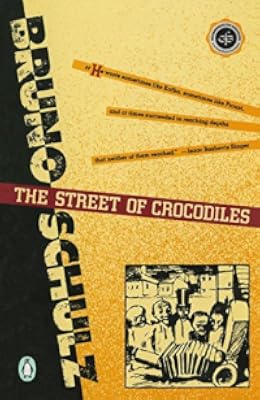
The Street of Crocodiles
by Bruno Schulz
On This Page
Description
"Complicite not only open our eyes to Bruno Schulz but turn his densely impressionistic stories into a piece of vividly imaginative theatre" (Michael Billington, Guardian) The Street of Crocodiles is inspired by the life and stories of Polish writer Bruno Schulz (1892-1942). Originally co-produced by Théâtre de Complicité and the Royal National Theatre it opened at the Cottesloe in 1992 and toured all over the world until 1994. The original production was remounted in 1998 and played in show more New York, Toronto, Minneapolis and Tokyo before opening at the Queen's Theatre London in January 1999. "This astounding production creates a vision of provincial Poland in the early part of the century as a restless ocean of unending flux...the miracle of Complicite's interpretation of Schulz's stories...is its ability to give specific theatrical life to this perceptual anarchy...when you leave the theatre you expect the ground beneath your feet to give way." (New York Times) show lessTags
Recommendations






Member Recommendations

S.D. Similar dream-like prose from Eastern Europe, both with Mad Father figures.
Member Reviews
This is one of the most beautiful books I have ever read.
This was like looking at one long autumn oil painting in minute detail, inch by inch, as it passes very slowly before your eyes at the same time the sounds and smells of autumn drift in through an open window.
Reading this book clearly brought to mind the many other books that I have read that have tried to do this but failed disappointingly without me ever realising or knowing that there was one book that had managed to pull off this seemingly impossible feat of a physical sense of beauty being manifested by words.
This was like looking at one long autumn oil painting in minute detail, inch by inch, as it passes very slowly before your eyes at the same time the sounds and smells of autumn drift in through an open window.
Reading this book clearly brought to mind the many other books that I have read that have tried to do this but failed disappointingly without me ever realising or knowing that there was one book that had managed to pull off this seemingly impossible feat of a physical sense of beauty being manifested by words.
On reading these stories through only once, I didn't really get much from them beyond a sense of having been raped by adjectives. It was after a second reading that this book came alive in utterly devastating ways. I have no doubt that I would likely get even more out of subsequent readings.
Schulz is certainly the kind of author who can haunt you in unexpected ways long after you thought you finished reading his work.
Schulz is certainly the kind of author who can haunt you in unexpected ways long after you thought you finished reading his work.
This book was first published, in Polish, in 1934. It began as a series of letters from the reclusive Schulz to a friend, Deborah Vogel. Only two books by Schultz were published before he was murdered by the Gestapo in 1942. His novel, The Messiah, and his unpublished writings were lost.
Schulz's descriptions are like paintings, but more, because the objects are active and sounds, movement and colours all play a part.
"The dark second-floor apartment of the house in Market Square was shot through each day by the naked heat of summer: the silence of the shimmering streaks of air, the squares of brightness dreaming their intense dreams on the floor; the sound of a barrel organ rising from the deepest golden vein of a day; two or three bars show more of a chorus, played on a distant piano over and over again, melting in the sun on the white pavement, lost in the fire of high noon."
It's impossible to classify this book. It is a comic memoir with Schulz as the young narrator and his eccentric father as the main character. It is a fantasy of the end of the world, an elegy to the death of a Galician town and its way of life. In parts it makes no sense, but if you let the words wash over you, there is meaning all the same.
I really enjoyed this book, though it is not at all the sort of thing I usually read. I got lost, and had to re-read many paragraphs and pages, but because the book is so short there is no rush to reach the end. show less
Schulz's descriptions are like paintings, but more, because the objects are active and sounds, movement and colours all play a part.
"The dark second-floor apartment of the house in Market Square was shot through each day by the naked heat of summer: the silence of the shimmering streaks of air, the squares of brightness dreaming their intense dreams on the floor; the sound of a barrel organ rising from the deepest golden vein of a day; two or three bars show more of a chorus, played on a distant piano over and over again, melting in the sun on the white pavement, lost in the fire of high noon."
It's impossible to classify this book. It is a comic memoir with Schulz as the young narrator and his eccentric father as the main character. It is a fantasy of the end of the world, an elegy to the death of a Galician town and its way of life. In parts it makes no sense, but if you let the words wash over you, there is meaning all the same.
I really enjoyed this book, though it is not at all the sort of thing I usually read. I got lost, and had to re-read many paragraphs and pages, but because the book is so short there is no rush to reach the end. show less
Strange, episodic story cycle of life in a gloomy Eastern European city (Drogobych), which is overstuffed with decaying marvels, cryptic artifacts, and just plain trash. (Same goes for the protagonist's home, which seems both cramped and weirdly infinite.) The book is populated by colorful / quirky / mad characters, most centrally the protagonist's father, who obsesses first over raising exotic birds and then later, over developing a quasi-Gnostic theory about tailor's dummies as a form of imprisoned matter. Uniquely European high weirdness, likely to be enjoyed by fans of Calvino's "Invisible Cities" or Kafka's parables.
Describing the township’s fear of a comet, Bruno Schulz writes the situation like this:
… unready and unfinished, just as it was, at a random point in time and space, without closing its accounts, without having reached any goal, in mid-sentence as it were, without a period or an exclamation mark, without a last judgment, or God’s wrath – in an atmosphere of friendly undertaking, loyally, by mutual agreement and in accordance with the rules agreed by both parties – the world was to be hit on the head, simply and irrevocably. No, it wasn’t to be an eschatological, tragic finale as forecast long ago by the prophets, nor the last act of the Divine Comedy. No. It was to be a trick cyclist’s, a prestidigitator’s, end of the show more world, splendidly hocus-pocus and bogus-experimental - …
Rewriting those words one at a time and reading them over gives more weight to their richness than when I read them. This is a slow book to read. You miss so much if tired late at night on not properly focussed. I like the image “trick cyclist”, getting about on velocipedes had become a thing in this little township from which one could stare from a height into the second floor living rooms of its inhabitants. This early 20thC scene places its inhabitants both in the modern world, but still mentally trained by centuries of spiritual and powers greater than themselves to fly into rapture.
Many of the descriptions of people take on a part animal or atavistic character, too. The natural world and the civilised world seem to grow in and out of each other. The father of the narrator sits gargoyle or raptor-like on a pelmet; indoor plants everywhere, flocks of hatched birds live in the large apartment. The word velocipede, too, sounds like the marriage of the technological and the corporeal to understand the state of the present world. Everything in a Bruno Schulz story is fresh, new, yet old and wondrous at the same time.
Describing the father in a form receding backwards from the human, insect? bird?:
We became used to his harmless presence, to his soft babbling and that childlike self-absorbed twittering, which sounded as though they came from the margins of our own time
Or, the when the same father explains the apartment on one occasion:
in old apartments there are rooms that are sometimes forgotten. Unvisited for months on end, they wilt neglected between the old walls and it happens that they close in on themselves, becoming overgrown with bricks and, for all to our memory, forfeit their only claim to existence.
Or this description of the town early one:
The suburban houses were sinking, windows and all, into the exuberant tangle of blossom in their little gardens.
Even buildings have organic form, the capacity grow or neglect parts of themselves out of their matter. So, I’m left thinking that Schulz can imagine forms beyond what we ordinarily see. And find the words and images to relate them. It’s a unique vision. And lately I’ve been interested in this uniqueness in the writing of Richard Brautigan, who similarly reimagines the world in new forms out of existing materials.
Some of the language I found ponderous, though, long descriptions aren’t the easiest late at night; or, the physically tired reading states I found myself in. Reading over them, I realised it was me, not Bruno.
If you can imagine human, inert matter, animal, natural forms in the way Bruno does, you enter a place where you exist beyond just material forms. Perhaps that’s why we ended up with the minds we have, to realise such visions as Bruno has, of places, people and things in a tangle of relationships. Nothing is separate, or disparate, or categorically alien from anything else. show less
… unready and unfinished, just as it was, at a random point in time and space, without closing its accounts, without having reached any goal, in mid-sentence as it were, without a period or an exclamation mark, without a last judgment, or God’s wrath – in an atmosphere of friendly undertaking, loyally, by mutual agreement and in accordance with the rules agreed by both parties – the world was to be hit on the head, simply and irrevocably. No, it wasn’t to be an eschatological, tragic finale as forecast long ago by the prophets, nor the last act of the Divine Comedy. No. It was to be a trick cyclist’s, a prestidigitator’s, end of the show more world, splendidly hocus-pocus and bogus-experimental - …
Rewriting those words one at a time and reading them over gives more weight to their richness than when I read them. This is a slow book to read. You miss so much if tired late at night on not properly focussed. I like the image “trick cyclist”, getting about on velocipedes had become a thing in this little township from which one could stare from a height into the second floor living rooms of its inhabitants. This early 20thC scene places its inhabitants both in the modern world, but still mentally trained by centuries of spiritual and powers greater than themselves to fly into rapture.
Many of the descriptions of people take on a part animal or atavistic character, too. The natural world and the civilised world seem to grow in and out of each other. The father of the narrator sits gargoyle or raptor-like on a pelmet; indoor plants everywhere, flocks of hatched birds live in the large apartment. The word velocipede, too, sounds like the marriage of the technological and the corporeal to understand the state of the present world. Everything in a Bruno Schulz story is fresh, new, yet old and wondrous at the same time.
Describing the father in a form receding backwards from the human, insect? bird?:
We became used to his harmless presence, to his soft babbling and that childlike self-absorbed twittering, which sounded as though they came from the margins of our own time
Or, the when the same father explains the apartment on one occasion:
in old apartments there are rooms that are sometimes forgotten. Unvisited for months on end, they wilt neglected between the old walls and it happens that they close in on themselves, becoming overgrown with bricks and, for all to our memory, forfeit their only claim to existence.
Or this description of the town early one:
The suburban houses were sinking, windows and all, into the exuberant tangle of blossom in their little gardens.
Even buildings have organic form, the capacity grow or neglect parts of themselves out of their matter. So, I’m left thinking that Schulz can imagine forms beyond what we ordinarily see. And find the words and images to relate them. It’s a unique vision. And lately I’ve been interested in this uniqueness in the writing of Richard Brautigan, who similarly reimagines the world in new forms out of existing materials.
Some of the language I found ponderous, though, long descriptions aren’t the easiest late at night; or, the physically tired reading states I found myself in. Reading over them, I realised it was me, not Bruno.
If you can imagine human, inert matter, animal, natural forms in the way Bruno does, you enter a place where you exist beyond just material forms. Perhaps that’s why we ended up with the minds we have, to realise such visions as Bruno has, of places, people and things in a tangle of relationships. Nothing is separate, or disparate, or categorically alien from anything else. show less
This is possibly the strangest novel I have ever completed. I could no more summarize the plot than I could fly to the moon (as my mother used to say). At times it verges on word salad but once I got comfortable with Schulz' cadence and style, I got swept up in this exuberant, wild celebration of metaphor, anthropomorphism, zoomorphism, personification, paralipsis, allegory, allusion, and the magic of language. For example, I adore this description of the emergence of the bicycle:
"It was not long before the city filled with velocipedes of various sizes and shapes. An outlook based on philosophy became obligatory. Whoever admitted to a belief in progress had to draw the logical conclusion and ride a velocipede. The first to do so were show more of course the lawyers' apprentices, that vanguard of new ideas, with their waxed mustaches and their bowler hats, the hope and flower of youth. Pushing through the noisy mob, they rode through the traffic on enormous bicycles and tricycles which displayed their wire spokes. Placing their hands on wide handlebars, they maneuvered from the high saddle the enormous hoop of the wheel and cut into the amused mob in a wavy line. Some of them succumbed to apostolic zeal. Lifting themselves on their moving pedals, as if on stirrups, they addressed the crowd from on high, forecasting a new happy era for mankind -- salvation through the bicycle ... And they rode on amid the applause of the public, bowing in all directions."
Trust me, this is not a novel about bicycles, nor is it a novel about lawyers' apprentices, nor is it about mobs. It's about culture and the passage of time. Or something like that. But Schulz' brief tangent made me laugh out loud and fold down the corner of the page for safekeeping.
The novel is, at its most basic level, about the narrator's manic-depressive father and his wild, delusional schemes. The impact on the narrator is clearly disorienting, and to say that in this novel the line between madness and reality is blurred would be a vast understatement.
Schulz uses metaphor with remarkable inventiveness. Describing Mr. Charles' nightly descent into bed after "...the pressure of the hot empty days":
"Groping blindly in the darkness, he sank between the white mounds of cool feathers and slept as he fell, across the bed or with his head downward, pushing deep into the softness of the pillows, as if in sleep he wanted to drill through, to explore completely, that powerful massif of feather bedding rising out of the night. He fought in his sleep against the bed like a bather swimming against the current, he kneaded it and molded it with his body like an enormous bowl of dough, and woke up at dawn panting, covered with sweat, thrown up on the shores of that pile of bedding which he could not master in the nightly struggle. Half-landed from the depths of unconsciousness, he still hung on to the verge of night, gasping for breath, while the bedding grew around him, swelled and fermented -- and again engulfed him in a mountain of heavy, whitish dough."
Now *that* is some restless sleep!
This is a work to be savored, perhaps to be read aloud. At the risk of unparalleled gaucheness, as Nick so eloquently stated in the 1983 Hollywood film, "The Big Chill," don't be too analytical. "Sometimes you just have to let art ... flow ... over you." Or, probably more appropriately, I'll quote Schulz, himself:
"...truth is not a decisive factor for the success of an idea. Our metaphysical hunger is limited and can be satisfied quickly."
Indeed. show less
"It was not long before the city filled with velocipedes of various sizes and shapes. An outlook based on philosophy became obligatory. Whoever admitted to a belief in progress had to draw the logical conclusion and ride a velocipede. The first to do so were show more of course the lawyers' apprentices, that vanguard of new ideas, with their waxed mustaches and their bowler hats, the hope and flower of youth. Pushing through the noisy mob, they rode through the traffic on enormous bicycles and tricycles which displayed their wire spokes. Placing their hands on wide handlebars, they maneuvered from the high saddle the enormous hoop of the wheel and cut into the amused mob in a wavy line. Some of them succumbed to apostolic zeal. Lifting themselves on their moving pedals, as if on stirrups, they addressed the crowd from on high, forecasting a new happy era for mankind -- salvation through the bicycle ... And they rode on amid the applause of the public, bowing in all directions."
Trust me, this is not a novel about bicycles, nor is it a novel about lawyers' apprentices, nor is it about mobs. It's about culture and the passage of time. Or something like that. But Schulz' brief tangent made me laugh out loud and fold down the corner of the page for safekeeping.
The novel is, at its most basic level, about the narrator's manic-depressive father and his wild, delusional schemes. The impact on the narrator is clearly disorienting, and to say that in this novel the line between madness and reality is blurred would be a vast understatement.
Schulz uses metaphor with remarkable inventiveness. Describing Mr. Charles' nightly descent into bed after "...the pressure of the hot empty days":
"Groping blindly in the darkness, he sank between the white mounds of cool feathers and slept as he fell, across the bed or with his head downward, pushing deep into the softness of the pillows, as if in sleep he wanted to drill through, to explore completely, that powerful massif of feather bedding rising out of the night. He fought in his sleep against the bed like a bather swimming against the current, he kneaded it and molded it with his body like an enormous bowl of dough, and woke up at dawn panting, covered with sweat, thrown up on the shores of that pile of bedding which he could not master in the nightly struggle. Half-landed from the depths of unconsciousness, he still hung on to the verge of night, gasping for breath, while the bedding grew around him, swelled and fermented -- and again engulfed him in a mountain of heavy, whitish dough."
Now *that* is some restless sleep!
This is a work to be savored, perhaps to be read aloud. At the risk of unparalleled gaucheness, as Nick so eloquently stated in the 1983 Hollywood film, "The Big Chill," don't be too analytical. "Sometimes you just have to let art ... flow ... over you." Or, probably more appropriately, I'll quote Schulz, himself:
"...truth is not a decisive factor for the success of an idea. Our metaphysical hunger is limited and can be satisfied quickly."
Indeed. show less
So maybe my expectations were too high, because I read Schulz's name often in the same sentence as Robert Walser's.
So I was disappointed, even though this book isn't bad by any means.
But I felt like it just never quite measured up.
All the reviews keep saying how the language is rich and full. I agree that there is a LOT of language going on here, but I feel like there is a little too much, and that the language hasn't been properly honed or paid full attention to. Almost like eating 10 desserts in one meal, this writing seems bloated and unfocused. A writer like Proust may jam a lot of words into his sentences, but you felt like every word mattered. Here, I just don't get that feeling. The words often seem to say the same thing over and show more over again. I do realize that this could be a problem with the translation, but since I don't read Polish, I can't really say for sure.
And while some of these episodes were pleasantly creative, overall this book just didn't blow me away. It certainly never reaches Walserian heights, at least for me. Speaking of which, Walser uses really simple language. Maybe the comparison with Walser has more to do with a child-like quality of both writers. But there is something charming and wonderful in Walser that I don't detect here. I think Bruno Schulz may write ABOUT childhood, but he doesn't infuse his writing WITH it, with that quality of pure delight; instead his reminiscences often feel melancholic and from a place of much reflection. Nothing wrong with that, except I wish people wouldn't put these two names together in sentences, since they feel completely different to me! show less
So I was disappointed, even though this book isn't bad by any means.
But I felt like it just never quite measured up.
All the reviews keep saying how the language is rich and full. I agree that there is a LOT of language going on here, but I feel like there is a little too much, and that the language hasn't been properly honed or paid full attention to. Almost like eating 10 desserts in one meal, this writing seems bloated and unfocused. A writer like Proust may jam a lot of words into his sentences, but you felt like every word mattered. Here, I just don't get that feeling. The words often seem to say the same thing over and show more over again. I do realize that this could be a problem with the translation, but since I don't read Polish, I can't really say for sure.
And while some of these episodes were pleasantly creative, overall this book just didn't blow me away. It certainly never reaches Walserian heights, at least for me. Speaking of which, Walser uses really simple language. Maybe the comparison with Walser has more to do with a child-like quality of both writers. But there is something charming and wonderful in Walser that I don't detect here. I think Bruno Schulz may write ABOUT childhood, but he doesn't infuse his writing WITH it, with that quality of pure delight; instead his reminiscences often feel melancholic and from a place of much reflection. Nothing wrong with that, except I wish people wouldn't put these two names together in sentences, since they feel completely different to me! show less
Members
- Recently Added By
Lists

A Ukraine Reading List
129 works; 91 members

Best of World Literature
437 works; 52 members

Canon de la narrativa universal del siglo XX
254 works; 6 members

Childhood: Books for or about children in different cultures around the wor
345 works; 18 members

1930s
262 works; 5 members

Speculative Fiction from around the World
610 works; 18 members

Reading Globally
136 works; 16 members

Tablet Magazine's List of 101 Great Jewish Books
103 works; 9 members

Harold Bloom - The Western Canon: D. The Chaotic Age
833 works; 24 members

Canon de la narrativa universal del s. XX (cicutadry)
499 works; 3 members

Top Five Books of 2024
795 works; 264 members
Author Information

46+ Works 3,925 Members
Some Editions
Awards and Honors
Awards
Notable Lists
Series
Belongs to Publisher Series
Work Relationships
Is contained in
Contains
Inspired
Common Knowledge
- Canonical title
- The Street of Crocodiles
- Original title
- Sklepy cynamonowe
- Alternate titles
- Cinnamon Shops
- Original publication date
- 1934
- Important places
- Drogobych
- First words
- In July my father went to take the waters and left me, with my mother and elder brother, a prey to the blinding white heat of the summer days.
- Last words
- (Click to show. Warning: May contain spoilers.)Still dressed, sitting on the bed, I silently take Eliza's hand and hold it awhile in mine.
- Original language
- Polish
- Disambiguation notice
- The Street of Crocodiles (0140186255 etc.) is a collection of short stories but contains different stories that The Street of Crocodiles and Other Stories (0143105140 etc.), most notably the latter includes S... (show all)anatorium Under the Sign of the Hourglass. Please do not combine.
Classifications
Statistics
- Members
- 1,216
- Popularity
- 20,466
- Reviews
- 37
- Rating
- (4.21)
- Languages
- 11 — Chinese, Danish, Dutch, English, Finnish, German, Icelandic, Polish, Russian, Spanish, Turkish
- Media
- Paper, Audiobook, Ebook
- ISBNs
- 13
- ASINs
- 8