
Witold Gombrowicz (1904–1969)
Author of Ferdydurke
About the Author
Gombrowicz, son of a wealthy lawyer, studied law at Warsaw University and philosophy and economics in Paris. His first novel, Ferdydurke, with its existential themes and a daring use of surrealistic techniques, became a literary sensation in Warsaw. Yvonne: Princess of Burgundia (1935), which show more anticipated many themes of the Theater of the Absurd, was also enormously successful; together with another of his plays, The Marriage (1953), it has been staged throughout the world. During the war, Gombrowicz lived in Argentina. In the postwar period, Ferdydurke was at first banned by the Polish authorities (continuing a ban imposed by the Nazis). During the "thaw" it was published in Warsaw in 1957 and its author was hailed as the "greatest living Polish writer" by the critic Sandauer. The ban on Gombrowicz's work was reimposed in 1958. By this time, however, Gombrowicz had achieved a wide reputation in western Europe and the United States. (Bowker Author Biography) show less
Series
Works by Witold Gombrowicz
Bakakaj. Ferdydurke. Trans-Atlantyk. Pornografia. Kosmos. Dramaty. Dziennik 1953-1956. Dziennik 1957-1961. Dziennik 1961-1966 (1986) 14 copies
Gombrowicziana : biografie in jaartallen en foto's, dagboekfragmenten, beschouwingen, nagelaten werk (1981) 7 copies
List do ferdydurkistów : wywiady, odpowiedzi na ankiety, listy do redakcji czasopism (2004) 4 copies
4 pièces de théâtre 4 copies
Eine Art Testament: Gespräche und Aufsätze (Witold Gombrowicz, Gesammelte Werke in elf Bänden (Taschenbuchausgabe)) (2006) 2 copies
Dziennik 2 copies
Correspondencia 1 copy
Forførelsen 1 copy
El enigma de Gombrowicz 1 copy
Dziennik 1967-1969 1 copy
Gvv jurnal teatru 1 copy
Dziennik 1957 - 1961 1 copy
Ivone, Princesa do Borgonha 1 copy
Dramaty 1 copy
Dzie a zebrane. 10, Varia 1 copy
Dziennik t. 1-3 1 copy
Dzienniki 1 copy
Sabrane priče 1 copy
Rozmowy z Gombrowiczem 1 copy
Dzieła Zebrane 1 copy
Forførelsen : Roman 1 copy
Dzienniki. 1953 - 1956. 1 copy
Ferdydurke : Roman 1 copy
Witold Gombrowicz (Soma 28) 1 copy
Diario 1 1 copy
Schiavi delle tenebre 1 copy
Ivonne, princesa de Borgoña 1 copy
Ślub 1 copy
Dziennik 1954 1 copy
Dziennik 1961-1969 Tom 3 1 copy
Associated Works
Tagged
Common Knowledge
- Canonical name
- Gombrowicz, Witold
- Legal name
- Gombrowicz, Witold Marian
- Other names
- Niewiesky, Z.
- Birthdate
- 1904-08-04
- Date of death
- 1969-07-25
- Gender
- male
- Education
- Saint Stanislaus Kostka's Gymnasium
Warsaw University (M.Jur|1927)
Institut des Hautes Etudes Internationales - Occupations
- bank clerk
novelist
short story writer
dramatist - Organizations
- Banco Polaco
- Awards and honors
- Prix International (1967)
- Nationality
- Poland
- Birthplace
- Małoszyce, Congress Poland, Russian Empire
- Places of residence
- Buenos Aires, Argentina
Paris, France - Place of death
- Saint-Paul-de-Vence, Alpes-Maritimes, France
- Burial location
- Town Cemetery, Saint-Paul-de-Vence, Alpes-Maritimes, France
Members
Reviews

…being a non-sparrow, it was, in a small way, a sparrow…
When two young men of middling acquaintance take a room in a country boarding house as a temporary refuge from school, work and family, their gregarious host welcomes their retreat to ‘peace and quiet, where the intellect can wallow like a fruit in a compote.' The ironic truth becomes apparent soon enough. Gombrowicz was a master of fiction that is both reflective and illustrative of our late-modern mental space, writing that show more conveys an idea but is also an example of that idea. If you don’t see the world as Gombrowicz did―as 'an inscrutable overabundance of entanglements,' ‘with every pulsation of our life composed of billions of trifles,’ ‘an excess of reality, swelling beyond endurance,’ ―his work will make little sense.
Our narrator Witold feels like someone looking for a melody or theme around which to re-create his history (who isn’t?) but he is distracted (who isn’t?) by concurrences, ‘the cobweb of connections.’ My hand has just moved and is touching the spoon―her hand has also moved and is touching the other spoon. All is ‘tumult’...‘cascade, vortex, swarm’...‘agglomeration, welter and whirl.’ The farther is closer, the trivial and nonsensical intrusive and hellish. The world is a trap. Everything looks like a symbol. Witold (and the reader) searches and studies as if there was something here to decipher. The decision to veer between two stones lying on a dirt path assumes an almost unbearable weight. Too much, too much. Which is the drop that makes the cup overflow?
Gombrowicz makes few accommodations to the reader. He writes books that thrum and rattle in your hand. Tone, feel, and vibe rather than character, plot, and story. (Hats off to the translator Danuta Borchardt). Best to just disremember the conventions of fiction and leap in.
The house ahead of us looked bitten by dust, to its very core, weakened…and the valley was like a false chalice, a poisonous bouquet, filled with powerlessness, the sky was disappearing, curtains were being drawn, closing, resistance was rising, objects were refusing to join in, they were crawling into their burrows, disappearance, disintegration, finality―even though there was still some light―but one was affected by the malicious depravity of vision itself. I smiled because, I thought, darkness can be convenient, while not seeing one can approach, come closer, touch, enfold, embrace, and love to the point of madness, but I didn’t feel like it, I didn’t feel like doing anything, I had eczema, I was sick, nothing, nothing, just spit into her mouth and nothing. show less
When two young men of middling acquaintance take a room in a country boarding house as a temporary refuge from school, work and family, their gregarious host welcomes their retreat to ‘peace and quiet, where the intellect can wallow like a fruit in a compote.' The ironic truth becomes apparent soon enough. Gombrowicz was a master of fiction that is both reflective and illustrative of our late-modern mental space, writing that show more conveys an idea but is also an example of that idea. If you don’t see the world as Gombrowicz did―as 'an inscrutable overabundance of entanglements,' ‘with every pulsation of our life composed of billions of trifles,’ ‘an excess of reality, swelling beyond endurance,’ ―his work will make little sense.
Our narrator Witold feels like someone looking for a melody or theme around which to re-create his history (who isn’t?) but he is distracted (who isn’t?) by concurrences, ‘the cobweb of connections.’ My hand has just moved and is touching the spoon―her hand has also moved and is touching the other spoon. All is ‘tumult’...‘cascade, vortex, swarm’...‘agglomeration, welter and whirl.’ The farther is closer, the trivial and nonsensical intrusive and hellish. The world is a trap. Everything looks like a symbol. Witold (and the reader) searches and studies as if there was something here to decipher. The decision to veer between two stones lying on a dirt path assumes an almost unbearable weight. Too much, too much. Which is the drop that makes the cup overflow?
Gombrowicz makes few accommodations to the reader. He writes books that thrum and rattle in your hand. Tone, feel, and vibe rather than character, plot, and story. (Hats off to the translator Danuta Borchardt). Best to just disremember the conventions of fiction and leap in.
The house ahead of us looked bitten by dust, to its very core, weakened…and the valley was like a false chalice, a poisonous bouquet, filled with powerlessness, the sky was disappearing, curtains were being drawn, closing, resistance was rising, objects were refusing to join in, they were crawling into their burrows, disappearance, disintegration, finality―even though there was still some light―but one was affected by the malicious depravity of vision itself. I smiled because, I thought, darkness can be convenient, while not seeing one can approach, come closer, touch, enfold, embrace, and love to the point of madness, but I didn’t feel like it, I didn’t feel like doing anything, I had eczema, I was sick, nothing, nothing, just spit into her mouth and nothing. show less
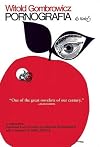
When reaching the end of a novel, rarely do I have so much to say, and also so little. This was my first experience with Gombrowicz, and it was a bewildering, exciting one. It has elective affinities with Kundera that make it a unique, and not wholly pleasurable, read. About one third of the way through the novel, I wasn't sure that I would make it the rest of the way. The purely distilled, unrelenting psychological depictions of its characters and occasional absurdism can sometimes make it show more arduous, but this eventually lets up a bit. I stuck with it, and I'm glad I did. I think I had insisted a bit too much before I even began reading the novel that it would have somehow relate to the War, our relation to it, and how we react to it.
As has already been noted by other reviewers, the title is appropriate, but the novel is not "pornographic" in the sense that we usually use the word. Perhaps that's why "Seduction" has often been used as a translation in the past. Instead the pornography here is a perversely pathological inspection of its central characters. While the novel is set only in Poland, Gombrowicz actually fled Poland shortly before the outbreak of World War II, thinking that he would wait it out; he would remain there for almost twenty-five years.
The two main characters in the novel, Fryderyk and Witold (again, like Coetzee, Gombrowicz tempts the reader with autobiography by using his name), conspire to get Henia and Karol romantically interested in one another, even though they hardly notice each other, and Henia is already engaged to a young attorney. Witold initially is the one who shows an interest in the young couple, however Fryderyk's interest soon comes to border on the obsessive, conniving to have Henia's fiancée catch them in a romantic tryst. Meanwhile, a Polish soldier fighting in the resistance movement heightens the tension of the story as several plots to kill him are eventually hatched within the household.
A fascination with youth apparently imbues much of Gombrowicz's work (the effort to realize the romantic connection consumes an inordinate amount of time), including 1937's "Ferdydurke," which I look forward to reading. He views youth as a kind of purity, physical and perhaps ideological. He says in his play "The Marriage," "Each person deforms the other person, while being at the same time deformed by them." I find it interesting and telling how he chose to define the interaction between two people here as a kind of destruction instead of construction. It definitely sums up the bleak undertones of the novel, while also showing what a relentless psychologist Gombrowicz is.
A few words in closing: I have heard that Danuta Borchardt's translation is the best one, so opt for this one, assuming you cannot read the original Polish. Also, do not approach it with some preconceived notion that it should be a philosophical meditation on war simply because World War II is its setting. I think this was one of the things that vitiated my reading pleasure the most. This novel certainly is not for everyone, but for those that love a thoughtful author - a real writer's writer - I would recommend this. show less
As has already been noted by other reviewers, the title is appropriate, but the novel is not "pornographic" in the sense that we usually use the word. Perhaps that's why "Seduction" has often been used as a translation in the past. Instead the pornography here is a perversely pathological inspection of its central characters. While the novel is set only in Poland, Gombrowicz actually fled Poland shortly before the outbreak of World War II, thinking that he would wait it out; he would remain there for almost twenty-five years.
The two main characters in the novel, Fryderyk and Witold (again, like Coetzee, Gombrowicz tempts the reader with autobiography by using his name), conspire to get Henia and Karol romantically interested in one another, even though they hardly notice each other, and Henia is already engaged to a young attorney. Witold initially is the one who shows an interest in the young couple, however Fryderyk's interest soon comes to border on the obsessive, conniving to have Henia's fiancée catch them in a romantic tryst. Meanwhile, a Polish soldier fighting in the resistance movement heightens the tension of the story as several plots to kill him are eventually hatched within the household.
A fascination with youth apparently imbues much of Gombrowicz's work (the effort to realize the romantic connection consumes an inordinate amount of time), including 1937's "Ferdydurke," which I look forward to reading. He views youth as a kind of purity, physical and perhaps ideological. He says in his play "The Marriage," "Each person deforms the other person, while being at the same time deformed by them." I find it interesting and telling how he chose to define the interaction between two people here as a kind of destruction instead of construction. It definitely sums up the bleak undertones of the novel, while also showing what a relentless psychologist Gombrowicz is.
A few words in closing: I have heard that Danuta Borchardt's translation is the best one, so opt for this one, assuming you cannot read the original Polish. Also, do not approach it with some preconceived notion that it should be a philosophical meditation on war simply because World War II is its setting. I think this was one of the things that vitiated my reading pleasure the most. This novel certainly is not for everyone, but for those that love a thoughtful author - a real writer's writer - I would recommend this. show less

Gombrowicz does something amazing here. Pornografia is the depiction of a struggle between a man and his own perceptions, and the narrator’s own perceptiveness is a commentary on the art of fiction. The narrator (“Witold”) imagines that others are engaged in a performance: nearly imperceptible gestures produce intimations of ecstasy or moments of crushing despair. An idyllic setting conjures an apparition of youthful eroticism—but also violence, cruelty and humiliation. The adults show more are repulsive and ridiculous, manipulative, sinister, formulating gestures fraught with a symbolism impossible to comprehend. “Witold” tells himself that he “must stick to the facts since he can’t recount events realistically.” I lost count of how many times I had to close the book and ponder a sentence like that. Gombrowicz presents both life (and literature) as a theatrical experiment: “We are all playing a game which creates us and the situations we find ourselves in,” and we are afraid of not living up to life’s drama. “We are what we are in order to avoid being something else.” The narrator has the sensation not that someone is watching him, but spying on him—is it the reader? What knocked me back was how at times it seemed like all the exalted violence and sordid sensuality summoned by Pornografia was taking place only in the minds of the characters, or in our minds. Of his friend the narrator says to himself, “When he became profound he could no longer remain superficial,” and I could only wonder, Who’s playing who? show less
Pornografi, Gombrowicz'in, insanı köşeye sıkıştıran, tüm varoluş biçimlerini elinden alan romanlarından biri daha. Atlantik Ötesi, Ferdydurke gibi romanlarından tanıdığımız, varoluşçuluğun, nihilizmin usta provokatörü Gombrowicz, yine hayatlarımızın derinliklerine nüfuz ediyor Pornografi'de. Bizi insanlığımızdan utandırıyor, çaresiz, eli kolu bağlı bırakıyor, alay ediyor bizimle. Görünüşte hiçbir şeyin olmadığı, normal, sıradan, masum show more yaşamlardaki olağanüstülüğü, başkalığı, suça ve cinayete doğallıkla varan insan ilişkilerini adım adım gösteren, felsefi şiir tadında bir roman Pornografi... show less
Lists
Awards


You May Also Like


Associated Authors
Statistics
- Works
- 141
- Also by
- 4
- Members
- 5,991
- Popularity
- #4,112
- Rating
- 3.9
- Reviews
- 83
- ISBNs
- 511
- Languages
- 26
- Favorited
- 65


