
Olga Tokarczuk
Author of Drive Your Plow Over the Bones of the Dead
About the Author
Image credit: Olga Tokarczuk
Works by Olga Tokarczuk
All Saints’ Mountain 2 copies
Tokarczuk, Olga Archive 1 copy
Tendre Stock 1 copy
Dieu, le temps, les hommes et les anges — Author — 1 copy
Marek Marek 1 copy
Ognosia : essee 1 copy
رحالة 1 copy
Associated Works
Chicago Review 46:03/04 (New Polish Writing) — Contributor — 2 copies
Tagged
Common Knowledge
- Canonical name
- Tokarczuk, Olga
- Birthdate
- 1962-01-29
- Gender
- female
- Education
- University of Warsaw (Psychology)
- Occupations
- psychologist
writer
essayist
poet
therapist - Organizations
- Zieloni 2004 (Poland's Green Party)
- Awards and honors
- Samuel-Bogumil-Linde-Preis (2008)
Usedomer Literaturpreis (2012)
Nagroda Fundacji im. Kościelskich (1997)
Paszport "Polityki" (1996)
Nagroda Literacka Nike ( [2002] ∙ [2008])
Nagroda Czytelników Nike ( [1997] ∙ 1999 ∙ [2008]) (show all 9)
Nagroda Literacka im. Władysława Reymonta (1999)
Vilenica International Literary Prize (2013)
Nobel Prize for Literature (2018) - Nationality
- Poland
- Birthplace
- Sulechów, Poland
- Places of residence
- Sulechów, Poland (birth)
Warsaw, Poland
Wrocław, Poland
Wałbrzych, Poland - Map Location
- Poland
Members
Reviews

On the opening page of this novel, an engineering student arrives by train on his way to a tuberculosis sanatorium in the mountains not long before the outbreak of the First World War, so it's pretty obvious what book we are supposed to supposed to have in mind as we read this. But Mieczysław is a Pole, a citizen of a country that doesn’t exist at that moment. He’s from Lwów (now Lviv) in Galicia, then part of the Austrian Empire, the sanatorium is at Görbersdorf (now Sokołowsko) in show more Silesia, then part of Germany, and the book is a mere 320 pages long.
I've a feeling we're not in Davos any more...
There is lots of elegant riffing off Thomas Mann along the way, but Tokarczuk angles the set-up in a different direction, as we would expect. She uses the all-male environment of the guest-house where Mieczysław is staying next to the sanatorium as a laboratory to explore how educated men talk about women. The misogynistic ideas they express are all paraphrased from actual Great (male) Thinkers, from St Augustine to Jack Kerouac (as Tokarczuk explains in a barbed acknowledgment at the end of the book). Our viewpoint character Mieczysław is a bit of an outsider in these discussions, mainly because his protective, military-minded father has kept him away from female company of all kinds for most of his life (his mother died when he was a young child).
At the same time, there is something nasty lurking in the woods, a moist, organic threat overshadowing the neat, highly organised life of the medical community. Mieczysław gradually becomes aware of the horror that has punctuated life in the area since medieval times, but is seldom spoken of.
As always with Tokarczuk, the result is a witty, dark, and distinctly unexpected kind of novel, rooted in the history and landscape of Silesia where she lives, and full of home truths for the reader to think about. With its crime/horror theme, it’s perhaps most similar in atmosphere to Drive your plow, but of course with Mann instead of Blake. And with a lot of mushrooms of various kinds along the way too. show less
I've a feeling we're not in Davos any more...
There is lots of elegant riffing off Thomas Mann along the way, but Tokarczuk angles the set-up in a different direction, as we would expect. She uses the all-male environment of the guest-house where Mieczysław is staying next to the sanatorium as a laboratory to explore how educated men talk about women. The misogynistic ideas they express are all paraphrased from actual Great (male) Thinkers, from St Augustine to Jack Kerouac (as Tokarczuk explains in a barbed acknowledgment at the end of the book). Our viewpoint character Mieczysław is a bit of an outsider in these discussions, mainly because his protective, military-minded father has kept him away from female company of all kinds for most of his life (his mother died when he was a young child).
At the same time, there is something nasty lurking in the woods, a moist, organic threat overshadowing the neat, highly organised life of the medical community. Mieczysław gradually becomes aware of the horror that has punctuated life in the area since medieval times, but is seldom spoken of.
As always with Tokarczuk, the result is a witty, dark, and distinctly unexpected kind of novel, rooted in the history and landscape of Silesia where she lives, and full of home truths for the reader to think about. With its crime/horror theme, it’s perhaps most similar in atmosphere to Drive your plow, but of course with Mann instead of Blake. And with a lot of mushrooms of various kinds along the way too. show less

“How does the world look when your life is filled with longing?”
A woman -our unnamed narrator- observes the residents of a remote village and takes us into a hallucinatory journey through folklore, magic, history and the hazy world of dreams. Nocturnal visions become the vehicle for her musings on life, darkness and light, friendship, madness, death and love.
So, we have an amalgamation of medieval legends-evident in the chapters dedicated to the life of Saint Kummernis- observations on show more mushrooms and wigs made of human hair, life after the Second World War, sexuality and longing. The writing is dense and sparse at the same time and there are entire chapters written with moving beauty.
The problem is that I ‘walked’ through this book without taking anything with me. I loved bits and pieces, but overall, I was left indifferent. I closed the book with a ‘That's it?’ expression. Furthermore, Paschalis's storyline felt like a cheap way to satisfy an agenda and I found these chapters distasteful. This is my personal opinion. I am sure there are plenty of readers who will have no qualms about them.
But I am not one of those readers.
I think that nothing will replace Flights in my heart when it comes to Tokarczuk's work. I will always visit her work since I find her cosmology alluring, but I won't be able to shake off my apprehension.
Oh, well…That's life… show less
A woman -our unnamed narrator- observes the residents of a remote village and takes us into a hallucinatory journey through folklore, magic, history and the hazy world of dreams. Nocturnal visions become the vehicle for her musings on life, darkness and light, friendship, madness, death and love.
So, we have an amalgamation of medieval legends-evident in the chapters dedicated to the life of Saint Kummernis- observations on show more mushrooms and wigs made of human hair, life after the Second World War, sexuality and longing. The writing is dense and sparse at the same time and there are entire chapters written with moving beauty.
The problem is that I ‘walked’ through this book without taking anything with me. I loved bits and pieces, but overall, I was left indifferent. I closed the book with a ‘That's it?’ expression. Furthermore, Paschalis's storyline felt like a cheap way to satisfy an agenda and I found these chapters distasteful. This is my personal opinion. I am sure there are plenty of readers who will have no qualms about them.
But I am not one of those readers.
I think that nothing will replace Flights in my heart when it comes to Tokarczuk's work. I will always visit her work since I find her cosmology alluring, but I won't be able to shake off my apprehension.
Oh, well…That's life… show less
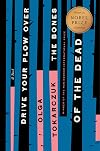
Because of my Polish heritage, I thought it remiss of me to not have read anything by Olga Tokarczuk who has won both the Booker Prize and the Nobel Prize for Literature. Drive your Plow over the Bones of the Dead is often classified as a murder mystery but I found it more philosophical than suspenseful.
The narrator, Janina Duszejko, introduces herself in the opening sentence: “I am already at an age and additionally in a state where I must always wash my feet thoroughly before bed, in the show more event of having to be removed by an ambulance in the Night.” She lives in an isolated village on the Czech-Polish border and devotes her time to studying astrology and translating William Blake. One by one, men in the area are found murdered. Since the victims are all hunters, Janina concludes that animals are responsible for the deaths. Of course, this theory results in her being scorned and dismissed by virtually everyone.
Part of the appeal of the book is the quirky narrator. She prefers to use nicknames rather than people’s actual names and she prefers animals to people. Though she knows that she lacks any real power and that people are laughing at her, she refuses to be dismissed as a silly old woman and continues to rail against injustices. She suffers from an unidentified chronic illness and bouts of crying; the latter seem to indicate how deeply troubled she is about the world.
Janina is very attuned to nature. When she comes across a familiar fox, she speaks of “seeing an old friend” and she refers to deer as “Young Ladies” and calls her dogs her “Little Girls”. When it rains she describes hearing “the rustle of grass growing, the ivy climbing up the walls, and the mushroom spore expanding underground. After the rain, when the Sun breaks through the clouds for a while, everything takes on such depth that one’s eyes are filled with tears.” Interestingly, each chapter begins with a quote from William Blake whose poetry emphasizes the importance of being close to the natural world. For example, “A dog starv’d at his Master’s Gate/Predicts the ruin of the State” and “A Skylark wounded in the wing,/A Cherubim does cease to sing” and “A Robin Red breast in a Cage/Puts all Heaven in a Rage” are three such quotations used.
Janina equates animal killings and the murder of humans. She wishes she could write warnings in animal script: “[people] won’t take pity on your poor souls, for they say you haven’t got souls. They don’t see their brethren in you, they won’t give you their blessing. The nastiest criminal has a soul, but not you, beautiful Deer, nor you, Boar, nor you, wild Goose, nor you Pig, nor you, Dog.” She asks, “What sort of world is this? Somebody’s body is made into shoes, into meatballs, sausages, a bedside rug, someone’s bones are boiled to make broth . . . Shoes, sofas, a shoulder bag made of someone’s belly, keeping warm with someone else’s fur, eating someone’s body, cutting it into bits and frying it in oil . . . This mass killing, cruel, impassive, automatic, without any pangs of conscience, without the slightest pause for thought, though plenty of thought is applied to ingenious philosophies and theologies. What sort of a world is this, where killing and pain are the norm? What on earth is wrong with us?”
The novel also examines how women and the old are marginalized and disregarded. She knows she is seen as a little old lady, a silly old bag, a crazy old crone and a madwoman. She hears people “snorting with laughter” at her and not taking her seriously, especially because she is a woman; when she has a conversation with a man, she knows that if she shared his gender “he’d have heard me out, considered his arguments and debated the matter. But to him I was just an old woman, gone off her rocker living in this wilderness. Useless and unimportant.”
Though serious in subject matter, the book also has humour. I loved Janina’s theory of testosterone autism: “With age, many men come down with testosterone autism, the symptoms of which are a gradual decline in social intelligence and capacity for interpersonal communication, as well as a reduced ability to formulate thoughts. The Person beset by this Ailment becomes taciturn and appears to be lost in contemplation. He develops an interest in various Tools and machinery, and he’s drawn to the Second World War and the biographies of famous people, mainly politicians and villains. His capacity to read novels almost entirely vanishes; testosterone autism disturbs the character’s psychological understanding.”
One element that did annoy me is the extended passages on astrology. They slow down the pace and diminish the suspense. Since I don’t believe in astrology, I tended to skim those sections, but perhaps that’s an example of how we tend to tune out people, like Janina, whose ideas are unconventional.
I understand why the author is a rather controversial figure in her home country of Poland. She does not stint on criticizing its culture and religion. At one point she rants, “people in our country don’t have the ability to club together to form a community . . . This is a land of neurotic egotists, each of whom, as soon as he finds himself among others, starts to instruct, criticize, offend, and show off his undoubted superiority.”
For a thriller, this book is slow-paced and not particularly suspenseful so it is not recommended to anyone looking for a quick, action-packed read. What it does have is a lot of ideas which are perhaps outside the parameters of conventional thinking but ideas that nonetheless should be given some consideration.
Note: Please check out my reader's blog (https://schatjesshelves.blogspot.com/) and follow me on Twitter (@DCYakabuski). show less
The narrator, Janina Duszejko, introduces herself in the opening sentence: “I am already at an age and additionally in a state where I must always wash my feet thoroughly before bed, in the show more event of having to be removed by an ambulance in the Night.” She lives in an isolated village on the Czech-Polish border and devotes her time to studying astrology and translating William Blake. One by one, men in the area are found murdered. Since the victims are all hunters, Janina concludes that animals are responsible for the deaths. Of course, this theory results in her being scorned and dismissed by virtually everyone.
Part of the appeal of the book is the quirky narrator. She prefers to use nicknames rather than people’s actual names and she prefers animals to people. Though she knows that she lacks any real power and that people are laughing at her, she refuses to be dismissed as a silly old woman and continues to rail against injustices. She suffers from an unidentified chronic illness and bouts of crying; the latter seem to indicate how deeply troubled she is about the world.
Janina is very attuned to nature. When she comes across a familiar fox, she speaks of “seeing an old friend” and she refers to deer as “Young Ladies” and calls her dogs her “Little Girls”. When it rains she describes hearing “the rustle of grass growing, the ivy climbing up the walls, and the mushroom spore expanding underground. After the rain, when the Sun breaks through the clouds for a while, everything takes on such depth that one’s eyes are filled with tears.” Interestingly, each chapter begins with a quote from William Blake whose poetry emphasizes the importance of being close to the natural world. For example, “A dog starv’d at his Master’s Gate/Predicts the ruin of the State” and “A Skylark wounded in the wing,/A Cherubim does cease to sing” and “A Robin Red breast in a Cage/Puts all Heaven in a Rage” are three such quotations used.
Janina equates animal killings and the murder of humans. She wishes she could write warnings in animal script: “[people] won’t take pity on your poor souls, for they say you haven’t got souls. They don’t see their brethren in you, they won’t give you their blessing. The nastiest criminal has a soul, but not you, beautiful Deer, nor you, Boar, nor you, wild Goose, nor you Pig, nor you, Dog.” She asks, “What sort of world is this? Somebody’s body is made into shoes, into meatballs, sausages, a bedside rug, someone’s bones are boiled to make broth . . . Shoes, sofas, a shoulder bag made of someone’s belly, keeping warm with someone else’s fur, eating someone’s body, cutting it into bits and frying it in oil . . . This mass killing, cruel, impassive, automatic, without any pangs of conscience, without the slightest pause for thought, though plenty of thought is applied to ingenious philosophies and theologies. What sort of a world is this, where killing and pain are the norm? What on earth is wrong with us?”
The novel also examines how women and the old are marginalized and disregarded. She knows she is seen as a little old lady, a silly old bag, a crazy old crone and a madwoman. She hears people “snorting with laughter” at her and not taking her seriously, especially because she is a woman; when she has a conversation with a man, she knows that if she shared his gender “he’d have heard me out, considered his arguments and debated the matter. But to him I was just an old woman, gone off her rocker living in this wilderness. Useless and unimportant.”
Though serious in subject matter, the book also has humour. I loved Janina’s theory of testosterone autism: “With age, many men come down with testosterone autism, the symptoms of which are a gradual decline in social intelligence and capacity for interpersonal communication, as well as a reduced ability to formulate thoughts. The Person beset by this Ailment becomes taciturn and appears to be lost in contemplation. He develops an interest in various Tools and machinery, and he’s drawn to the Second World War and the biographies of famous people, mainly politicians and villains. His capacity to read novels almost entirely vanishes; testosterone autism disturbs the character’s psychological understanding.”
One element that did annoy me is the extended passages on astrology. They slow down the pace and diminish the suspense. Since I don’t believe in astrology, I tended to skim those sections, but perhaps that’s an example of how we tend to tune out people, like Janina, whose ideas are unconventional.
I understand why the author is a rather controversial figure in her home country of Poland. She does not stint on criticizing its culture and religion. At one point she rants, “people in our country don’t have the ability to club together to form a community . . . This is a land of neurotic egotists, each of whom, as soon as he finds himself among others, starts to instruct, criticize, offend, and show off his undoubted superiority.”
For a thriller, this book is slow-paced and not particularly suspenseful so it is not recommended to anyone looking for a quick, action-packed read. What it does have is a lot of ideas which are perhaps outside the parameters of conventional thinking but ideas that nonetheless should be given some consideration.
Note: Please check out my reader's blog (https://schatjesshelves.blogspot.com/) and follow me on Twitter (@DCYakabuski). show less

A richly imagined old woman narrator and her enigmatic interactions with the other people in a remote Polish village serve as the vessel for Tokarczuk’s subtle prose, which lures us into believing that we all begin as sparks from a star, that nature’s tally of our misdeeds is ongoing, and that the human psyche evolved to defend us against seeing the truth. And how do we figure the narrator's observation regarding the local writer?:
In a way, people like her, those who wield a pen, can be show more dangerous. At once a suspicion of fakery springs to mind—that such a Person is not him or herself, but an eye that’s constantly watching, and whatever it sees it changes into sentences; in the process it strips reality of its most essential quality—its inexpressibility. show less
In a way, people like her, those who wield a pen, can be show more dangerous. At once a suspicion of fakery springs to mind—that such a Person is not him or herself, but an eye that’s constantly watching, and whatever it sees it changes into sentences; in the process it strips reality of its most essential quality—its inexpressibility. show less
Lists
2025 (1)
Unmarried women (1)
Spirituality (1)
Books for Birute (1)
2024 (1)
Greatest Books (1)
Stuff from Bard (1)
Five star books (2)
A Novel Cure (1)
Wishlist (1)
At the Library (1)
. (1)
NTS Book Channel (1)
Books for Dustin (1)
Female Author (1)
Awards


You May Also Like


Associated Authors
Statistics
- Works
- 36
- Also by
- 8
- Members
- 11,419
- Popularity
- #2,059
- Rating
- 3.9
- Reviews
- 364
- ISBNs
- 490
- Languages
- 37
- Favorited
- 31


