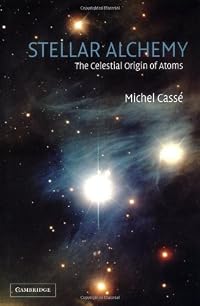
Stellar Alchemy: The Celestial Origin of Atoms
by Michel Cassé
On This Page
Description
Why do the stars shine? What messages can we read in the light they send to us from the depths of the night? Nuclear astrophysics is a fascinating discipline, and enables connections to be made between atoms, stars, and human beings. Through modern astronomy, scientists have managed to unravel the full history of the chemical elements, and understand how they originated and evolved into all the elements that compose our surroundings today. The transformation of metals into gold, something show more once dreamed of by alchemists, is a process commonly occurring in the cores of massive stars. But the most exciting revelation is the intimate connection that humanity itself has with the debris of exploded stars. This engaging account of nucleosynthesis in stars, and the associated chemical evolution of the Universe, is suitable for the general reader. show lessTags
Recommendations




Members
- Recently Added By
Lists

Chemistry
53 works; 3 members
Author Information

18 Works 71 Members
Michel Casse is an astrophysicist at the Service d'Astrophysique in Saclay, France, and an associate research scientist at the Institut d'Astrophysique de Paris.
Common Knowledge
- Original title
- Stellar Alchemy: The Celestial Origin of Atoms
- Original publication date
- 2003
- Dedication
- This book is dedicated to Andre Grau
To exorcise the sadness of the finite,
I have chosen the sky.
Always polite with light,
I let it have the first word.
Instruction should be gentle. - First words
- Preface: Rising ideas in the sky of knowledge
The constellated sky has never ceased to foster the enthusiasm of men and
women in search of illumination.
1
Nuclear astrophysics: defence and illustration
The aim of nuclear astrophysics is threefold. Firstly, it seeks to determine the
mechanisms whereby the various nuclear species occurring in nature are built
up... (show all), from deuterium with its two nucleons to uranium with 238 nucleons. Secondly,
it seeks to identify the astrophysical site in which these species are
produced. And thirdly, it attempts to unravel the temporal sequence of the nuclear
phenomena that fashion baryonic matter, the stuff of stars and humans,
making up the galaxies. Beyond this, it aims to explain the composition of the
Solar System and the main trends of chemical evolution in the Galaxy, such as
the gradual enrichment in metals and the relative abundances of the elements. - Last words
- (Click to show. Warning: May contain spoilers.)Such was once the good fortune of the atom. There were secret bonds and
nuclear wedlock, and behold! The whole history of time is thrown open for all
to see. Lucretius sings once more and supernovas burst out laughing in the face
of the Universe. - Original language
- French
Classifications
Statistics
- Members
- 25
- Popularity
- 1,007,268
- Languages
- English
- Media
- Paper, Ebook
- ISBNs
- 5