On This Page
Description
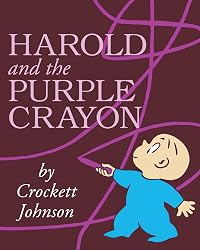
Harold goes for an adventurous walk in the moonlight with his purple crayon.Tags
Recommendations



Member Recommendations
Member Reviews
Harold and the Purple Crayon is an instant classic: a transient storytelling of a boy who is both demiurge and innocence. We travel with Harold throughout his pilgrimage with his magical purple crayon and see the unbelievable in the creative force that creates and destroys
In a Nutshell: An ingenious picture book about an imaginative kid who makes his own adventure at bedtime. Whimsical and imaginative, but not exactly my cup of tea. I can see why kiddos will enjoy it though.
~~~~~~~~~~~~~~~~~~~~~~~
You might have heard of ‘Choose Your Own Adventure’ books, whereby each story, written in second person, allows the reader to choose where they want the story to go. This is also a ‘Choose Your Own Adventure’, not for the readers but for the little titular protagonist.
The story of this classic picture book, first published in 1955, is straightforward enough at least on the surface. Little Harold decides to go on a walk at night with his purple crayon in hand. As he walks, he sketches every component of show more his adventure, right from the moon, the road, some unexpected perils and some timely solutions.
The purple crayon is some kind of a magical device because whatever Harold sketches in his simple line drawings, the crayon seems to convert to a fully-functional three-dimensional object. It is a vital component of the story as it conveniently allows Harold to escape from sticky situations, merely by drawing himself a solution. This leaves several gaps of logic. As such, whether you enjoy the book or not might depend on how right-brained or left-brained you are. Creative readers will be thrilled with Harold’s magical adventure, while logical readers could be left evaluating the gaps in the storyline. (You know which one I am! show less
~~~~~~~~~~~~~~~~~~~~~~~
You might have heard of ‘Choose Your Own Adventure’ books, whereby each story, written in second person, allows the reader to choose where they want the story to go. This is also a ‘Choose Your Own Adventure’, not for the readers but for the little titular protagonist.
The story of this classic picture book, first published in 1955, is straightforward enough at least on the surface. Little Harold decides to go on a walk at night with his purple crayon in hand. As he walks, he sketches every component of show more his adventure, right from the moon, the road, some unexpected perils and some timely solutions.
The purple crayon is some kind of a magical device because whatever Harold sketches in his simple line drawings, the crayon seems to convert to a fully-functional three-dimensional object. It is a vital component of the story as it conveniently allows Harold to escape from sticky situations, merely by drawing himself a solution. This leaves several gaps of logic. As such, whether you enjoy the book or not might depend on how right-brained or left-brained you are. Creative readers will be thrilled with Harold’s magical adventure, while logical readers could be left evaluating the gaps in the storyline. (You know which one I am! show less
When Harold decides that he wants to go for a walk in the moonlight, the youngster doesn't allow the lack of either moon or path to stand in his way. Taking his magical purple crayon, he creates them both, drawing the world into existence around him, as he proceeds from adventure to adventure. Falling into the sea, but then drawing himself a sailing boat; plummeting off a one-sided mountain, but creating a hot-air balloon in mid-tumble - Harold has everything he needs in his purple crayon...
Originally published in 1955, this classic picture-book for younger children is one of those universally beloved books that I somehow missed, in my own girlhood reading. I'm glad that it was chosen as one of our November titles over in The show more Picture-Book Club to which I belong, where our theme this month is "Classic Picture-Book Characters," as this gave me the impetus I needed to finally pick it up. What an incredibly perceptive portrait of a child's imaginative process it contains! How true it is that we create the world around us (and not just as children) through our imaginative lives. The starkly minimal artwork here perfectly complements the simple but effective text, which builds the story outward at first - outward into the blank unknown, where Harold has the freedom to be and do anything, safe in the knowledge that his purple crayon (his creative power) will keep him safe - before returning it to the safety of home and of bed. Amusing, clever, perceptive - Harold and the Purple Crayon is children's literature at its best, demonstrating yet again that for those with the true vision, great artistic and intellectual merit can be found in the simple and the small. show less
Originally published in 1955, this classic picture-book for younger children is one of those universally beloved books that I somehow missed, in my own girlhood reading. I'm glad that it was chosen as one of our November titles over in The show more Picture-Book Club to which I belong, where our theme this month is "Classic Picture-Book Characters," as this gave me the impetus I needed to finally pick it up. What an incredibly perceptive portrait of a child's imaginative process it contains! How true it is that we create the world around us (and not just as children) through our imaginative lives. The starkly minimal artwork here perfectly complements the simple but effective text, which builds the story outward at first - outward into the blank unknown, where Harold has the freedom to be and do anything, safe in the knowledge that his purple crayon (his creative power) will keep him safe - before returning it to the safety of home and of bed. Amusing, clever, perceptive - Harold and the Purple Crayon is children's literature at its best, demonstrating yet again that for those with the true vision, great artistic and intellectual merit can be found in the simple and the small. show less
I absolutely loved this book when I was a kid. Our copy was at the lake, so I have memories of cozying up with my parents on the couch after a long day of playing to hear about Harold's adventures.
Harold's a little boy with a purple crayon who uses said crayon to go for a walk in the moonlight...by drawing the moon, drawing the path, and then drawing his way off the beaten path and into exciting new things. With his crayon to express his imagination, he creates places, animals, transportation, cities...and, finally, a cozy bedroom, where his crayon falls to the floor as he falls asleep. Along the way, there are clever turns of phrase--"Harold made land", "Harold made his bed", "drew up the covers"--and playful reference to the plain show more white background, such as Harold falling into plain, white nothing.
A great example of what a simple picture book can be: imaginatively and visually playful. Can't wait to read this one to Alina!
(I'm totally cheating by putting this on my "great world building" shelf, but hey, Harold literally builds/draws his own world!) show less
Harold's a little boy with a purple crayon who uses said crayon to go for a walk in the moonlight...by drawing the moon, drawing the path, and then drawing his way off the beaten path and into exciting new things. With his crayon to express his imagination, he creates places, animals, transportation, cities...and, finally, a cozy bedroom, where his crayon falls to the floor as he falls asleep. Along the way, there are clever turns of phrase--"Harold made land", "Harold made his bed", "drew up the covers"--and playful reference to the plain show more white background, such as Harold falling into plain, white nothing.
A great example of what a simple picture book can be: imaginatively and visually playful. Can't wait to read this one to Alina!
(I'm totally cheating by putting this on my "great world building" shelf, but hey, Harold literally builds/draws his own world!) show less
Armed only with a purple crayon, a little boy named Harold draws a moon and a path to walk on, then draws his way into an adventure. Eventually he draws his way back home, and draws himself a bed to sleep in.
Very cute, but seems like it might be trying to appeal more to parents than kids. The stark drawings are beautiful, but it’s a little too long to hold my niece’s attention, and there’s the obvious concern about promoting drawing on walls. I’ll be interested to see if she likes this one more when she’s a little older.
Very cute, but seems like it might be trying to appeal more to parents than kids. The stark drawings are beautiful, but it’s a little too long to hold my niece’s attention, and there’s the obvious concern about promoting drawing on walls. I’ll be interested to see if she likes this one more when she’s a little older.
I enjoyed this book for two reasons. I love the perspective the author gives the audience. I really enjoy reading books from a child’s perspective. I think Johnson really captured the imagination and wonder that a child’s imagination has. I also believe he captured the effortless complexity of living in their imagination through the illustrations. For example, Harold draws an apple tree but is concerned someone will take the apples from the tree, “The apples would be very tasty, Harold thought, when they got red. So he put a frightening dragon under the tree to guard the apples.” His imagination creates a dragon that he draws and then later becomes afraid of. His creative ideas become so real to him, that he believes his show more drawings to be real. As an adult, we often forget the depth and realness of a child’s imagination, making this book a great reminder.
I also love how the author created a character with really great problem-solving skills. I think this is a really cool character trait that isn’t often seen in such young children’s books. I love how when Harold falls into the water, he draws a boat. Or when there was a lot of pie left over and he didn’t want to be wasteful, so he drew hungry animals to help finish the food. Harold’s solutions are both mature and comically naïve. I really like how the author then relates problem-solving with art, sending a message to children that they can work through their problems through a creative medium. The main idea of this story is to use your imagination to solve problems. show less
I also love how the author created a character with really great problem-solving skills. I think this is a really cool character trait that isn’t often seen in such young children’s books. I love how when Harold falls into the water, he draws a boat. Or when there was a lot of pie left over and he didn’t want to be wasteful, so he drew hungry animals to help finish the food. Harold’s solutions are both mature and comically naïve. I really like how the author then relates problem-solving with art, sending a message to children that they can work through their problems through a creative medium. The main idea of this story is to use your imagination to solve problems. show less
Harold and the Purple Crayon has been a favorite of the picture book genre for quite some time, and the reputation is well deserved. In this charming story about creativity, Harold decides to go for a walk in the moonlight. He needs some moon for a moonlight walk, though, so he draws one. He also draws the path, and the field, and the forest he finds. With his wonderful purple crayon, he draws everything he sees and experiences along his journey, mostly by intention, but occasionally by accident. When he draws a dragon to guard the apple tree, he is so frightened by his own invention that his hand shakes, creating water waves into which he stumbles. Good thing he keeps his head and draws a boat. Or when he draws a mountain to look for show more his house, but trips at the top; he hasn't drawn the other side of the mountain yet, so he is falling through the air, when he thinks about drawing a hot air balloon, and saves himself. Eventually, Harold finds his way back to his own familiar room. He draws up his covers, and falls asleep.
Harold's adventures show his creativity and the power of his imagination, which sweep him up so completely that sometimes he's controlling it, and sometimes it's controlling him. Each page uses just a small amount of simple sentences, because the illustrations convey so much of the story. This narrative is perfect for reading aloud, not only because the word count is small, but also because the text is readable. The rhythm is just right, the concise descriptions embed sly humor (drew up the covers, and so on). The subject matter is brilliant - children love to draw. My oldest daughter is in a phase right now where she draws all over the place. The act of creation is a powerful force, and children are especially attuned to this gift. Harold's story, about a boy drawing an entire world around him, is therefore quite appealing. My girls, who are just beginning to sit still for simpler picture books, listen closely to this whole narrative, even though it has more pages than others. I definitely agree with this picture book's standing as a child's classic, and recommend it to families. show less
Harold's adventures show his creativity and the power of his imagination, which sweep him up so completely that sometimes he's controlling it, and sometimes it's controlling him. Each page uses just a small amount of simple sentences, because the illustrations convey so much of the story. This narrative is perfect for reading aloud, not only because the word count is small, but also because the text is readable. The rhythm is just right, the concise descriptions embed sly humor (drew up the covers, and so on). The subject matter is brilliant - children love to draw. My oldest daughter is in a phase right now where she draws all over the place. The act of creation is a powerful force, and children are especially attuned to this gift. Harold's story, about a boy drawing an entire world around him, is therefore quite appealing. My girls, who are just beginning to sit still for simpler picture books, listen closely to this whole narrative, even though it has more pages than others. I definitely agree with this picture book's standing as a child's classic, and recommend it to families. show less
Members
- Recently Added By
Lists

Favorite Childhood Books
1,651 works; 519 members

Best children's picture books
377 works; 85 members

Top-Rated Children's Books
87 works; 16 members
1001 Children's Books You Must Read Before You Grow Up
774 works; 101 members

Five in a Row
144 works; 8 members

Childhood Favorites
427 works; 24 members

Scholastic 100 Best Read-Aloud Books
100 works; 8 members
27 Books Parents Should Read to Their Kids Before They Grow Up
27 works; 7 members
Picture Book Library
49 works; 7 members

Sonlight Books
1,487 works; 25 members

Baby's First Postmodernism
52 works; 8 members

Storytime
145 works; 2 members

Books with Colourful Titles
171 works; 8 members

Night Sky (recc titles)
26 works; 1 member

End of Your Life Book Club
134 works; 4 members

Youth: Personal Values
252 works; 1 member

Youth: DEI
296 works; 2 members

A Rainbow of Books: Colors in the Title
570 works; 24 members

Books tagged favorites
390 works; 30 members

SYES Library Wishlist
1,080 works; 4 members

Before Austen Comes Aesop
318 works; 9 members

Mustich's 1000 Books to Read Before You Die: A Life Changing List
1,001 works; 20 members

Five in a Row
174 works; 2 members

Nifty Fifties
129 works; 14 members

Books We Love to Reread
688 works; 296 members
Favorite Picture Books
479 works; 160 members
Book Worlds We'd Like To Visit
322 works; 158 members

Books We Loved As Children
603 works; 252 members

Written and Illustrated By
805 works; 1 member

Books We Discovered On LibraryThing
530 works; 130 members

Fiction with Men's Given Names in the Title
302 works; 11 members

The Peaceful Preschool Curriculum
58 works; 1 member

Recommended Reading List
219 works; 1 member
Author Information

Crockett Johnson, pen name for David Johnson Leisk, was born October, 20, 1906 in New York City. He studied art at Cooper Union in 1924 and New York University in 1925. He wrote political cartoons for the New Masses from 1940-1943. In 1942, his popular character Barnaby first appeared in the newspaper, PM, and was later syndicated into 52 American show more newspapers. He married author Ruth Krauss in the early 1940s and illustrated three of her children's books: The Carrot Seed, How to Make an Earthquake, and The Happy Egg. His first children's book, Who's Upside Down? was published in 1952. His well-known series with his character Harold, began in 1955 with Harold and the Purple Crayon. He died of lung cancer on July 11, 1975 at the age of 68. show less
Awards and Honors
Notable Lists
Series

Work Relationships
Is contained in
Common Knowledge
- Canonical title
- Harold and the Purple Crayon
- Original publication date
- 1955
- People/Characters
- Harold [Harold and the Purple Crayon]; Moose [Harold and the Purple Crayon]; Porcupine [Harold and the Purple Crayon]
- Related movies
- Harold and the Purple Crayon (2002 | IMDb); Harold and the Purple Crayon (1969 | IMDb); Harold and the Purple Crayon (2024 | IMDb); Harold and the Purple Crayon (1959 | IMDb); Harold and the Purple Crayon (2001 | IMDb)
- First words
- One evening, after thinking it over for some time, Harold decided to go for a walk in the moonlight.
- Last words
- (Click to show. Warning: May contain spoilers.)And Harold dropped off to sleep.
- Original language
- English
Classifications
Statistics
- Members
- 9,318
- Popularity
- 1,131
- Reviews
- 228
- Rating
- (4.26)
- Languages
- 12 — Chinese, Danish, Dutch, English, Finnish, French, German, Italian, Polish, Spanish, Swedish, Turkish
- Media
- Paper, Audiobook, Ebook
- ISBNs
- 71
- UPCs
- 4
- ASINs
- 37