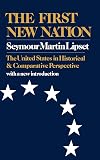
The First New Nation: The United States in Historical and Comparative Perspective
by Seymour Martin Lipset
On This Page
Description
"The United States was the first major colony to revolt successfully against colonial rule. In this sense, it was the first "new nation." To see how, in the course of American history, its values took shape in institutions may help us to understand some of the problems faced by the new nations emerging today on the world scene. In The First New Nation, two broad themes occupy Seymour Martin Lipset's attention: the social conditions that make a stable democracy possible, and the extent to show more which the American experience was representative or exceptional. The volume is divided into three parts, each of which deals with the role of values in a nation's evolution, but each approaches this role from a different perspective. Part 1, "America as a New Nation," compares early America with today's emerging nations to discover problems common to them as new nations, and analyzes some of the consequences of a revolutionary birth for the creation of a national character and style. Part 2, "Stability in the Midst of Change," traces how values derived from America's revolutionary origins have continued to influence the form and substance of American institutions. Lipset concentrates on American history in later periods, selecting for discussion as critical cases religious institutions and trade unions. Part 3, "Democracy in Comparative Perspective," attempts to show by comparative analysis some ways through which a nation's values determine its political evolution. It compares political development in several modern industrialized democracies, including the United States, touching upon value patterns, value differences, party systems, and the bases of social cleavage."--Provided by publisher. show lessTags
Recommendations










































Members
- Recently Added By
Author Information

67+ Works 1,233 Members
Seymour Martin Lipset: March 18, 1922 - December 31, 2006 American political theorist and sociologist, Seymour Martin Lipset, was born in New York City on March 18, 1922, and educated at City College of New York and Columbia University. Lipset taught at a number of universities, including the University of Toronto, Columbia University, the show more University of California at Berkeley, Harvard University, and Stanford University. A senior fellow at the Hoover Institution, he was also a member of the International Society of Political Psychology, the American Political Science Association, and the American Academy of Science. Among Lipset's many works are "Political Man: The Social Bases of Politics" (1960), "Class, Status, and Power" (1953), and "Revolution and Counterrevolution" (1968). He also contributed articles to a number of magazines, including The New Republic, Encounter, and Commentary. Lipset has received a number of awards for his work, including the MacIver Award in 1962, the Gunnar Myrdal Prize in 1970, and the Townsend Harris Medal in 1971. Lipset died on December 31, 2006, as a result of complications following a stroke. He was 84. (Bowker Author Biography) show less
Awards and Honors
Awards
Common Knowledge
- Original publication date
- 1963
Classifications
Statistics
- Members
- 70
- Popularity
- 446,708
- Languages
- English
- Media
- Paper, Ebook
- ISBNs
- 6
- ASINs
- 1