On This Page
Description
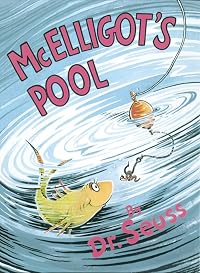
A boy imagines the rare and wonderful fish he might catch in McElligot's pool.Tags
Recommendations








Member Reviews
That imaginative young boy from Dr. Seuss' very first picture-book, And To Think That I Saw It on Mulberry Street, published in 1937, returns in this second adventure, full of all of the make-believe and whimsy that one would expect. Advised that he is unlikely to catch anything in the eponymous McElligot's Pool, which serves as a sort of trash dump for the farmers thereabouts, Marco demurs, certain that there is a possibility, at the very least, of catching some interesting fish. What follows is a wondrous catalogue of all of the unlikely fish that might be swimming up the theoretical underground spring connecting the pool to the sea. From dogfish with floppy ears (chasing catfish, of course), to fish with checkerboard bellies; from show more sunburnt tropical fish to anorak-wearing arctic fish (more on this anon); from two-headed eels to roughneck lobsters - the possibilities are as limitless as one's own imagination, leading Marco to conclude that he is no fool at all, for fishing in McElligot's Pool...
A delightful pean to the power of the imagination, McElligot's Pool was first published in 1947, ten years after Marco's previous adventure, and seven years after Seuss' (then) most recent picture-book, Horton Hatches the Egg. Between 'McElligot' and 'Horton' lie seven years of war (World War II) and its immediate aftermath. Seuss, who was active as a cartoonist during this period - his adult war work has been criticized as racist propaganda, and was something that he himself apparently regretted, in later years - did not publish any children's books between 1940 and 1947. Although it was never a personal favorite in my childhood home, I do recall that we owned a copy of this book, when I was a girl, and that I read and enjoyed it many times. I picked it up for this reread as part of a recently undertaken Dr. Seuss retrospective, launched as an act of personal protest against the recent decision from Dr. Seuss Enterprises to suppress six of the author's titles, because they contain outdated and potentially offensive elements. Those titles include this one, McElligot's Pool, as well as And to Think That I Saw It on Mulberry Street, If I Ran the Zoo, Scrambled Eggs Super!, On Beyond Zebra! and The Cat's Quizzer.
McElligot's Pool was chosen as a Caldecott Honor Book in 1948, and it is not difficult to see why, given its entertaining text and magical artwork, which work so well together. Dr. Seuss continued to develop and improve his wordplay in the book, which, like its immediate predecessor (Horton Hatches the Egg), displayed a rhythmically rhyming text not seen in his first three children's books. His artwork also continued to evolve here, utilizing far more color than in previous titles, where the black-and-white drawings were often relieved by a single color accent (The King's Stilts), or a limited range of color accents (And To Think That I Saw It On Mulberry Street). Here the illustrations alternate between black-and-white spreads, and full-color ones utilizing a wide variety of shades, to marvelous effect. The sheer inventiveness of Marco's catalogue of wondrous fish is delightful, and the accompanying artwork beautiful. In short: a wonderful picture-book! What then has caused Dr. Seuss Enterprises to stop publishing it, despite its undeniably good qualities, its status as a classic of American childhood, and the fact that it has been a perennial bestseller?
The trouble lies chiefly with the aforementioned "arctic fish," which are described in the text as "Eskimo Fish," and which are seen swimming past a stereotypical "Eskimo," complete with igloo and furry anorak. The fish too are depicted in this style, with a furry collar around their faces, suggesting anoraks of their own. The two-page spread depicting this scene directly follows another, depicting tropical fish swimming past a stereotypical tropical islander, shown taking a siesta underneath a palm tree. I haven't seen much commentary on the latter image, although it's entirely possible I've missed it. In any case, there is no doubt that the word "Eskimo" is now considered outdated, and even offensive to some, and that terms like Inuit and Yupik are preferred. At the time of original publication, obviously, this was not the case, and "Eskimo" was considered by most to be a neutral word, used to describe a human demographic group, in much the same way that "Negro" once was. We don't use the latter word today, save in a historical sense - referring to the Negro League, for instance - and I had always assumed that "Eskimo" was the same. I own a collection of folklore from Inupiaq storyteller Lela Kiana Oman, for instance, that was originally published in 1959, and is entitled Eskimo Legends. It would simply never occur to me that it should be banned and suppressed, as a result. To be fair, it would never occur to me that any book should be banned or suppressed, regardless of the circumstances. Far more recently, in 1990, Ka-Ha-Si and The Loon: An Eskimo Legend was published. While I didn't care for the book myself - one of my main critiques, as it happens, was the use of the term "Eskimo," which I found unacceptably vague in a folktale retelling, as it leaves the reader in the dark when it comes to the cultural origin of the story - I certainly wasn't calling for it to be pulled from library shelves. Are we supposed to just discard every book that contains outdated vocabulary, or words that were considered unexceptional in their own day, but offensive in ours? How far should we take it?
So much for the word "Eskimo." But what about the image? Here, I can understand some readers' discomfort, as the artwork certainly does feel very much like a caricature. Then again, it doesn't seem any more like a caricature to me than the figure of the somnolescent tropical islander, or the hayseed farmer who initially warns Marco, at the beginning of the book. Dr. Seuss is an artist whose work relies upon caricature, of all kinds, and I don't perceive any more malice behind this particular example, than behind any others of his that I have seen. That is, of course, a matter of personal experience and perception, and I am alive to the fact that the "Eskimo" image exists as part of a larger trend of stereotypical depiction, rather than in isolation, as a single example. As I mentioned in my review of And to Think That I Saw It on Mulberry Street, it is not my place to tell other readers what they should or should not find offensive and/or hurtful in the books they encounter, just as it is not their place to tell me. I have no argument with those who, seeing this single two-page spread, decide they would rather avoid the book altogether, and choose not to share it with the children in their lives. The world is wide, and there are many books in it. Readers looking for children's books with a culturally authentic depiction of Inuit peoples, by the by, can do no better than turn to Inhabit Media, an Inuit-owned publisher based in Nunavut, Canada, whose children's catalogue is almost universally excellent. But I digress. It is possible to acknowledge that there are some outdated and potentially insensitive elements in McElligot's Pool, but to still believe, either that the book still has something to offer, or that it should, as a matter of principle, be left up to the individual whether to read it. I happen to believe both of these things, and I find the decision to suppress it deeply disturbing and offensive.
I have seen a number of false arguments put forward around this issue, both in the commentariat and by private citizens on the internet. The first is that these books have no artistic and/or literary merit, and would be small loss if they disappeared. This is demonstrably false, both in the case of And to Think That I Saw It on Mulberry Street, which I reviewed a few days ago, and here, with McElligot's Pool. These are marvelous books of high quality, books which have enchanted and entertained generations of readers, becoming a part of our culture and our heritage in the process. Which brings me to the second false claim: to whit, that these books are not particularly popular, do not sell well, and will not be missed. Here again, I must disagree. I have worked in the book business for thirty years now, and have never known a time when Seuss books - including these six titles - didn't sell steadily. There is a consistent demand for them, and the reaction of the public to the news of this recent decision by Dr. Seuss Enterprises - at least fifteen Seuss titles have shot onto Amazon's bestseller list in the past week, and library requests have skyrocketed (42 outstanding hold requests for McElligot's Pool at the NYPL, as I write this) - demonstrates that the bulk of the citizenry is either uncomfortable with, or deeply opposed to this development. In the end, people want to decide for themselves what to read, and what they should think about it. Finally, I have seen the ludicrous argument that this is no book banning, and that there is nothing censorious going on here, with the decision to cease publication of these six books. I'll repeat something I wrote in my review of And to Think That I Saw It on Mulberry Street to answer this disingenuous claim:
This book may not have been censored by any government entity, nor outright banned by any institution, but the final effect of this decision to self-censor will be the same as if it had. Publication will stop, the book will become scarce, libraries will begin removing copies from their shelves - this has already begun at some libraries - and the books will become less and less accessible, even to those who want to read them. It strikes me that the harm caused by this - authors' estates and publishers pulling their own books, libraries cooperating to purge objectionable material - will be far greater than anything these Seuss books could inflict. Truly, a sad moment for the children's literature world, and for the world of letters in general. show less
A delightful pean to the power of the imagination, McElligot's Pool was first published in 1947, ten years after Marco's previous adventure, and seven years after Seuss' (then) most recent picture-book, Horton Hatches the Egg. Between 'McElligot' and 'Horton' lie seven years of war (World War II) and its immediate aftermath. Seuss, who was active as a cartoonist during this period - his adult war work has been criticized as racist propaganda, and was something that he himself apparently regretted, in later years - did not publish any children's books between 1940 and 1947. Although it was never a personal favorite in my childhood home, I do recall that we owned a copy of this book, when I was a girl, and that I read and enjoyed it many times. I picked it up for this reread as part of a recently undertaken Dr. Seuss retrospective, launched as an act of personal protest against the recent decision from Dr. Seuss Enterprises to suppress six of the author's titles, because they contain outdated and potentially offensive elements. Those titles include this one, McElligot's Pool, as well as And to Think That I Saw It on Mulberry Street, If I Ran the Zoo, Scrambled Eggs Super!, On Beyond Zebra! and The Cat's Quizzer.
McElligot's Pool was chosen as a Caldecott Honor Book in 1948, and it is not difficult to see why, given its entertaining text and magical artwork, which work so well together. Dr. Seuss continued to develop and improve his wordplay in the book, which, like its immediate predecessor (Horton Hatches the Egg), displayed a rhythmically rhyming text not seen in his first three children's books. His artwork also continued to evolve here, utilizing far more color than in previous titles, where the black-and-white drawings were often relieved by a single color accent (The King's Stilts), or a limited range of color accents (And To Think That I Saw It On Mulberry Street). Here the illustrations alternate between black-and-white spreads, and full-color ones utilizing a wide variety of shades, to marvelous effect. The sheer inventiveness of Marco's catalogue of wondrous fish is delightful, and the accompanying artwork beautiful. In short: a wonderful picture-book! What then has caused Dr. Seuss Enterprises to stop publishing it, despite its undeniably good qualities, its status as a classic of American childhood, and the fact that it has been a perennial bestseller?
The trouble lies chiefly with the aforementioned "arctic fish," which are described in the text as "Eskimo Fish," and which are seen swimming past a stereotypical "Eskimo," complete with igloo and furry anorak. The fish too are depicted in this style, with a furry collar around their faces, suggesting anoraks of their own. The two-page spread depicting this scene directly follows another, depicting tropical fish swimming past a stereotypical tropical islander, shown taking a siesta underneath a palm tree. I haven't seen much commentary on the latter image, although it's entirely possible I've missed it. In any case, there is no doubt that the word "Eskimo" is now considered outdated, and even offensive to some, and that terms like Inuit and Yupik are preferred. At the time of original publication, obviously, this was not the case, and "Eskimo" was considered by most to be a neutral word, used to describe a human demographic group, in much the same way that "Negro" once was. We don't use the latter word today, save in a historical sense - referring to the Negro League, for instance - and I had always assumed that "Eskimo" was the same. I own a collection of folklore from Inupiaq storyteller Lela Kiana Oman, for instance, that was originally published in 1959, and is entitled Eskimo Legends. It would simply never occur to me that it should be banned and suppressed, as a result. To be fair, it would never occur to me that any book should be banned or suppressed, regardless of the circumstances. Far more recently, in 1990, Ka-Ha-Si and The Loon: An Eskimo Legend was published. While I didn't care for the book myself - one of my main critiques, as it happens, was the use of the term "Eskimo," which I found unacceptably vague in a folktale retelling, as it leaves the reader in the dark when it comes to the cultural origin of the story - I certainly wasn't calling for it to be pulled from library shelves. Are we supposed to just discard every book that contains outdated vocabulary, or words that were considered unexceptional in their own day, but offensive in ours? How far should we take it?
So much for the word "Eskimo." But what about the image? Here, I can understand some readers' discomfort, as the artwork certainly does feel very much like a caricature. Then again, it doesn't seem any more like a caricature to me than the figure of the somnolescent tropical islander, or the hayseed farmer who initially warns Marco, at the beginning of the book. Dr. Seuss is an artist whose work relies upon caricature, of all kinds, and I don't perceive any more malice behind this particular example, than behind any others of his that I have seen. That is, of course, a matter of personal experience and perception, and I am alive to the fact that the "Eskimo" image exists as part of a larger trend of stereotypical depiction, rather than in isolation, as a single example. As I mentioned in my review of And to Think That I Saw It on Mulberry Street, it is not my place to tell other readers what they should or should not find offensive and/or hurtful in the books they encounter, just as it is not their place to tell me. I have no argument with those who, seeing this single two-page spread, decide they would rather avoid the book altogether, and choose not to share it with the children in their lives. The world is wide, and there are many books in it. Readers looking for children's books with a culturally authentic depiction of Inuit peoples, by the by, can do no better than turn to Inhabit Media, an Inuit-owned publisher based in Nunavut, Canada, whose children's catalogue is almost universally excellent. But I digress. It is possible to acknowledge that there are some outdated and potentially insensitive elements in McElligot's Pool, but to still believe, either that the book still has something to offer, or that it should, as a matter of principle, be left up to the individual whether to read it. I happen to believe both of these things, and I find the decision to suppress it deeply disturbing and offensive.
I have seen a number of false arguments put forward around this issue, both in the commentariat and by private citizens on the internet. The first is that these books have no artistic and/or literary merit, and would be small loss if they disappeared. This is demonstrably false, both in the case of And to Think That I Saw It on Mulberry Street, which I reviewed a few days ago, and here, with McElligot's Pool. These are marvelous books of high quality, books which have enchanted and entertained generations of readers, becoming a part of our culture and our heritage in the process. Which brings me to the second false claim: to whit, that these books are not particularly popular, do not sell well, and will not be missed. Here again, I must disagree. I have worked in the book business for thirty years now, and have never known a time when Seuss books - including these six titles - didn't sell steadily. There is a consistent demand for them, and the reaction of the public to the news of this recent decision by Dr. Seuss Enterprises - at least fifteen Seuss titles have shot onto Amazon's bestseller list in the past week, and library requests have skyrocketed (42 outstanding hold requests for McElligot's Pool at the NYPL, as I write this) - demonstrates that the bulk of the citizenry is either uncomfortable with, or deeply opposed to this development. In the end, people want to decide for themselves what to read, and what they should think about it. Finally, I have seen the ludicrous argument that this is no book banning, and that there is nothing censorious going on here, with the decision to cease publication of these six books. I'll repeat something I wrote in my review of And to Think That I Saw It on Mulberry Street to answer this disingenuous claim:
This book may not have been censored by any government entity, nor outright banned by any institution, but the final effect of this decision to self-censor will be the same as if it had. Publication will stop, the book will become scarce, libraries will begin removing copies from their shelves - this has already begun at some libraries - and the books will become less and less accessible, even to those who want to read them. It strikes me that the harm caused by this - authors' estates and publishers pulling their own books, libraries cooperating to purge objectionable material - will be far greater than anything these Seuss books could inflict. Truly, a sad moment for the children's literature world, and for the world of letters in general. show less
I never liked Dr. Seuss as a child; I found "The Cat in the Hat" or maybe it was "Green Eggs and Ham" movie shown at my local library when I was a kid disconcerting. But this book has an appealing exuberance.
Who doesn't love Dr. Sues? I know I do and this book added to that love a bit more. The rhythm and word patterns Dr. Sues uses is what keeps me so interested and wanting to read more. In "McElligot's Pool" particularly, I thought the illustrations are very detailed and eye catching. Even the pictures with no color were just as appealing as the colored pictures because of the detail. I loved this book because of its variety and diversity and I believe a lot of Dr. Sues' books tend to have this theme. I would love to read this again and it will definitely be added to my collection.
A young boy is fishing by the side of McElligot's pool when a farmer comes along and calls the boy a fool, claiming that the pool is much too small and polluted to ever catch a fish in. The boy then tells the man that you never know, the pool might just be connected to an underground brook that travels for miles and miles, leading to the sea. The boy imagines all the strange fish that he might possibly catch because "you never can tell what goes on down below.
I am a huge Dr. Seuss fan, so any of his books I would rate with five stars. I like to read his book with the tongue twisters because I believe it helped me with my reading. I was not and still not the greatest at reading aloud, but these books give a certain rhythm that i can keep up with. I loved the plot of this story cause it's true you do not know what is under the water all the time or what you could catch. Dr. Seuss gives every mind of way of traveling off to another dimension almost when you read his stories. "McElligot's Pool" is no different. Incorporating this book into my classroom would be a definite. I would celebrate Dr. Seuss week with as many books as I could and I could see this book being a regular in my classroom.
Marco knew the old man was wrong, when he told him to leave after fishing for so long. Marco stood by McElligot's pool, and proved to the old man that he wasn't a fool. Marco imagined what the pool would look like, especially after never getting a bite. Finally, Marco hooked a fish and Mcelligot's pool granted his only wish.
This book was the first Dr. Suess book I have read in about ten years. It truly made me smile, laugh, and think. The contrast in colors truly brought the story to life. The first page was black and white while the second one was in bright colors. The book followed that pattern the whole way. This was an interesting action by Dr. Suess. I am honestly not one-hundred percent sure why he did this. I would think the show more color would draw more attention to the story, but the contrast of the two kept the element of surprise for the reader. Besides the beautiful and creative artwork, Dr. Suess leaves the reader motivated to never give up and to dream as big as possible. Marco thought of every kind of fish he could catch even after being called a fool. In life people are going to diminish dreams, but when that happens I will now think of Marco and how he grew in self-esteem. show less
This book was the first Dr. Suess book I have read in about ten years. It truly made me smile, laugh, and think. The contrast in colors truly brought the story to life. The first page was black and white while the second one was in bright colors. The book followed that pattern the whole way. This was an interesting action by Dr. Suess. I am honestly not one-hundred percent sure why he did this. I would think the show more color would draw more attention to the story, but the contrast of the two kept the element of surprise for the reader. Besides the beautiful and creative artwork, Dr. Suess leaves the reader motivated to never give up and to dream as big as possible. Marco thought of every kind of fish he could catch even after being called a fool. In life people are going to diminish dreams, but when that happens I will now think of Marco and how he grew in self-esteem. show less
In my opinion this picture book was enjoyable since the language was engaging and the illustrations help depict the imagination of the narrator. The language was engaging since Dr. Seuss uses words that rhyme with each other and words that aren’t actually words. Having tongue twisters when words rhyme with each other and a rhythm helped moved this story along. I enjoyed being able to also see the narrator’s imagination also come through in the words like “ Thing-a-ma-jigger”. The illustrations also help depict this young child’s imagination since the story starts out completely in black and white but as he narrates what could be in McElligot’s pool the pictures gain color and continue to get more elaborate. McElligot’s show more Pool is about a young boy who goes to a farm pool and begins fishing only to be told that he’ll have no luck fishing there. The young boy goes on to inform the man that he could have luck fishing at McElligot’s pool if he has patience since the pool could be connected to other waterways with other sorts of fish seeking relaxation in McElligot’s pool. The big idea this story gives light to is that patience is a virtue and not to judge a book or item by what it appears to be. show less
Members
- Recently Added By
Lists

Favorite Childhood Books
1,651 works; 515 members

Caldecott Honor Books
296 works; 23 members

Banned or Challenged Books
400 works; 41 members

Books that are a victim of Cancel Culture
46 works; 3 members

Purged Books
6 works; 1 member

1970s
657 works; 23 members

Cancelled Books
79 works; 2 members

Written and Illustrated By
805 works; 1 member

Books We Resisted Reading
178 works; 110 members
Author Information

799+ Works 359,721 Members
Theodor Seuss Geisel was born in Springfield, Massachusetts on March 2, 1904. He wrote and illustrated more than 45 picture books under the pseudonym Dr. Seuss. His first picture book, And to Think That I Saw It on Mulberry Street, was published in 1937. His other books included The Cat in the Hat, The Butter-Battle Book, The Lorax, The Bippolo show more Seed and Other Lost Stories, Fox in Socks: Dr. Seuss's Book of Tongue Tanglers, What Pet Should I Get?, and Oh, the Places You'll Go. In 1984, he received a Pulitzer Prize for his contributions to children's literature. He died of oral cancer on September 24, 1991 at the age of 87. (Bowker Author Biography) show less
Awards and Honors
Series

Belongs to Publisher Series
Work Relationships
Is contained in
Common Knowledge
- Canonical title
- McElligot's Pool
- Alternate titles
- McElligot's Pool
- Original publication date
- 1947
- Dedication
- This book is dedicated to T. R. Geisel of Springfield, Mass., The World's Greatest Authority on Blackfish, Fiddler Crabs and Deegel Trout
- First words
- "Young man," laughed the farmer, "You're sort of a fell! you'll never catch fish in McElligot's Pool!"
- Last words
- (Click to show. Warning: May contain spoilers.)And that's why I think That I'm not such a fool When I sit here and fish In McElligot's Pool!
- Original language
- English
Classifications
Statistics
- Members
- 1,585
- Popularity
- 14,366
- Reviews
- 42
- Rating
- (4.11)
- Languages
- English, Norwegian, Spanish
- Media
- Paper, Ebook
- ISBNs
- 24
- ASINs
- 15