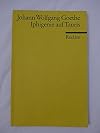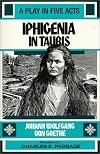
Iphigenia in Tauris
by Johann Wolfgang von Goethe
On This Page
Description
The Greek fleet bound for Troy is becalmed. For the sake of a wind, Agamemnon, leader of the Greek forces, is persuaded that he must sacrifice his daughter Iphigenia. But as the priest raises his knife to slit the child's throat, the goddess Diana spirits her away. Clytemnestra, Agamemnon's wife, believing her beloved daughter to be dead, slays her husband in revenge on his return from the Trojan wars. Their son, Orestes, avenges his father's death by killing his mother. Now, years later, as show more Iphigenia, a prisoner of the temple of Diana, looks across the sea to Greece, longing to return home show lessTags
Recommendations
















































Member Reviews
Da sie Diana ihr Leben verdankt, dient Iphigenie der Göttin auf der Insel Tauris als Priesterin, obwohl sie sich schmerzlich nach ihrer Heimat Griechenland sehnt. Als ihr Bruder Orest auf die Insel kommt und der Göttin geopfert werden soll, muss Iphigenie sich zwischen Pflicht und eigenen Wünschen entscheiden. Goethes Bearbeitung des antiken Stoffs, die er 1786 endgültig abschloss, besticht durch ihre glanzvolle Komposition und psychologische Tiefe: Mit seinem Drama »Iphigenie auf Tauris« schuf er eines der großen Meisterwerke der Weimarer Klassik.
This was a fair work by the great Goethe that touches on much of the poetic imagery that I saw prevalent in Faust. Overall, the work is impressive, but it is if there is something lacking here the carefully teetered lines that Goethe presents the reader.
Nonetheless, a decent read.
Nonetheless, a decent read.
A Goethe classic but not the most exciting drama in the world. I read this just before seeing performed live in Mannheim. Seeing it live was more entertaining than reading it.
1/11/94
Die Geschwister Iphigenie und Orest wollen den Kreislauf von Blutrache und Gewalttat, aus dem ihre Familie nicht herauskommt, durchbrechen. Obwohl sie von einem Halbgott abstammen, ist an ihnen nichts mehr göttlich, sie sind nur noch Menschen. Ihr Weg, das Schicksal zu wenden, ist voller Gefahren. Goethes Schauspiel, das Schiller als "erstaunlich modern und ungriechisch" empfand, ist der Inbegriff klassischer Humanitätsdichtung. Die Prosafassung, die Urform dieses Werkes, mit ihren vielen schönen realistischen Details zeigt viel deutlicher als das Versdrama, wie problematisch und gefährdet der Sieg der Humanität ist, den Iphigenie bei den "Barbaren" auf Tauris herbeiführt. Jutta Wachowiak sprach diese erste Fassung von 1779 zuerst show more auf der Bühne des Deutschen Theaters Berlin. Für die Hörbuchfassung ging sie noch einmal ins Studio.
Autorenporträt
Johann Wolfgang von Goethe (1749-1832) verbrachte seine Jugend in Frankfurt, zog in seiner Studienzeit nach Leipzig und Straßburg und arbeitete ab 1771 als Anwalt wieder in seiner Heimatstadt Frankfurt. 1775 wurde er an den Hof von Weimar berufen, wo er (mit Unterbrechungen wie der Italienischen Reise) bis zu seinem Tod blieb. show less
Autorenporträt
Johann Wolfgang von Goethe (1749-1832) verbrachte seine Jugend in Frankfurt, zog in seiner Studienzeit nach Leipzig und Straßburg und arbeitete ab 1771 als Anwalt wieder in seiner Heimatstadt Frankfurt. 1775 wurde er an den Hof von Weimar berufen, wo er (mit Unterbrechungen wie der Italienischen Reise) bis zu seinem Tod blieb. show less
Jun 29, 2007German
1
Η Ιφιγένεια, μετά τη σωτηρία της στην Αυλίδα, βρίσκεται περίπου δεκαπέντε χρόνια στην ακτή των Ταύρων στη Σκυθία ως ιέρεια της Άρτεμης, αγνοώντας την τύχη της οικογένειάς της και "αναζητώντας με την ψυχή τη χώρα των Ελλήνων". Στην ίδια ακτή φθάνουν ο Ορέστης, κυνηγημένος από τις Ερινύες, και ο Πυλάδης, για να κλέψουν το είδωλο της Άρτεμης. Συλλαμβάνονται και η Ιφιγένεια κατ' εντολή του βασιλιά πρέπει να τους show more θυσιάσει στη θεά. Ύστερα από την αναγνώριση των δύο αδελφών και μια αποτυχημένη απόπειρα δραπέτευσης, η Ιφιγένεια πείθει τον βασιλιά Θόα να της επιτρέψει να φύγει ειρηνικά με τον αδελφό της.
Το υλικό της Ιφιγένειας απασχόλησε τον Γκαίτε τουλάχιστον οκτώ χρόνια, από το 1779 ως το 1787. Ο Γκαίτε έγραψε την πρώτη εκδοχή του θεατρικού του σε έξι εβδομάδες και παρουσιάστηκε για πρώτη φορά στις 6 Απριλίου 1779 σε πεζογραφία. Το ξαναέγραψε το 1781, πάλι σε πεζογραφία και τέλος το 1786 σε στίχο. (Από την παρουσίαση στο οπισθόφυλλο του βιβλίου) show less
Το υλικό της Ιφιγένειας απασχόλησε τον Γκαίτε τουλάχιστον οκτώ χρόνια, από το 1779 ως το 1787. Ο Γκαίτε έγραψε την πρώτη εκδοχή του θεατρικού του σε έξι εβδομάδες και παρουσιάστηκε για πρώτη φορά στις 6 Απριλίου 1779 σε πεζογραφία. Το ξαναέγραψε το 1781, πάλι σε πεζογραφία και τέλος το 1786 σε στίχο. (Από την παρουσίαση στο οπισθόφυλλο του βιβλίου) show less
Sep 2, 2024Greek
Members
- Recently Added By
Lists

Agamemnon's legacy
38 works; 4 members

Robinsonade Novels
55 works; 4 members

German Literature
518 works; 51 members

In der Schule gelesen (Read in school)
13 works; 1 member
Author Information

Johann Wolfgang von Goethe, 1749-1832 Johann Wolfgang von Goethe was born in Frankfurt am Main. He was greatly influenced by his mother, who encouraged his literary aspirations. After troubles at school, he was taught at home and gained an exceptionally wide education. At the age of 16, Goethe began to study law at Leipzig University from 1765 to show more 1768, and he also studied drawing with Adam Oeser. After a period of illness, he resumed his studies in Strasbourg from 1770 to 1771. Goethe practiced law in Frankfurt for two years and in Wetzlar for a year. He contributed to the Frankfurter Gelehrte Anzeigen from 1772 to 1773, and in 1774 he published his first novel, self-revelatory Die Leiden des Jungen Werthers. In 1775 he was welcomed by Duke Karl August into the small court of Weimar, where he worked in several governmental offices. He was a council member and member of the war commission, director of roads and services, and managed the financial affairs of the court. Goethe was released from day-to-day governmental duties to concentrate on writing, although he was still general supervisor for arts and sciences, and director of the court theatres. In the 1790s Goethe contributed to Friedrich von Schiller´s journal Die Horen, published Wilhelm Meister's Apprenticeship, and continued his writings on the ideals of arts and literature in his own journal, Propyläen. The first part of his masterwork, Faust, appeared in 1808, and the second part in 1832. Goethe had worked for most of his life on this drama, and was based on Christopher Marlowe's Faust. From 1791 to 1817, Goethe was the director of the court theatres. He advised Duke Carl August on mining and Jena University, which for a short time attracted the most prominent figures in German philosophy. He edited Kunst and Altertum and Zur Naturwissenschaft. Goethe died in Weimar on March 22, 1832. He and Duke Schiller are buried together, in a mausoleum in the ducal cemetery. (Bowker Author Biography) show less
All Editions
Some Editions
Awards and Honors
Awards
Series
Belongs to Publisher Series
Work Relationships
Is contained in
Goethes Werke [4] : [Egmont, Iphigenie auf Tauris, Torquato Tasso, Die natürliche Tochter] by Johann Wolfgang von Goethe
Goethes Werke. Unter Mitwirkung mehrerer Fachgelehrter herausgegeben von Prof. Dr. Karl Heinemann. Bd. 6. by Johann Wolfgang von Goethe
Goethes Werke - Band 3 : Götz von Berlichingen; Egmont; Iphigenie auf Tauris; Torquato Tasso; Hermann und Dorothea - (Bong 4 Bde.) by Johann Wolfgang von Goethe
Goethes poetische Werke. Dritter Band. Dramen (Stella - IDie Geschwister - Iphigenie auf Tauris - Götz von Berlichingen - Egmont - Rorquato Tasso - Clavigio) by Johann Wolfgang von Goethe
Hamburger Lesehefte : Johann Wolfgang von Goethe : Iphigenie auf Tauris by Johann Wolfgang von Goethe
Hamburger Lesehefte plus Königs Materialien : Johann Wolfgang von Goethe : Iphigenie auf Tauris by Rüdiger Bernhardt (indirect)
Is an adaptation of
Has as a commentary on the text
Has as a student's study guide
Königs Erläuterungen : Johann Wolfgang von Goethe : Iphigenie auf Tauris [1984] by Johann W. von Goethe
Grundlagen und Gedanken zum Verständnis klassischer Dramen : Goethe : Iphigenie auf Tauris by Rudolf Ibel
Reclam Erläuterungen und Dokumente : Johann Wolfgang Goethe : Iphigenie auf Tauris by Benedikt Jeßing
Hamburger Lesehefte : Johann Wolfgang von Goethe : Iphigenie auf Tauris by Johann Wolfgang von Goethe
Königs Erläuterungen : Johann Wolfgang von Goethe : Iphigenie auf Tauris [20. Aufl.] by Oswald Woyte
Königs Erläuterungen : Johann Wolfgang von Goethe : Iphigenie auf Tauris [2011] by Rüdiger Bernhardt
Common Knowledge
- Canonical title
- Iphigenia in Tauris
- Original title
- Iphigenie auf Tauris
- Alternate titles*
- Iphigenie
- Original publication date
- 1779 (original German) (original German); 1787 (rev.) (rev.); 1963 (English: Passage) (English: Passage)
- People/Characters
- Iphigenia; Thoas, King of Tauris; Orestes; Pylades; Arkas
- Important places
- Tauris
- Related movies
- Iphigenie auf Tauris (1968 | IMDb)
- First words
- Heraus in eure Schatten, rege Wipfel
Des alten, heil'gen, dicht belaubten Haines,
Wie in der Göttin stilles Heiligtum,
Tret ich noch jetzt mit schauderndem Gefüfl,
Als wenn ich sie zum ersten... (show all)am beträte,
Und es gewöhnt sich nicht mein Geist hierher.
(German) - Last words
- (Click to show. Warning: May contain spoilers.)Lebt wohl! (German)
- Original language*
- Deutsch
*Some information comes from Common Knowledge in other languages. Click "Edit" for more information.
Classifications
- Genre
- Fiction and Literature
- DDC/MDS
- 832.6 — Literature & rhetoric German & related literatures German drama 1750–1832 : 18th century; classical period; romantic period
- LCC
- PT2026 .I4 — Language and Literature German, Dutch and Scandinavian literatures German literature Individual authors or works 1700-ca. 1860/70 Goethe Translations
- BISAC
Statistics
- Members
- 690
- Popularity
- 41,429
- Reviews
- 7
- Rating
- (3.28)
- Languages
- 14 — Catalan, Danish, Dutch, English, Esperanto, Finnish, French, German, Greek, Hungarian, Italian, Portuguese, Slovenian, Turkish
- Media
- Paper, Audiobook, Ebook
- ISBNs
- 76
- UPCs
- 1
- ASINs
- 33