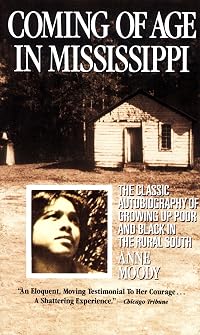
Coming of Age in Mississippi
by Anne Moody
On This Page
Description
Born to a poor couple who were tenant farmers on a plantation in Mississippi, Anne Moody lived through some of the most dangerous days of the pre-civil rights era in the South. The week before she began high school came the news of Emmet Till's lynching. Before then, she had "known the fear of hunger, hell, and the Devil. But now there fear of being killed just because I was black." In that, moment was born the passion for freedom and justice that would change her life. An all-A student show more whose dream of going to college is realized when she wins a basketball scholarship, she finally dares to join the NAACP in her junior year. Through the NAACP and later through CORE and SNCC she has first-hand experience of the demonstrations and sit-ins that were the mainstay of the civil rights movement, and the arrests and jailings, the shotguns, fire hoses, police dogs, billy clubs and deadly force that were used to destroy it. A deeply personal story but also a portrait of a turning point in our nation's destiny, this autobiography lets us see history in the making, through the eyes of one of the foot soldiers in the civil rights movement. show lessTags
Recommendations










Member Reviews
[Coming of Age in Mississippi] by [[Anne Moody]]
Anne Moody's memoir of her childhood and young adult years growing up Black in Mississippi is raw and honest and full of pain. Moody was born in 1940 in rural Mississippi. She grew up in poverty with a father who deserted her mother and then a mostly absent stepfather. She began working in service at a young age to earn money. A good student, Moody's education and drive are a large part of the book, but her need to make money is always present. She goes to college and starts working with the civil rights movement - participating in sit-ins and demonstrations and trying to stir up support among the Black population.
This book is hard to read for several reasons. Of course, Moody's life is a show more impossible-to-deny look at how hard life was for Black Americans in the 1950s and 60s. She pulls no punches talking about how all opportunities were denied for her and her family and everything was a struggle. Her language is coarse and angry at times, with lots of swearing, as is understandable considering what she was fighting against. She blames many different people for the lack of change - recognizing the systemic racism in government systems, questioning the efficacy of peaceful protest, calling out police corruption, and screaming in frustration at fellow Blacks who refuse to vote.
Her book is keenly observant and incredibly moving. It is not easy to read, but it is just as important today as it was when it was written in 1968. For me, it clearly shows why we are still where we are today. This was life in America just over 40 years ago. show less
Anne Moody's memoir of her childhood and young adult years growing up Black in Mississippi is raw and honest and full of pain. Moody was born in 1940 in rural Mississippi. She grew up in poverty with a father who deserted her mother and then a mostly absent stepfather. She began working in service at a young age to earn money. A good student, Moody's education and drive are a large part of the book, but her need to make money is always present. She goes to college and starts working with the civil rights movement - participating in sit-ins and demonstrations and trying to stir up support among the Black population.
This book is hard to read for several reasons. Of course, Moody's life is a show more impossible-to-deny look at how hard life was for Black Americans in the 1950s and 60s. She pulls no punches talking about how all opportunities were denied for her and her family and everything was a struggle. Her language is coarse and angry at times, with lots of swearing, as is understandable considering what she was fighting against. She blames many different people for the lack of change - recognizing the systemic racism in government systems, questioning the efficacy of peaceful protest, calling out police corruption, and screaming in frustration at fellow Blacks who refuse to vote.
Her book is keenly observant and incredibly moving. It is not easy to read, but it is just as important today as it was when it was written in 1968. For me, it clearly shows why we are still where we are today. This was life in America just over 40 years ago. show less
A marvelously intimate account of life for a young black girl/woman in Mississippi during the 1950s and 1960s. The sense of dread, terror, and overweening racism of Jim Crow Mississippi exists side by side with the ho-hum of lives accepted along the bottom of a racially stratified world. It is interesting to see the continuation of antebellum realities like interracial sexual liaisons with a somewhat different power dynamic involved--of course, continuing to work really in only one direction, white man to black woman.
Moody's description of the dreadful effects of all this on the lives, psyches, and attitudes of black men reminds us that undoing multiple generations of incredible damage is probably not the work of a day or a year or even show more a decade or two.
And yet, the author's courageous spirit, will, and commitment to herself, to reality, and to the truth suggests that once the impediments of policy are removed, there is little to hold back human character and ingenuity (at least externally). Anne Moody's world in the 1950s and 1960s was a world in tremendous flux and transition. It is remarkable to have such a view of it and for it hold up so remarkably well.
Also, interesting to see how historical events and actors play here--Dr. King, not very well; Kennedy, only in death; assassination of Medgar Evers and the Birmingham KKK attack that killed four little girls, grim inflection points.
If you've never looked into Civil Rights memoirs before, this is an excellent place to start, teeming as it is with the raw emotions of having recently survived as well as the excellent eye for details and interesting narration of a talented and capable writer. show less
Moody's description of the dreadful effects of all this on the lives, psyches, and attitudes of black men reminds us that undoing multiple generations of incredible damage is probably not the work of a day or a year or even show more a decade or two.
And yet, the author's courageous spirit, will, and commitment to herself, to reality, and to the truth suggests that once the impediments of policy are removed, there is little to hold back human character and ingenuity (at least externally). Anne Moody's world in the 1950s and 1960s was a world in tremendous flux and transition. It is remarkable to have such a view of it and for it hold up so remarkably well.
Also, interesting to see how historical events and actors play here--Dr. King, not very well; Kennedy, only in death; assassination of Medgar Evers and the Birmingham KKK attack that killed four little girls, grim inflection points.
If you've never looked into Civil Rights memoirs before, this is an excellent place to start, teeming as it is with the raw emotions of having recently survived as well as the excellent eye for details and interesting narration of a talented and capable writer. show less
This is an unforgettable and powerful autobiography of growing up poor and black in rural Mississippi. Anne Moody was born into poverty in rural Wilkinson County Mississippi in 1940. She got her first job at 9 years old. A few weeks before she entered high school, Emmet Till was murdered a few towns down the road. "Before Emmet Till's murder, I had known the fear of hunger, hell, and the Devil. But now there was a new fear known to me--the fear of being killed just because I was black." "But I didn't know what one had to do or not do as a Negro not to be killed."
In high school she learned it was dangerous to even ask what the NAACP was. Nevertheless, after graduation she attended a black college and began participating in civil rights show more organizing activities. She participated in the first lunch counter sit-ins in Jackson, and she also participated in voter registration efforts. Her family begged her to stop her activities, telling her she was trying to get every Negro in her town murdered. Wilkinson County where she was born and raised was considered too "tough" at the time for organizers to tackle. Members of her family were in fact murdered, and she learned that she herself was on a KKK hit list.
She was at the rally after which Medgar Evers was assassinated. The book ends in 1964, when she is on a bus on the way to DC to attend Congressional hearings and attend a rally with Martin Luther King. The people on the bus are singing "We shall overcome," and Anne ends the book, "I WONDER. I REALLY WONDER." The book was written in 1968, when she was only 28. I finished the book hungering for more information about her life, and I learned a bit from Wikipedia, but unfortunately she did not write another book.
This book brought home to me in a way that was personal and visceral the dangers faced by those working in the civil rights movement in the south in the 1960's, and the atrocities of the Jim Crow era. I knew it was bad, but it was so much worse that I imagined, and I admire these heroes so much. Senator Ted Kennedy called it, "A history of our time seen from the bottom up." Everyone should read this book. show less
In high school she learned it was dangerous to even ask what the NAACP was. Nevertheless, after graduation she attended a black college and began participating in civil rights show more organizing activities. She participated in the first lunch counter sit-ins in Jackson, and she also participated in voter registration efforts. Her family begged her to stop her activities, telling her she was trying to get every Negro in her town murdered. Wilkinson County where she was born and raised was considered too "tough" at the time for organizers to tackle. Members of her family were in fact murdered, and she learned that she herself was on a KKK hit list.
She was at the rally after which Medgar Evers was assassinated. The book ends in 1964, when she is on a bus on the way to DC to attend Congressional hearings and attend a rally with Martin Luther King. The people on the bus are singing "We shall overcome," and Anne ends the book, "I WONDER. I REALLY WONDER." The book was written in 1968, when she was only 28. I finished the book hungering for more information about her life, and I learned a bit from Wikipedia, but unfortunately she did not write another book.
This book brought home to me in a way that was personal and visceral the dangers faced by those working in the civil rights movement in the south in the 1960's, and the atrocities of the Jim Crow era. I knew it was bad, but it was so much worse that I imagined, and I admire these heroes so much. Senator Ted Kennedy called it, "A history of our time seen from the bottom up." Everyone should read this book. show less
An awe-inspiring memoir of a young woman deeply involved with the Civil Rights campaign in some of the most dangerous counties in Mississippi. It's tempting to say that such atrocities happened in the past, until you stop to think that there are states that even now are doing their utmost to erase such stories as this from our schools, and from history. Unless we can own our past, we are assuredly doomed to repeat it.
This is one of the best books I have ever read. Anne Moody, as she describes herself and her life in this autobiography, is one of the greatest American heroes of modern times. Importantly she describes the white aggression and violence that she encountered in the segregated south as common and endemic to african americans at the time, recognizing countless unamed freedom fighters. She fought racism in her life trying to increase african american voter turn outs at the polls. She took part in the famous lunch counter sit ins. Encountering fear and loss of the deepest magnitude Moody was forced to wonder whether the struggle for rights was worth the added pain she was forced to endure for her heroic efforts.
I finished this book a few days ago and have really thought a lot about what to say. I have such mixed feelings. It was good enough to hold my interest, but about 3/4 of the way through I grew weary of what I perceived as near constant whining.
Anne deserves so much credit for her bravery during the civil rights movement. A part of the infamous Woolworth sit in at the lunch counter wherein she and her fellow protesters sat at what was then an all white lunch counter. Refusing to leave, they suffered verbal and physical abuse. Anne was arrested throughout her career in civil rights protests and she deserves much credit for thousands of hours of trying to canvas black neighborhoods in the hope of increasing voter registration.
Dirt poor as show more a child, her parents separated and times were very tough. At an early age, she helped support her family by doing various domestic work. She was indeed a very spunky, tough self reliant person.
My fault with the book is the repetitive negativity. It seems that Anne has quite a huge chip on her shoulder, not just regarding white people, but blacks as well. And, many times she comes across as a know it all. Even her assessment of Dr. Martin Luther King's I Had a Dream Speech seemed derogatory.
While I can admire her accomplishments and her fortitude, I also think she had some severe issues of inability to look at herself in relation to her negative comments and actions of others.
I started out very interested in her story and her depiction in all terrible atrocities of southern whites and their treatment of blacks. I can only imagine what it was like to live in this terrible period of history.
However, as I finished the book, I truly wish I could have liked her more. show less
Anne deserves so much credit for her bravery during the civil rights movement. A part of the infamous Woolworth sit in at the lunch counter wherein she and her fellow protesters sat at what was then an all white lunch counter. Refusing to leave, they suffered verbal and physical abuse. Anne was arrested throughout her career in civil rights protests and she deserves much credit for thousands of hours of trying to canvas black neighborhoods in the hope of increasing voter registration.
Dirt poor as show more a child, her parents separated and times were very tough. At an early age, she helped support her family by doing various domestic work. She was indeed a very spunky, tough self reliant person.
My fault with the book is the repetitive negativity. It seems that Anne has quite a huge chip on her shoulder, not just regarding white people, but blacks as well. And, many times she comes across as a know it all. Even her assessment of Dr. Martin Luther King's I Had a Dream Speech seemed derogatory.
While I can admire her accomplishments and her fortitude, I also think she had some severe issues of inability to look at herself in relation to her negative comments and actions of others.
I started out very interested in her story and her depiction in all terrible atrocities of southern whites and their treatment of blacks. I can only imagine what it was like to live in this terrible period of history.
However, as I finished the book, I truly wish I could have liked her more. show less
My recollection of this book is that while it's a good recounting of growing up the Jim Crow South, Moody is so goddamned full of herself that it's hard to get past that to see your way through the interesting and important parts of the book. A good portion of the book is taken up with accounts of Moody's beauty (a lot on that topic), bravery, intelligence, industriousness, political acumen, blah blah blah. And of course, to hear her tell it, no one around her is quite as smart and on-the-ball as she is. I came away with the distinct impression that the civil rights movement would never have gotten off the ground at all without Anne Moody as a mover and shaker behind it.
In fairness, I read this book a long time ago now, and should show more probably give it another try. show less
In fairness, I read this book a long time ago now, and should show more probably give it another try. show less
Members
- Recently Added By
Lists

Feminists' memoirs/autobiographies
38 works; 11 members

The 99% -- Most Readable Non-Fiction
37 works; 8 members

Read These Too
458 works; 9 members
500 Great Books by Women
507 works; 60 members

Zora Canon
100 works; 6 members

The Zora Canon
98 works; 4 members

Best Sellers / Popular 1968
237 works; 5 members

Schomburg Centennial Reading List
100 works; 4 members
Author Information

6+ Works 1,855 Members
Anne Moody was born Essie Mae Moody on September 15, 1940 in Centreville, Mississippi. As a girl, she cleaned white neighbors' houses to help support her family. She received a bachelor's degree from Tougaloo College in 1964. During these years she was active in civil rights efforts in Mississippi, working with the Congress of Racial Equality, the show more National Association for the Advancement of Colored People, and the Student Nonviolent Coordinating Committee. In 1963, she joined a racially mixed group in a sit-in at a Woolworth's lunch counter in Jackson, Mississippi. She wrote Coming of Age in Mississippi, which was published in 1968, while living in New York. This non-fiction work described what it was like to grow up black in the era of Jim Crow. Her other book, Mr. Death, is a collection of short stories for young people on the theme of mortality and was published in 1975. She held a series of non-writing jobs, including as a counselor in a New York City antipoverty program, before returning to Mississippi. She died on February 5, 2015 at the age of 74. (Bowker Author Biography) show less
All Editions
Some Editions
Awards and Honors
Distinctions
Work Relationships
Is abridged in
Has as a student's study guide
Common Knowledge
- Canonical title
- Coming of Age in Mississippi
- Original publication date
- 1968
- People/Characters
- Anne Moody; Emmett Till
- Important places
- Mississippi, USA
- Important events
- African-American Civil Rights Movement; Civil Rights Movement
- First words
- I'm still haunted by dreams of the time we lived on Mr. Carter's plantation.
- Last words
- (Click to show. Warning: May contain spoilers.)We shall overcome, We shall overcome
We shall overcome some day.
I WONDER. I really WONDER.
Classifications
- Genres
- Biography & Memoir, Nonfiction, History, General Nonfiction
- DDC/MDS
- 917.62250360924 — History & geography Geography & travel Geography of and travel in North America South Central U.S. Mississippi
- LCC
- E185.97 .M65 .A3 — History of the United States United States Elements in the population Afro-Americans Biography. Genealogy
- BISAC
Statistics
- Members
- 1,834
- Popularity
- 11,826
- Reviews
- 32
- Rating
- (3.99)
- Languages
- English, German
- Media
- Paper, Audiobook, Ebook
- ISBNs
- 16
- ASINs
- 25