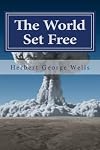
The World Set Free
by H. G. Wells
On This Page
Description
The World Set Free is H. G. Wells' prophetic 1914 novel, telling of world war and the advent of nuclear weapons. Although Wells' atomic bombs only have a limited power of explosion, they keep on exploding for days on end. "Never before in the history of warfare had there been a continuing explosive; indeed, up to the middle of the twentieth century the only explosives known were combustibles whose explosiveness was due entirely to their instantaneousness; and these atomic bombs which science show more burst upon the world that night were strange even to the men who used them.". show less
Tags
Recommendations




















Member Reviews
This is a kind of retro-future history, giving the great sweep of events leading to the Last World War (a nuclear one), the collapse of society, and the creation of a scientifically-organized utopia. It dips in and out of indviduals' perspectives in a way that's kind of neat: this inventor here, this soldier there, this king somewhere. Bits of it are interesting; the last segment, as the utopia gets put together is not. Wells's earlier novels of apocalypse-becoming-utopia (The War in the Air and The Sleeper Awakes) were much more circumspect about the details of the utopia, and I think that was the better move.
Folks will tell you that Wells was the first to depict nuclear bombs in fiction. He got it wrong (not sure if that's because he show more was wrong or contemporary science was), using the idea of the half life pretty strongly:
"What the earlier twentieth-century chemists called its half period was seventeen days; that is to say, it poured outpouring half of the huge store of energy in its great molecules in the space of seventeen days, the next seventeen days' emission was a half of that first period's outpouring, and so on. As with all radio-active substances this Carolinum, though every seventeen days its power is halved, though constantly it diminishes towards the imperceptible, is never entirely exhausted, and to this day the battle-fields and bomb-fields of that frantic time in human history are sprinkled with radiant matter and so centres of inconvenient rays...." (59-60)
How cool is that (from a fictional perspective)-- bombs that go on forever in ever-diminishing amounts. It's a frightening, but fascinating image.
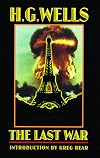
(For some reason this Bison Frontiers of the Imagination edition retitles The World Set Free to The Last War: A World Set Free. Ugh. Why? Who knows, because there's no editorial matter other than Greg Bear's introduction, which specifically rejects the retitling in a footnote.) show less
Folks will tell you that Wells was the first to depict nuclear bombs in fiction. He got it wrong (not sure if that's because he show more was wrong or contemporary science was), using the idea of the half life pretty strongly:
"What the earlier twentieth-century chemists called its half period was seventeen days; that is to say, it poured outpouring half of the huge store of energy in its great molecules in the space of seventeen days, the next seventeen days' emission was a half of that first period's outpouring, and so on. As with all radio-active substances this Carolinum, though every seventeen days its power is halved, though constantly it diminishes towards the imperceptible, is never entirely exhausted, and to this day the battle-fields and bomb-fields of that frantic time in human history are sprinkled with radiant matter and so centres of inconvenient rays...." (59-60)
How cool is that (from a fictional perspective)-- bombs that go on forever in ever-diminishing amounts. It's a frightening, but fascinating image.
(For some reason this Bison Frontiers of the Imagination edition retitles The World Set Free to The Last War: A World Set Free. Ugh. Why? Who knows, because there's no editorial matter other than Greg Bear's introduction, which specifically rejects the retitling in a footnote.) show less
The most notable thing about this sf novel is that in 1914 Wells predicted atomic energy and atomic warfare. It’s too bad no one heeded his warning. In fact it seems his ideas inspired the scientists who worked on the atom bomb. This is the only book of 1914 I encountered that admitted the possibility of a war that would kill millions, even as such a war got underway. This book doesn’t have a plot or main characters in a traditional way. It’s a history book from the future, and the first chapter (the “prelude”) covers actual history. The rest of the book covers the development of atomic power which essentially creates free energy that destroys the world economy, and then atomic war destroys all the major cities, killing show more everyone and leaving a radioactive landscape. However, after that the book becomes remarkably upbeat as the survivors create a world government that unifies the planet. You get snapshots of life from different people throughout the book. Other than a kind of dismissive attitude toward India, this book isn’t even racist. The edition I read had an actually interesting introduction, by Greg Bear, comparing Henry James and Wells, who were frenemies. Bear says that this was the moment when speculative fiction and literary fiction parted ways. Spec fic (along with my bff Arnold Bennett) was dismissed as trying to get people to believe in something and too action/plot oriented. Literary fiction was elevated for being sexless, bloodless, and more about money and people’s inner lives than stuff happening. Bear puts forward the non-dual POV that there’s no reason these two styles had to be opposed to each other. Anyway, I thought it was notable that this was one of the few books of 1914 that has been reprinted by a reputable press with attention paid to the book design—because actual normal humans might want to read this book. show less
I’m setting myself free from this book. It is seen as prescient because it was written just before the First World War and described atomic bombs and nuclear warfare with what turned out to be reasonable accuracy. The first part of the book was OK, but when the book moved into quoting extracts from a fictional Great Novelist who described the nuclear war, I lost interest rapidly. It was hard to tell what was Wells’s narration and what was the fictional book. On the plus side, this book didn’t scare the pants off me like most books about nuclear warfare do.
This was a fairly decent book by H.G Wells. Many of the nightmarish scenario qualities that inhabit this universe are relatable to our modern era and that makes the book less aged and dated than some of the language would make it seem. This is a book focused on its plot, setting, and the implications that it raises instead of its characters. This is the power of the tale, but also its detraction. Overall, a fairly good read for those interested in Wells' science fiction.
3 stars.
3 stars.
My reactions to reading this novel in 1996. Spoilers follow.
“Introduction”, Brian Aldiss -- Introduction that emphasizes that Wells’ claim to being a prophet (a reputation he garnered in his day) rests on his prediction of atomic warfare in this novel and tanks in “The Land Ironclads”. The technological inspiration came from the work of Frederick Soddy who won a 1921 Nobel Prize for radioactive chemistry. Soddy wrote a popular account of his work in 1909. Aldiss points out the technical flaws of story construction and character in the novel.
The World Set Free, H. G. Wells -- This novel gets much credit for being the first sf story to depict atomic warfare. Wells certainly shows warfare of incredible destructiveness and long show more lingering effects, but those effects are not from radioactivity but from continuous explosions, in effect perpetual volcanoes where the bombs land. I’m not sure if this accurately reflects the scientific opinion of the day. Still, like atomic warfare in our day, the introduction of the weapon produces social change, massive social change since the weapons are used promiscuously and, like Wells’ The Shape of Things to Come (which I know only from the film not the novel), a new social order – created and maintained by an elite group. If the descriptions of atomic warfare were not totally prescient, this may be the first sf novel to feature the atomic powered future (including cars and planes) that was common in sf until the 1960s. Here the atomic engines even have the side effect of producing gold which ruins Earth’s economy.
This is Wells’ attempt to write a mosaic (in the sense of no central characters who take us all the way through the story) future history starting with chapter one which I liked a great deal. It details the history of Man’s growing sentience and increasing use of nature’s energy to better his life. This chapter also glosses man’s social inventions to tame his animal nature. Essentially, that is the typical Wellsian theme of this book. Man has outgrown his social inventions, including the legal system and capitalism. Wells’ replacement is, of course, his notion of a World State with socialism, scientific research, central planning, the “Dawn of Love”, and ruled by self-appointed elite (here seen taking decisive to round up stray nukes). His narrative strategy – memoirs, multiple viewpoint characters (including a central section dealing with the war and its tactics – Wells, author of the wargaming text Little Wars was interested in such things) – is more interesting than the usual (for his later sf) Wells’ story of society transformed from contemporary corruption and archaism (to Wells) to a utopia. King Egbert is implausibly good. “The Slavic fox” is plausibly bad and interesting. (The social prescriptions of this novel are thinner than Wells' A Modern Utopia.)
There is some other prescience in this novel. Written before WWI and Woodrow Wilson’s intervention, this novel has the American president usher in the new world. Wells’ is enthusiastic about Americans saying that have a “gigantic childishness”, that they are a “simple peoples by whom the world was saved." Wells, advocator of “Free Love” seems to, in the last chapter, view sex as a young person’s distraction from the “eternal search for knowledge” (a reprise of the search for the sun mentioned in the title of the first chapter). The whole chapter is a plea to go beyond the sexual differentiation in humans (and Wells throws in one of his critiques of women and their fashions). show less
“Introduction”, Brian Aldiss -- Introduction that emphasizes that Wells’ claim to being a prophet (a reputation he garnered in his day) rests on his prediction of atomic warfare in this novel and tanks in “The Land Ironclads”. The technological inspiration came from the work of Frederick Soddy who won a 1921 Nobel Prize for radioactive chemistry. Soddy wrote a popular account of his work in 1909. Aldiss points out the technical flaws of story construction and character in the novel.
The World Set Free, H. G. Wells -- This novel gets much credit for being the first sf story to depict atomic warfare. Wells certainly shows warfare of incredible destructiveness and long show more lingering effects, but those effects are not from radioactivity but from continuous explosions, in effect perpetual volcanoes where the bombs land. I’m not sure if this accurately reflects the scientific opinion of the day. Still, like atomic warfare in our day, the introduction of the weapon produces social change, massive social change since the weapons are used promiscuously and, like Wells’ The Shape of Things to Come (which I know only from the film not the novel), a new social order – created and maintained by an elite group. If the descriptions of atomic warfare were not totally prescient, this may be the first sf novel to feature the atomic powered future (including cars and planes) that was common in sf until the 1960s. Here the atomic engines even have the side effect of producing gold which ruins Earth’s economy.
This is Wells’ attempt to write a mosaic (in the sense of no central characters who take us all the way through the story) future history starting with chapter one which I liked a great deal. It details the history of Man’s growing sentience and increasing use of nature’s energy to better his life. This chapter also glosses man’s social inventions to tame his animal nature. Essentially, that is the typical Wellsian theme of this book. Man has outgrown his social inventions, including the legal system and capitalism. Wells’ replacement is, of course, his notion of a World State with socialism, scientific research, central planning, the “Dawn of Love”, and ruled by self-appointed elite (here seen taking decisive to round up stray nukes). His narrative strategy – memoirs, multiple viewpoint characters (including a central section dealing with the war and its tactics – Wells, author of the wargaming text Little Wars was interested in such things) – is more interesting than the usual (for his later sf) Wells’ story of society transformed from contemporary corruption and archaism (to Wells) to a utopia. King Egbert is implausibly good. “The Slavic fox” is plausibly bad and interesting. (The social prescriptions of this novel are thinner than Wells' A Modern Utopia.)
There is some other prescience in this novel. Written before WWI and Woodrow Wilson’s intervention, this novel has the American president usher in the new world. Wells’ is enthusiastic about Americans saying that have a “gigantic childishness”, that they are a “simple peoples by whom the world was saved." Wells, advocator of “Free Love” seems to, in the last chapter, view sex as a young person’s distraction from the “eternal search for knowledge” (a reprise of the search for the sun mentioned in the title of the first chapter). The whole chapter is a plea to go beyond the sexual differentiation in humans (and Wells throws in one of his critiques of women and their fashions). show less
Another astonishingly prescient book from Wells - this one not only anticipated the atomic bomb but a world war that was about to begin just a few months after the book was published. As a novel, it's a bit of a collage - almost like linked stories that bring the reader through the scientific discoveries that led to the making of the atomic bomb and descriptions of the world before and after. Like so many of Wells' novels from this period, there is a real tension between optimism and pessimism.
Like so much of Wells's writing, this combines his strength in popular history, scientific futurism and utopian ideas. It is best known as a novel predicting future discoveries in atomic energy, but (more significantly) also the social and political consequences of that knowledge.
Members
- Recently Added By
Lists

Books Read in 2016
4,666 works; 199 members
Talk Discussions
Past Discussions
1914: H. G. Wells - The World Set Free in Literary Centennials (March 2014)
Author Information

1,559+ Works 109,210 Members
H. G. Wells was born in Bromley, England on September 21, 1866. After a limited education, he was apprenticed to a draper, but soon found he wanted something more out of life. He read widely and got a position as a student assistant in a secondary school, eventually winning a scholarship to the Royal College of Science in South Kensington, where show more he studied biology. He graduated from London University in 1888 and became a science teacher. He also wrote for magazines. When his stories began to sell, he left teaching to write full time. He became an author best known for science fiction novels and comic novels. His science fiction novels include The Time Machine, The War of the Worlds, The Wonderful Visit, The Island of Doctor Moreau, The Invisible Man, The First Men in the Moon, and The Food of the Gods. His comic novels include Love and Mr. Lewisham, Kipps: The Story of a Simple Soul, The History of Mr. Polly, and Tono-Bungay. He also wrote several short story collections including The Stolen Bacillus, The Plattner Story, and Tales of Space and Time. He died on August 13, 1946 at the age of 79. (Bowker Author Biography) show less
Some Editions
Series
Belongs to Publisher Series
Work Relationships
Common Knowledge
- Canonical title
- The World Set Free
- Alternate titles
- The Last War
- Original publication date
- 1914
Classifications
Statistics
- Members
- 515
- Popularity
- 58,466
- Reviews
- 17
- Rating
- (3.33)
- Languages
- English, French, German, Italian
- Media
- Paper, Audiobook, Ebook
- ISBNs
- 118
- ASINs
- 24