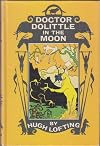
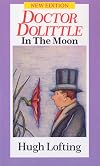
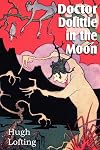
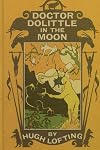
Doctor Dolittle in the Moon
by Hugh Lofting
Doctor Dolittle (Publication Order) (1928), Doctor Dolittle (9)
On This Page
Description
Doctor Dolittle is on the moon, where he finds a whole new world of animals and vegetables to study.Tags
Recommendations


























Member Reviews
Doctor Dolittle in the Moon is the eighth book in the Dolittle series. It takes up the story directly from the end of the previous volume, Doctor Dolittle's Garden.
The storyline changed rather radically in the middle of the book; it represented a profound shift in tone. Instead of trying to cope with the foibles and difficulties of human society such as the Doctor's near-constant (albeit unwilling) need for money, the plot began to focus instead on exploration and mystery, as strange and unknown creatures and forces seemed to be impelling John Dolittle off the face of the Earth entirely.
Doctor Dolittle in the Moon continues in that new key. It presents an entirely new environment, the lunar environment: an apparent utopia. Utopias are show more often somewhat dull places, but Hugh Lofting's Moon (which is, of course, in utter violation of everything we know about the Moon today) is actually rather an interesting place. Lofting's descriptions are vivid and memorable, representing some of his best work. The sense of mystery is strong and intriguing. All in all, it's a refreshing change in this classic series.
I won't go into great detail. Here's the important thing: I read Doctor Dolittle in the Moon to my son, Sebastian, aged seven. He loved it. We've read the previous seven volumes over the last two or three years, and some of them were more or less interesting than others, but Doctor Dolittle in the Moon took the prize. I'd told him while reading one of the earlier books that Doctor Dolittle would eventually visit the moon, and he'd been looking forward to reading about the trip ever since. Even so, his reaction surprised me.
He had me bring the book in the car, to read to him driving to and from the train station (my wife was driving, not me!). He had me read it to him while he was flossing and brushing his teeth. The mystery of the identity of the Moon Man mesmerized him. And last night, he had me start reading to him early and stayed up late - we spent nearly two hours reading, until we finished the book. I had expected him to fall asleep, but instead he became more awake as the story progressed. Fortunately he fell asleep fairly quickly after I finished the book.
I'm fond of the book (my parents gave me a copy when I was young), but Sebastian loved it. I would have given it a four (or a 4.3 in a fractional scale), but he'd give it a solid "5". He's already very eager to start reading the sequel, Doctor Dolittle's Return.
A few notes: Unlike some of the earlier Dolittle books, this one has no racial or cultural issues which might provoke censorship (some of the earlier Dolittle books are badly bowdlerized). According to Wikipedia, Lofting originally intended this to be the final Dolittle book. If so, I don't know what changed his mind - but he wrote four more Dolittle books, as well as two related books.
Along with Doctor Dolittle's Return, this book represents one of the better-written and more interesting parts of the Dolittle series. show less
The storyline changed rather radically in the middle of the book; it represented a profound shift in tone. Instead of trying to cope with the foibles and difficulties of human society such as the Doctor's near-constant (albeit unwilling) need for money, the plot began to focus instead on exploration and mystery, as strange and unknown creatures and forces seemed to be impelling John Dolittle off the face of the Earth entirely.
Doctor Dolittle in the Moon continues in that new key. It presents an entirely new environment, the lunar environment: an apparent utopia. Utopias are show more often somewhat dull places, but Hugh Lofting's Moon (which is, of course, in utter violation of everything we know about the Moon today) is actually rather an interesting place. Lofting's descriptions are vivid and memorable, representing some of his best work. The sense of mystery is strong and intriguing. All in all, it's a refreshing change in this classic series.
I won't go into great detail. Here's the important thing: I read Doctor Dolittle in the Moon to my son, Sebastian, aged seven. He loved it. We've read the previous seven volumes over the last two or three years, and some of them were more or less interesting than others, but Doctor Dolittle in the Moon took the prize. I'd told him while reading one of the earlier books that Doctor Dolittle would eventually visit the moon, and he'd been looking forward to reading about the trip ever since. Even so, his reaction surprised me.
He had me bring the book in the car, to read to him driving to and from the train station (my wife was driving, not me!). He had me read it to him while he was flossing and brushing his teeth. The mystery of the identity of the Moon Man mesmerized him. And last night, he had me start reading to him early and stayed up late - we spent nearly two hours reading, until we finished the book. I had expected him to fall asleep, but instead he became more awake as the story progressed. Fortunately he fell asleep fairly quickly after I finished the book.
I'm fond of the book (my parents gave me a copy when I was young), but Sebastian loved it. I would have given it a four (or a 4.3 in a fractional scale), but he'd give it a solid "5". He's already very eager to start reading the sequel, Doctor Dolittle's Return.
A few notes: Unlike some of the earlier Dolittle books, this one has no racial or cultural issues which might provoke censorship (some of the earlier Dolittle books are badly bowdlerized). According to Wikipedia, Lofting originally intended this to be the final Dolittle book. If so, I don't know what changed his mind - but he wrote four more Dolittle books, as well as two related books.
Along with Doctor Dolittle's Return, this book represents one of the better-written and more interesting parts of the Dolittle series. show less
http://nwhyte.livejournal.com/2704151.html
It's a very short book, the eighth of the series of twelve books about the Doctor who learns to talk to animals. The writer assumes that the reader has read the previous books in the series, particularly the immediately preceding Doctor Dolittle's Garden which apparently ends with the Doctor and friends borne to the Moon by a giant moth. So we start bang in the middle of the narrative, with no explanation of who any of the characters are or why they are doing what they are doing' it's a bit unnerving.
Then we get to the Moon, which owes a certain amount to Lucian of Samosata, with a couple of updates to take account of contemporary scientific knowledge (the lighter gravity, the shorter distance show more to the horizon; though by the 1920s it was pretty clear that there was no beathable atmosphere, let alone lush vegetation). The Doctor leantrs to talk to lunar plants, applying the techniques he has long employed for animals on Earth. The plot, such as it is, revolves around the race-memory of the formation of the moon passed down to the monkey Chee-Chee and the true identity of the Man in the Moon. It's interesting to note that the plants of the moon submit to a centrally planned schedule of reproduction so as to avoid exhausting their world's natural resources, but probably this should be read as vaguely utopian rather than anything more specific. show less
It's a very short book, the eighth of the series of twelve books about the Doctor who learns to talk to animals. The writer assumes that the reader has read the previous books in the series, particularly the immediately preceding Doctor Dolittle's Garden which apparently ends with the Doctor and friends borne to the Moon by a giant moth. So we start bang in the middle of the narrative, with no explanation of who any of the characters are or why they are doing what they are doing' it's a bit unnerving.
Then we get to the Moon, which owes a certain amount to Lucian of Samosata, with a couple of updates to take account of contemporary scientific knowledge (the lighter gravity, the shorter distance show more to the horizon; though by the 1920s it was pretty clear that there was no beathable atmosphere, let alone lush vegetation). The Doctor leantrs to talk to lunar plants, applying the techniques he has long employed for animals on Earth. The plot, such as it is, revolves around the race-memory of the formation of the moon passed down to the monkey Chee-Chee and the true identity of the Man in the Moon. It's interesting to note that the plants of the moon submit to a centrally planned schedule of reproduction so as to avoid exhausting their world's natural resources, but probably this should be read as vaguely utopian rather than anything more specific. show less
The Hugh Lofting Doctor Dolittle stories are classics that stand the test of time. I really enjoy them and find them clever and enjoyable. I think the writing can be seen as a bit dated but I think it's still extremely readable.
Dr. Dolittle has landed on the Moon! He meets Otho Bludge the Moon Man, a Stone Age artist who was the only human on the Moon when it broke away from the Earth. The animals of the Moon flock to Doctor Dolittle, and he discovers how to communicate with the intelligent plants there. But will the lunar flora and fauna ever let him leave?
Very good condition
Very good condition
Members
- Recently Added By
Lists

Kidnapping -- children's/young adult fiction
598 works; 3 members

Children's Literature 1900 - 1950 in order
413 works; 8 members
Author Information

166+ Works 13,822 Members
Hugh Lofting was born in 1866 in Maidenhead, England. He trained as a civil engineer, getting his education from the Massachusetts Institute of Technology and the Polytechnic Institute of London. He worked in Africa, the West Indies and Canada and then settled in New York to become a writer. The stories about Doctor Dolittle began as letters to show more his children while overseas in England during World War I, where Lofting served with the British Army. The first Doctor Dolittle book published was "The Story of Doctor Dolittle" in 1920. He wrote thirteen more, winning the Newberry Medal in 1923 for "The Voyages of Doctor Dolittle." Lofting illustrated all of the Dolittle books himself. In 1967, the Doctor Dolittle books were made into a musical film starring Rex Harrison. Hugh Lofting died in 1947 at the age of 81. show less
Series


Work Relationships
Common Knowledge
- Original publication date
- 1928
- People/Characters
- Doctor Dolittle
- Important places
- The Moon
- First words
- In writing the story of our adventures in the Moon I, secretary to John Dolittle, M.D. (and son of Jacob Stubbins, the cobbler of Puddleby-on-the-Marsh) find myself greatly puzzled.
- Last words
- (Click to show. Warning: May contain spoilers.)Between them they will find a way.
Classifications
- Genres
- Fiction and Literature, Children's Books, Kids
- DDC/MDS
- 823.912 — Literature & rhetoric English & Old English literatures English fiction 1900- 1901-1999 1901-1945
- LCC
- PZ10.3 .L85 .D — Language and Literature Fiction and juvenile belles lettres Fiction and juvenile belles lettres Juvenile belles lettres
- BISAC
Statistics
- Members
- 390
- Popularity
- 80,422
- Reviews
- 7
- Rating
- (3.69)
- Languages
- 5 — Dutch, English, German, Polish, Spanish
- Media
- Paper, Ebook
- ISBNs
- 13
- ASINs
- 29