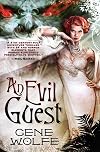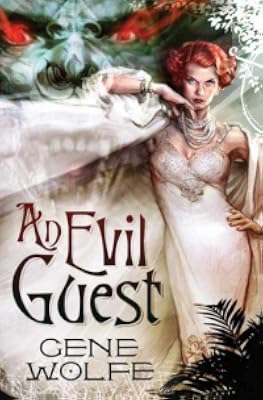
An Evil Guest
by Gene Wolfe
On This Page
Description
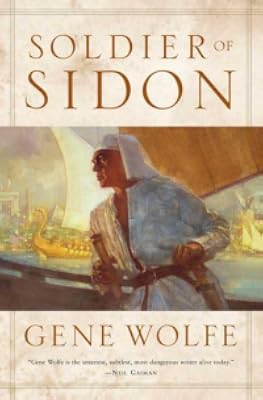
Lovecraft meetsBlade Runner in a stand-alone supernatural horror novel. Gene Wolfe can write in whatever genre he wants--and always with superb style and profound depth. Now following his World Fantasy Award winner,Soldier of Sidon, and his stunningPirate Freedom, Wolfe turns to the tradition of H. P. Lovecraft and the weird science tale of supernatural horror. Set a hundred years in the future,An Evil Guest is the story of an actress who becomes the lover of both a mysterious private show more detective and an even more mysterious and powerful rich man, a man who has been to the human colony on an alien planet and learned strange things there. Her loyalties are divided--perhaps she loves them both. The detective helps her to release her inner beauty and become a star overnight. The rich man is the angel of a play she stars in. But something is very wrong. Money can be an evil guest, but there are otherevils. As Lovecraft said, "That is not dead which can eternal lie." show lessTags
Recommendations








Member Reviews
A funny thing happened yesterday. I decided to stop reading a Gene Wolfe novel. Yup, I decided An Evil Guest just wasn't worth my time. I love Wolfe. Soldier of Sidon and The Wizard Knight were amongst my favurite reads last year, but this? Nope. It's set in the future but drenched in the past, and so triangulates on the present. Consequently, stuff that passes fine in his science fiction and fantasy becomes unbearably grating, specifically his patented 'dialogue as spoken by no living person, ever, not even bad old pulp stories.' The way characters bring Sherlock Holmes style razor sharp deductive reasoning skills to bear on stuff that at first looks trivial, and then later turns out to actually be trivial. People telling each other show more exactly how many points they're about to make. Vacuous female characters.
It all feels like a subtle joke, (and I suspect this book is supposed to be humourous,) not necessarily on the reader, but it just doesn't seem terribly funny, and if there's all this stuff going on in the background or hidden, then why does the stuff up front have to be so boring and stodgy? Never a badly written sentence, mind you. Maybe I'll pick it up again later in the year and it'll be better. show less
It all feels like a subtle joke, (and I suspect this book is supposed to be humourous,) not necessarily on the reader, but it just doesn't seem terribly funny, and if there's all this stuff going on in the background or hidden, then why does the stuff up front have to be so boring and stodgy? Never a badly written sentence, mind you. Maybe I'll pick it up again later in the year and it'll be better. show less
"Money is an evil guest."
Gene Wolfe can write in any genre he desires, I suppose. This book was a noir with subtle science fiction elements. The blurbs and book jacket call it Lovecraftian horror, which is a lie. You can expect 95% dialogue, well-polished, for about 250 pages, and the final 50 pages reward you with a surprising, even shocking, ending.
The best part of the book is the main character, Cassie Casey, who is a well-rounded (voluptuous), smart, funny, charming, likeable, up-and-coming actress, who stumbles into a conspiracy of cosmic significance. Her run-ins with rich bastards and slick sorcerers, and later, vicious islanders, make for an occasionally harrowing drama. But for the bulk of the novel you will be piecing together show more the plot elements through Wolfe's effective dialogue, which only reveals enough background to draw you into the tale. What it does on the surface level is establish deep characters, with complex motivations - enough for any fan of pulp noir.
Written with the simplicity and pace of a Philip K. Dick novel, Gene Wolfe afficionados and neophytes alike will appreciate a breather from his near-incomprehensible world-building. This was a refreshing, easy, compelling and surprising read, even if it lacked the abyss-like depth of Wolfe's masterpieces.
A close examination of his themes and devices reveals far more hidden meanings in the characters' names and "metamorphoses" than I gathered from my reading - as usual, I had to look them up. Wolfe, the sorcerer himself, doesn't disappoint on this score. But one can't help but wonder about Woldercan and many of the unexplored "islands" of this book. How much of the interior and exterior universe do we actually get to see? Very little. He maintains a close perspective, and limits himself to cast an aura of historical nostalgia. It would be a simple matter to dismiss this as a minor work, a mere curiosity in Wolfe's disturbing cabinet of secrets.
Yet, the dialogue-heavy explication does undermine the author's typically genius plot cues. We are given an Idiot's Guide through the characters's anxious dialogues. Cassie is still figuring out the scenario along with the reader. But I think this is more playful sleight-of-hand on Wolfe's part. How are you supposed to notice the influences outside the narrator's field of vision? Luckily, we are presented with a wider view at the end of the book. I think this abrupt shift in perspective saved this book from being ordinary, though it will bother some readers, who were enjoying the simplicity preceding it.
A memorable, exciting and still profound book by a grandmaster of the bizarre. show less
Gene Wolfe can write in any genre he desires, I suppose. This book was a noir with subtle science fiction elements. The blurbs and book jacket call it Lovecraftian horror, which is a lie. You can expect 95% dialogue, well-polished, for about 250 pages, and the final 50 pages reward you with a surprising, even shocking, ending.
The best part of the book is the main character, Cassie Casey, who is a well-rounded (voluptuous), smart, funny, charming, likeable, up-and-coming actress, who stumbles into a conspiracy of cosmic significance. Her run-ins with rich bastards and slick sorcerers, and later, vicious islanders, make for an occasionally harrowing drama. But for the bulk of the novel you will be piecing together show more the plot elements through Wolfe's effective dialogue, which only reveals enough background to draw you into the tale. What it does on the surface level is establish deep characters, with complex motivations - enough for any fan of pulp noir.
Written with the simplicity and pace of a Philip K. Dick novel, Gene Wolfe afficionados and neophytes alike will appreciate a breather from his near-incomprehensible world-building. This was a refreshing, easy, compelling and surprising read, even if it lacked the abyss-like depth of Wolfe's masterpieces.
A close examination of his themes and devices reveals far more hidden meanings in the characters' names and "metamorphoses" than I gathered from my reading - as usual, I had to look them up. Wolfe, the sorcerer himself, doesn't disappoint on this score. But one can't help but wonder about Woldercan and many of the unexplored "islands" of this book. How much of the interior and exterior universe do we actually get to see? Very little. He maintains a close perspective, and limits himself to cast an aura of historical nostalgia. It would be a simple matter to dismiss this as a minor work, a mere curiosity in Wolfe's disturbing cabinet of secrets.
Yet, the dialogue-heavy explication does undermine the author's typically genius plot cues. We are given an Idiot's Guide through the characters's anxious dialogues. Cassie is still figuring out the scenario along with the reader. But I think this is more playful sleight-of-hand on Wolfe's part. How are you supposed to notice the influences outside the narrator's field of vision? Luckily, we are presented with a wider view at the end of the book. I think this abrupt shift in perspective saved this book from being ordinary, though it will bother some readers, who were enjoying the simplicity preceding it.
A memorable, exciting and still profound book by a grandmaster of the bizarre. show less
Oh, Gene. I was so excited when I read the dustjacket. Pulp 1930s Lovecraftian noir fiction by Gene Wolfe? I was salivating. But what's here does not deliver the goods -- not even slightly.
What this really looks like is two novellas mashed together with mostly the same characters, and only one of them is any good. The first two-thirds of the book reads like a [b:Raymond Chandler|2052|The Big Sleep|Raymond Chandler|http://ecx.images-amazon.com/images/I/41AGA624Z5L._SL75_.jpg|1222673] detective-noir piece. It's almost all dialogue, and while the suspense is great and the characters interesting, it's like reading a sketch of a novel. So little information about anything is there that one keeps reading to learn something -- anything -- that show more will put the dialogue in some kind of context.
The last third of the book we suddenly get the Lovecraftian elements we've been waiting for, but only as stage props. Only two or three times does Wolfe manage a passage that's Lovecraftian in language or effect. That said, we also find out a lot more about what's going on, which makes this part of the book far more interesting.
But wait. The conflict from the first two-thirds of the book is rendered null and void by fiat in part two. So Wolfe has to concoct an entirely new conflict -- warmed-over HPL -- that ultimately fails to deliver the goods.
I wanted to like it, I really did. But if you truly love Gene Wolfe, go read "Shadow of the Torturer" again. You'll be far, far happier. show less
What this really looks like is two novellas mashed together with mostly the same characters, and only one of them is any good. The first two-thirds of the book reads like a [b:Raymond Chandler|2052|The Big Sleep|Raymond Chandler|http://ecx.images-amazon.com/images/I/41AGA624Z5L._SL75_.jpg|1222673] detective-noir piece. It's almost all dialogue, and while the suspense is great and the characters interesting, it's like reading a sketch of a novel. So little information about anything is there that one keeps reading to learn something -- anything -- that show more will put the dialogue in some kind of context.
The last third of the book we suddenly get the Lovecraftian elements we've been waiting for, but only as stage props. Only two or three times does Wolfe manage a passage that's Lovecraftian in language or effect. That said, we also find out a lot more about what's going on, which makes this part of the book far more interesting.
But wait. The conflict from the first two-thirds of the book is rendered null and void by fiat in part two. So Wolfe has to concoct an entirely new conflict -- warmed-over HPL -- that ultimately fails to deliver the goods.
I wanted to like it, I really did. But if you truly love Gene Wolfe, go read "Shadow of the Torturer" again. You'll be far, far happier. show less
Gideon Chase, professor and wizard, is asked by the president to keep tabs on Bill Reiss, a vaguely menacing man. He hires Cassie Casey, a mediocre actress, to romance Bill. Gideon sees her star potential and uses his magical abilities to bring it out. She becomes a star literally overnight and attracts Bill’s attention. Cassie falls in love with both men. She is pursued by agents from the government and different covert organizations who want to get to Bill. Bill takes her to an island paradise to make her his queen, but something evil dwells there.
I enjoyed the beginning and middle of the novel better than the end. Cassie Casey’s character is great (can you think of a better name for an actress?) especially at the start of the show more novel. She is a like-able woman who is thrust into a confusing situation, kind of like this reviewer trying to read this book. Cassie is worried about her career, her weight, and in love with two very different men. It’s a science fiction novel with only hints of the future; we have visited other planets and have some advanced technology yet the setting has a 1930’s feel. The dialogue is like film noir; everybody speaks quickly and is very evasive. The end turns into a crazy evil-on-an-island-paradise story that I didn’t much like. There are hints at the beginning with Bill Reiss producing Cassie in an over the top musical call “Dating the Volcano God.” Then, all of a sudden, we are whisked away to a small chain of islands where the natives believe in strange and menacing gods. I am told that this is a Cthulhu Mythos story; I guess I haven’t read enough of the mythos to really appreciate it. The end seemed very silly, like a badly written pulp novel. The rest of the novel is terrific. show less
I enjoyed the beginning and middle of the novel better than the end. Cassie Casey’s character is great (can you think of a better name for an actress?) especially at the start of the show more novel. She is a like-able woman who is thrust into a confusing situation, kind of like this reviewer trying to read this book. Cassie is worried about her career, her weight, and in love with two very different men. It’s a science fiction novel with only hints of the future; we have visited other planets and have some advanced technology yet the setting has a 1930’s feel. The dialogue is like film noir; everybody speaks quickly and is very evasive. The end turns into a crazy evil-on-an-island-paradise story that I didn’t much like. There are hints at the beginning with Bill Reiss producing Cassie in an over the top musical call “Dating the Volcano God.” Then, all of a sudden, we are whisked away to a small chain of islands where the natives believe in strange and menacing gods. I am told that this is a Cthulhu Mythos story; I guess I haven’t read enough of the mythos to really appreciate it. The end seemed very silly, like a badly written pulp novel. The rest of the novel is terrific. show less
I had added this to my to-read list a long, long time ago after seeing rave reviews along the lines of "Wolfe does Lovecraft right", and it's been gathering dust for a while.
I had really enjoyed Wolfe's Book of the New Sun series (despite how much it made my head spin); An Evil Guest surprised me with how little I enjoyed it. It has its moments, but getting to them is a slog through a boring story. I'm aware that Wolfe's whole thing is an ostensibly simple surface concealing something complex, but...well, even when I didn't understand what was going on in the Book of the New Sun, I was able to sort of drink in the scenery as Severian wandered about. Cassie Casey's future America fails to produce that same sense of wonder and discovery. show more (I have to say that even looking up analysis of this online doesn't drive me to reread it the same way that looking up information about Book of the New Sun did) The ending is pretty interesting, but it's just too little, too late.
Maybe it's unfair of me to compare a big, dense series like New Sun to a single novel, but that's all the Wolfe experience I've got, and I just feel like this one failed to grab me. show less
I had really enjoyed Wolfe's Book of the New Sun series (despite how much it made my head spin); An Evil Guest surprised me with how little I enjoyed it. It has its moments, but getting to them is a slog through a boring story. I'm aware that Wolfe's whole thing is an ostensibly simple surface concealing something complex, but...well, even when I didn't understand what was going on in the Book of the New Sun, I was able to sort of drink in the scenery as Severian wandered about. Cassie Casey's future America fails to produce that same sense of wonder and discovery. show more (I have to say that even looking up analysis of this online doesn't drive me to reread it the same way that looking up information about Book of the New Sun did) The ending is pretty interesting, but it's just too little, too late.
Maybe it's unfair of me to compare a big, dense series like New Sun to a single novel, but that's all the Wolfe experience I've got, and I just feel like this one failed to grab me. show less
Set a hundred years in the future, yet feeling like a pulp mystery from the early twentieth century, An Evil Guest concerns a stage actress--somewhat famous but not a superstar--who finds herself caught between two very mysterious and powerful men. A "wizard" named Gideon Chase, at the behest of the president, enlists the assistance of Cassiopeia Casey to entrap William Reis, allegedly the most dangerous man in the world. At least that's how things start out. Along the way, alliances form, dissolve, and reverse... I have to admit it was hard to keep track of, and if the novel hadn't been written to a certain style (I felt), I would have found it all rather implausible, and I would have wanted considerably more substance to support it. show more But I really enjoyed reading, and it reads quickly. (It's almost entirely dialogue-driven, with little narrative exposition.)
Then in the last third of the book there's a jarring shift. This is where the Lovecraftian stuff mentioned on the cover comes in. I had mixed feelings about it. I was enjoying the noir feel and hated to see it go away, but this new direction was intriguing as well. I certainly can't say it was predictable. I enjoyed the book overall, but I think perhaps I need to let the story gel for a while... show less
Then in the last third of the book there's a jarring shift. This is where the Lovecraftian stuff mentioned on the cover comes in. I had mixed feelings about it. I was enjoying the noir feel and hated to see it go away, but this new direction was intriguing as well. I certainly can't say it was predictable. I enjoyed the book overall, but I think perhaps I need to let the story gel for a while... show less
This book charmed me, then took a few left turns without, I think, enough clues to bring me along. It's worth a little more puzzling out, and it was certainly fun while it lasted, but....
Members
- Recently Added By
Author Information

313+ Works 43,492 Members
Gene Wolfe was born in New York City on May 7, 1931. He dropped out of Texas A&M University during his junior year and was drafted into the Army to fight in the Korean War. After the war, he received a degree in mechanical engineering from the University of Houston. He worked as an industrial engineer for Procter and Gamble, where he developed the show more machine that cooks the dough used to make Pringles potato chips. He was an editor of the trade journal Plant Engineering from 1972 to 1984 before retiring to become a full-time writer. He wrote more than 30 books during his lifetime including The Fifth Head of Cerberus, Peace, The Book of the New Sun, and The Land Across. He received the Campbell Memorial Award, the Edward E. Smith Memorial Award, the Locus Award four times, and the Nebula Award and the World Fantasy Award two times each. In 1996, he was given the World Fantasy Award for Lifetime Achievement. He was inducted into the Science Fiction Hall of Fame in 2007 and was named a Grand Master by the Science Fiction and Fantasy Writers of America in 2012. He died after a long battle with heart disease on April 14, 2019 at the age of 87. (Bowker Author Biography) show less
Some Editions
Awards and Honors
Awards
Distinctions
Common Knowledge
- Original publication date
- 2008
- People/Characters
- Cassie Casey; Gideon Chase
- Epigraph
- "Gold is the kindest of all hosts when it shines in the sky, but comes as an evil guest to those who receive it in the hand."
-- Simonides of Ceos - Dedication
- This book is dedicated to Joe and Rebecca Bushong-Taylor.
- First words
- They sat at ease in the Oval Office.
- Last words
- (Click to show. Warning: May contain spoilers.)And when the Milky Way was a little band of bright stars, a thing like a diamond bracelet seen from a great distance, "Come back to me, Wally! Please, oh, please, Wally! Come back to me!"
- Blurbers
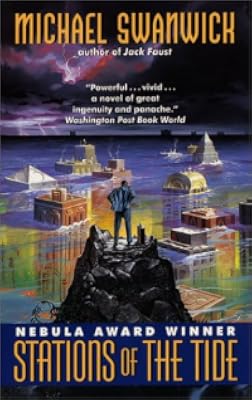
- Gaiman, Neil; Chappell, Fred; Shea, Michael; Blaylock, James P.; Swanwick, Michael
- Original language
- English
Classifications
Statistics
- Members
- 425
- Popularity
- 72,374
- Reviews
- 17
- Rating
- (3.31)
- Languages
- English
- Media
- Paper, Ebook
- ISBNs
- 4
- ASINs
- 3