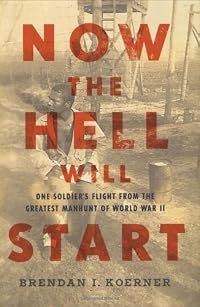
Now the Hell Will Start
by Brendan I. Koerner 
On This Page
Description
The remarkable tale of Herman Perry, a native of North Carolina who wound up going native in the Indo-Burmese jungle. Perry was shipped in a segregated labor battalion to South Asia in 1943, one of thousands of black soldiers dispatched to build the Ledo Road, from the mountains of northeast India across the tiger-infested vales of Burma. Perry could not endure the jungle's brutality, nor the racism of his white officers. Finally, in emotional collapse, he shot a white lieutenant. So began show more Perry's flight through one of the planet's most hostile realms. He eventually stumbled upon a village festooned with polished human skulls, where, amid a tribe of elaborately tattooed headhunters, he would find bliss--and would marry the chief 's fourteen-year-old daughter. Author Koerner spent nearly five years chasing Perry's ghost through the remotest corners of India and Burma, and uncovering the forgotten story of the Ledo Road's black G.I.s.--From publisher description. show lessTags
Recommendations




Member Recommendations

Member Reviews
Koerner is one my favorite American non-fiction writers (of my generation). This is his first book which concerns a black soldier, Herman Perry, sent to the backwater Burma theater of WWII. While there he gets into trouble, runs off into the jungle and is hunted. Koerner in an interview compares Perry to Kurtz from Heart of Darkness since he goes native beyond the pale. In fact the book has some of that aspect, but it's not as romantic as it sounds, this is really a book about Jim Crow America - in the Burmese jungle. Jim Crow America is Kurtz gone feral, Perry is civilization's naturally insane reaction. Seeing old racist patterns in an exotic location opens our eyes to injustice. It's no accident that when blacks returned after the show more war they were more willing to stick up for their rights (see Devil the Grove for the explosive results). Koerner has his finger on the pulse of America - race issues, a big wild territory tamed with brute engineering, a love interest, and how the little guy takes on the man and, for a while anyway, wins. All in a package of solid historical research told with cinematic effect. Spike Lee might film it, we can hope.
This book has been added to my WWII recluse literature collection. During WWII there were a number of individuals who for various reasons, intentionally or by necessity, turned their backs on Civilization and went alone into the Wilderness. While the rest of the world destroyed itself in conflict, they found solitude in nature and reflected on what it means to be truly "civilized". They lived off the land with native peoples, or alone, and on the run. show less
This book has been added to my WWII recluse literature collection. During WWII there were a number of individuals who for various reasons, intentionally or by necessity, turned their backs on Civilization and went alone into the Wilderness. While the rest of the world destroyed itself in conflict, they found solitude in nature and reflected on what it means to be truly "civilized". They lived off the land with native peoples, or alone, and on the run. show less
Reading this book reminded me why I love wartime history so much...war really does bring out the best and the worst in humanity. There are equally countless tales of heroism and of dastardly deeds.
But this story ends up being both. Koerner's portrait of Herman Perry, the "Jungle King," is unflinching but sympathetic. As such, it is a gripping expression of the tragic weakness that is humanity.
P.S. I read this book as a follow-up to Laura Hillenbrand's amazing work "Unbroken." You couldn't ask for a better contrast of individual war experiences. I highly recommend reading them back-to-back.
But this story ends up being both. Koerner's portrait of Herman Perry, the "Jungle King," is unflinching but sympathetic. As such, it is a gripping expression of the tragic weakness that is humanity.
P.S. I read this book as a follow-up to Laura Hillenbrand's amazing work "Unbroken." You couldn't ask for a better contrast of individual war experiences. I highly recommend reading them back-to-back.
I had some problems taking this work of non-fiction seriously beginning with a footnote claiming that a tiger attack had permanently turned the victim's hair white. My patience was further strained by heavy-handed phrases like "Calcutta, that notorious hive of scum and villainy", and I skipped about three 15-page chunks towards the end. The story itself, however, is a fascinating one. The jacket marketing puts the focus on the epic manhunt for Herman Perry, a black WWII deserter, but the author devotes a great deal of time to the experience of black soldiers in WWII, which was drastically different from that of their white counterparts.
I thought this book was the perfect combination of suspenseful and informative. It provided me with a clear understanding of the role of African Americans in World War II, Army policy relating to African American conscripts, the Allied actions in China, Burma, and India, and then of course Herman Perry, the soldier the book is about.
The book is an excellent and well-written thriller (despite being non-fiction), but more than anything, it is an eye-opening look at the treatment of blacks in the American Army at the time. A lot of the well-known literature on this subject relates to the Harlem Hellfighters (infantry) or the Tuskegee Airmen (pilots), but "Now the Hell Will Start" discusses the Jim Crow mentality of the Army and the fact show more that the overwhelming majority of black men in the military were relegated to manual labor, since they were deemed unfit for combat due to the racist science of the time that suggested blacks were mentally incapable of handling anything else.
The book is also an excellent introduction to the Burmese jungle, which I previously knew nothing about. The author explains the role of Burma, China, and India in World War II, and Herman Perry was deployed to Burma to work on building a road that ultimately ended up being mostly pointless. I found the detail about the perils of the Burmese jungles and the monsoon season to be both fascinating and horrifying.
Some people have claimed that this book paints Herman Perry in a sympathetic light despite the fact that he killed an officer. While I agree that he was painted in a sympathetic light, I do think it is warranted. The disparities between the treatment of white soldiers and black soldiers were glaring, particularly with regard to soldiers who exhibited any degree of mental instability, as Herman Perry did. This combined with the fact that everyone (white or black) working in China, Burma, and India was essentially ignored by the Army brass made me wonder why more people did not end up in the same situation.
I definitely recommend this book, though the descriptions of life in the Burmese jungle are not for the faint of heart. show less
The book is an excellent and well-written thriller (despite being non-fiction), but more than anything, it is an eye-opening look at the treatment of blacks in the American Army at the time. A lot of the well-known literature on this subject relates to the Harlem Hellfighters (infantry) or the Tuskegee Airmen (pilots), but "Now the Hell Will Start" discusses the Jim Crow mentality of the Army and the fact show more that the overwhelming majority of black men in the military were relegated to manual labor, since they were deemed unfit for combat due to the racist science of the time that suggested blacks were mentally incapable of handling anything else.
The book is also an excellent introduction to the Burmese jungle, which I previously knew nothing about. The author explains the role of Burma, China, and India in World War II, and Herman Perry was deployed to Burma to work on building a road that ultimately ended up being mostly pointless. I found the detail about the perils of the Burmese jungles and the monsoon season to be both fascinating and horrifying.
Some people have claimed that this book paints Herman Perry in a sympathetic light despite the fact that he killed an officer. While I agree that he was painted in a sympathetic light, I do think it is warranted. The disparities between the treatment of white soldiers and black soldiers were glaring, particularly with regard to soldiers who exhibited any degree of mental instability, as Herman Perry did. This combined with the fact that everyone (white or black) working in China, Burma, and India was essentially ignored by the Army brass made me wonder why more people did not end up in the same situation.
I definitely recommend this book, though the descriptions of life in the Burmese jungle are not for the faint of heart. show less
Come for the title; stay for the story. Other reviewers here have complained that there's too much about the Ledo Road--but I thought that was all pretty interesting and a reminder of how much of modern warfare is simply slogging through awful terrain. It ain't all Steve Rogers beating up the Red Skull. This was an illuminating and genuinely interesting story. Who knew?
It isn't easy to delve into one man's view of life as a soldier of the U. S. Army in World War II but Koerner does more than a decent job. Herman Perry of the 849th Engineer Aviation Battalion, Company A, a black regiment, goes to India to help build the Ledo Road (aka Stilwell Road). It's back-breaking and mind-numbing; the day-in and day-out relentless physical work takes its toll on many soldiers. Perry, in order to cope, turns to the easy-to-get opium and marijuana. Strung out, he makes a terrible decision - he shoots and kills a superior white officer. The murder is witnessed by at least two other soldiers. Perry flees into the jungles of Burma and somehow manages to survive. It's an almost fantastical tale, where Perry lives with show more a native tribe, marries the chief's daughter, makes a stupid attempt to steal some supplies and is captured, tried, sentenced to be hung, and escapes again! He is, of course, captured again and the execution is carried out. But Koerner's persuit of the story, his travels to what remains of the Ledo Road, are impressive. The story is at its best when focused on Perry and his family back in the states including the side story of Aaron Perry, Herman's younger brother who had a promising career as a boxer that he foolishly threw away. The Perry family lived in Monroe, North Carolina during their childhood years - Koerner does attempt to connect the racist attitudes of Monroe during those childhood years to Herman's fragile mental state. Essentially, in spite of Monroe's own turbulent civil rights era (Robert Williams), it is really the attitude of the times, not just Monroe, that shaped and formed many an African-American's mental outlook and future - not just Perry's. This is a book well-worth reading to learn about the black soldier in World War II. Many historians point to the Burma and Ledo Roads and the Negro soldiers who built them as the catalyst in the desegregation of the Army. Note: It is exciting that Spike Lee is interested in making the book into a film and Koerner is supposedly working on the script at this time. show less
What I love about the second world war is scale of the conflict was so big that it touched so many parts of the world and so many different people. Herman Perry's story is pretty heartwrenching. The treatment of black GIs working on the Leto Road in Burma was horrendous and I cant believe more didnt do what Herman Perry did. His time on the run from the authorities is fascinating. The author provides interesting historical interludes that help contextualize the things happening to Perry. The section regarding the Naga people and the relationship between Chiang and Stilwell are particularly clarifying.
Members
- Recently Added By
Author Information

6+ Works 527 Members
Brendan I. Koerner is a LibraryThing Author, an author who lists their personal library on LibraryThing.
Common Knowledge
- Canonical title
- Now the Hell Will Start
- Alternate titles
- Now the Hell Will Start: One Soldier's Flight From the Greatest Manhunt of World War II
- Original publication date
- 2008
- People/Characters
- Herman Perry
- Important places
- Ledo Road
- First words
- It is best to use discretion when comforting an emotionally shattered man, especially if he's holding a semiautomatic rifle.
- Last words
- (Click to show. Warning: May contain spoilers.)A joke, perhaps, but stranger things have happened in the jungle.
Classifications
- Genres
- Nonfiction, History, General Nonfiction, Biography & Memoir
- DDC/MDS
- 940.548 — History & geography History of Europe History of Europe 1918- Military history of World War II Other Topics
- LCC
- D810 .N4 .P4756 — History of Europe, Asia, Africa and Oceania History (General) World War II (1939-1945)
- BISAC
Statistics
- Members
- 127
- Popularity
- 256,210
- Reviews
- 12
- Rating
- (4.06)
- Languages
- English
- Media
- Paper, Audiobook, Ebook
- ISBNs
- 5
- ASINs
- 6