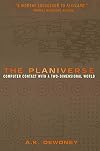
The Planiverse: Computer Contact with a Two-dimensional World
by A. K. Dewdney
On This Page
Description
The Planiverse is a classic book about life in a two-dimensional universe. A.K. Dewdney is a well-known author, and this is a well-known book, which is now brought back into print in a revised and updated edition. The book is written within the great tradition of Abbott's Flatland, and Hinton's famous Sphereland. Accessible, imaginative, clever, the book will appeal to a wide array of readers, from serious mathematicians and computer scientists, to science fiction fansTags
Recommendations


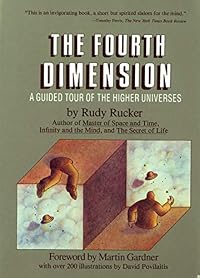











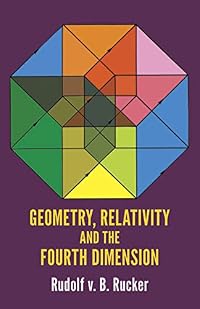























Member Recommendations
Member Reviews
Of course this book begs comparisons to Flatland...though not as well known as that famous romp through a world with only two dimensions, I believe this book is much better. Dewdney put a lot of thought in the way a civilization must necessarily be set up in a two-dimensional world - how will the laws of physics affect these creatures and their world? How can a two-dimensional creature have a digestive tract without being cut in half? How to pass each other in the street? How to build a dwelling that can be easily maneuvered through? This book asked and answered questions before I even thought of them, and truly expanded the way I thought about the 2nd - and of course, the 3rd and 4th - dimension, as well as tackling ideas about show more philosophy, evolution, and intelligent ingenuity.
If you were intrigued by Flatland, read this book. Your imagination will thank you. show less
If you were intrigued by Flatland, read this book. Your imagination will thank you. show less
What a wild premise. If you thought Flatland was kind of cool but kind of stupid, this is Flatland if the author actually really thought about it... like really thought about it. Ideas for two-dimensional physics, biology, mechanics, games, social customs, and theology. Plot? Not so much. But who needs plot when you can find out how digestion works in two-dimensional animals!
A lot of fun, and a better platform for the imagination than it is a story.
In "The Planiverse," we have a frame story that wraps around a travelogue through a two-dimensional world. The 2D world itself is fascinating; the frame story in our world, less so. The faux real-world contact was enough to make teenage me wonder if it could be true, but as an adult, it's a lot easier to see through the deception, and even to resent its intrusion into an otherwise interesting study.
It is clear that the author has put a lot of thought into how the science of a 2D world would work. Whereas Flatland explored the mathematical and social implications of such a world, the Planiverse gave us actual science, enough to make such a world feel show more claustrophobically plausible. However, the ending was nothing but pseudo-mystical oddness, designed to distract the reader from the lack of an ending, and totally at odds with the hard science nature of the earlier sections.
Recommendation: Great food for thought, and worth reading if you are of a scientific bent and like thinking about different dimensions. Don't approach it if all you want is a story, however. show less
In "The Planiverse," we have a frame story that wraps around a travelogue through a two-dimensional world. The 2D world itself is fascinating; the frame story in our world, less so. The faux real-world contact was enough to make teenage me wonder if it could be true, but as an adult, it's a lot easier to see through the deception, and even to resent its intrusion into an otherwise interesting study.
It is clear that the author has put a lot of thought into how the science of a 2D world would work. Whereas Flatland explored the mathematical and social implications of such a world, the Planiverse gave us actual science, enough to make such a world feel show more claustrophobically plausible. However, the ending was nothing but pseudo-mystical oddness, designed to distract the reader from the lack of an ending, and totally at odds with the hard science nature of the earlier sections.
Recommendation: Great food for thought, and worth reading if you are of a scientific bent and like thinking about different dimensions. Don't approach it if all you want is a story, however. show less
The Planiverse: Computer Contact with a Two Dimensional World by AK Dewdney
The setting is a graduate program in the early 1980's. Computers are mainframes, time and resources are precious, and programs are primitive at best.
A group of students led by their professor decide to model a two dimensional world--with the deptyh and horizontal axis rather than the horizontal and vertical axes of Flatland. It starts as an exercise in pure physics, mathematics and computer science, until their model somehow connects to a real two-dimensional world, and an inhabitant, YNDRD, who can hear them in his mind.
And with YNDRD as our guide, we begin to learn about himself and the two dimensional Planiverse that makes his home...
Its a classic for good show more and many reasons. Dewdney's characters, with the exception of a little unnecessary and half-baked melodrama, are easily recognized academic types, jealous of their prize, and eager to learn more and more about the world they have inadvertently contacted. The Planiverse is a marvel of a gedankenexperiment--how could an inhabitable two-dimensional world exist and what would it be like? YNDRD goes on what is ultimately a spiritual quest (the novel can be thought of, really as a sufi story)--so there is a fair dollop of philosophy mixed in with the science.So we get to see a wide swath of his world, his beliefs and his life,and learn about it all as he makes his journey.
Although the technology has changed over time, the novel can comfortably be thought of as taking place in the early 1980's rather than as a contemporary novel. Once upon a time, computers really were this primitive.
There are lots of asides and text boxes exploring some of the concepts touched upon, as well as appendices that give the Planiverse even more depth. It's an amazing book and definitely suited to those who would want to think about the implications and puzzle of a two-dimensional world. The narrative itself is pretty basic and straightforward--but the universe, man, is where this novel shines. Dewdney's conceit in making the novel at first seem like a first hand account of a real event gives it verisimilitude, and the level of detail, as said above, sells it.
Highly Recommended. show less
The setting is a graduate program in the early 1980's. Computers are mainframes, time and resources are precious, and programs are primitive at best.
A group of students led by their professor decide to model a two dimensional world--with the deptyh and horizontal axis rather than the horizontal and vertical axes of Flatland. It starts as an exercise in pure physics, mathematics and computer science, until their model somehow connects to a real two-dimensional world, and an inhabitant, YNDRD, who can hear them in his mind.
And with YNDRD as our guide, we begin to learn about himself and the two dimensional Planiverse that makes his home...
Its a classic for good show more and many reasons. Dewdney's characters, with the exception of a little unnecessary and half-baked melodrama, are easily recognized academic types, jealous of their prize, and eager to learn more and more about the world they have inadvertently contacted. The Planiverse is a marvel of a gedankenexperiment--how could an inhabitable two-dimensional world exist and what would it be like? YNDRD goes on what is ultimately a spiritual quest (the novel can be thought of, really as a sufi story)--so there is a fair dollop of philosophy mixed in with the science.So we get to see a wide swath of his world, his beliefs and his life,and learn about it all as he makes his journey.
Although the technology has changed over time, the novel can comfortably be thought of as taking place in the early 1980's rather than as a contemporary novel. Once upon a time, computers really were this primitive.
There are lots of asides and text boxes exploring some of the concepts touched upon, as well as appendices that give the Planiverse even more depth. It's an amazing book and definitely suited to those who would want to think about the implications and puzzle of a two-dimensional world. The narrative itself is pretty basic and straightforward--but the universe, man, is where this novel shines. Dewdney's conceit in making the novel at first seem like a first hand account of a real event gives it verisimilitude, and the level of detail, as said above, sells it.
Highly Recommended. show less
Dewdney, a computer science professor, has his students work to develop a world that has only two dimensions (akin to our three dimensional world). The students develop an elaborate world complete with its own ecosystem and rudimentary AI. However, something happens, and their virtual world is somehow replaced with a real world, through which the students and professor have computer contact.
The world is still two dimensional, primitive in many ways, and advanced in others. The professor and students wish to learn more about the world without influencing their contact in a way that would violate something like Star Trek's Prime Directive.
The book is like a travelogue, containing details of the world of their 2-D contact, who calls show more himself YNDRD, and is in turn called by the students Yendred. He takes them on a pilgrimage and they all learn about the strange 2-D world Yendred inhabits.
This book is greatly inspired by Flatland with a little bit of Sufi mixed in. It should appeal to you if you're a fan of the former. I'm not sure if it is as appealing to fans of the latter, as I can only speak for myself, who is nearly obsessed with Flatland. Nevertheless, if you enjoy a good tale of 2-D worlds, then this will most likely fill that void (as long as the void has only a length and a height, with no width). show less
The world is still two dimensional, primitive in many ways, and advanced in others. The professor and students wish to learn more about the world without influencing their contact in a way that would violate something like Star Trek's Prime Directive.
The book is like a travelogue, containing details of the world of their 2-D contact, who calls show more himself YNDRD, and is in turn called by the students Yendred. He takes them on a pilgrimage and they all learn about the strange 2-D world Yendred inhabits.
This book is greatly inspired by Flatland with a little bit of Sufi mixed in. It should appeal to you if you're a fan of the former. I'm not sure if it is as appealing to fans of the latter, as I can only speak for myself, who is nearly obsessed with Flatland. Nevertheless, if you enjoy a good tale of 2-D worlds, then this will most likely fill that void (as long as the void has only a length and a height, with no width). show less
The central idea, or speculation, of this book is the nature of the world and civilization if we were confined to two dimensions instead of three. This is a fascinating concept and the author seems to be able to communicate it very well. In the descriptions of the book’s 2D world, the science, technology and sociology are set out in a way that I think strikes a good balance in terms of supplying information and maintaining the narrative. A lot of more complex material is relegated to an appendix, which I think is a good idea.
Unfortunately the author has chosen to cast the book in the form of a memoir that purports to be a true story, so there is a “back story” concerned with his discovery of this other world. The style is often show more clumsy when he is describing the “real world” characters and their problems making and maintaining contact with the 2D world, and this tends to detract from the real meat of the book, which is of course the minutiae of everyday life in two dimensions.
There aren’t many books around on this subject, and this is probably the most accessible one, so I have to rate it as worth a read. However, if it had been cast in a different form, or if the author had been somewhat better in his handling of “real” people’s characters, I can’t help feeling it would have been so much better. show less
Unfortunately the author has chosen to cast the book in the form of a memoir that purports to be a true story, so there is a “back story” concerned with his discovery of this other world. The style is often show more clumsy when he is describing the “real world” characters and their problems making and maintaining contact with the 2D world, and this tends to detract from the real meat of the book, which is of course the minutiae of everyday life in two dimensions.
There aren’t many books around on this subject, and this is probably the most accessible one, so I have to rate it as worth a read. However, if it had been cast in a different form, or if the author had been somewhat better in his handling of “real” people’s characters, I can’t help feeling it would have been so much better. show less
Inspired by Flatland, Planiverse is a work of fantasy, or mathematics, or science, intended (in part) to solve the mind problem of how life and technology could work in a two dimensional universe. Planiverse was written in the mid-1980s by a colleague of my father's at the University of Western Ontario whose Wikipedia entry amusingly describes him as a "Canadian mathematician, computer scientist, author, filmmaker, and conspiracy theorist". I don't know how the 1980s computer stuff translates to 21st century readers, but I learned computing with DOS and those green on black screens. Nostalgia.
Members
- Recently Added By
Author Information

27+ Works 1,947 Members
Recreations, his column which appeared in Scientific American for more than eight years. He has been an Associate Professor of Computer Science at the University of Western Ontario in Canada since 1968, and is president of Turing Omnibus, Inc. Among his many books on computer science, science and mathematics are Two Hundred Percent of Nothing show more (1993), an effort to expose abuses of math and statistics in everyday life and its companion work, Yes, We Have No Neutrons (1997). Dewdney is also interested in growing and distributing rare native trees, as manifested in his book, Hungry Hollow: The Story of a Natural Place (1998). Hungry Hollow examines the elements of a natural habitat in both time and space. (Bowker Author Biography) show less
Awards and Honors
Distinctions
Work Relationships
Was inspired by
Common Knowledge
- Canonical title
- The Planiverse: Computer Contact with a Two-dimensional World
- Original publication date
- 1984
- People/Characters
- A. K. Dewdney; Yendred
- Important places
- Arde; Ajem Kollosh, Arde
- Dedication
- Dedicated to my father Selwyn Hanington Dewdney artist, writer, scholar 1909-1979
- First words
- The following book, of which I am not so much the author as compiler, originates with the being whose picture appears in the title page.
- Last words
- (Click to show. Warning: May contain spoilers.)ADOLF HERE-WAITING FOR THROGS.
- Blurbers
- Adams, Douglas; Penrose, Roger; Gardner, Martin
- Original language
- English
Classifications
Statistics
- Members
- 453
- Popularity
- 67,018
- Reviews
- 12
- Rating
- (4.11)
- Languages
- 5 — Dutch, English, French, German, Italian
- Media
- Paper, Ebook
- ISBNs
- 11
- ASINs
- 4