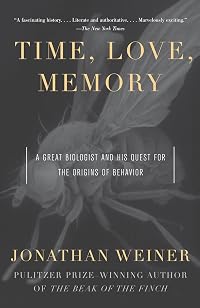
Time, Love, Memory: A Great Biologist and His Quest for the Origins of Behavior
by Jonathan Weiner
On This Page
Description
The story of a biologist's search for the foundations of behavior. Looking over the shoulder of some of the premier scientists in the field, biologist Weiner takes us into their laboratories to show us how pieces of DNA actually shape behavior. He focuses on the work of Seymour Benzer, who, decades ago, with James Watson and Francis Crick, helped to crack the genetic code. Then, in a simple experiment using a few test tubes, a light bulb, and 100 fruit flies, Benzer invented the genetic show more dissection of behavior. Now we see how he and his students find and study genes that build our inner clocks, genes that shape the way we love, and genes that decide what we can (or cannot) remember. These breakthroughs help explain secrets of human behavior and may lead to advance treatments for behavioral disorders ranging from rage to autism to schizophrenia.--From publisher description. show lessTags
Recommendations










Member Reviews
This book is a highly regarded examination of the state-of-the-art in genetics and its discoveries regarding the biological foundations of behavior. It won the 1999 American National Book Critics Circle Award for General Nonfiction, highlighting the life and contributions of pioneering scientist Seymour Benzer and his groundbreaking studies of fruit flies (*Drosophila*).
It serves as an engaging biography of Seymour Benzer, a gifted and somewhat eccentric scientist who invented the use of fruit flies to investigate behavior's genetic foundation. Weiner details eloquently Benzer's path from physics to phage genetics and finally to the study of *Drosophila*, demonstrating his distinct method of scientific investigation. The book focuses show more on the "Fly Rooms" at Caltech, where thousands of mutant fruit flies were carefully examined to learn how genes affect intricate behaviors like learning and recall (memory), courtship rituals (love), and circadian rhythms (time). Tiny creatures, with their relatively simple genetic makeup, became invaluable models for understanding fundamental biological processes that have counterparts in humans.
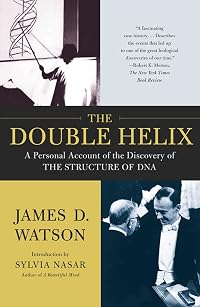
Beyond Benzer's individual story, "Time, Love, Memory" provides a broader historical context for the field of genetics, tracing its evolution from Gregor Mendel's pea plants to the revolutionary discoveries of DNA by Watson and Crick and the subsequent explosion of molecular biology. Weiner adeptly connects Benzer's work to these larger scientific narratives.
Weiner excels at humanizing the scientific process, offering "you-are-there" descriptions of lab life and portraying the personalities of the scientists involved. He reveals the humor, quirks, frustrations, and triumphs that are inherent to scientific discovery, making complex ideas accessible and engaging for a wide audience. He also weaves in allusions to philosophy, literature, and popular culture, enriching the narrative. show less
It serves as an engaging biography of Seymour Benzer, a gifted and somewhat eccentric scientist who invented the use of fruit flies to investigate behavior's genetic foundation. Weiner details eloquently Benzer's path from physics to phage genetics and finally to the study of *Drosophila*, demonstrating his distinct method of scientific investigation. The book focuses show more on the "Fly Rooms" at Caltech, where thousands of mutant fruit flies were carefully examined to learn how genes affect intricate behaviors like learning and recall (memory), courtship rituals (love), and circadian rhythms (time). Tiny creatures, with their relatively simple genetic makeup, became invaluable models for understanding fundamental biological processes that have counterparts in humans.
Beyond Benzer's individual story, "Time, Love, Memory" provides a broader historical context for the field of genetics, tracing its evolution from Gregor Mendel's pea plants to the revolutionary discoveries of DNA by Watson and Crick and the subsequent explosion of molecular biology. Weiner adeptly connects Benzer's work to these larger scientific narratives.
Weiner excels at humanizing the scientific process, offering "you-are-there" descriptions of lab life and portraying the personalities of the scientists involved. He reveals the humor, quirks, frustrations, and triumphs that are inherent to scientific discovery, making complex ideas accessible and engaging for a wide audience. He also weaves in allusions to philosophy, literature, and popular culture, enriching the narrative. show less
time, Love, Memory is Seymour Benzer's story. While Charles Darwin was obsessed with finding the origins of species, Benzer was obsessed with figuring out the origins of behavior. He dedicated his research to finding out the riddle of both animal and human behavior. He wanted to dig deeper into the concepts of nature and nurture, knowing that life was a balance of both. The the diea of reading a book about genes, fruit flies and DNA sounds boring, don't worry. Weiner's style of writing adds a warm and humorous texture to the otherwise scientific plot.
I've read books on evolutionary biology and other sciences, but for some reason found this one a little confusing. Maybe my natural biases of the role of genes in behavior influenced how I understood the progression of the research's varying interpretations of the nature-nurture debate. Still, not a difficult or long read, and recommended to anyone with a natural interest.
As a researcher having being working on flies for nearly a decade, I found this book is still full of useful information. The stories also have been elegantly told, which is rare in scientific field.
I just have been bothered sometimes by the lack of biological or fly genetics common sense of the author, which is inevitable for a non-fly geneticist. Also, the author is too rumbling in some chapters.
I just have been bothered sometimes by the lack of biological or fly genetics common sense of the author, which is inevitable for a non-fly geneticist. Also, the author is too rumbling in some chapters.
Jonathan Weiner takes a well known personality in science and introduces him to the rest of the world in a very pragmatic way in "Time, Love, Memory". Seymour Benzer is a scientist studying fruit fly genetics and Weiner is able to tell his story as well as tell the story of the development of modern genetics in a way that is easy for all to understand. He does this through steady character development and patient detailing or research and methods. A good book for anyone interested in science, history or the fusion of the two.
This is a bad book. The author quotes philosophers gratuitously throughout, filling pages with it and often putting together three or four random quotes in one paragraph. He does not to understand what he is writing about. He seems to believe that the research he is writing about, focused on Benzer's study of fruit fly genetics at Caltech, is deeply connected to philosophical questions. For example, when he comes to the discovery of a gene that regulates fruit fly sleep cycles, he waxes rhapsodically on how molecular biology has discovered the nature of time. He ends by talking about how understanding genetic effects on behavior will let us solve the problem of free will. However, this is all clearly nonsense. None of the people he is show more writing about believe in any of it, so he is always reduced to quoting more random philosophers.
The book is useful for its story of the history of early behavioral genetics research, but it does an extremely poor job describing the progression of the research techniques and we are left with almost no idea of what the current research situation is. show less
The book is useful for its story of the history of early behavioral genetics research, but it does an extremely poor job describing the progression of the research techniques and we are left with almost no idea of what the current research situation is. show less
amusing, informative, and somewhat melancholy biography of Seymour Benzer; nice history of early genetics and genetic mapping
Members
- Recently Added By
Published Reviews
ThingScore 75
Weiner's book is well written and fun to read, although the question arises, who is the audience? This is scientific reportage and as such should not be expected to provide in-depth analysis of tenets and conclusions. Therefore, those who wish to find a critical assessment of neurogenetics should look elsewhere.
added by jlelliott
Weiner's book is a fascinating history of the effort, led by Benzer, to find the specific genes that regulate time, love and memory in fruit flies and therefore to demonstrate something larger about the connection between genes and behavior. Benzer was dealing with what Weiner calls one of the ultimate questions, like the origin of the universe.
added by jlelliott
Author Information

9+ Works 3,803 Members
Jonathan Weiner's books have won the Pulitzer Prize, the National Book Critics Circle Award, and the Los Angeles Times Book Prize. He is the author of The Beak of the Finch; Time, Love, Memory; His Brother's Keeper; and other books. He lives in New York, where he teaches science writing at Columbia University's Graduate School of Journalism.
Awards and Honors
Common Knowledge
- People/Characters
- Seymour Benzer; Francis Crick; Jeff Hall; Gregor Mendel; Thomas Hunt Morgan; Alfred Sturtevant
- Epigraph
- Little Fly,
Thy summer's play
My thoughtless hand
Has brush'd away.
Am not I
A fly like thee?
Or art thou
A man like me?
-William Blake,
"The Fly."
from Songs of Experience - Dedication
- For two good friends: my brother, Eric, and John Bonner.
- First words
- Seymour Benzer's laboratory runs along two corridors of Church Hall at the California Institute of Technology in Pasadena.
- Quotations
- This is a science that is dedicated to exploring the inward infinity that Pascal imagined and to reading the writing on John Locke's slate - for even Locke knew that the slate is not blank.
- Last words
- (Click to show. Warning: May contain spoilers.)This is the kind of problem that more and more neurobiologists and neurophilosophers are trying to solve, but Benzer only raises his eyebrows and smiles his molecular smile: "Oh, they can have it. I'll leave it to them."
Classifications
Statistics
- Members
- 530
- Popularity
- 56,211
- Reviews
- 11
- Rating
- (3.71)
- Languages
- 6 — English, French, German, Korean, Polish, Spanish
- Media
- Paper, Ebook
- ISBNs
- 12
- ASINs
- 3